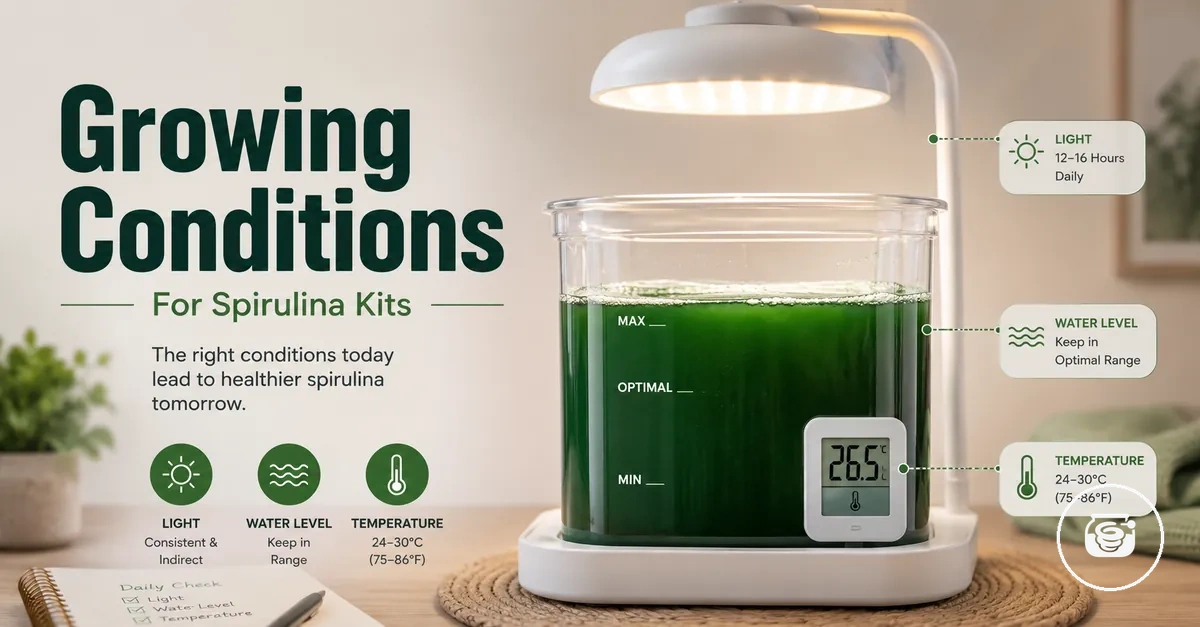
Growing Conditions for Spirulina Growing Kits
A spirulina growing kit supports a viable culture when its growing conditions keep light, temperature, alkaline water chemistry, nutrient medium, container exposure, and monitoring compatible with one another. The required values are strain-, medium-, and container-specific, so one laboratory setting should not be treated as a universal home-growing target.
Growing conditions describe the culture environment rather than the kit setup, maintenance routine, contamination controls, or buying decision.
Growing conditions describe the culture environment rather than the kit setup, maintenance routine, contamination controls, or buying decision. The 2022 review Tendencies Affecting the Growth and Cultivation of Genus Spirulina identifies light, temperature, nutrient availability, strain, mixing, and aeration as connected factors that influence spirulina biomass production.
Condition interaction means that a usable value for one attribute depends on the state of the others.
Condition interaction means that a usable value for one attribute depends on the state of the others. For example, a controlled Spirulina platensis study tested temperatures from 25 to 34.5°C together with light intensities from 15 to 69 micromoles of photons per square metre per second, showing that temperature and light were evaluated jointly rather than as isolated settings.
These condition groups establish the culture-viability frame before the article examines each attribute in detail.
The summary below organizes the main compatibility conditions that should be measured or observed before slow growth is attributed to one cause. These condition groups establish the culture-viability frame before the article examines each attribute in detail.
- Light: The light source, exposure duration, distance, and culture depth must provide illumination without causing a measured rise in water temperature or visibly uneven exposure.
- Temperature: Water temperature must be checked inside the culture container because lamp heat, window exposure, and overnight room changes can make the culture warmer or cooler than the surrounding air.
- pH and salinity: The alkaline medium must remain within the range specified by the starter-culture or nutrient-medium instructions; research conditions differ by strain and formulation, so a single universal home-kit range is not established by the reviewed sources.
- Nutrient medium: The grow medium must provide the carbon, nitrogen, and mineral composition specified for that formulation; adding nutrients cannot compensate for incompatible light, temperature, or pH.
- Water quality: The water source must be screened for treatment chemicals, dissolved minerals, and visible particles that could alter the prepared medium or confuse later measurements.
- Indoor placement and monitoring: The container should remain on a clean, stable surface where light exposure, airflow, water temperature, pH, and visible culture response can be checked under repeatable conditions.
This compatibility frame applies across spirulina growing kits, while the exact operating values must come from the supplied culture strain, nutrient-medium formulation, container configuration, and measuring method.
Table of Contents
Core Conditions That Keep a Spirulina Culture Viable
A spirulina culture is viable when its cells remain active and capable of continued growth under connected conditions for light, warmth, alkaline water, nutrients, and container exposure. No single universal viability threshold applies across strains and cultivation systems; the usable values must remain tied to the culture strain, nutrient medium, vessel depth, mixing method, and measurement conditions.
A spirulina culture is viable when its cells remain active and capable of continued growth under connected conditions for light, warmth, alkaline water, nutrients, and container exposure.
Core Conditions That Keep a Spirulina Culture Viable are easiest to understand as one growth environment because a change in light or warmth can alter culture response even when pH and nutrients remain unchanged. For example, a controlled study published in the Brazilian Journal of Chemical Engineering evaluated Spirulina platensis across 25–34.5°C and 15–69 micromoles of photons per square metre per second, demonstrating that temperature and light intensity were tested as interacting variables rather than independent guarantees of growth.
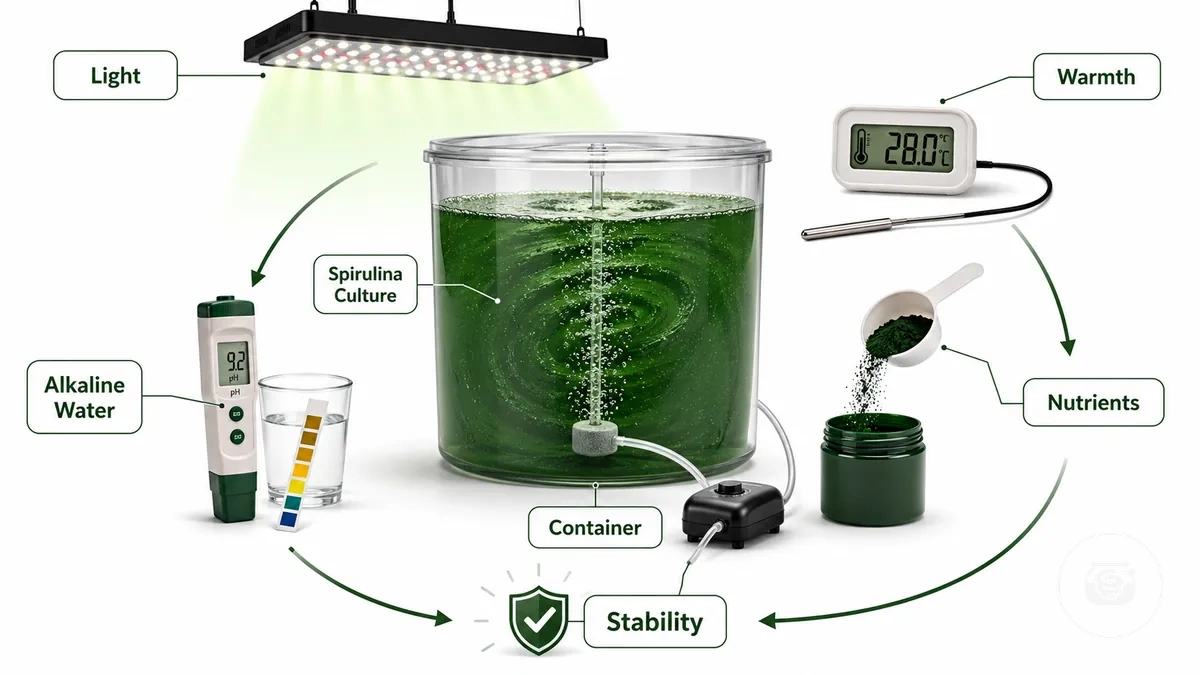
The condition groups below identify what must remain compatible and the effect each group can have on culture stability. Poor growth can result from a mismatch among these conditions, but this overview does not identify one variable as the cause without measurements and observation.
- Light: Light must provide photosynthetic energy without creating excessive water heating or uneven exposure. The controlled study in the Brazilian Journal of Chemical Engineering tested 15–69 micromoles of photons per square metre per second, but that laboratory interval is not a universal home-kit recommendation because container depth and culture density alter light penetration.
- Warmth: Water temperature must remain within the range supported by the specific strain and medium. The same controlled study tested 25–34.5°C, while a separate University of Santa Catarina study cultivated Arthrospira platensis at 30°C under constant aeration, showing that published values describe defined experimental systems rather than one fixed threshold for every culture.
- Alkaline water: The culture medium must maintain an alkaline pH appropriate to its formulation. A 2025 Marine Drugs study tested Limnospira platensis at pH 9–11 with sodium chloride concentrations of 0.2–10 grams per litre, so pH and salinity should be interpreted together instead of as isolated values.
- Nutrients: The medium must supply usable carbon, nitrogen, and minerals in the proportions defined by its recipe. The 2022 review Tendencies Affecting the Growth and Cultivation of Genus Spirulina identifies nutrient availability, light, temperature, strain, mixing, and aeration as factors governing biomass production, which means extra nutrients do not compensate for an incompatible physical environment.
- Container exposure and monitoring: The container must allow repeatable observation of water temperature, pH, light exposure, and culture density. Mixing or aeration should distribute cells through illuminated and nutrient-rich zones; without that distribution, different parts of one container can experience different growth conditions.
The relevant components that affect conditions include the culture container, nutrient medium, light source, thermometer, pH-testing method, and any mixing or aeration tool that changes exposure within the culture.
Light Exposure for Indoor Spirulina Kits
Indoor light exposure supports photosynthesis in a spirulina kit when the photoperiod, light intensity, and light source provide consistent illumination without causing excessive heat or glare. The usable lighting condition must remain tied to container size, culture depth, room temperature, and observed culture density rather than to one universal lamp distance or schedule.
The usable lighting condition must remain tied to container size, culture depth, room temperature, and observed culture density rather than to one universal lamp distance or schedule.
The 2022 review Tendencies Affecting the Growth and Cultivation of Genus Spirulina reports a 12-hour light and 12-hour dark photoperiod with approximately 4 kilolux illumination as one documented cultivation condition. This value is a source-specific example, not a universal home-kit target, because lamp output, direct sun exposure, vessel geometry, and culture concentration change the amount of light and heat reaching the cells.
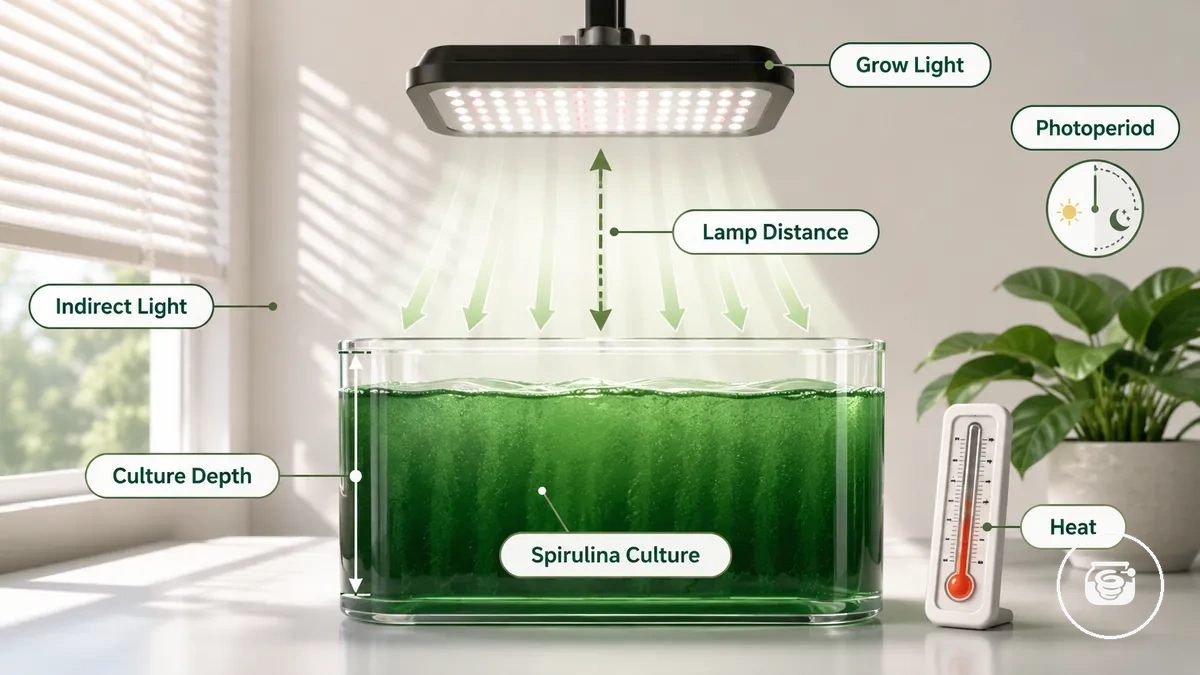
The table organizes the six light factors that affect photosynthesis, culture density, and stability. Each adjustment cue remains conditional because changing duration, intensity, source, or lamp distance can also change water temperature and light penetration.
| Light factor | Condition to check | Possible effect | Adjustment cue |
|---|---|---|---|
| Duration | Compare the daily photoperiod with the culture instructions; the 2022 review documents a 12-hour light and 12-hour dark cycle as one cultivation condition. | A repeatable light-dark rhythm supports photosynthesis without treating continuous illumination as necessary. | Change the timer only after comparing culture appearance and density across repeated daily cycles. |
| Intensity | The same review documents approximately 4 kilolux in one cultivation condition, but it does not establish that value as a universal indoor-kit threshold. | Insufficient illumination can limit photosynthetic activity, while excess illumination combined with heat can reduce stability. | Adjust intensity gradually and check water temperature and culture colour after each change. |
| Light source | Assess whether the culture receives a controlled grow light, filtered window light, or a combination of both. | A stable source provides more repeatable exposure than sunlight that changes with weather, season, and window angle. | Use the source that produces repeatable daily exposure without glare or measurable overheating. |
| Lamp distance | No universal lamp distance is supported because output, beam angle, container width, culture depth, and room heat differ. | Reducing distance increases illumination at the container and can also increase water temperature. | Change distance in small steps and retain the setting only when temperature and culture response remain stable. |
| Direct sun | Check whether direct sun reaches the container and raises the water temperature above its shaded or lamp-lit reading. | Direct sun can produce glare, uneven illumination, and heat accumulation even when total light is abundant. | Use shaded window light or controlled indoor lighting when direct exposure produces a measurable temperature rise. |
| Culture depth | Compare the illuminated surface with the lower part of the culture container because light penetration decreases through denser or deeper culture. | Cells below the surface can receive less usable light than cells near the light source, which can create uneven photosynthetic exposure. | Interpret culture depth together with mixing and light placement instead of increasing brightness alone. |
Useful light remains consistent enough to support photosynthesis without producing a sustained rise in water temperature, while harmful exposure combines glare, uneven illumination, or heat accumulation. After changing the grow light, lamp distance, or window position, compare water temperature and visible culture density under the previous and revised conditions before making another adjustment.
Light Duration and Day-Night Rhythm
Light duration supports a spirulina culture when the photoperiod follows a consistent day-night rhythm with both a light period and a darkness period. The 2022 review Tendencies Affecting the Growth and Cultivation of Genus Spirulina reports a 12-hour light and 12-hour dark cycle as one documented cultivation condition, but that schedule is a source-specific example rather than a universal rule for every indoor culture.
Light duration supports a spirulina culture when the photoperiod follows a consistent day-night rhythm with both a light period and a darkness period.
Light duration and day-night rhythm are easiest to manage with a timer because the timer keeps one daily variable consistent while culture observation continues. The image below organizes the light-on period, dark period, timer cue, culture container, and indoor light source without prescribing one fixed schedule.
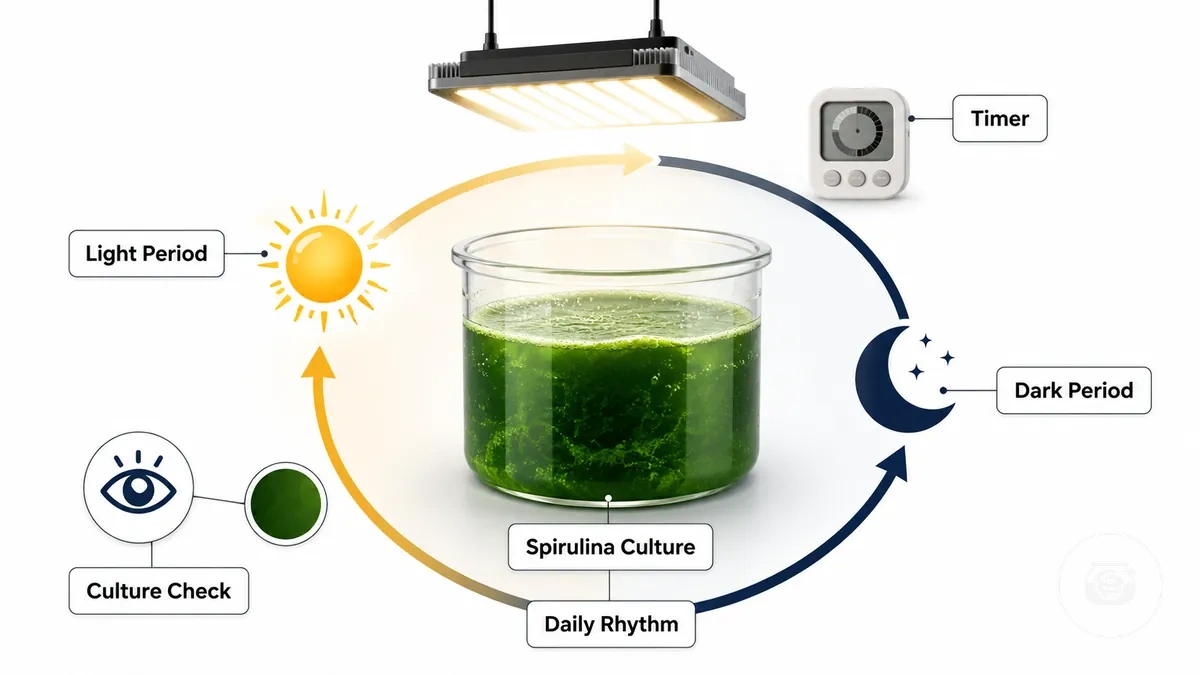
- Timer consistency: Keep the same daily cycle long enough to compare culture appearance across repeated light-dark periods.
- Light-on period: Match the photoperiod to the starter-culture or cultivation instructions; use the documented 12-hour light period only as a conditional reference.
- Darkness period: Preserve a regular dark interval instead of treating continuous illumination as the default.
- Culture observation: Compare colour, density, and visible stability over multiple daily cycles before linking a change to light duration.
- Adjustment signal: Change one timing variable at a time when repeated observations show a consistent decline or improvement.
For example, a timer set to 12 hours on and 12 hours off reproduces the reviewed study condition, but it should remain unchanged only when the specific culture, medium, and indoor environment show a stable response. If observations change after the schedule changes, compare the new response with the previous cycle before making another adjustment.
Light Intensity, Lamp Distance, and Direct Sun Limits
Light intensity and lamp distance provide usable light for a spirulina culture only when illumination is balanced against heat generation and culture response rather than maximised. According to the reviewed cultivation evidence, no universal indoor lux value, lamp wattage, or fixed distance applies because usable light depends on the grow lamp, culture depth, container geometry, and the resulting water temperature.
Light intensity, lamp distance, and direct sun limits should therefore be evaluated together instead of as separate settings.
Light intensity, lamp distance, and direct sun limits should therefore be evaluated together instead of as separate settings. The comparison below distinguishes lighting conditions that normally preserve usable light from conditions where heat, glare, shading, or uneven illumination require observation and adjustment rather than additional brightness.
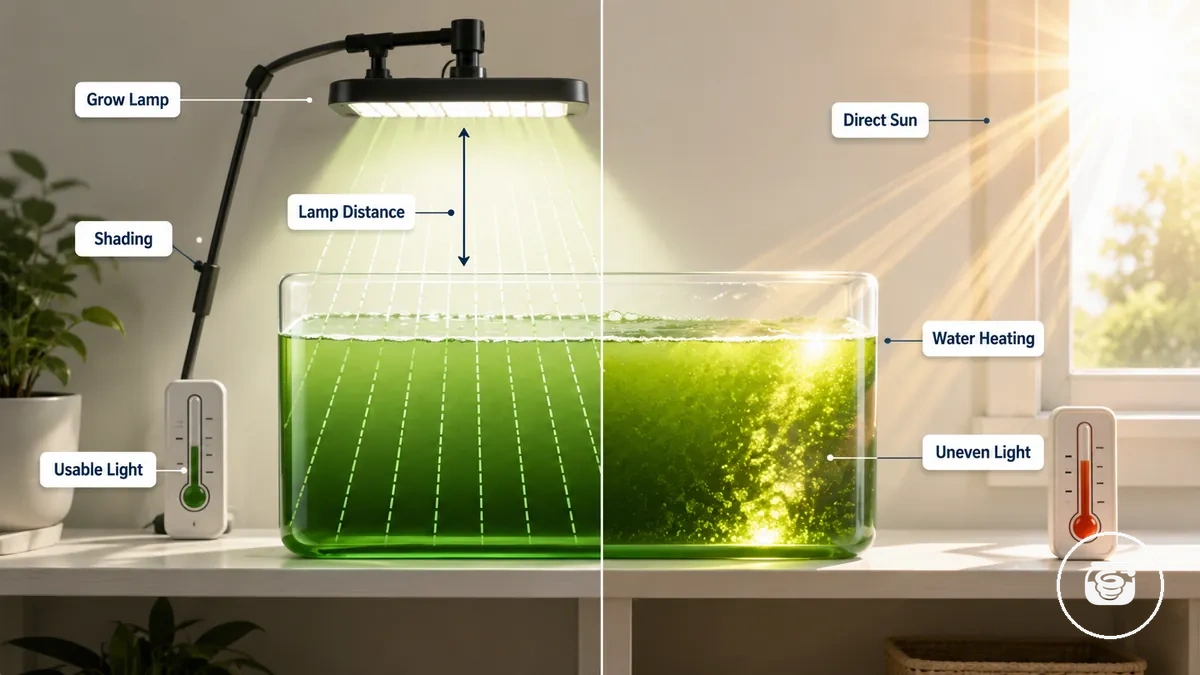
The comparison separates usable light from excessive light exposure that can increase heat without improving photosynthesis.
| Light condition | What it can mean for the culture |
|---|---|
| Grow lamp at an adjustable observation distance | Provides usable light when water temperature remains stable and the culture keeps an even green appearance instead of showing signs of stress. |
| Grow lamp moved too close | Increases light intensity and radiant heat together, which can raise water heating and increase bleaching risk if the culture begins to lose its uniform colour. |
| Direct sun through a window | Can produce glare and localized water heating even when overall room temperature appears unchanged, making indirect placement or shading more suitable for consistent observation. |
| Uneven illumination | Creates brighter and darker areas within the culture so photosynthetic exposure becomes inconsistent until the grow lamp position or shading is adjusted. |
For example, suppose a grow lamp is moved closer to the culture and the water temperature increases by 2°C during the same lighting period while the culture becomes noticeably paler. This illustrative numerical example shows that the additional light is no longer fully usable because heat has become part of the lighting condition, so increasing lamp distance or adding shading before making another adjustment provides a clearer assessment of the culture response.
Temperature Range and Daily Stability
Temperature range and daily stability support a spirulina culture when the water temperature remains within the range specified for its strain and medium without repeated day-to-night swings. The 2022 review Tendencies Affecting the Growth and Cultivation of Genus Spirulina reports 35–37°C as an optimal cultivation range in the reviewed laboratory literature, but this is not a universal indoor-kit target because strain, medium, lighting, mixing, and measurement conditions differ. Daily stability therefore matters alongside the measured temperature.
Daily stability therefore matters alongside the measured temperature.
Water temperature should be checked with a thermometer inside the culture because room temperature does not include heat transferred by a grow lamp, direct sunlight, or another heat source. A controlled Spirulina platensis study published in the Brazilian Journal of Chemical Engineering maintained inoculum cultures at 30 ± 2°C, showing that published values belong to defined cultivation systems rather than one fixed household setting. No universal maximum daily fluctuation for home spirulina kits was established by the reviewed sources, so morning and evening water readings provide the relevant evidence for temperature stability.
Water temperature should be checked with a thermometer inside the culture because room temperature does not include heat transferred by a grow lamp, direct sunlight, or another heat source .
The table separates warm-stable, cool, overheated, and fluctuating conditions by the measurement to check and the conditional effect on metabolism, growth speed, stress, and culture density.
| Temperature state | What to check | Likely culture response | Safer wording for action |
|---|---|---|---|
| Warm-stable | Water readings remain within the strain-and-medium range across repeated morning and evening measurements. | Metabolism, growth speed, and culture density are more likely to remain consistent when light, pH, and nutrients are also compatible. | Retain the condition while repeated measurements and culture observation remain consistent. |
| Cool | Water readings remain below the range specified for the cultivation method, even when the room feels warm. | Metabolic activity and density increase may slow without indicating immediate culture failure. | Confirm the pattern across multiple readings before changing the heat source. |
| Overheated | Water temperature rises after lamp exposure, direct sun, or another heat source and exceeds the strain-and-medium range. | Heat stress may increase and culture density may become less stable. | Reduce the confirmed source of heating and remeasure the water before making another change. |
| Fluctuating | Morning and evening water readings repeatedly differ; the reviewed sources do not define one universal allowable daily difference for home kits. | Repeated fluctuation can alter metabolic rate and make changes in growth speed or density harder to interpret. | Use repeated water measurements to identify the timing and source of the fluctuation. |
For example, suppose an indoor room is 22°C overnight and 28°C in the afternoon, while the culture water measures 24°C in the morning and 31°C after several hours beside a sunlit window. This illustrative 7°C water-temperature change does not establish a failure threshold, but it shows why the culture reading—not the room thermostat—should guide assessment of daily stability before other conditions are adjusted.
Productive Warmth Versus Heat and Cold Stress
Productive warmth supports a spirulina culture when water temperature remains within the operating range specified for its strain and medium, allowing growth speed and culture density to remain comparatively consistent. Cold stress is associated with a gradual slowdown after sustained cooling or repeated overnight drops, while heat stress is associated with faster instability when overheating pushes the culture beyond that operating range. The reviewed cultivation evidence does not establish one fixed safe temperature that separates productive warmth from stress across all strains, media, and indoor containers.
This contrast separates progressive slowdown from an acute stress signal without treating either response as proof of one cause.
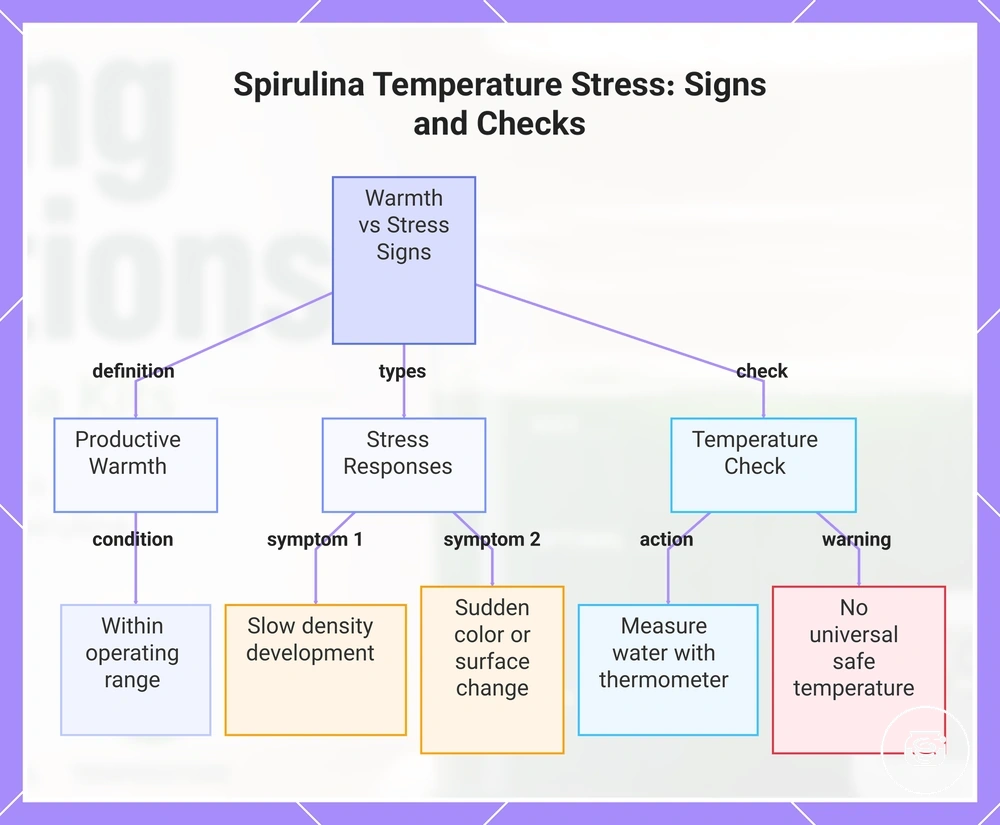
A visible culture response to cold stress may appear as slower density development across repeated observations, whereas heat stress may produce a more sudden change in colour, surface condition, or growth pattern because temperature affects metabolism and the surrounding medium together. This contrast separates progressive slowdown from an acute stress signal without treating either response as proof of one cause. Measure the culture water with a thermometer before adjustment, because room temperature alone does not capture heat retained from lamps, sunlight, container depth, or overnight cooling.
This chart shows the contrast between productive warmth and heat/cold stress in spirulina culture, including visible symptoms and a practical temperature check.
This chart shows the contrast between productive warmth and heat/cold stress in spirulina culture, including visible symptoms and a practical temperature check.
Water Temperature Checks Inside the Culture Container
Water temperature checks should be performed directly inside the culture container because the culture water determines the spirulina cells' thermal environment, whereas room air does not necessarily reflect the water temperature. The reviewed evidence does not define a universal checking interval, allowable day-to-night fluctuation, or mandatory measurement depth for home spirulina kits, so the reliable criterion is to compare culture-water readings taken under the same conditions before changing any growing condition.
Use the same measurement method each time so differences between readings reflect changes in the culture rather than differences in how the temperature was measured.
Use the same measurement method each time so differences between readings reflect changes in the culture rather than differences in how the temperature was measured.
- Where to measure: Place the thermometer in the culture water inside the culture container instead of estimating the temperature from the container wall or surrounding room air.
- When to measure: Compare one light-on reading taken during the normal lighting period with one light-off reading taken after the lighting period has ended. The reviewed evidence does not specify a fixed waiting time before either reading.
- How often to compare: Use repeated checks under the same placement and lighting conditions across multiple days rather than relying on a single reading.
- What to record: Record the water temperature together with the measurement time, whether the light was on or off, and whether a nearby window, lamp, or other heat source could have influenced the reading.
- When to recheck: Repeat the culture-water measurement after any placement change before adjusting another growing condition so the observed difference can be verified under comparable conditions.
For example, if a culture container is moved from beside a sunlit window to a shaded indoor location, the next light-on reading should be compared with a new light-off reading taken under the revised placement rather than with an earlier measurement from a different location. Rechecking after the placement change provides a more reliable basis for condition adjustments than assuming the room thermostat represents the culture-water temperature.
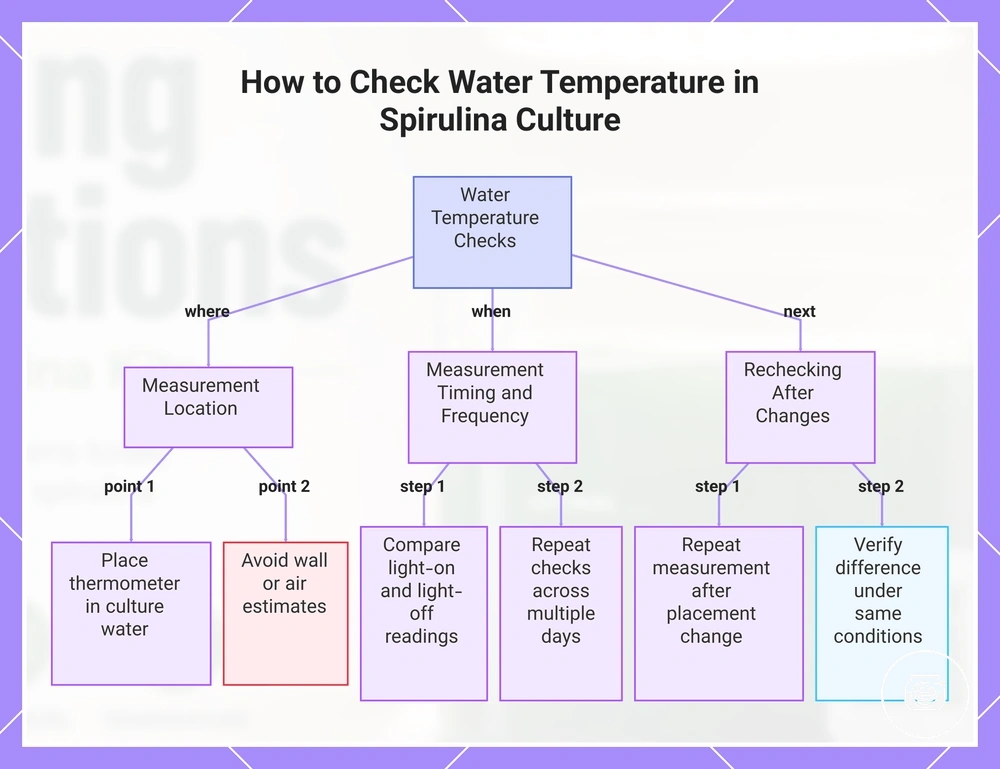
This chart shows the key steps for measuring water temperature inside the culture container to ensure accurate readings and reliable condition adjustments.
This chart shows the key steps for measuring water temperature inside the culture container to ensure accurate readings and reliable condition adjustments.
Water Chemistry for Spirulina Culture Growth
Water chemistry is the combined condition of pH, salinity, dissolved minerals, and source-water composition that forms the medium for spirulina culture growth. The 2022 review Tendencies Affecting the Growth and Cultivation of Genus Spirulina reports pH 8.5–10.5 and dissolved solids of 10–60 g/L for one documented cultivation condition, but these values are condition-specific rather than a universal home-kit formula for every strain or nutrient medium.
Water chemistry is the combined condition of pH , salinity , dissolved minerals , and source-water composition that forms the medium for spirulina culture growth.
pH, salinity, and water quality interact because a change in the water source can alter mineral balance, dissolved salts, and the final pH after nutrients are added. Suitable test methods therefore include a pH test for alkalinity and a formulation-specific method for checking dissolved salts or mineral concentration; the reviewed evidence does not establish one universal home-kit instrument, sampling interval, or salinity target.
pH, salinity, and water quality interact because a change in the water source can alter mineral balance, dissolved salts, and the final pH after nutrients are added.
The table links each chemistry factor to the condition that should be checked, its likely effect on the culture, and the evidence boundary that limits interpretation.
| Chemistry factor | Condition to check | Effect on culture | Qualification |
|---|---|---|---|
| pH | Measure whether the prepared medium remains within the strain-and-formulation range; one reviewed cultivation condition used pH 8.5–10.5. | Maintains the alkaline environment associated with spirulina culture growth and nutrient use. | The 8.5–10.5 range is source-specific and should not be generalised to every culture system. |
| Salinity | Check dissolved-salt concentration against the nutrient-medium formulation rather than adding salts without a defined recipe. | Changes osmotic conditions and can alter culture response when it moves outside the formulation-specific level. | The reviewed evidence does not provide one universal salinity value for all home spirulina kits. |
| Dissolved minerals | Confirm that the medium supplies its specified carbon, nitrogen, and mineral components; one documented condition reported total dissolved solids of 10–60 g/L. | Provides the dissolved nutrients and ions required for biomass development. | The 10–60 g/L value describes a documented cultivation condition, not untreated water or a complete universal recipe. |
| Water source | Compare the source water with the requirements of the chosen medium, including existing minerals, treatment residues, and visible particles. | Changes the starting chemistry from which the final culture medium is prepared. | The reviewed evidence does not identify one household water source as universally suitable. |
| Contaminants | Observe unexpected particles, odour, colour changes, or unexplained chemistry shifts and separate those observations from routine pH or salinity adjustment. | Unexpected material can change measured water chemistry and interfere with culture growth assessment. | Chemistry testing alone does not verify microbiological safety, purity, or contamination prevention. |
Water chemistry supports culture growth by maintaining a compatible alkaline medium, but suitable pH, salinity, and mineral balance do not replace clean handling or regular maintenance. Chemistry readings describe growth conditions; they do not certify that a culture is free from contaminants or safe for consumption.
Alkaline pH and Salinity Balance
Alkaline pH and salinity balance are linked conditions because the culture medium's alkalinity and dissolved salts jointly influence spirulina growth and stress. The reviewed evidence includes an experimental Limnospira platensis range of pH 9–11 with sodium chloride concentrations of 0.2–10 g/L, but these values are study-specific rather than a universal target for home kits; interpretation must follow the kit instructions, medium recipe, strain, and measurement accuracy.
Use the checks below to separate acceptable variation from a repeated pattern that requires rechecking.
Use the checks below to separate acceptable variation from a repeated pattern that requires rechecking.
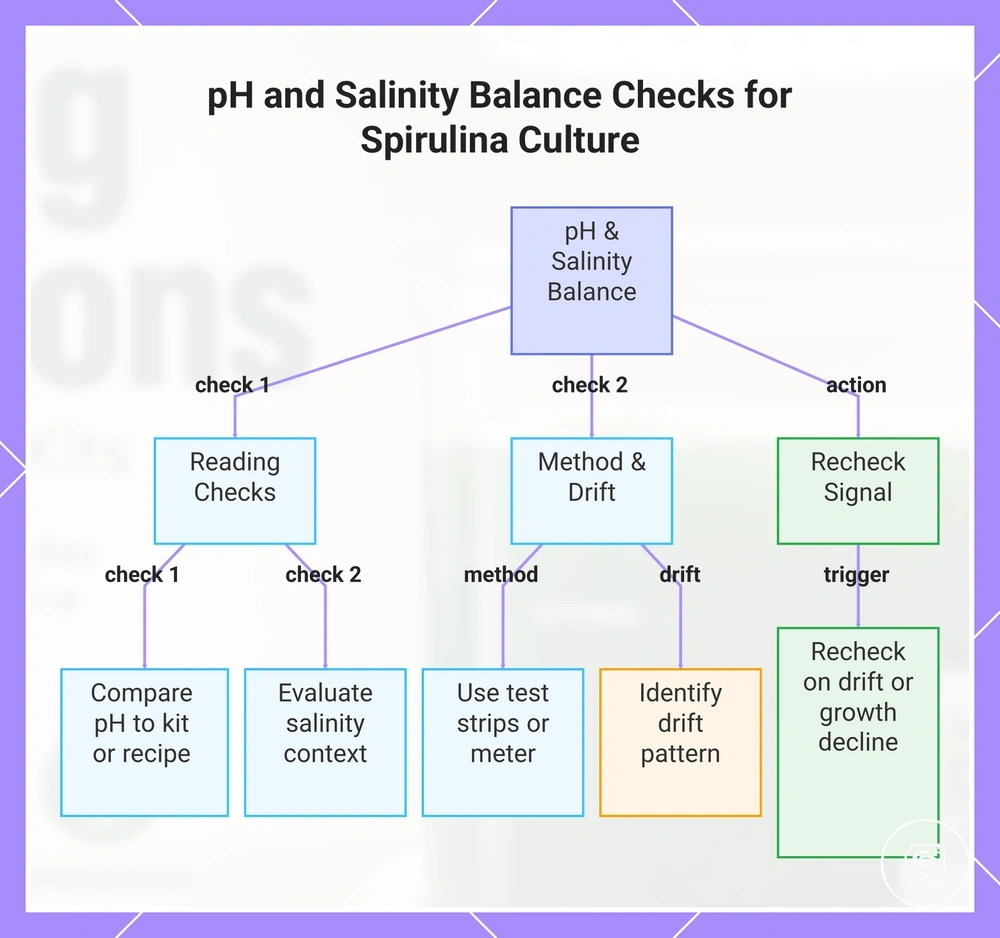
- pH reading: Compare the measured alkaline range with the kit instructions or medium recipe; a value inside a published research interval does not confirm suitability for a different strain or formulation.
- Salinity context: Evaluate dissolved salts against the prepared medium because similar pH readings can occur at different salt concentrations, producing different culture conditions.
- Test method: Use test strips for a bounded colour-scale result or a calibrated meter for a numerical reading, while recognising the resolution and measurement accuracy of the selected method.
- Drift: Treat one isolated change within the test method's resolution differently from repeated drift in the same direction, which indicates that the medium condition is changing over time.
- Recheck signal: Recheck pH and salinity under the same sampling and measurement conditions when repeated readings move outside the kit or medium range, or when the shift coincides with reduced growth or visible stress.
This chart shows the key checks to distinguish acceptable variation from drift in pH and salinity balance, and when to recheck.
Water Source, Contaminants, and Dissolved Particles
Water source affects spirulina culture stability when contaminants, dissolved particles, treatment residues, or the existing mineral load change the prepared medium. The reviewed evidence does not establish one universal chlorine, chloramine, or dissolved-solids threshold for every strain and medium, so the practical criterion is to identify the source-water composition before nutrient preparation. This makes water-source screening the relevant first step.
This makes water-source screening the relevant first step.
The checklist below screens source water for conditions that can slow growth or make chemistry measurements harder to interpret.
- Chlorine and chloramine: Check whether the supplier reports either treatment chemical and follow the water preparation method specified by the kit or medium recipe; the reviewed evidence does not define one universal acceptable concentration for home spirulina cultures.
- Mineral load: Compare reported calcium, magnesium, sodium, chloride, and other dissolved minerals with the medium recipe because existing mineral content changes the final concentration after nutrients are added.
- Visible particles: Record cloudiness, sediment, flakes, or other visible particles separately from dissolved matter because suspended material can obscure culture colour without identifying its chemical cause.
- Dissolved solids: Treat a total-dissolved-solids reading as the combined amount of dissolved matter rather than proof of a specific contaminant, because salts and minerals can contribute to the same measurement.
- Water preparation: Use the preparation choice stated for the selected strain and nutrient formulation instead of assuming untreated tap, filtered, distilled, and mineral water are interchangeable.
For example, suppose one water source measures 80 mg/L total dissolved solids and another measures 220 mg/L before the same nutrient mix is added. This illustrative difference of 140 mg/L does not identify the dissolved substances, but it shows how two cultures can begin with different mineral conditions and produce confusing pH or growth comparisons; record the source-water reading and use cautious water preparation before changing the medium.
Nutrient Medium Conditions That Support Biomass Density
Nutrient medium is the dissolved supply of nitrogen, carbonates, bicarbonates, and other minerals that supports spirulina biomass production. Its effective value is a formulation-specific nutrient balance rather than one universal recipe because nutrient availability influences growth rate and biomass density only under the conditions for which the medium was designed.
Nutrient medium is the dissolved supply of nitrogen , carbonates , bicarbonates , and other minerals that supports spirulina biomass production.
Nitrogen provides the primary nutrient for protein and cellular biomass synthesis, while carbonates or bicarbonates supply inorganic carbon for photosynthesis in alkaline media. According to the reviewed evidence, one experimental formulation containing 16 g/L sodium bicarbonate, 5 g/L sodium nitrate, and 0.25 g/L dipotassium phosphate increased dry biomass by 37.6% and daily productivity by 38.1% compared with the control under that study's cultivation conditions. These measured values apply only to that experimental formulation and should not be interpreted as a universal medium recipe for home spirulina cultures.
These measured values apply only to that experimental formulation and should not be interpreted as a universal medium recipe for home spirulina cultures.
The table below links each nutrient condition with the attribute that should be monitored, the corresponding culture response, and the evidence boundary for interpretation.
| Nutrient condition | Attribute to watch | Culture response | Qualification |
|---|---|---|---|
| Nitrogen availability | Availability of the nitrogen source specified by the selected nutrient medium. | Supports protein synthesis, continued growth rate, and increasing culture density. | The required nitrogen source and concentration depend on the formulation used and are not universal. |
| Carbonate or bicarbonate support | Presence of carbonates or bicarbonates within the intended formulation. | Provides dissolved inorganic carbon for photosynthetic biomass production. | The cited study used 16 g/L sodium bicarbonate as one experimental condition rather than a universal recommendation. |
| Mineral balance | Presence of the formulation's intended phosphorus, potassium, magnesium, iron, and trace minerals. | Supports enzyme activity, metabolism, and continued biomass development. | Mineral effectiveness depends on balanced formulation rather than increasing a single mineral independently. |
| Medium strength | Prepared nutrient concentration compared with the selected formulation. | Maintains nutrient availability throughout culture growth. | The reviewed evidence does not define one universal medium strength for every strain or cultivation system. |
| Replenishment timing | Repeated observation of culture density together with the cultivation method. | Restores nutrients consumed during continued biomass production. | The reviewed evidence does not specify one universal replenishment interval for all spirulina cultures. |
For example, the experimental formulation that produced a 37.6% increase in dry biomass also maintained the defined bicarbonate and nitrogen supply throughout cultivation, illustrating that nutrient composition and measured response must be interpreted together rather than as independent values. Nutrient additions cannot compensate for unsuitable light, pH, or temperature, because biomass density depends on balanced culture conditions instead of nutrient availability alone.
Mineral Balance, Nutrient Availability, and Culture Density
Mineral balance and nutrient availability affect culture density when the prepared nutrient medium supplies the formulation-specific minerals required for continued growth without becoming under-supplied or over-concentrated. Underfeeding can limit biomass formation, while over-concentration can change medium strength and increase stress; however, culture color and density are response signals rather than standalone diagnoses. The retained section evidence does not establish one universal nutrient dose or density threshold for home spirulina cultures, so nutrient availability must be verified against the medium instructions instead of treated as a shortcut to faster growth.
The diagnostic checks below distinguish nutrient-related changes from similar responses caused by other growing conditions.
The diagnostic checks below distinguish nutrient-related changes from similar responses caused by other growing conditions.
- Underfeeding: Consider limited nutrient availability when density increases more slowly than expected after the specified replenishment point, but confirm the preparation record before linking the growth response to nutrient shortage.
- Over-concentration: Recheck medium preparation when growth slows after an unmeasured addition or when the prepared concentration exceeds the formulation instructions, because excess dissolved material changes the culture environment.
- pH interaction: Compare nutrient conditions with the measured pH because a pH interaction can reduce mineral availability even when the original nutrient quantity has not changed.
- Culture color: Treat pale, dark, or uneven colour as an observation requiring comparison with density and preparation records, since light exposure, temperature, mixing, and culture depth can create similar visible changes.
- Cross-check conditions: Slow growth after missed replenishment supports an underfeeding check, whereas slow growth with suitable medium preparation requires light, temperature, and pH to be checked before more nutrients are added.
Container Placement and Culture Exposure
Container placement determines whether culture exposure remains compatible with indoor growing by controlling the combined effects of light, heat, airflow, and agitation. No universal window, shelf, bench, or lamp position is established for every culture because the usable location changes with container shape, depth, transparency, light output, and room heat. Placement should therefore be evaluated through these exposure variables together.
Placement should therefore be evaluated through these exposure variables together.
A transparent, shallow container on a window shelf can receive broad daylight but can also experience local heating and larger day-to-night changes, while an interior bench under a lamp can provide more repeatable illumination but still develop uneven exposure if the lamp position is off-centre. A deeper or less transparent container reduces light penetration, and limited movement can leave dense cells in stagnant zones. These scenarios describe placement-dependent effects rather than fixed outcomes because the room, vessel, and light source alter the result.
A deeper or less transparent container reduces light penetration, and limited movement can leave dense cells in stagnant zones .
The checklist below tests whether a placement location keeps the main exposure conditions compatible before another growing variable is changed.
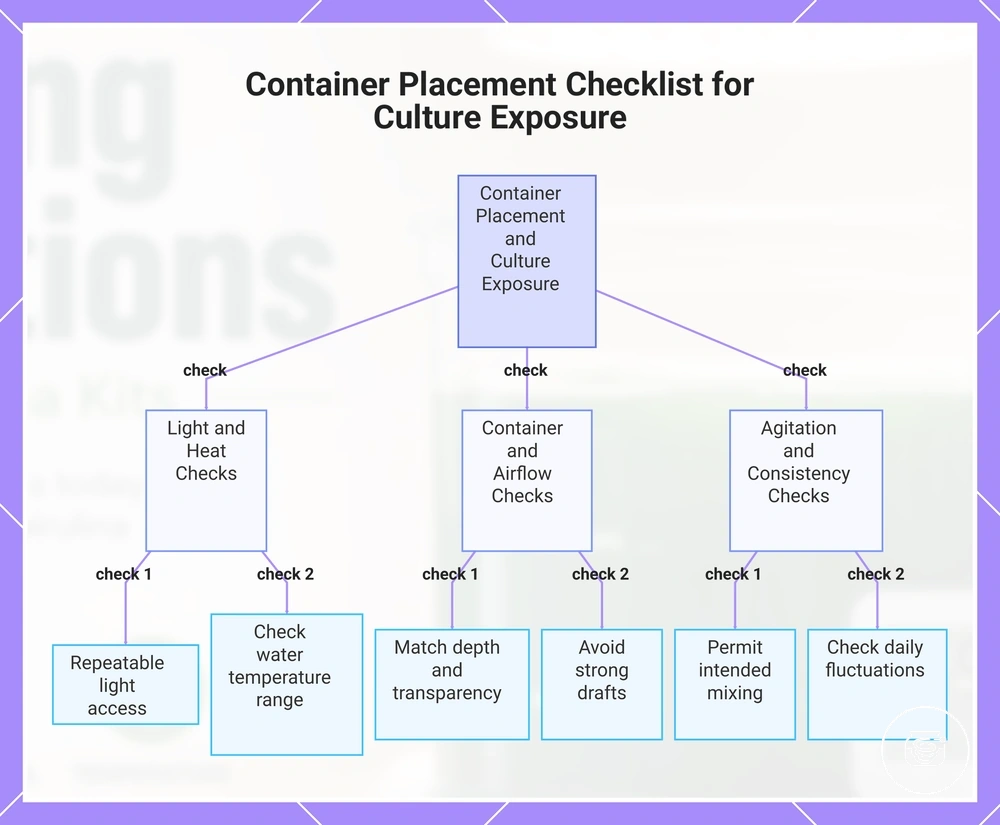
- Light access: Use a position where the container receives repeatable illumination across its visible surface rather than persistent shading from walls, shelves, blinds, or nearby objects.
- Heat exposure: Compare the culture-water temperature before and during normal window or lamp exposure; recheck the position when the water repeatedly warms beyond the range specified for the strain and medium.
- Container depth and transparency: Match the placement to the vessel geometry because increasing depth or reducing transparency decreases the light reaching cells farther from the illuminated surface.
- Airflow: Keep the container in normal room airflow without placing it in a strong draft that repeatedly changes surface evaporation or cooling.
- Agitation: Choose a location that permits the intended mixing or aeration method so cells move through illuminated and nutrient-rich zones instead of remaining in stagnant zones.
- Surface stability: Use a level, secure bench or shelf that does not vibrate, tilt, or place the container at risk of being disturbed during routine observation.
- Room fluctuation: Compare morning and evening conditions when window exposure, lamp heat, or room heating changes across the day; repeated shifts require the placement to be reassessed under the same measurement method.
Container placement is a compatibility decision for exposure conditions, not a complete evaluation of whether a room can support the entire growing process. Broader factors such as available space, routine access, lighting control, and household use belong within indoor kit suitability.
This chart shows the key exposure conditions to check when placing a container for indoor culture growth.
This chart shows the key exposure conditions to check when placing a container for indoor culture growth.
Shallow Container Depth and Light Access
Shallow container depth improves light access by shortening the path that illumination travels through the culture, while greater depth or higher culture concentration reduces usable light in lower layers. The reviewed evidence reports commercial Arthrospira cultivation depths of 0.15–0.30 m where light availability is a limiting condition, but this source-specific range is not an exact depth guarantee for an indoor kit because surface area, container transparency, mixing, and lamp position also affect light penetration.
The comparison below shows how container depth and culture condition change usable light within the culture layer.
The comparison below shows how container depth and culture condition change usable light within the culture layer.
| Container condition | Effect on light access |
|---|---|
| Shallow clear container | A shorter culture layer and transparent wall reduce the distance light must cross, increasing exposure when the surface area and light position remain compatible. |
| Deeper container | A longer light path reduces illumination in lower layers; for example, increasing depth from 0.15 m to 0.30 m doubles the vertical distance that light must travel, although this calculated comparison does not establish either value as suitable for a specific kit. |
| Dense culture | Higher culture concentration increases light absorption and scattering, so lower layers receive less usable illumination even when external light and container depth remain unchanged. |
| Uneven exposure | Off-centre lighting, reduced transparency, or limited movement creates bright and shaded zones; use a shallower depth only when it improves exposure without conflicting with the culture volume, agitation method, or kit instructions. |
Airflow, Agitation, and Stagnant Zones
Airflow around the container and agitation within the culture support even exposure when they create gentle movement without persistent still areas. A stagnant zone is a region where fluid movement is minimal or absent; inside a spirulina container, these stagnant zones can form near corners or beneath settled sediment, producing uneven density and inconsistent surface exposure. The retained evidence does not establish one universal air pump flow rate or agitation interval for home cultures, so circulation should be evaluated through visible culture movement rather than an unsupported fixed setting.
Airflow around the container and agitation within the culture support even exposure when they create gentle movement without persistent still areas.
The checklist below evaluates whether airflow and agitation reduce still areas without treating movement as a complete correction for every growth condition.
- Gentle movement: Confirm that the culture circulates through the container without remaining motionless or producing persistent splashing; when an air pump is part of the cultivation method, its output should match that system's instructions.
- Still corners: Check corners and edges for visibly denser areas that remain separated from the moving culture, because limited circulation can create uneven exposure.
- Sediment: Recheck movement when settled material persists on the container base after normal agitation, while recognising that sediment alone does not identify its composition or cause.
- Surface exposure: Confirm that circulation repeatedly moves culture between the illuminated surface and lower layers instead of leaving the same material at the top or bottom.
- Condition boundary: Agitation supports more even light and nutrient exposure, but it cannot compensate for unsuitable light, temperature, or pH because those variables independently constrain the culture's growth response.
How Condition Mismatches Slow Spirulina Growth
Condition mismatches are a common reason for slow spirulina growth because one or more growing conditions can move outside the compatibility range intended for the selected culture medium. A slow increase in culture density, weaker colour, or inconsistent growth should be interpreted as a conditional diagnostic signal rather than evidence of one certain cause, and the first assessment should focus on weak light, low temperature, unstable pH, heat stress, direct sun, nutrient imbalance, and water quality. The retained evidence does not establish a universal measurement threshold that distinguishes normal variation from slow growth across all home spirulina kits.
A measurement-led comparison provides a more reliable diagnostic starting point than assuming a single cause.
These symptoms frequently overlap because photosynthesis, nutrient availability, and cell metabolism respond to multiple growing conditions simultaneously. For example, the same slow density increase can occur under weak light, low temperature, or nutrient imbalance, so changing the culture before comparing recent measurements may hide the original condition mismatch. A measurement-led comparison provides a more reliable diagnostic starting point than assuming a single cause.
These symptoms frequently overlap because photosynthesis, nutrient availability, and cell metabolism respond to multiple growing conditions simultaneously.
The table below groups common symptoms by their most likely condition group and identifies the first measurement that should be checked before any adjustment is made.
| Symptom | Likely condition issue | Check first | What it means |
|---|---|---|---|
| Slow density increase | Weak light or nutrient imbalance | Compare recent light exposure with the nutrient preparation record. | The culture may be receiving insufficient energy for photosynthesis or an unsuitable nutrient balance for continued biomass production. |
| Pale or weak culture | Weak light or water quality | Review light conditions and inspect the prepared culture medium. | The visible culture response may reflect reduced photosynthetic activity or a change in medium quality rather than one confirmed cause. |
| Temperature fluctuation | Low temperature or heat stress | Measure culture-water temperature under the same light-on and light-off conditions. | Repeated temperature changes can slow metabolic activity and reduce growth consistency. |
| pH drift | Unstable pH | Repeat the pH measurement using the same sampling method. | A changing pH can reduce nutrient availability even when the original nutrient formulation has not changed. |
| Heat exposure | Direct sun | Compare container placement with recent culture-water temperature measurements. | Repeated direct sun exposure can increase culture-water temperature beyond the intended growing condition and contribute to slower growth. |
After these criteria-based checks, recheck measurements before changing more than one growing condition because multiple condition mismatches can occur together. If slow growth continues after these comparisons, continue with the dedicated guide on troubleshooting poor growth for detailed diagnostic pathways rather than applying multiple corrective changes at the same time.
Weak Light, Low Temperature, or Unstable pH
Weak light, low temperature, and unstable pH can produce similar slow-growth signals, including slower density change and a lighter culture color, so these observations do not identify one condition as the cause on their own. The retained evidence does not define a universal light duration, water temperature, or pH threshold that distinguishes these conditions for every home spirulina culture, making separate checks of light duration and lamp placement, water temperature, and pH drift the appropriate diagnostic approach.
The checklist below separates three similar symptom pathways so each condition is checked with a different observation before any adjustment is made.
The checklist below separates three similar symptom pathways so each condition is checked with a different observation before any adjustment is made.
- Weak light: Compare the actual light duration and lamp placement with the cultivation setup. A slower density change together with a paler culture color supports a light-related check only after water temperature and pH remain unchanged across repeated observations.
- Low temperature: Measure the water temperature inside the culture rather than relying on room air. Cool water can produce slow-growth signals similar to weak light even when illumination and culture color appear unchanged.
- Unstable pH: Repeat the pH measurement using the same sampling method to confirm pH drift. A confirmed change in pH can reduce nutrient availability and create slow-growth signals that resemble weak light or low temperature.
Because the same visible symptom can follow different condition pathways, compare the relevant measurements before adjusting the growing conditions rather than treating one observation as sufficient evidence.
Excess Heat, Direct Sun, or Nutrient Imbalance
More light, warmth, or nutrients do not automatically produce faster spirulina growth. Excess heat, direct sun, and nutrient imbalance become stressors when they cause overheating, evaporative concentration, unsuitable nutrient strength, or a pH shift; a change in colour or density is a visible culture response, not proof of one cause. The retained evidence does not establish one universal heat, sunlight, or nutrient threshold for every home culture, so an abundant condition becomes stressful when a measured value moves outside the range specified for the strain and medium.
More light, warmth, or nutrients do not automatically produce faster spirulina growth.
The comparison below separates a beneficial input from the condition under which that input can become excessive.
| Abundant condition | When it becomes stress |
|---|---|
| Light | Strong sun or prolonged lamp exposure becomes a stress condition when it raises culture-water temperature or creates uneven illumination instead of maintaining stable exposure. |
| Heat | Heat becomes stress when measured water temperature exceeds the operating range specified for the strain and medium; slower density development or paler colour can support a heat-related check but does not confirm the cause alone. |
| Nutrients | An addition becomes a nutrient imbalance when the prepared concentration no longer matches the medium recipe, changing osmotic conditions and nutrient availability. |
| Evaporation | Water loss causes evaporative concentration because dissolved salts and nutrients remain in the container, increasing medium strength without a new nutrient addition. |
| pH shift | A pH shift becomes relevant when repeated readings move outside the formulation-specific range and coincide with a visible culture response or reduced density development. |
A sunny window or lamp may provide useful illumination during a long light period yet still cause overheating when radiant heat raises the measured culture-water temperature; recheck water temperature and pH before attributing the response to direct sun, lamp heat, or nutrient strength alone.
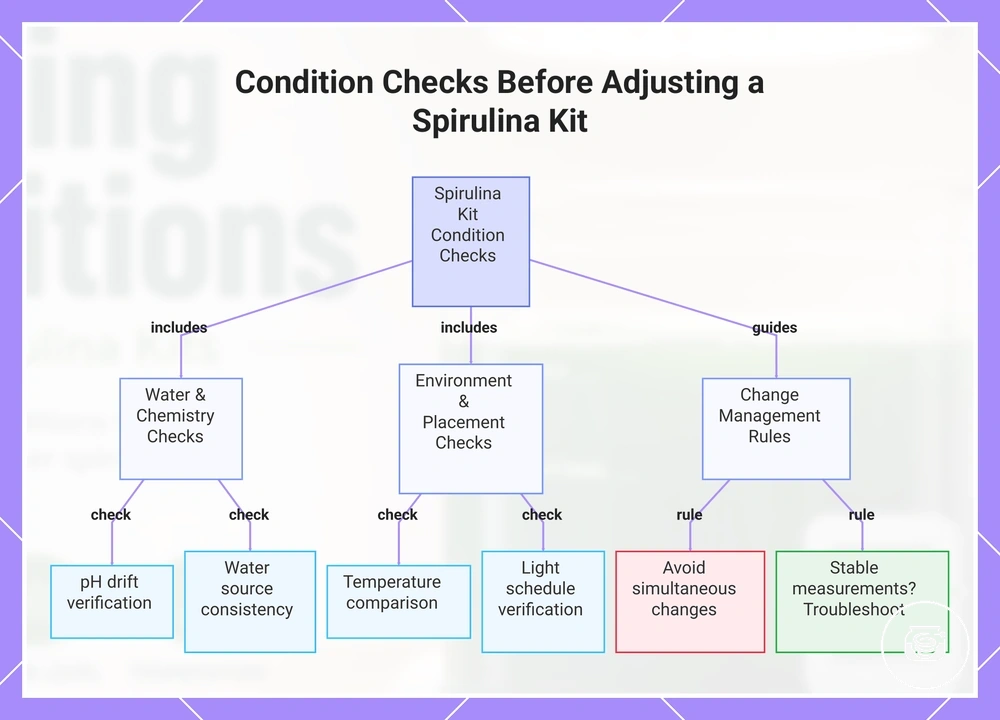
Condition Checks Before Adjusting a Spirulina Kit
Condition checks should precede adjusting a spirulina kit because measured conditions provide a more reliable basis for decisions than visible culture changes alone. Before changing light, temperature, water chemistry, nutrients, or container placement, compare thermometer readings, pH testing, the light schedule, container placement, the water source, nutrient timing, and recent changes using the same measurement method each time. The retained evidence does not specify universal numerical thresholds for every home spirulina culture, so the decision depends on whether repeated measurements remain consistent or show a confirmed directional change.
The checklist below follows a condition → check → decision sequence so each measurement verifies one variable before another adjustment is considered.
The checklist below follows a condition → check → decision sequence so each measurement verifies one variable before another adjustment is considered.
- Thermometer readings: Compare culture-water temperature under the same lighting condition to verify whether heat exposure has changed; repeated differences support reviewing temperature-related conditions before making an adjustment.
- pH testing: Repeat the pH measurement using the same sampling method to verify whether pH drift is genuine rather than a one-off reading; confirmed drift supports reviewing water chemistry before altering nutrients.
- Light schedule: Verify that the planned daily lighting period has not changed unexpectedly; an altered schedule supports reviewing light exposure before changing another condition.
- Container placement: Check whether the container has been moved closer to a window, lamp, heater, or draft because placement changes can influence both light exposure and culture-water temperature simultaneously.
- Water source: Confirm whether the same prepared water source has been used throughout the cultivation period; a different source may change dissolved minerals or treatment residues and complicate comparison with earlier measurements.
- Nutrient timing: Compare the most recent nutrient addition with the intended cultivation plan to verify whether nutrient availability has changed before adding more nutrients.
- Recent changes: Record the latest alteration to lighting, placement, water preparation, nutrients, or room conditions because the newest change is the first variable that should be compared with the observed culture response.
Interpret recent changes by comparing one changed condition with measurements collected before and after that change. Avoid adjusting several variables at the same time because multiple simultaneous changes make it difficult to identify which condition produced the observed culture response. For example, if both the lamp position and nutrient quantity were changed on the same day, compare new thermometer readings and pH results with the earlier measurements before deciding which condition requires further adjustment.
Interpret recent changes by comparing one changed condition with measurements collected before and after that change.
If repeated measurements remain stable but growth problems continue, dedicated troubleshooting is more appropriate than additional condition changes. When the original order of lighting, water preparation, nutrient mixing, or container placement may explain the current conditions, review the setup sequence before making further adjustments.
This chart shows the key condition checks and decision rules to follow before making adjustments to a spirulina culture kit.
This chart shows the key condition checks and decision rules to follow before making adjustments to a spirulina culture kit.