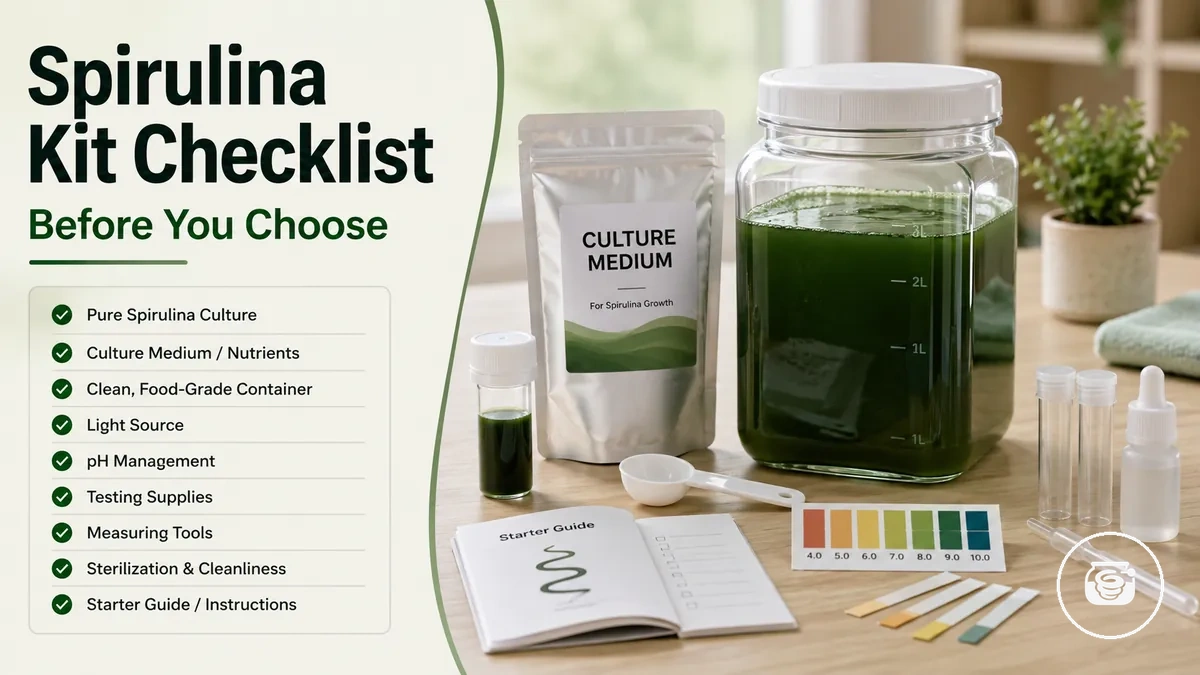
Spirulina Growing Kit Buying Checklist
A spirulina growing kit buying checklist is a decision-support tool for evaluating whether a kit includes the essential components, suitability, and safety information needed before purchase. Its primary purpose is to reduce buying uncertainty by confirming that the kit is complete for its intended use, while recognising that culture performance, safety, and yield remain dependent on the supplier's instructions and growing conditions rather than the kit alone.
If these details are not stated, treat them as information that should be verified before purchase rather than assumed.
When comparing spirulina growing kits, the first step is to verify whether the package is described as a complete kit or whether key items must be obtained separately. A complete kit should clearly identify the included starter culture, grow medium, pH test, light guidance, harvest filter, and any required refills or supporting equipment. If these details are not stated, treat them as information that should be verified before purchase rather than assumed.
The following section moves from this buying framework into detailed verification of each essential component and safety check.
Missing or unclear component information can increase preparation time, additional costs, and the likelihood of purchasing incompatible supplies later. This page is a checklist for choosing and verifying a spirulina growing kit, not a guide to setup, harvesting, or troubleshooting. The following section moves from this buying framework into detailed verification of each essential component and safety check.
Table of Contents
Minimum Components a Spirulina Growing Kit Should Include
A spirulina growing kit should include the minimum biological, monitoring, harvesting, and instructional components needed for the supplier's stated first-use configuration. The primary buying criterion is whether every essential function is explicitly marked as included or missing, because omitted components increase preparation cost and the risk of purchasing incompatible supplies separately.
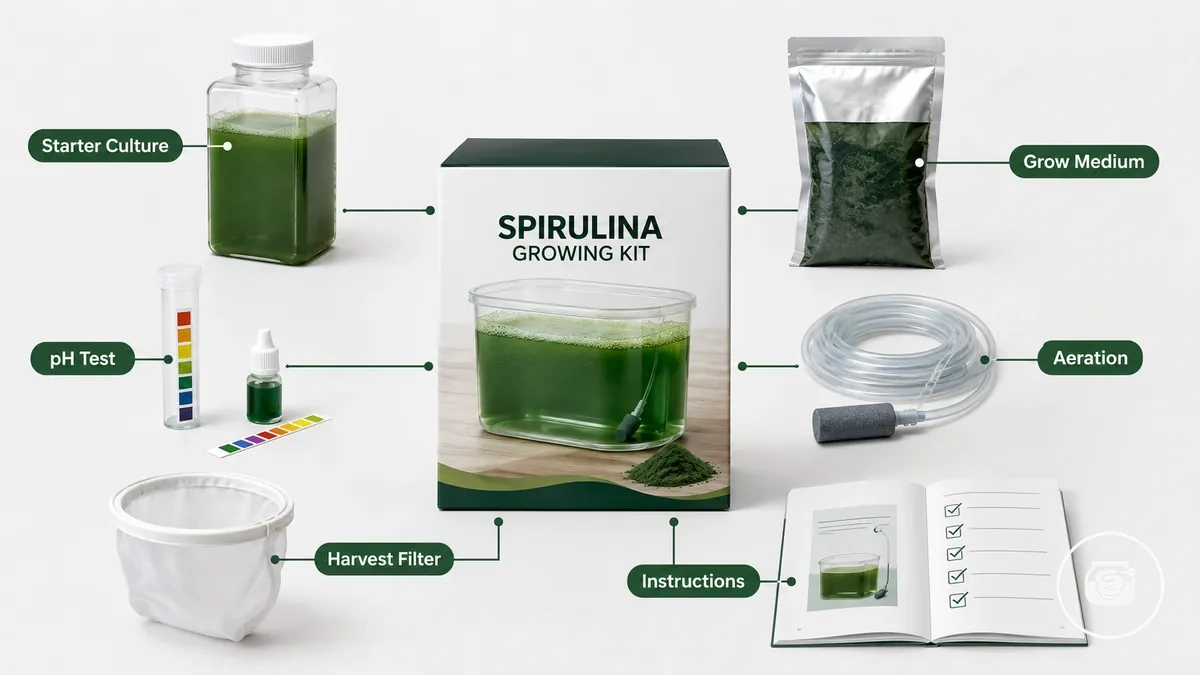
- Starter culture and grow medium: Verify that the kit clearly states whether a live spirulina starter culture and nutrient medium are included. For example, Algae Research Supply specifies that its 5-gallon kit contains 1 litre of live Spirulina culture together with two nutrient bags, each formulated to prepare one 5-gallon batch of growth medium. If either item is missing, the kit is not immediately ready for culture initiation.
- Container and aeration: Confirm whether the growing container, air pump, tubing, and diffuser are included or must be supplied separately. In the same supplier example, a 6-foot air hose, connector, and stainless-steel bubble tube are included, while the 10-gallon aquarium and air pump are listed as buyer-supplied items. This distinction determines whether additional equipment must be purchased before use.
- Monitoring and harvesting tools: Check whether the kit includes a pH test, culture-monitoring tool, and harvest filter. Some suppliers include a Secchi Stick and harvesting screen but require the buyer to obtain a pH testing method separately. A missing monitoring or harvesting component increases the risk of incomplete culture management after purchase.
- Instructions and reference material: Verify that written guidance identifies the culture strain, nutrient preparation, operating procedure, and routine maintenance requirements. A kit containing physical materials without clear instructions provides lower purchase readiness because the essential operating information is absent.
After verifying these functions, compare them with the documented included kit components. A practical pass condition is that every essential function—culture, growth medium, monitoring, harvesting, and operating guidance—is explicitly identified as included or clearly identified as a separate buyer responsibility before purchase.
Live Starter Culture and Grow Medium
Live starter culture and grow medium should be listed as separate included items because each component performs a different function within the minimum component check. The live starter culture supplies viable spirulina cells, while the grow medium provides the nutrient solution required to begin cultivation. A complete kit description should identify both items separately, state their condition, and specify their quantity where available, because missing or unclear information has a direct buying consequence.
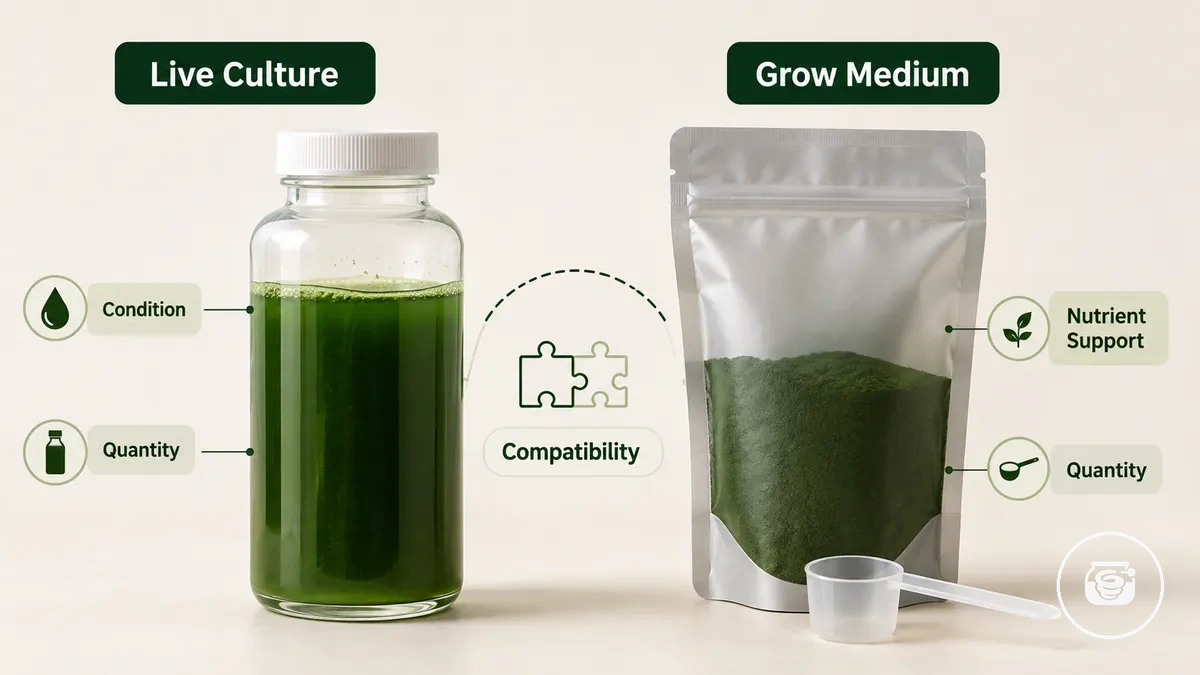
Live starter culture and grow medium should be verified before comparing other kit parts because they determine whether the package contains the essential biological and nutrient components rather than only generic growing supplies. Check the following attributes in the kit description before treating the component as complete:
- Starter culture: Confirm that the included item is explicitly described as a live spirulina culture rather than a generic starter material or unspecified algae supply. If the culture condition is not stated, verify it with the supplier before purchase.
- Grow medium: Verify that the nutrient medium is listed as a separate included item and that its preparation quantity or batch capacity is specified instead of referring only to general growing supplies.
- Quantity and compatibility: Where measurable values are provided, compare them directly. For example, some suppliers specify 1 litre of live starter culture together with nutrient medium formulated for a defined batch size, while descriptions that omit quantity or compatibility make it difficult to verify whether both components are intended to function together.
- Buying implication: A kit passes this local component check only when the live starter culture and grow medium are separately identified, their included condition is clear, and their quantity or intended compatibility is described rather than implied through vague supply claims.
Container, Aeration, Light, pH Testing, and Harvest Filter
Container, aeration, light, pH testing, and harvest filter are support components that determine whether a spirulina growing kit is complete beyond its biological materials. Each component should be identified separately in the kit description with its function, included condition, or stated buyer requirement because a missing support tool can prevent immediate culture setup even when the live starter culture and grow medium are included. The reviewed supplier evidence shows that support tools are frequently split between included and buyer-supplied items, making individual verification part of the purchase decision.
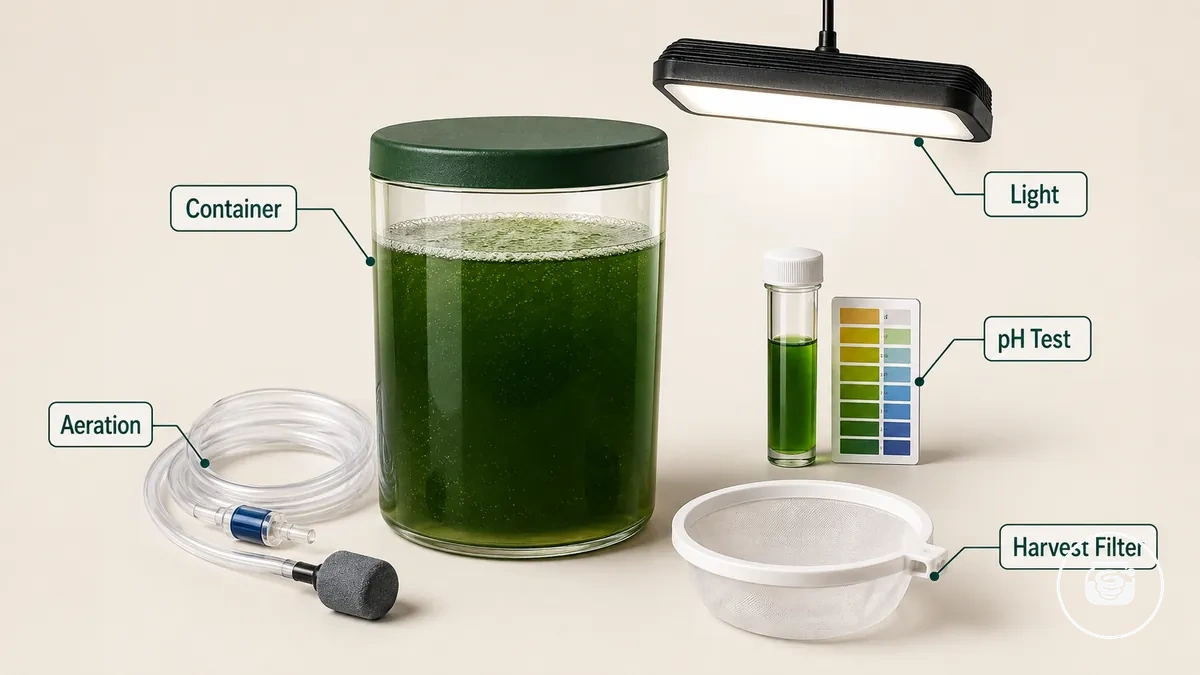
Container, aeration, light, pH testing, and harvest filter should be verified together because they cover condition control, monitoring, and harvesting rather than biological growth materials. Review each support component individually before treating the kit as complete.
- Container: Confirm whether the growing container is an included item or a buyer-supplied component. For example, some supplier kits include culture accessories but require a separate 10-gallon aquarium or similar container, making the vessel an external purchase rather than part of the kit.
- Aeration: Verify whether aeration components are listed individually. A kit may include tubing, connectors, or a diffuser while requiring the air pump separately, so the buying consequence depends on the included condition rather than assuming a complete aeration system.
- Light and pH testing: Check whether a light source and a pH testing item are both identified in the kit description. Their function is monitoring and environmental support, but if either component is omitted, verify whether compatible equipment must be supplied separately before purchase.
- Harvest filter: Confirm that a harvesting screen or filter is listed when the kit is promoted as harvest-ready. If no harvesting tool appears in the component list, additional harvesting equipment will normally be required after cultivation begins.
A kit passes this local support-component check only when each tool is clearly identified by function, included condition, and buying consequence instead of being grouped under broad descriptions such as general growing supplies.
Kit Completeness Versus Missing Supplies
Kit completeness versus missing supplies is the comparison between what a spirulina growing kit explicitly includes and what the buyer must obtain separately before cultivation can begin. A complete kit, starter kit, and media-only kit represent different inclusion levels rather than quality rankings, so the correct buying decision is to verify included items, missing supplies, refills, and follow-on requirements before judging overall value. The reviewed supplier evidence indicates that inclusion levels differ substantially between kit categories, making checklist verification more reliable than relying on product names alone.
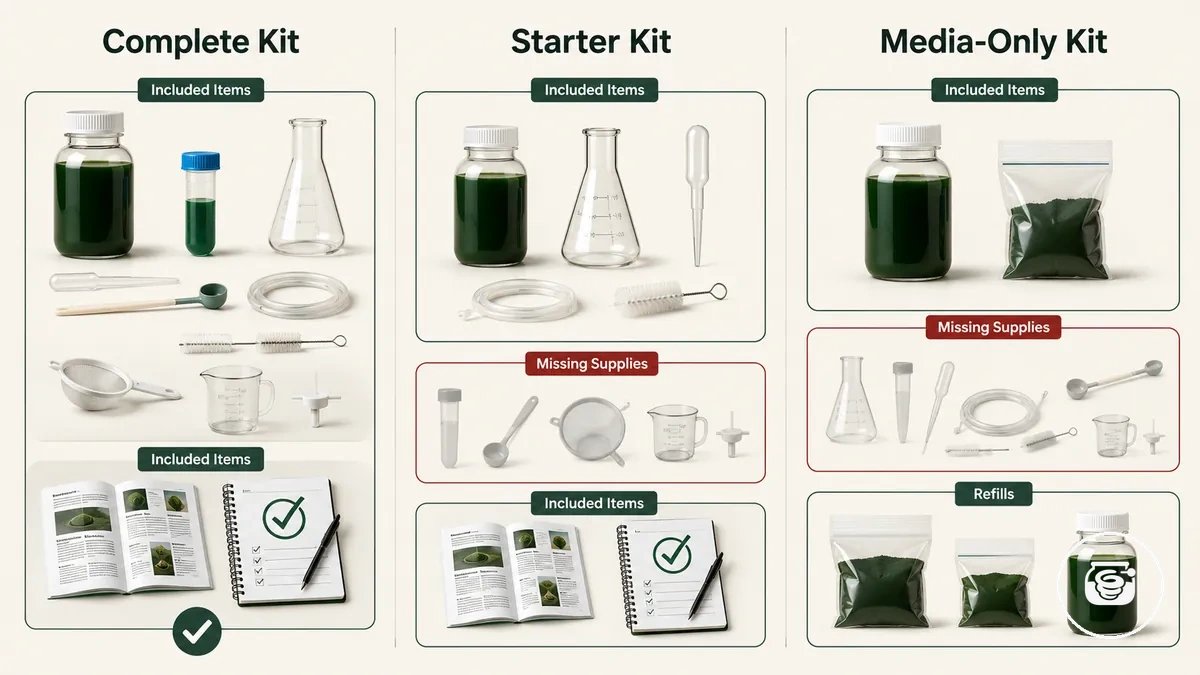
Kit completeness versus missing supplies should be assessed by comparing the included condition of each supply category rather than assuming a lower-priced package is complete. For example, supplier documentation reviewed for this section shows that some starter kits include a live culture and selected growing supplies but still require buyer-supplied equipment such as the culture container or air pump, while media-only kits generally provide nutrient media or refill materials without including a live starter culture. The practical consequence is that missing supplies create additional purchases, increasing total ownership cost even when the initial kit price appears lower.
- Complete kit: Includes the primary biological materials together with most support tools identified by the supplier. Verify whether future refills or a small number of external supplies remain buyer responsibilities before treating the package as operationally complete.
- Starter kit: Includes the minimum components needed to begin cultivation but commonly leaves supporting equipment or consumables as missing supplies. Those omissions increase preparation effort and can create extra cost before the first cultivation cycle.
- Media-only kit: Includes nutrient media or refill materials but does not function as a complete culture kit because a compatible live spirulina culture and any omitted growing supplies must already be available or purchased separately.
- Instructions, tools, and refills: Confirm whether written instructions, harvesting tools, replacement nutrients, and refill supplies are included or sold separately because these items influence long-term value rather than only the initial purchase.
A practical pass condition is that every missing supply and follow-on requirement is identified before purchase so the total ownership requirement is clear rather than assumed. After confirming the inclusion level, compare kit types to understand how complete kits, starter kits, and media-only kits differ without relying on marketing descriptions.
Complete Kits, Starter Kits, and Media-Only Kits
Complete kits, starter kits, and media-only kits differ by their inclusion level, which determines what the buyer must still supply before cultivation can begin. A complete kit generally includes the core culture materials together with most support components, a starter kit includes the minimum growing supplies but leaves more missing dependencies, and a media-only kit supplies nutrient media or refill materials without functioning as a complete culture kit. The buying decision should therefore compare included parts, missing dependencies, effort, and suitability instead of relying on the kit name alone.
| Kit type | Included parts | Missing dependencies | Effort and suitability |
|---|---|---|---|
| Complete kit | Includes the live culture, grow medium, and most supporting kit parts required for the supplier's intended starting configuration. | The buyer may still need supplier-specified external items such as a growing container, air pump, or future nutrient refills. | Suitable when fewer additional purchases are preferred before beginning cultivation. |
| Starter kit | Includes the minimum growing supplies needed to begin the first cultivation cycle. | Supporting equipment or consumable items commonly remain separate purchases before the setup is fully operational. | Suitable when compatible equipment is already available or the buyer is prepared to source the remaining items. |
| Media-only kit | Includes nutrient media or refill ingredients rather than a complete culture system. | A compatible live starter culture and any omitted growing equipment must be available separately before cultivation can begin. | Suitable for maintaining an existing spirulina culture or replenishing supplies rather than establishing a first-time setup. |
This comparison verifies how inclusion level changes the buyer's responsibilities rather than which kit type is superior. The checklist passes when the selected kit matches your existing equipment and every missing dependency has been identified before purchase; broader feature or performance comparisons fall outside the scope of this buying checklist.
Instructions, Measurement Tools, and Refill Needs
Instructions, measurement tools, and refill needs are criteria that determine whether a spirulina growing kit is ready for first use and whether repeat cultivation can continue without unexpected purchases. The buying decision should verify that written guidance, measurement tools, and refill information are clearly identified as included or missing, because unclear support materials increase the risk of purchasing additional growing supplies after the kit arrives.
Use the following checklist to confirm how well the spirulina growing kit supports first-use readiness and ongoing supply planning before purchase.
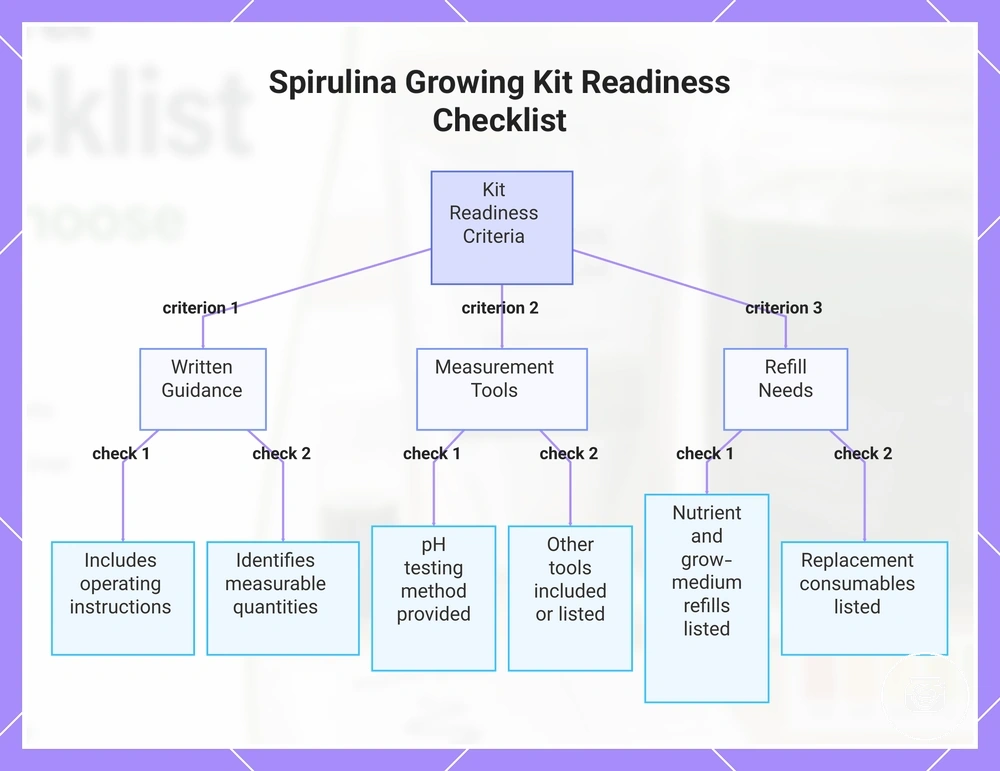
Use the following checklist to confirm how well the spirulina growing kit supports first-use readiness and ongoing supply planning before purchase. A kit passes this local criterion when every support item has a clearly stated condition and buying consequence rather than being left unspecified.
- Written guidance: Verify that the kit includes operating instructions covering culture preparation, routine monitoring, harvesting, and safe handling. Instructions should identify measurable quantities where applicable instead of relying only on general descriptions.
- Measurement tools: Check whether measuring tools, such as a pH testing method or culture-monitoring tool, are included or listed as separate purchases. Missing measurement tools reduce the ability to confirm growing conditions before and during cultivation.
- pH support: Confirm whether the kit provides a pH testing item or specifies a compatible alternative. A clearly identified measurement method provides a stronger purchase signal than a general recommendation to monitor pH without identifying the required tool.
- Refill visibility: Review whether nutrient refills, grow-medium refills, and replacement consumables are listed separately. A stated refill path helps the buyer plan repeat-use supplies and reduces the risk of hidden follow-on purchases after the initial cultivation cycle.
- Decision signal: A spirulina growing kit meets this criterion when written guidance, measurement tools, and refill needs are all explicitly identified as included or separately required before purchase, making the kit easier to evaluate and maintain without implying successful growth.
This chart shows the three main criteria to verify before purchasing a spirulina growing kit: written guidance, measurement tools, and refill needs, with specific checks for each.
Kit Size and Home Growing Fit
Kit size and home growing fit should be judged by whether the supplier-stated culture volume, container space, light clearance, storage needs, and water-handling condition match the intended home setup. The reviewed evidence does not establish a universal footprint, culture capacity, or expected yield for spirulina growing kits, so those values remain unverified unless the supplier provides dimensions, volume, and operating conditions.
Use the following checklist to compare kit size with the available growing space and intended scale.
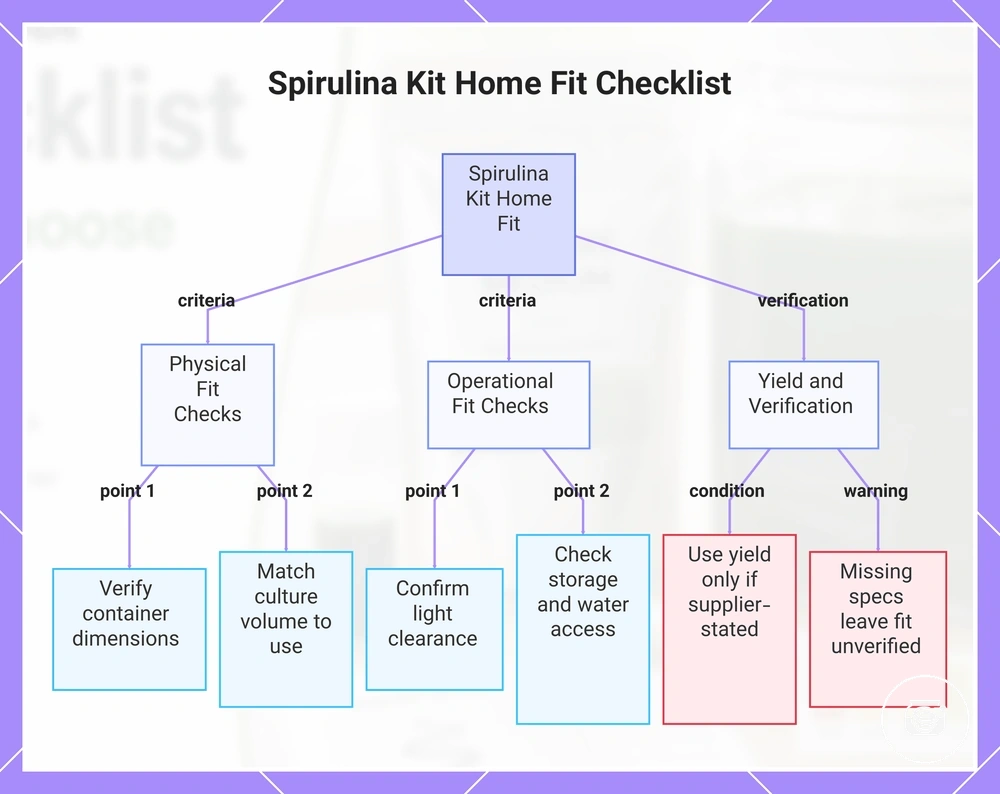
Use the following checklist to compare kit size with the available growing space and intended scale. Expected yield is condition-dependent because it is meaningful only when the supplier identifies the relevant culture volume, kit design, and operating condition.
- Container footprint: Verify the stated length, width, and height against the available bench, shelf, or floor area. If one or more dimensions are missing, the container space cannot be confirmed before purchase.
- Culture volume: Match the supplier-stated culture capacity to the intended use case. A smaller indoor home setup requires a vessel that fits the available space, while larger ongoing use requires proportionally more container capacity, water handling, and support space.
- Light placement: Confirm that the home setup provides enough clearance for the specified light source and its mounting or positioning method. A container that fits physically still fails the home-fit check when the required light cannot be placed safely and securely.
- Storage and water handling: Include storage space for nutrients, filters, measuring tools, and replacement supplies, plus practical access for filling or moving water. Missing storage or difficult water access increases handling effort even when the main vessel fits.
- Expected yield: Use an expected yield figure only when it is supplier-stated and linked to a defined culture volume and operating condition. If those details are absent, record expected yield as unspecified rather than using it to judge suitability.
A kit passes this sizing check when its documented footprint, culture volume, light clearance, storage requirement, and water-handling condition all fit the intended home setup. If any required dimension or capacity is missing, the buying consequence is that home growing fit remains unverified until the supplier provides the relevant specification.
This chart shows the key criteria to verify whether a spirulina growing kit fits your home space and the consequence of missing specifications.
This chart shows the key criteria to verify whether a spirulina growing kit fits your home space and the consequence of missing specifications.
Culture Volume, Container Space, and Expected Yield
Culture volume, container space, and expected yield should be evaluated together when deciding whether a spirulina kit size suits the intended home setup. The reviewed evidence provides no universal working volume, container dimensions, light distance, or yield range for home spirulina kits, so each value is supplier-specific and should be recorded as missing when the kit description does not state it. Expected yield is condition-dependent because culture health, light, pH, water quality, and ongoing maintenance affect the result alongside culture volume.
- Culture volume: Verify the supplier-stated working volume rather than treating total container capacity as usable culture capacity. If the working volume is missing, the kit's intended scale remains unverified.
- Container space: Compare the stated length, width, and height with the available shelf or bench space in the home setup. Missing dimensions prevent a reliable fit decision even when a culture-volume figure is provided.
- Light distance: Confirm the supplier-stated placement or clearance requirement for the light source. If no distance or positioning condition is given, the full container space requirement remains unspecified.
- Expected yield: Use a yield claim only when it is linked to a defined culture volume and stated operating conditions. Without those values, expected yield should be treated as unspecified rather than as a predictor of production.
The sizing check passes when the working culture volume, container dimensions, light-placement condition, and basis of any expected-yield claim are all stated and compatible with the home setup. If one of these values is missing, the buying consequence is that fit or production expectations remain unverified.
Culture Quality Indicators Before Buying
Culture quality indicators before buying are the criteria used to judge whether the starter culture and grow medium in a spirulina growing kit are described clearly enough to support the buying decision. The reviewed evidence does not identify a universal retail grading system for these kits, so culture condition, medium labelling, nutrient compatibility, shipping information, and freshness cues should be treated as the verifiable values; when any value is missing, the related purchase risk remains unresolved.
Specific culture information creates a lower decision risk than vague wording because it lets the buyer verify what is included and under which condition it should be supplied.
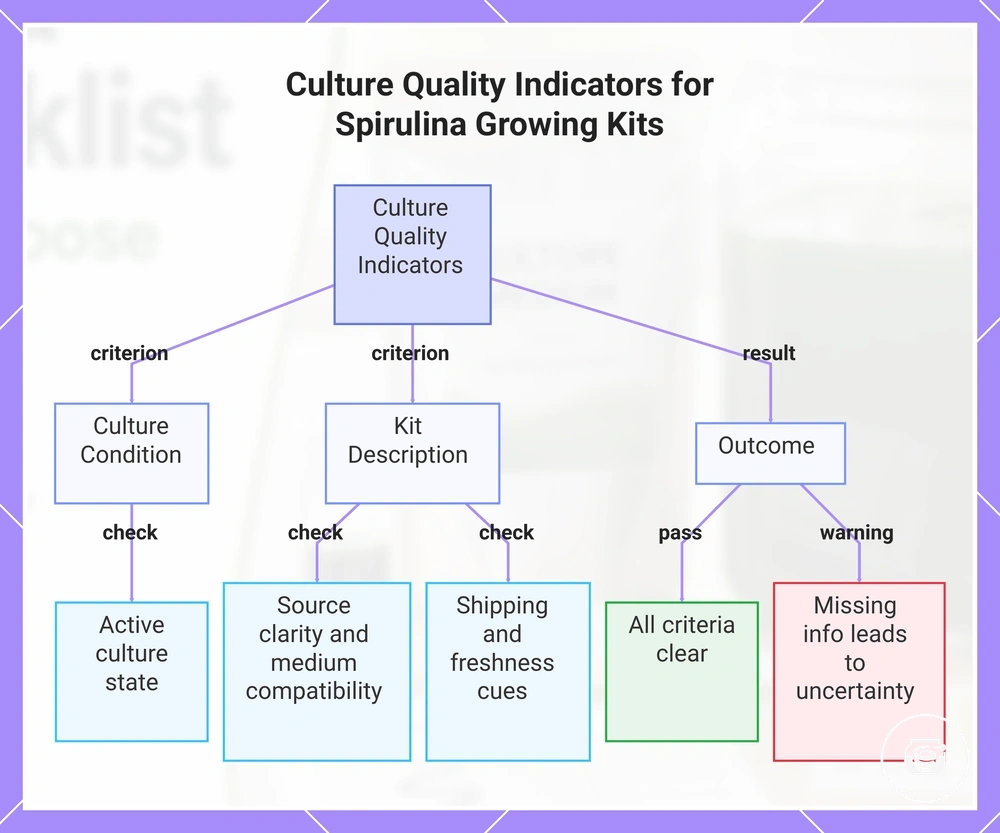
Specific culture information creates a lower decision risk than vague wording because it lets the buyer verify what is included and under which condition it should be supplied. A description that identifies a live starter culture, names the supplied medium, states compatibility between the two, and provides handling or freshness information is more credible than one that refers only to a starter or growing supplies without defining those attributes.
- Active culture condition: The starter culture should be identified as live or described with another explicit condition. If the culture state is missing, its readiness remains unverified.
- Source clarity: The spirulina growing kit should identify the starter culture and medium separately rather than grouping them under general kit-part wording. Clear identification reduces the risk of assuming that a biological or nutrient component is included when it is not.
- Shipping cues: The supplier should state any relevant dispatch, storage, or handling condition for the culture. If no handling information is provided, transport suitability cannot be verified before purchase.
- Medium labelling and nutrient compatibility: The medium should be named or otherwise clearly described, and its intended compatibility with the included culture should be stated. Missing compatibility information leaves the culture-medium relationship uncertain.
- Freshness indicators: The listing should provide a preparation, packaging, use-by, replacement, or equivalent supplier-stated freshness cue. If no freshness indicator is available, freshness should be recorded as unspecified rather than assumed.
This criterion passes when the culture condition, medium identity, compatibility, shipping cues, and freshness indicators are all stated clearly enough to verify the included materials and their condition. When one or more of these values is missing, the buying consequence is higher uncertainty rather than proof that the culture or medium is unsuitable.
When one or more of these values is missing, the buying consequence is higher uncertainty rather than proof that the culture or medium is unsuitable.
This chart shows the key criteria to verify when evaluating a spirulina kit's culture and medium description, and the consequence of missing information.
Active Culture Condition and Shipping Cues
Active culture condition and shipping cues should be verified in the kit description before treating a live-culture component as a credible included item. The useful values are an explicit culture state, clear packaging information, stated temperature or handling conditions, defined dispatch timing, and a supplier communication path; when any of these are missing, the buying consequence is unresolved arrival risk rather than proof that the culture is unusable.
The following cues help assess whether the component's function and shipping condition are described clearly enough for a purchase decision.
The following cues help assess whether the component's function and shipping condition are described clearly enough for a purchase decision. Long-distance delivery, temperature exposure, and uncertain dispatch timing increase concern only when the listing does not explain how the live culture is packed, handled, or scheduled for shipment.
- Culture state: The kit description should identify the included item as a live culture or state another explicit condition. If the culture state is missing, its intended function and pre-shipping condition remain unverified.
- Packaging clarity: The component should have a described container, seal, or protective packaging method. Generic wording without packaging detail leaves containment during transport unspecified.
- Temperature exposure: The listing should state any relevant hot-weather, cold-weather, or seasonal handling condition. When no temperature guidance is provided, the effect of transit exposure remains unknown rather than confirmed safe or harmful.
- Dispatch timing: The supplier should state when live-culture orders are normally dispatched or identify any scheduling limitation. Unclear dispatch timing creates more uncertainty for long-distance shipping because the likely transit condition cannot be estimated reliably.
- Supplier communication: The kit description should provide a way to confirm packaging, dispatch, or handling details before purchase. If both the listing and communication path are missing, the buyer cannot verify the included culture's shipping condition.
This check passes when the culture state, packaging method, handling condition, dispatch timing, and communication path are all explicit enough to support the buying decision. Missing cues leave arrival condition unverified, but they do not guarantee loss of viability.
Growth Medium Clarity and Nutrient Compatibility
Growth medium and nutrient compatibility should be verified by confirming that the supplied medium is identified for the intended spirulina culture, that the nutrient salts are clearly labelled, and that pH support, preparation quantity, and refill compatibility are stated in the kit description. The reviewed evidence does not establish one universal nutrient formula or pH specification for all retail spirulina kits, so missing composition, quantity, or compatibility information should be treated as an unresolved buying condition rather than assumed suitability.
- Medium type: The growth medium should name the spirulina culture or kit configuration it is intended to support. If the intended culture is not identified, compatibility remains unverified.
- Nutrient salts: The included nutrient salts should be listed separately and linked to a stated preparation volume or batch quantity. If neither value is supplied, the usable amount of medium remains unspecified.
- Label clarity: The kit description should distinguish the growth medium, nutrient salts, and any separate additives by function. Generic wording such as “nutrients included” does not show which component performs each role.
- pH support: The supplier should state whether pH support is included, requires a separate product, or is limited to monitoring guidance. If this condition is missing, the buyer cannot verify whether another supply is required.
- Refill compatibility: A refill should identify the culture, medium system, or kit configuration it is intended to replenish. A refill without a stated compatibility condition should not be assumed to match the original nutrient system.
A media-only item supplies growth medium or nutrient salts but should not be interpreted as a complete culture kit unless a live spirulina culture and the other required kit parts are also stated as included. This check passes when medium type, nutrient contents, quantity, pH support, and refill compatibility are explicit; when one is missing, the buying consequence is an unverified need for additional or different supplies.
Safety and Contamination Checks Before Buying
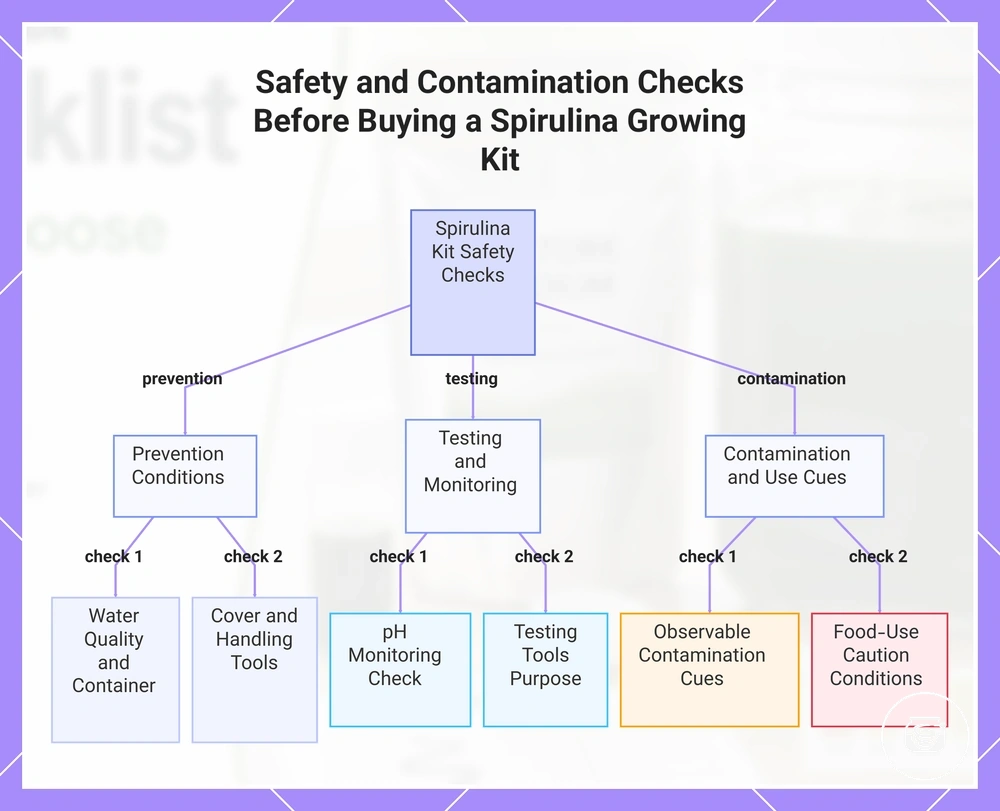
Safety and contamination checks before buying should confirm that a spirulina growing kit documents pH monitoring, water quality, clean-container handling, culture covering, testing tools, contamination cues, and food-use caution. No single included tool verifies that a culture is suitable for consumption; when these conditions are missing, the buying consequence is unresolved contamination risk rather than evidence of safety.
The World Health Organization’s Five Keys to Safer Food identifies keeping clean and using safe water and raw materials as core food-handling controls.
The World Health Organization’s Five Keys to Safer Food identifies keeping clean and using safe water and raw materials as core food-handling controls. The US Food and Drug Administration also states that blue-green algae products may be tested when microcystin contamination is suspected, so vague purity wording should not replace documented prevention and testing information.
- Prevention: Verify that the kit description specifies suitable water quality, a clean container, clean handling tools, and a cover or another stated method for limiting unwanted material entering the culture. If these instructions are missing, the kit provides no documented contamination-prevention condition.
- pH monitoring: Confirm whether a pH test is included, separately required, or not specified, and whether its monitoring function is explained. A pH tool is one safety check and does not establish the absence of biological or chemical contaminants.
- Testing tools: Check whether each included testing tool has a named purpose, method, and interpretation guide. A supplier claim that a tool verifies purity or food safety remains unsupported when the relevant test and limitation are not identified.
- Contamination cues: The kit description should state which observable changes require the culture not to be used and where further guidance is available. Appearance or odour may support a caution decision, but neither provides laboratory confirmation of contamination.
- Food-use caution: Any consumption statement should identify the applicable culture, handling condition, and supplier instructions rather than provide a general safety assurance. The FDA reports that microcystins can contaminate blue-green algae products, making contaminant controls and appropriate testing more informative than broad purity claims.
This safety check passes when pH and water guidance, clean-container requirements, covered handling, testing tools, contamination decision cues, and food-use conditions are stated clearly. Missing information does not prove contamination, but it prevents the buyer from verifying how the kit addresses the relevant risk.
For prevention and response criteria beyond this pre-purchase screen, review the safety checks before buying .
For prevention and response criteria beyond this pre-purchase screen, review the safety checks before buying.
This chart groups the key safety and contamination checks to verify in a spirulina kit description before purchase into prevention conditions, testing and monitoring, and contamination and use cues.
This chart groups the key safety and contamination checks to verify in a spirulina kit description before purchase into prevention conditions, testing and monitoring, and contamination and use cues.
pH Range, Water Quality, and Cleanliness Safeguards
pH range, water quality, and cleanliness safeguards should be verified in the kit description before treating a spirulina growing kit as adequately documented for contamination risk control. The reviewed evidence does not establish one universal pH range or water-preparation rule for every kit, so the required values are the supplier-stated pH condition, a named testing method, explicit water guidance, and clearly assigned cleanliness responsibilities. If any value is missing, the buying consequence is an unverified safeguard rather than proof that the culture is suitable for food use.
The checklist below separates safeguards that are included from conditions the buyer must manage separately.
The checklist below separates safeguards that are included from conditions the buyer must manage separately.
- pH support: The kit description should state a target pH range, threshold, or supplier-defined monitoring condition. If no value is stated, the pH requirement remains unspecified and must be confirmed from the instructions before purchase.
- pH strips or meter: Confirm whether pH strips, a meter, or another named testing method is included, separately required, or missing. An unnamed method does not provide a verifiable way to monitor the stated pH condition.
- Water quality: The listing should identify the required water type or preparation condition. If water suitability is not described, water preparation remains a buyer-supplied responsibility and the related contamination-control condition is unverified.
- Clean container and lid: Verify whether a clean container and lid are included or must be supplied separately, and whether their protective function is stated. Missing containment information leaves exposure control unspecified.
- Tool hygiene: The kit description should identify which measuring or handling tools must be kept clean and whether those tools are included. If hygiene guidance is missing, tool cleanliness is an assumed responsibility rather than a documented safeguard.
This safety check passes when the pH condition, testing method, water quality guidance, clean-container requirement, lid, and tool-hygiene responsibilities are explicit. Missing safeguards do not establish contamination, but they increase uncertainty and support food-use caution until the supplier provides the missing conditions.
Testing, Contamination, and Food-Use Cautions
Testing, contamination, and food-use cautions should affect the purchase decision by showing whether a spirulina growing kit includes a named pH test, clear contamination warnings, clean harvesting tools, and explicit food-use caution. A pH test, visual check, clean container, or water quality statement cannot verify every possible hazard, so missing test support or vague safety wording leaves the relevant condition unresolved rather than confirming suitability for consumption.
The following safety check distinguishes verifiable kit information from responsibilities the buyer must manage separately.
The following safety check distinguishes verifiable kit information from responsibilities the buyer must manage separately.
- pH test availability: The kit description should state whether pH strips, a meter, or another named method is included, separately required, or missing. An unspecified test leaves its monitoring function and buying consequence unclear.
- Contamination warnings: The instructions should identify observable warning cues that require caution without claiming that appearance alone diagnoses contamination. If warning language is missing, the buyer has no documented decision condition.
- Clean harvesting tools: The listing should identify whether a clean filter, screen, scoop, or transfer tool is included and explain its hygiene condition. Missing tool guidance makes contamination prevention an assumed buyer responsibility.
- Food-use caution: Any consumption statement should identify the applicable culture, water quality requirement, clean-container condition, and handling guidance rather than provide a broad safety assurance. Missing food-use guidance should reduce purchase confidence for buyers planning to consume home-grown spirulina.
- Vague safety wording: Claims such as “pure,” “safe,” or “contamination-free” should identify the supporting test, method, and limitation. Without those values, the wording provides no verifiable safety evidence.
This safety check passes when test availability, warning language, harvesting-tool hygiene, and food-use caution are stated clearly enough to support the buying decision. Missing information does not prove contamination, but it creates a buying consequence: the kit should not be treated as adequately documented for food use until the absent conditions are clarified.
Purchase-Readiness Questions for Choosing a Spirulina Growing Kit
Purchase-readiness is reached when a spirulina growing kit has the must-have inclusions, every missing supply is identified, the setup has a verified home fit, the culture credibility is documented, and the safety checks are clear. If one essential condition remains unspecified, the buying consequence is an unresolved dependency rather than a purchase-ready choice.
Use these final questions to verify the kit’s conditions, trade-offs, and next step before making a selection.
Use these final questions to verify the kit’s conditions, trade-offs, and next step before making a selection.
- Must-have inclusions: Does the kit description state that the live spirulina culture, compatible growth medium, instructions, and required support components are included?
- Missing supplies: Can every external requirement be classified as already owned, separately required, optional, or not specified? An unspecified essential item prevents a complete purchase-readiness decision.
- Home fit: Do the stated container dimensions, working volume, light clearance, storage needs, and water-handling requirements match the intended space?
- Culture credibility: Does the listing identify the culture condition, packaging, dispatch handling, medium compatibility, and a supplier contact path instead of relying on vague claims?
- Safety checks: Are pH monitoring, water quality, clean handling, contamination cautions, testing limitations, and food-use guidance documented without implying certainty?
- Next step: Are all essential conditions either verified or assigned a clear action before purchase? If not, clarify the missing information before treating the kit as ready.
A spirulina growing kit passes this final check when its inclusions, dependencies, home fit, culture credibility, and safety conditions match the buyer’s documented requirements. To compare these conditions across available configurations, choose a kit only after resolving any remaining gaps.
To compare these conditions across available configurations, choose a kit only after resolving any remaining gaps.
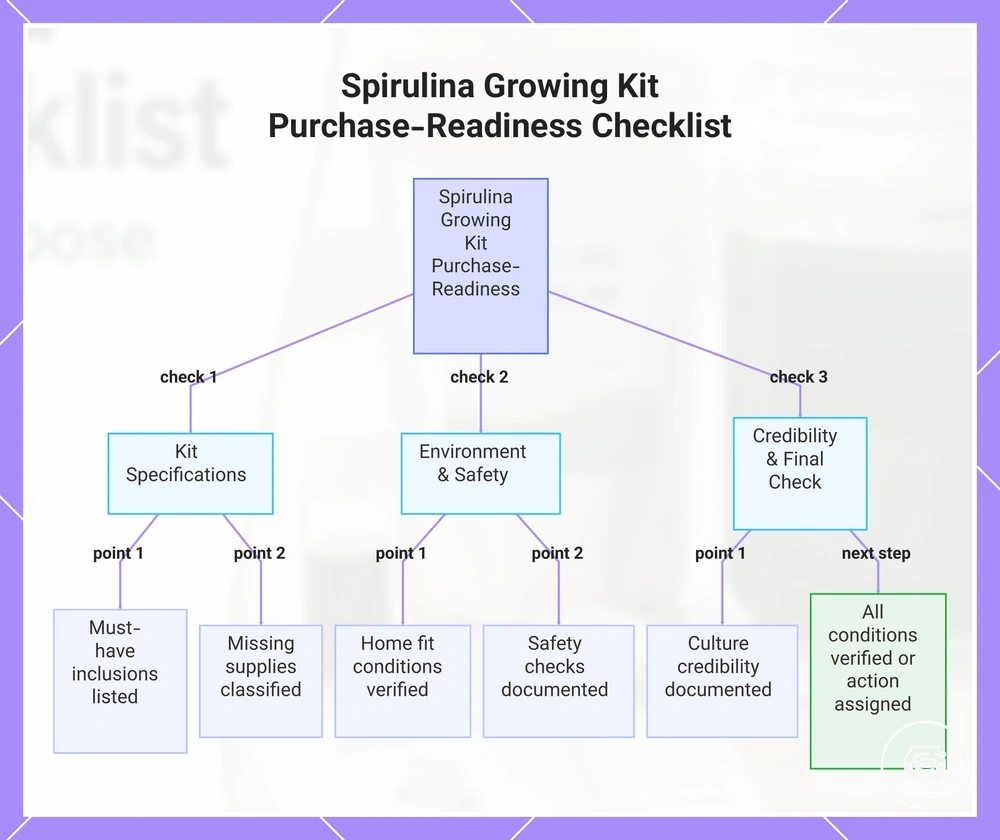
This chart shows the key verification categories to determine if a spirulina growing kit is purchase-ready, covering inclusions, home fit, safety, culture credibility, and final checks.
Here are product examples that may make comparison easier.
Here are product examples that may make comparison easier. Before buying, always review the compatibility criteria, essential features, and product details.