
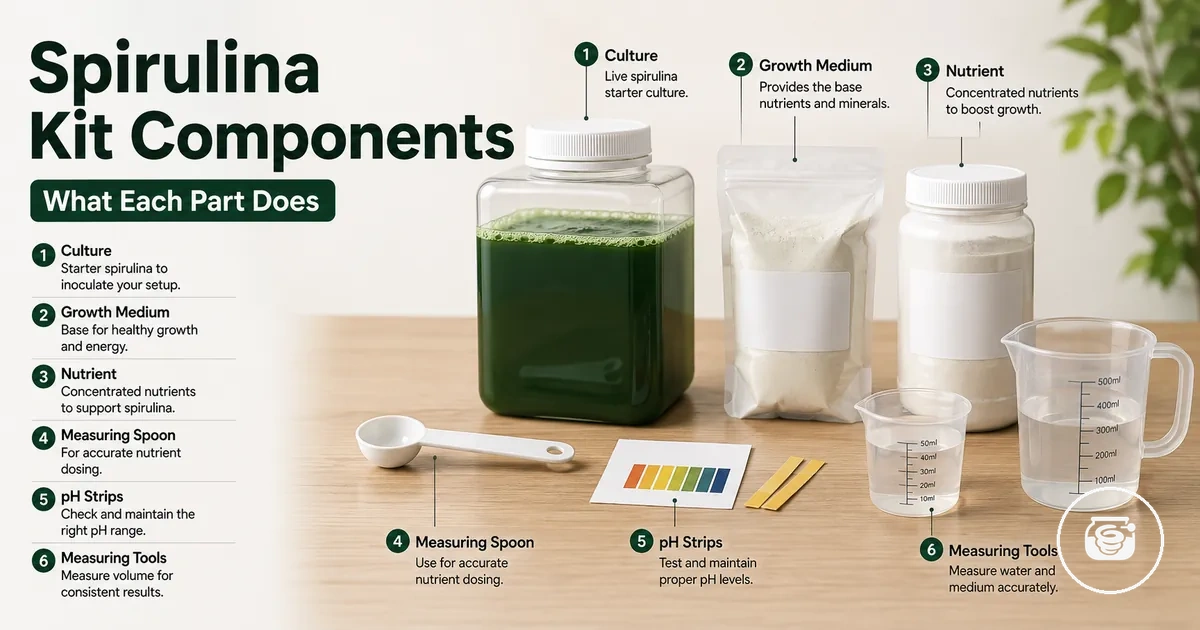
Spirulina Growing Kit Components and Their Functions
Spirulina growing kit components are the biological, chemical, physical, monitoring, and harvesting parts that collectively support a viable spirulina culture. A typical spirulina growing kit includes a live culture, a culture medium with nutrients, a growing container, monitoring tools, and a harvest filter, although manufacturers do not use a universal component standard and the exact contents differ between kits. The following sections explain each component by the function it performs in maintaining a healthy culture rather than by setup sequence or product variation.
This introduction explains component functions only and does not cover setup instructions, growing-condition targets, or kit-type comparisons.
People compare spirulina growing kit components to confirm that a kit contains every functional category required to culture spirulina instead of simply counting accessories. Commercial cultivation guides published by the Food and Agriculture Organization of the United Nations (FAO) describe spirulina production as requiring a living inoculum, an appropriate nutrient medium, a cultivation vessel, environmental monitoring, and a harvesting method, while individual home kits package these functions in different ways. This introduction explains component functions only and does not cover setup instructions, growing-condition targets, or kit-type comparisons.
The detailed sections below examine each component and its specific role within the spirulina growing kit.
The main component classes are the live culture, which supplies the Spirulina (Arthrospira) cells; the culture medium and nutrients, which provide the minerals needed to support growth; the container and support equipment, which hold the culture at a suitable water volume and allow light exposure; the monitoring tools, which help observe pH, temperature, and overall culture condition; and the harvest filter, which separates mature biomass from the culture liquid for collection. For example, a home kit may include one culture container, one pH measuring tool, one temperature monitor, and one harvest mesh, with each item serving a distinct function rather than replacing another. The detailed sections below examine each component and its specific role within the spirulina growing kit.
Table of Contents
What Belongs Inside a Spirulina Growing Kit
A spirulina growing kit component is a part, material, or tool that helps start, support, monitor, or harvest a spirulina culture. A complete kit is defined by its functional component classes rather than by a fixed inventory because manufacturers include different accessories while serving the same cultivation purpose. The essential component classes are a live culture, culture medium, nutrients, a growing container, environmental support equipment, monitoring tools, and harvesting tools, with each class contributing a separate function that supports a viable culture.
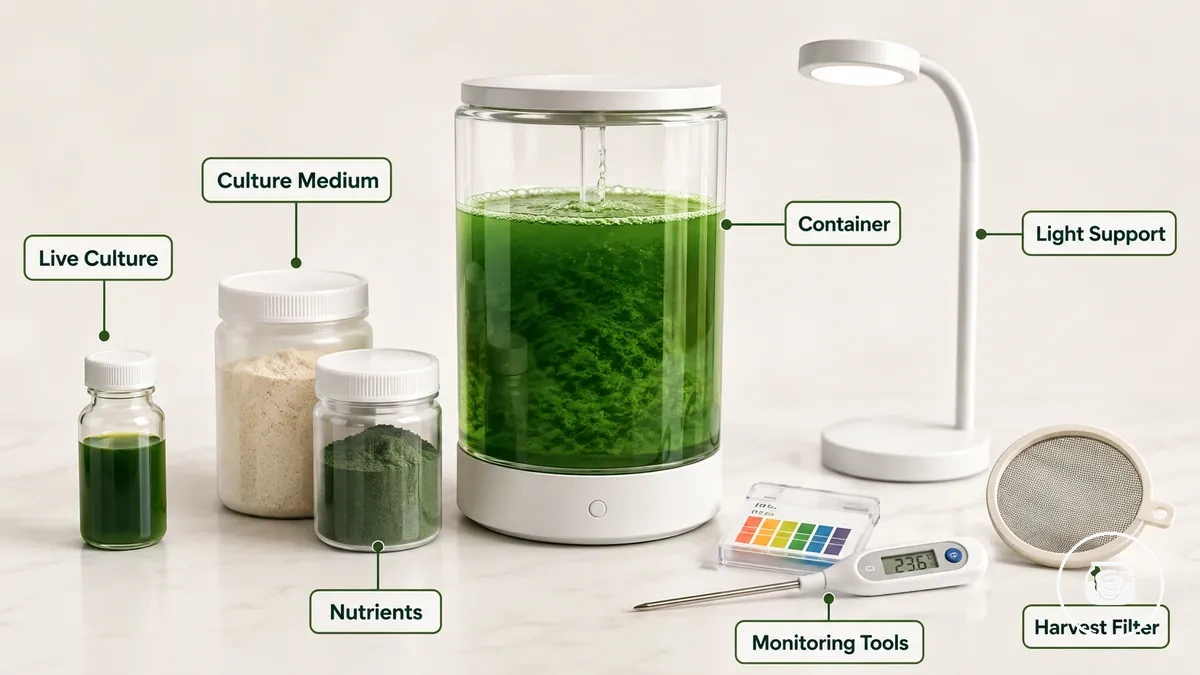
Each spirulina growing kit component has one primary role within the culture system. The live culture provides the Spirulina (Arthrospira) organism, the culture medium and nutrients establish suitable water chemistry, the container holds the culture, environmental support equipment helps maintain suitable growing conditions, monitoring tools measure culture condition such as pH and temperature, and harvesting tools separate mature biomass from the liquid culture. For example, a home kit commonly contains one culture vessel, one pH measuring tool, one thermometer, and one harvest mesh, with each item supporting a different cultivation function instead of replacing another.
Each spirulina growing kit component has one primary role within the culture system.
Equipment such as supplementary lighting, heaters, or aeration devices can support a spirulina growing kit but may also be purchased separately because they optimise cultivation conditions rather than define the kit's core component classes. For broader context about kit categories and related resources, visit the spirulina growing kits hub.
Biological, Chemical, and Physical Component Groups
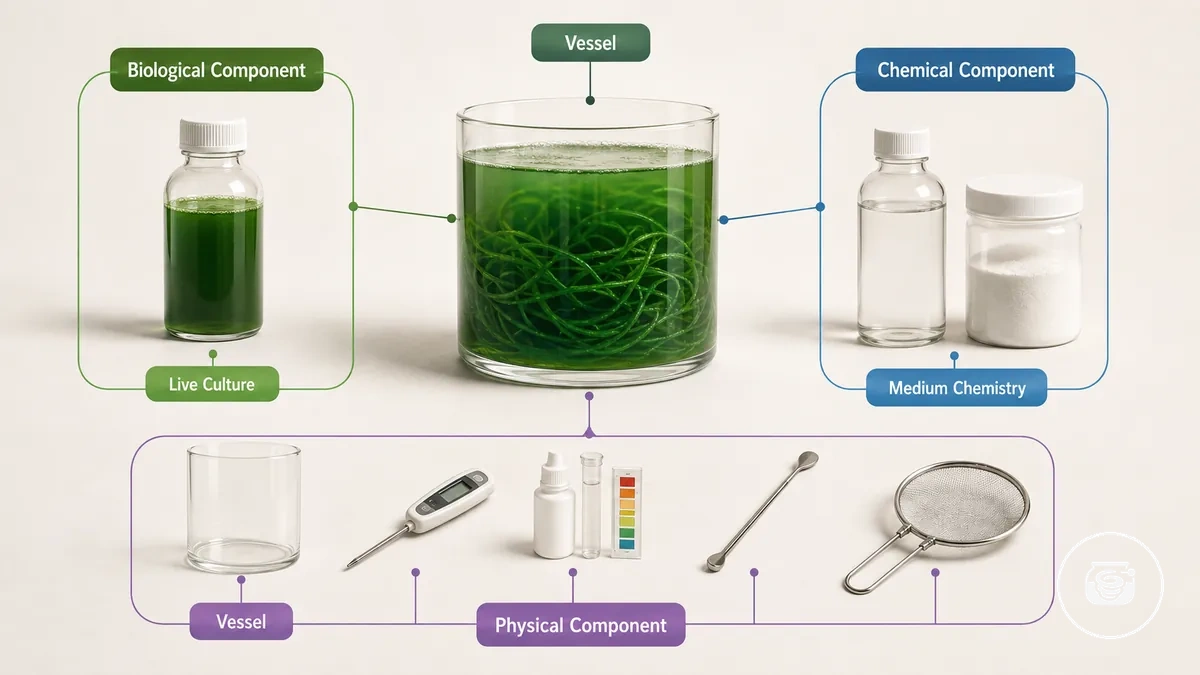
Spirulina growing kit components can be organised into biological, chemical, and physical component groups according to what they contribute to the culture rather than how manufacturers package them. The biological component supplies the live culture, the chemical component establishes and maintains medium chemistry, and the physical component provides containment, monitoring, movement, and harvesting functions. Grouping components by function clarifies how each category contributes to culture viability and practical cultivation.
| Component group | Main attribute | Practical effect |
|---|---|---|
| Biological component | Live culture containing viable Spirulina (Arthrospira) cells | Starts and maintains the growing culture by supplying living biomass. |
| Chemical component | Medium chemistry created by nutrients, minerals, and alkaline culture solution | Provides the chemical conditions required for cell growth and photosynthesis. |
| Physical component | Vessel and support tools used for containment, monitoring, circulation, and harvesting | Maintains the physical growing environment and enables routine culture management. |
Each component group performs a distinct function and cannot replace another group. For example, a home spirulina growing kit may include one live starter culture, one prepared nutrient medium, and one culture vessel with a thermometer and pH test tool; even if all physical equipment is present, the culture cannot grow without both the biological component and the chemical component that supports medium chemistry.
Each component group performs a distinct function and cannot replace another group.
This functional grouping separates component roles without turning the kit into an accessory checklist. Manufacturers may include different tools or package items differently, but a complete home spirulina growing kit still relies on biological, chemical, and physical component groups to support a healthy spirulina culture.
Live Spirulina Culture
Live spirulina culture is the biological starting material in a spirulina growing kit because it contains viable Arthrospira cells that can establish a new culture after inoculation. Its key attributes are viability, concentration, freshness, and handling condition, all of which influence whether the starter culture can successfully begin growth. Unlike a dry grow medium, the live culture supplies living cells rather than nutrients.
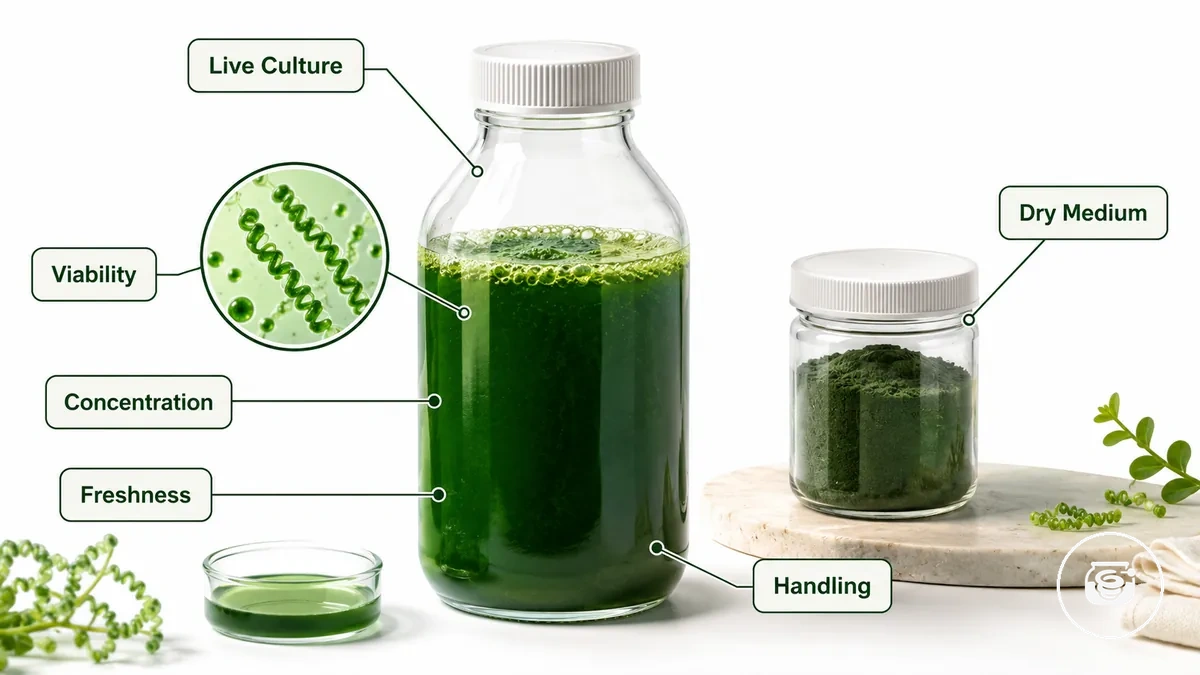
- Viability: The starter culture must contain living spirulina cells because only viable cells can reproduce and establish a new culture.
- Concentration: Starter cultures are commonly supplied as concentrated liquid inoculum, but manufacturers do not specify a universal cell concentration for all home spirulina growing kits.
- Freshness: A recently propagated starter culture retains higher biological activity than an aged or deteriorated sample, improving its suitability as starting material.
- Handling condition: Exposure to unsuitable temperatures or extended transport before use can reduce viable cell numbers and slow culture establishment.
For example, many home spirulina growing kits include approximately 500 mL of live starter culture together with a separate dry grow medium, although this volume is a manufacturer-specific packaging choice rather than a universal cultivation requirement. For a detailed comparison of these biological and chemical components, see live culture and grow medium.
Culture Medium, Nutrients, and Grow Salts
Culture medium, nutrients, and grow salts are the chemical support components in a spirulina growing kit because they establish the alkaline water chemistry that spirulina uses for growth. Their key attributes are alkalinity, mineral supply, concentration, and water compatibility, all of which influence culture stability instead of supplying living cells. According to the retained section evidence, culture media function as nutrient mixtures that provide the chemical environment needed for cell growth, while the exact concentration range depends on the formulation supplied with the kit rather than a universal recipe.
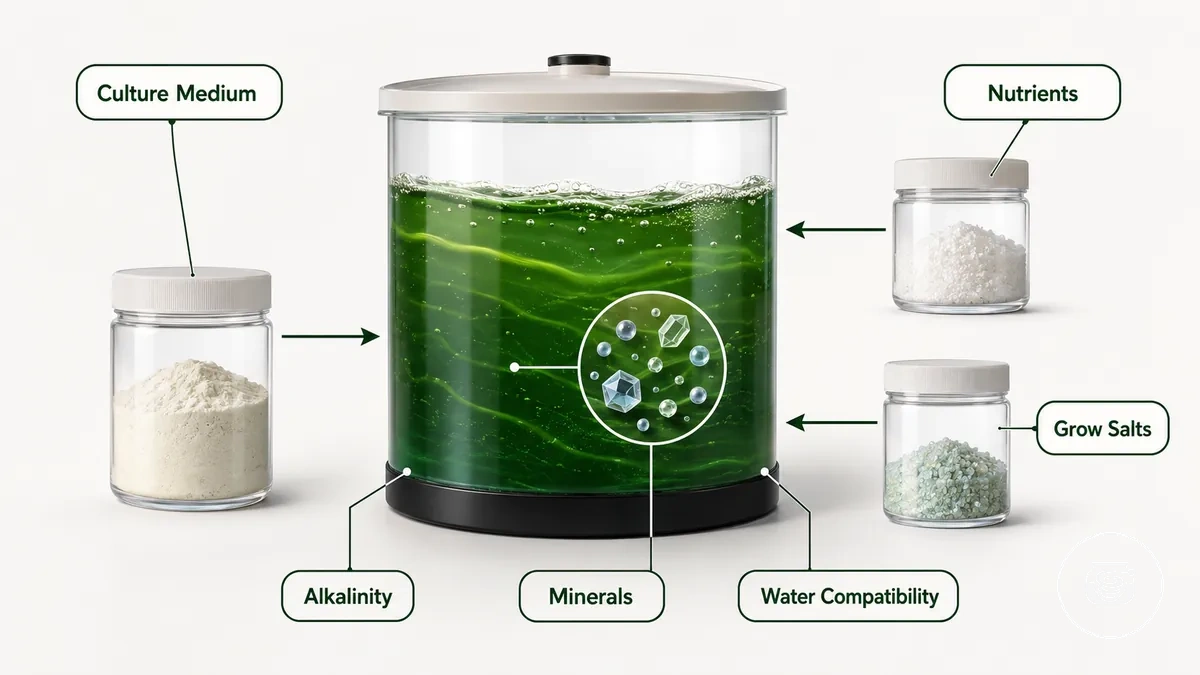
The chemical support components contribute different functions within the same growing system.
| Component | Primary attribute | Effect on culture stability |
|---|---|---|
| Culture medium | Alkalinity and water compatibility | Creates the alkaline chemical environment that supports stable spirulina growth. |
| Nutrients | Mineral supply | Provide dissolved minerals required for normal cellular metabolism and growth. |
| Grow salts | Concentration | Maintain the intended medium chemistry when mixed according to the manufacturer's formulation instead of a universal dosage. |
For example, a home spirulina growing kit may include one prepared grow salt mix and one separate live culture because the chemical medium supports water chemistry while the live culture supplies viable Arthrospira cells. Detailed medium preparation methods and mixing ratios belong in the dedicated live culture and grow medium guide rather than this component overview.
Equipment That Holds, Moves, and Supports the Culture
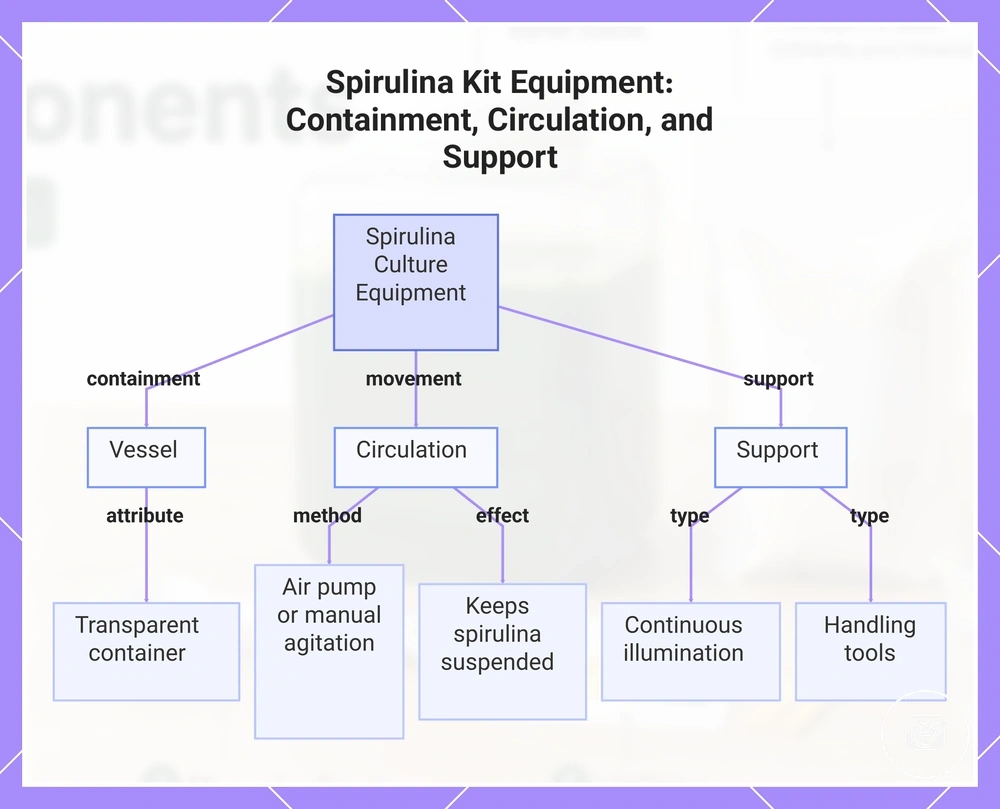
Equipment in a spirulina growing kit consists of the physical parts that create and maintain the usable growing environment around the culture. The main equipment groups are a vessel, pump or agitation support, light support, and handling tools, with each physical attribute providing a distinct culture effect rather than supplying nutrients or living cells. Together, these components support containment, circulation, illumination, and routine culture handling throughout cultivation.
- Vessel: The physical attribute is a transparent container that holds the spirulina culture and allows light to pass through, helping maintain a stable growing environment.
- Pump or agitation support: The physical attribute is gentle circulation created by an air pump or manual agitation, which keeps spirulina suspended and improves light distribution across the culture.
- Light support: The physical attribute is continuous illumination from natural or artificial light, enabling photosynthesis when available daylight alone is insufficient.
- Handling tools: The physical attribute is safe manipulation of the culture using simple kit tools, such as a stirrer or harvest utensil, which assists routine maintenance while minimising unnecessary disturbance.
For example, a typical home spirulina growing kit may include one culture vessel, one small air pump or manual agitation method, one light source, and one handling tool, with each item performing a separate physical function instead of replacing another component. This equipment supports the physical environment only and does not replace the chemical role of the culture medium or the biological role of the live spirulina culture.
This chart shows the three main equipment groups in a spirulina growing kit: vessel, circulation, and support, along with their key attributes and effects.
This chart shows the three main equipment groups in a spirulina growing kit: vessel, circulation, and support, along with their key attributes and effects.
Culture Containers and Growing Vessels
A culture container, or growing vessel, is the main physical component that holds the spirulina culture and shapes light access, water volume, cleaning, and handling. The most relevant attributes are material, transparency, surface area, depth, opening, and capacity, because each attribute changes how easily the culture can be observed, illuminated, moved, and maintained. No single container size or shape is specified for every home spirulina setup.
| Container attribute | Suitable value or condition | Effect on culture management |
|---|---|---|
| Material | Clear glass or clear food-compatible plastic | Provides physical containment and a surface that can be inspected and cleaned. |
| Transparency | Transparent rather than opaque | Allows light to enter through the vessel walls and makes visual checks easier. |
| Surface area | Broad enough to expose more culture to incoming light | Improves light access compared with a narrow vessel holding the same volume. |
| Depth | Shallow or moderate relative to the vessel width | Reduces the distance light must travel through the culture liquid. |
| Opening | Wide enough for cleaning and handling tools | Simplifies filling, stirring, sampling, and cleaning. |
| Capacity | Matched to the intended home culture volume | Determines how much liquid the vessel holds and how difficult it is to lift, move, or clean. |
For a small home culture, a clear vessel with a wide opening and moderate depth can make observation and cleaning easier, while a larger-capacity vessel holds more culture but also increases water weight and handling effort. This contrast explains why capacity should be treated as a setup-specific attribute rather than a universal recommendation.
This contrast explains why capacity should be treated as a setup-specific attribute rather than a universal recommendation.
Container choice should therefore be based on the intended culture volume, available light, cleaning access, and handling limits. Exact vessel dimensions remain unspecified because the reviewed evidence does not establish one supported size range for all home spirulina growing kits.
Container Shape, Depth, and Light Exposure
Container shape and depth are physical attributes that influence surface area, light exposure, and light distribution within a spirulina culture. A wide, shallow vessel exposes more culture surface to incoming light, while a tall, narrow vessel places a greater proportion of the culture farther from the light source, which can reduce observation clarity and create less even light distribution. No authoritative standard specifies one universal container shape for all home spirulina growing kits because suitability also depends on container capacity, transparency, and the intended home setup.
| Container attribute | Wide, shallow vessel | Tall, narrow vessel |
|---|---|---|
| Surface area | Greater exposed culture surface | Smaller exposed culture surface |
| Culture depth | Shorter light path through the culture | Longer light path through the culture |
| Light distribution | More even light access across the culture | Less even light access as depth increases |
| Observation | Easier visual inspection of colour and density | Visual assessment becomes more difficult as depth increases |
For example, suppose two transparent containers each hold an illustrative 10 L culture. A container with a 0.50 m² base would produce an approximate culture depth of 2 cm, whereas a container with a 0.10 m² base would produce an approximate depth of 10 cm; this theoretical comparison demonstrates how increasing surface area reduces culture depth for the same volume, improving light access throughout the culture. These values are calculated examples that illustrate the geometric relationship rather than manufacturer specifications. For broader environmental guidance beyond container attributes, see water, light, and temperature needs.
Water Volume and Culture Capacity
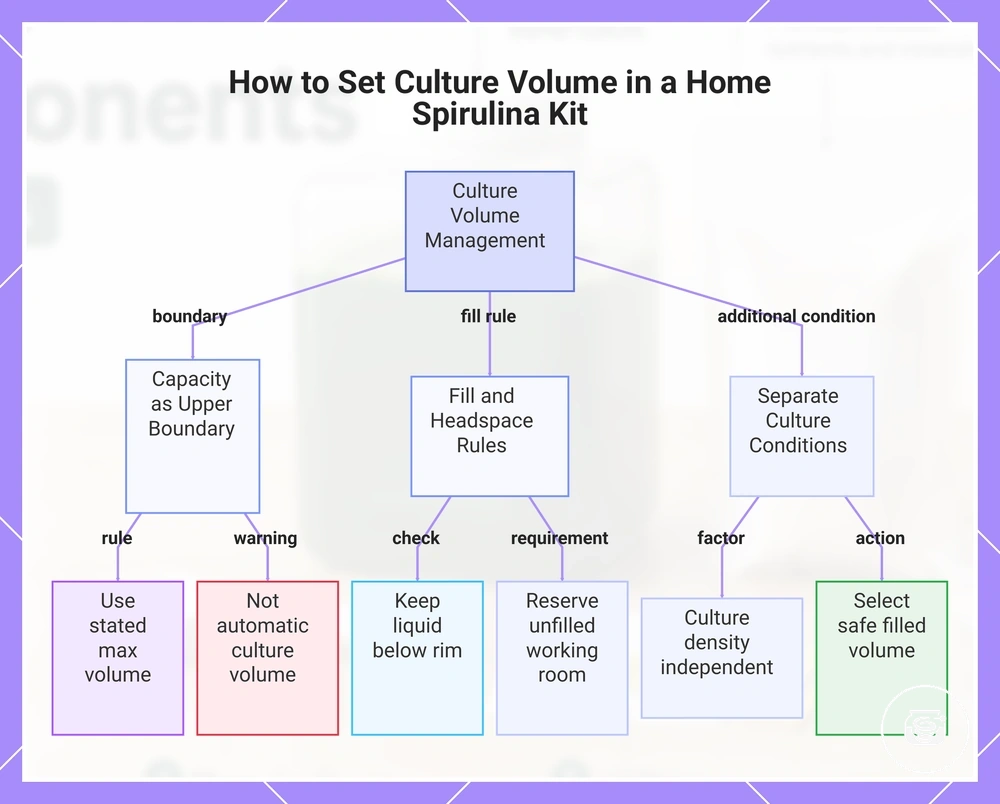
Water volume and culture capacity are vessel-sizing attributes that determine the fill level, available headspace, and practical working room for monitoring, movement, and harvest handling. The reviewed evidence does not establish one supported capacity or fill-level threshold for every home spirulina kit, so the usable culture volume must remain below the vessel's rated capacity and leave enough unfilled space for routine handling; capacity alone does not predict harvest output because outcomes also depend on culture density, light, nutrients, and maintenance.
- Vessel capacity: Use the manufacturer's stated maximum volume as the upper boundary, not as the automatic culture volume.
- Fill level: Keep the liquid level below the rim so stirring, sampling, and movement do not cause overflow.
- Headspace: Reserve an unfilled volume that provides working room for agitation and harvest tools; the reviewed evidence does not specify one percentage for every vessel design.
- Culture density: Treat density as a separate culture condition because two vessels with the same water volume can contain different biomass concentrations.
- Handling practicality: Select a filled volume that can be observed, moved, and harvested safely within the limits of the container and home setup.
For example, an illustrative 10 L vessel filled with 8 L of culture retains 2 L of headspace, equal to 20% of its stated capacity, while filling the same vessel to 10 L leaves no working room. This calculation demonstrates the relationship between capacity, fill level, and handling space; it is not a recommended universal ratio or a yield estimate.
This chart shows the key vessel-sizing attributes and practical rules for determining usable culture volume in a home spirulina kit.
This chart shows the key vessel-sizing attributes and practical rules for determining usable culture volume in a home spirulina kit.
Environmental Support Components
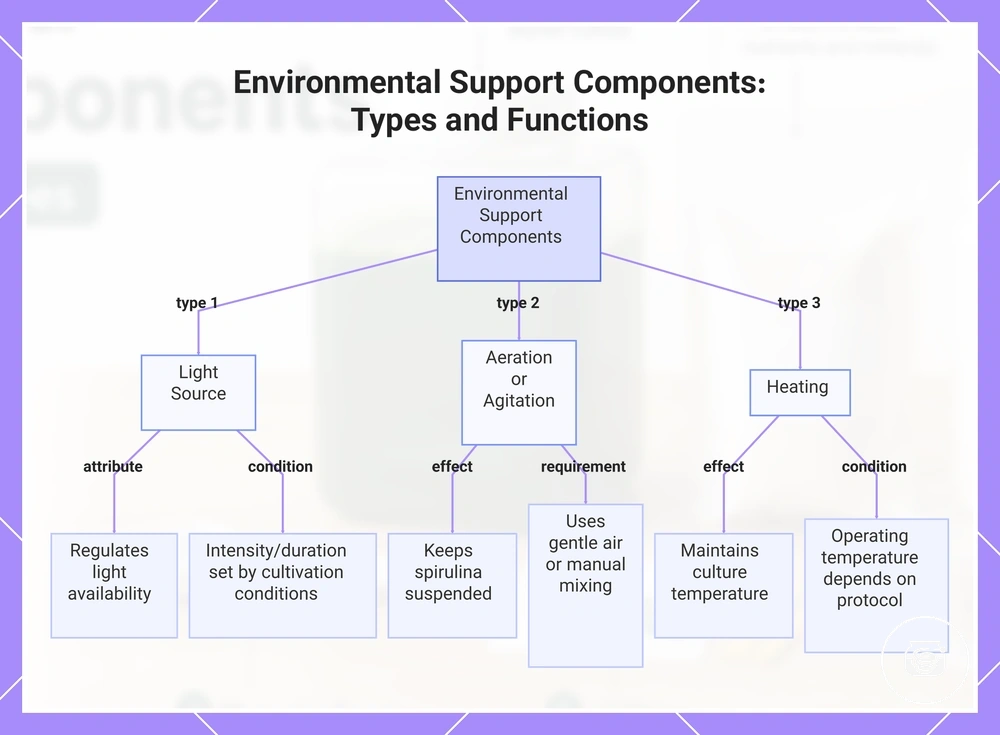
Environmental support components are kit parts that regulate the conditions surrounding a spirulina culture rather than supplying the culture itself. Their functions fall into three categories: a light source controls light availability, aeration or agitation controls culture movement, and heating controls the surrounding temperature. These components support culture stability by maintaining environmental conditions, but they do not replace the biological starter culture or the chemical growth medium.
Each environmental support component regulates one primary attribute that contributes to culture stability under suitable operating conditions.
Each environmental support component regulates one primary attribute that contributes to culture stability under suitable operating conditions.
- Light source → Light availability → Culture stability: Artificial or natural light provides the energy required for photosynthesis when available daylight is insufficient. The required light intensity and operating duration are determined by the cultivation conditions rather than by the kit component itself.
- Aeration or agitation → Culture movement → Culture stability: Gentle air circulation or manual mixing keeps spirulina suspended, helping distribute cells throughout the culture and reducing stagnant areas inside the vessel.
- Heating → Temperature → Culture stability: A heating device helps maintain the surrounding culture temperature when the growing environment is cooler than the intended cultivation conditions. The appropriate operating temperature depends on the cultivation protocol and is not defined by the environmental support component alone.
For example, a home spirulina culture placed in a room with insufficient daylight may require an artificial light source, while the same culture in a cooler room may also require heating support to maintain stable environmental conditions. These tools regulate environmental attributes around the culture rather than changing the biological or chemical components supplied with the kit.
These tools regulate environmental attributes around the culture rather than changing the biological or chemical components supplied with the kit.
Specific condition targets, operating ranges, and daily management procedures belong in the dedicated water, light, and temperature needs guide rather than this overview of environmental support components.
This chart illustrates the three types of environmental support components, each regulating a key attribute for spirulina culture stability.
This chart illustrates the three types of environmental support components, each regulating a key attribute for spirulina culture stability.
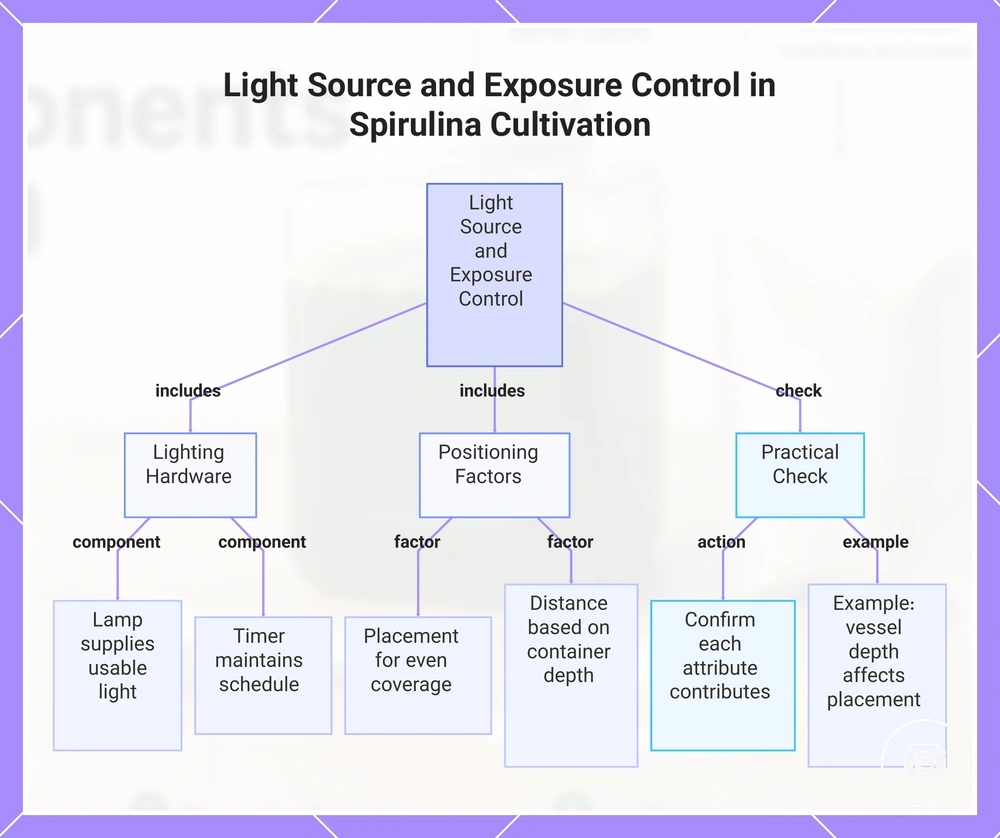
Light Source and Exposure Control
Light source is the support component that provides usable light exposure for a spirulina culture when natural daylight alone does not provide sufficient illumination. Its primary exposure-control attributes are the lamp, timer, placement, and distance, while the reviewed evidence does not identify one universal lighting duration or lamp-to-container distance because suitable exposure depends on the container, culture density, and growing environment. This component regulates light availability rather than guaranteeing a specific growth rate or harvest outcome.
This component regulates light availability rather than guaranteeing a specific growth rate or harvest outcome.
A practical exposure-control check should confirm that each light-support attribute contributes to usable illumination under the selected growing conditions.
- Lamp: Supplies usable light when ambient daylight is insufficient for the culture.
- Timer: Maintains a repeatable lighting schedule when artificial lighting is used, although the reviewed evidence does not specify a universal operating duration.
- Placement: Position the lamp so light reaches the culture surface as evenly as practical instead of concentrating illumination on one area of the vessel.
- Distance: Keep the lamp at a suitable separation for the container size and culture density because moving the light closer increases the light reaching the culture, while moving it farther away reduces usable light; the reviewed evidence does not define one universal distance.
For example, two transparent vessels containing the same illustrative 5 L culture may require different lamp placement if one vessel is shallow and the other is deeper, because culture depth changes how much usable light reaches suspended cells. The equal culture volume in this hypothetical comparison highlights the effect of placement and distance rather than recommending a fixed lighting specification.
This chart shows the definition, key attributes, and practical check for light source and exposure control in spirulina culture.
This chart shows the definition, key attributes, and practical check for light source and exposure control in spirulina culture.
Aeration, Agitation, and Water Movement
Aeration, agitation, and other forms of water movement support circulation within a spirulina culture, helping distribute the medium, improve nutrient distribution and gas exchange, and reduce stagnant zones. A pump with a diffuser provides powered circulation, while manual stirring provides intermittent movement; the reviewed evidence does not establish one circulation method or operating schedule for every kit because the required movement depends on vessel size, culture density, and kit design.
- Pump: Produces continuous powered circulation when the kit design includes an aeration system.
- Diffuser: Spreads incoming air through multiple bubbles, distributing movement across more of the vessel than a single open airline.
- Manual stirring: Produces temporary agitation during each stirring event and is therefore intermittent rather than continuous.
- Agitation: Keeps suspended culture and dissolved nutrients moving, which supports more even culture consistency and limits stagnant areas.
For example, two hypothetical 5 L cultures can have the same water volume but different circulation conditions: a pump-driven vessel receives continuous movement, whereas a manually stirred vessel moves only when stirred. This comparison explains the functional difference between powered and manual movement without treating either method as mandatory for every spirulina growing kit.
Heating and Temperature Support
Heating support uses a heater and thermometer to keep a spirulina culture within a usable temperature range when room temperature is too cool or unstable. A 2023 study published in Water identified 30–35 °C as a key growth range for the tested Spirulina platensis culture, but that research value is specific to its strain and conditions rather than a fixed setting for every home kit; the heater supplies warmth, while the thermometer verifies the measured culture temperature and helps limit temperature-related culture stress.
- Heater: Adds heat when the measured culture temperature is below the range specified for the selected culture and kit configuration.
- Thermometer: Provides the measured temperature used to determine whether heating is needed and whether the culture is approaching its intended range.
- Room temperature: Acts as the surrounding condition; a cooler room increases heat loss, while a stable room reduces the amount of temperature correction required.
- Stability: Keeping the measured temperature within the applicable culture range reduces repeated cooling and reheating, while unmonitored heating can create excessive warming.
For example, if a culture measures an illustrative 24 °C and its strain-specific instructions specify 30 °C, the calculated temperature gap is 6 °C. Heating support would be used to reduce that gap while the thermometer confirms the result; this hypothetical calculation explains component function rather than prescribing a heater setting or predicting growth.
Monitoring Tools for Culture Condition
Monitoring tools are kit components that connect a measured attribute to an interpretation and a practical next decision about the spirulina culture. The core tools are pH strips or a pH meter for acidity or alkalinity, a thermometer for culture temperature, and concentration checks for changes in apparent culture density; the reviewed evidence does not establish one target range or concentration threshold for every home kit, so each reading must be compared with the instructions for the specific culture and method.
Each monitoring tool supports condition assessment rather than an exact diagnosis.
Each monitoring tool supports condition assessment rather than an exact diagnosis.
| Monitoring tool | Measured attribute | Interpretation | Next decision |
|---|---|---|---|
| pH strips or pH meter | Culture pH | Determine whether the reading is inside, below, or above the range specified for the selected culture. | Continue routine monitoring when the reading is within range, or review the culture instructions before making an adjustment when it is outside range. |
| Thermometer | Culture temperature in °C | Compare the measured temperature with the operating range specified for the culture and vessel setup. | Maintain the current environment when the reading is within range, or assess heating and room conditions when it is outside range. |
| Concentration checks | Relative or instrument-measured culture concentration | Compare the current result with earlier readings taken by the same method under similar conditions. | Continue observation when the trend is stable, or review culture management when the result changes unexpectedly. |
For example, suppose a thermometer records an illustrative 28 °C on day one and 25 °C on day two while the pH reading remains unchanged; the measured temperature difference is 3 °C, so the next decision is to review room temperature or heating support before changing the culture medium. This hypothetical comparison shows how monitoring tools narrow the next check, but the readings do not confirm contamination, identify a single cause, or replace maintenance and troubleshooting guidance.
pH Testing Tools
pH testing tools check the alkalinity of the culture medium by converting a sample into either a colour-matched range from a strip or a numerical value from a calibrated meter. Confidence in the result depends on the tool's supported reading range, stated accuracy or scale interval, calibration condition, and repeatability; the reviewed evidence does not establish one specification that applies to every strip or meter.
- Strip → Reading range → Medium condition: A pH strip is limited to the values and colour intervals printed on its supplied scale, so it indicates a bounded pH range rather than an exact measurement.
- Meter → Numerical reading → Measurement reliability: A calibrated meter provides a specific pH value, but its interpretation must remain within the model's stated range and accuracy specification.
- Repeated test → Repeatability → Interpretation confidence: Results taken with the same tool, sample method, and similar conditions provide a more useful trend than isolated readings taken with different procedures.
For example, suppose the same meter records illustrative readings of 10.1 and 10.2 under similar sampling conditions; the calculated difference is 0.1 pH unit. That change should be compared with the meter's stated accuracy and repeated before it is treated as evidence of a changed medium condition, while interpretation should also consider the medium formulation, source water, and visible culture condition rather than using one reading as a complete diagnosis.
Temperature and Concentration Checks
Temperature check and concentration check methods provide separate condition signals for assessing a spirulina culture without diagnosing the cause of a change. A thermometer gives a numerical temperature reading in degrees Celsius, while a visual density check gives a relative concentration comparison only when the vessel, lighting, sample depth, and viewing method remain consistent.
- Thermometer → Temperature → Condition signal → Practical decision: Compare the measured temperature with the operating range specified for the selected culture and kit, then review room conditions or heating support when the reading falls outside that range.
- Visual-density tool → Apparent concentration → Condition signal → Practical decision: Compare the current colour or light transmission with an earlier reading taken by the same method; a darker sample indicates greater apparent density, while a lighter sample indicates reduced apparent density.
- Combined checks → Wider context → Interpretation: Use temperature and density together with the medium, water, odour, colour pattern, and visible culture condition before changing the setup.
For example, suppose a thermometer records an illustrative 28 °C on one day and 26 °C on the next while the visual-density result remains unchanged; the calculated difference is 2 °C. This hypothetical pattern supports a practical decision to review the surrounding temperature and repeat both checks, but it does not prove culture safety, identify a growth problem, or confirm harvest readiness.
Harvesting and Handling Components
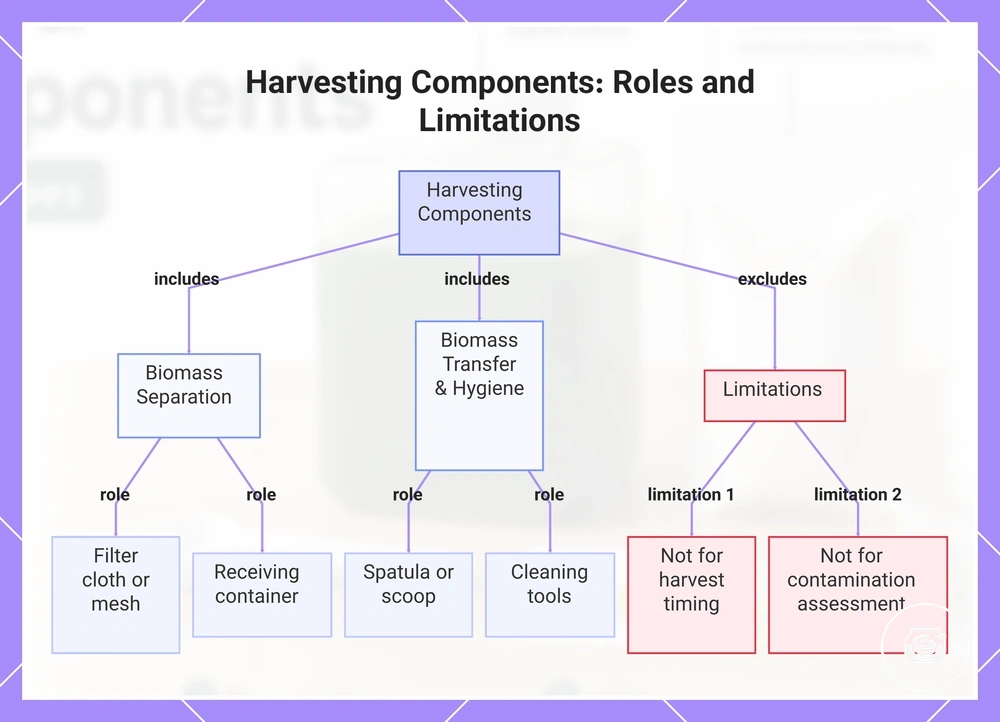
Harvesting components are the kit tools used after a spirulina culture has produced enough biomass for separation, supporting filtration and clean handling rather than determining harvest readiness. Their primary attribute is controlled contact with the culture through a filter cloth or mesh, receiving container, spatula, and cleaning tools, each performing a separate handling role that reduces unnecessary transfers during biomass collection. The reviewed evidence does not identify one universal mesh size or harvesting-tool specification for all spirulina growing kits.
- Filter cloth or mesh → Contact role → Filtration: Retains spirulina biomass while allowing the culture liquid to pass through, supporting biomass separation during harvesting.
- Receiving container → Contact role → Usability: Collects filtered biomass or drained culture liquid, reducing additional transfers between containers during handling.
- Spatula or scoop → Contact role → Clean handling: Moves harvested spirulina from the filter surface into the receiving container with controlled contact, helping minimise unnecessary disturbance of the biomass.
- Cleaning tools → Contact role → Hygiene: Remove residue from reusable harvesting components before the next harvesting cycle, supporting cleaner filtration equipment without guaranteeing sterility.
For example, suppose an illustrative 2 L spirulina culture is poured through a 100 µm mesh into a receiving container before the retained biomass is transferred with a spatula. This hypothetical numerical example demonstrates the separate contact role of each harvesting component and explains the filtration sequence only; it does not represent a recommended universal mesh specification or harvesting method. Harvest timing and contamination assessment require separate evaluation because harvesting components alone cannot confirm when a culture is ready for collection or whether it remains free from contamination.
This chart shows the main harvesting components used in spirulina cultivation, their handling roles, and what they do not determine.
This chart shows the main harvesting components used in spirulina cultivation, their handling roles, and what they do not determine.
Harvest Filter, Mesh, or Cloth
Harvest filter is the component that separates spirulina biomass from culture liquid during harvest. Its key selection attributes are mesh fineness, material, flow behavior, and cleaning need; the reviewed evidence does not establish one micron rating or material that applies to every kit because separation performance changes with the filter design, culture condition, and harvesting method.
Harvest filter is the component that separates spirulina biomass from culture liquid during harvest.
A finer mesh, cloth, or screen retains smaller suspended particles but usually slows liquid flow, while a coarser filter allows faster drainage with less fine-particle retention. Woven cloth offers a flexible filtration surface, whereas a rigid or semi-rigid screen provides a fixed opening pattern and easier shape control during handling; either material requires cleaning after use because retained biomass can restrict later flow. For example, an illustrative 100 µm filter processing the same 2 L culture would be expected to drain more slowly than a 250 µm filter while retaining more fine biomass, but these hypothetical values explain the fineness-to-flow relationship rather than prescribing a kit specification.
Clean Handling Tools After Filtration
Clean handling tools reduce avoidable contamination risk after filtration by limiting the harvested spirulina culture to clean contact surfaces during transfer. Their function is supportive rather than protective because clean handling lowers the opportunity for unwanted contamination but does not guarantee culture safety or hygiene.
- Receiving container → Cleanliness attribute → Handling outcome: Use a visibly clean receiving container so harvested spirulina contacts only a clean interior surface during collection.
- Spoon or spatula → Cleanliness attribute → Handling outcome: Use a clean spoon or spatula dedicated to harvesting to reduce unnecessary contact with additional utensils before transfer is complete.
- Rinse method → Cleanliness attribute → Risk reduction: Rinse reusable handling tools according to the kit or manufacturer's cleaning instructions before reuse because removing visible residue helps reduce avoidable contamination risk. The reviewed evidence does not specify one universal rinse agent, temperature, or procedure.
- Storage-contact tool → Cleanliness attribute → Practical outcome: Use one clean contact tool for the final transfer into the next container so the harvested culture touches fewer handling surfaces.
For example, suppose an illustrative harvest is transferred using one clean spatula directly into one clean receiving container, creating two contact surfaces. A second workflow using three separate utensils before collection creates four contact surfaces. This hypothetical comparison shows how reducing contact points can lower avoidable contamination risk through simpler handling, but it does not establish a food-safety guarantee or confirm culture quality.
Essential and Optional Spirulina Kit Parts
Essential parts are the components needed to start culture under the selected kit design and growing context, while optional parts add control, convenience, or precision. A live culture, compatible growth medium, suitable vessel, and usable instructions normally form the starting group; lighting, heating, aeration, monitoring, and harvesting accessories become conditionally essential when the environment or manual routine cannot provide the same function.
For beginner home use, manual mixing and simple observation can keep some accessories optional when the vessel is manageable and room conditions remain suitable.
For beginner home use, manual mixing and simple observation can keep some accessories optional when the vessel is manageable and room conditions remain suitable. Larger vessels increase the value of powered circulation and easier harvesting tools, while tighter monitoring needs increase the value of a thermometer, pH tool, timer, or concentration check because each tool replaces estimation with a repeatable observation.
| Kit part | Essentiality condition | Reason | Effect |
|---|---|---|---|
| Live spirulina culture | Essential for every new culture start | Supplies the living starter material | Enables the culture to begin |
| Growth medium or nutrients | Essential unless already supplied in prepared culture water | Provides the chemical environment required by the starter culture | Supports culture establishment |
| Culture vessel | Essential when no suitable container is already available | Holds the culture at the intended working volume | Provides the physical growing space |
| Light source | Conditionally essential when ambient light does not meet the kit instructions | Replaces insufficient environmental light | Improves light control |
| Aeration or agitation support | Optional for manageable cultures with reliable manual mixing; conditionally essential for larger vessels or reduced manual control | Maintains regular culture movement | Improves circulation convenience and consistency |
| Heater and thermometer | Conditionally essential when room conditions cannot maintain or verify the intended temperature | Adds temperature support and measurement | Improves environmental control and precision |
| pH strips or pH meter | Optional for a basic start; more important when repeated alkalinity checks are required | Provides a range estimate or numerical pH reading | Improves monitoring precision |
| Harvest filter and handling tools | Optional during initial growth; essential when biomass is harvested | Separates and transfers collected biomass | Supports filtration and handling convenience |
These categories describe functional conditions rather than a fixed checklist, so an accessory can shift from optional to essential when culture scale, room conditions, or tolerance for manual control changes. Readers evaluating complete configurations for different experience levels and support needs can compare kit types.
Minimum Parts Needed to Start a Culture
Minimum parts for starting a spirulina culture are a viable culture, a suitable medium, a vessel, water, sufficient light support for the growing environment, and basic monitoring or handling appropriate to the kit. This checklist confirms start-readiness rather than product completeness because the required components depend on the kit design, culture scale, and whether one item combines multiple functions.
The checklist below verifies that every required function is available before cultivation begins.
The checklist below verifies that every required function is available before cultivation begins.
- Viable culture → Required function: Provides the living spirulina cells needed to establish a culture. Missing-part risk: Without a viable culture, cultivation cannot begin.
- Suitable medium → Required function: Supplies the nutrients and chemical environment required by the culture. Missing-part risk: The culture lacks the conditions needed for establishment.
- Vessel → Required function: Holds the culture and medium throughout cultivation. Missing-part risk: The culture cannot be maintained under stable growing conditions.
- Water → Required function: Forms the liquid environment used to prepare the medium according to the kit instructions. Missing-part risk: The culture system cannot be assembled.
- Light support → Required function: Provides usable illumination when natural light does not satisfy the kit's growing conditions. Missing-part risk: The culture may not receive sufficient light for the intended setup.
- Basic monitoring or handling → Required function: Supports routine observation, temperature checking, stirring, or harvesting appropriate to the starter kit. Missing-part risk: Important culture conditions cannot be checked or managed consistently.
For example, a hypothetical 5 L starter culture containing a viable culture, suitable medium, vessel, and water still requires artificial light if the growing location does not provide adequate natural illumination. A bundled starter kit that includes pre-mixed medium inside the culture container performs two functions with one component while meeting the same start-readiness criteria.
Optional Parts That Improve Control or Convenience
Optional parts are upgrades that add monitoring precision, handling ease, environmental control, or convenience without changing the basic definition of a spirulina kit. Their value is conditional: accessories become more useful as setup variability, culture volume, or the user's tolerance for manual checks increases, but they do not guarantee better growth or justify every added cost.
| Optional part | Added attribute | Practical effect | Selection condition |
|---|---|---|---|
| pH meter | Numerical monitoring precision | Replaces colour-based estimation with a repeatable pH reading. | Useful when the user wants tighter comparison between checks. |
| Digital thermometer | Measured temperature control | Shows the culture temperature directly instead of relying on room-temperature assumptions. | Useful in indoor setups with changing daily temperatures. |
| Light timer | Repeatable lighting control | Reduces the need to switch artificial lighting manually. | Useful where daylight or user schedules are inconsistent. |
| Air pump and diffuser | Continuous culture movement | Reduces repeated manual stirring and improves handling convenience. | Useful for larger vessels or users with limited time for manual mixing. |
| Filter stand or vessel support | Handling stability | Reduces unnecessary movement during filtration and transfer. | Useful when harvest volume or handling difficulty increases. |
For example, a beginner managing a hypothetical 5 L compact indoor culture may accept manual stirring and visual checks, while a hypothetical 20 L setup may justify a timer, pump, and digital monitoring because repeated manual control becomes less convenient. These figures illustrate selection logic rather than required kit specifications; users comparing different combinations can compare kit types according to their growing context.