Indoor Spirulina Growing Kit Suitability for Home Use
An indoor spirulina growing kit is suitable for home use only when the household can keep its light, temperature, water chemistry, space, and maintenance conditions within the kit or culture supplier’s stated limits. This conditional fit supports culture stability, but it does not establish a harvest quantity or guarantee that every indoor location will work.
This conditional fit supports culture stability, but it does not establish a harvest quantity or guarantee that every indoor location will work.
Indoor suitability means that the room, container position, culture medium, and maintenance access can collectively support controlled cultivation. The Food and Agriculture Organization of the United Nations reports that spirulina production is favoured by alkaline water at pH 8.5–11.0, while a published laboratory study of Arthrospira platensis maintained its test cultures at 30 °C with a 12-hour light and 12-hour dark cycle, a light intensity of 140 µmol photons m−2 s−1, and continuous aeration. These figures describe documented cultivation conditions rather than universal settings for every home spirulina culture kit, so indoor suitability must be separated from setup instructions and yield expectations.
Indoor suitability means that the room, container position, culture medium, and maintenance access can collectively support controlled cultivation.
In an apartment or small home, a compact spirulina growing kit is a practical compatibility candidate when a stable shelf or bench can hold the container, the culture remains accessible for observation and maintenance, and the selected position allows the required environmental controls. A location that forces frequent container movement, restricts maintenance access, or cannot hold the supplier-specified conditions presents a suitability limitation even when the kit itself fits the available shelf space. The first feasibility check is therefore whether the indoor location can sustain the required conditions consistently, not simply whether the container can be placed there.
Table of Contents
Can Spirulina Growing Kits Work Indoors?
Yes, spirulina growing kits can work indoors when the growing environment provides controlled light, stable warmth, an alkaline culture medium, and regular maintenance access. Indoor feasibility depends on maintaining these controllable conditions rather than on the room itself, so an indoor location is suitable only if it can consistently support culture stability.
Indoor feasibility means an indoor room can provide the environmental conditions needed for spirulina cultivation throughout the growing period.
Indoor feasibility means an indoor room can provide the environmental conditions needed for spirulina cultivation throughout the growing period. According to the Food and Agriculture Organization of the United Nations (FAO), commercial spirulina cultivation is carried out in alkaline water, typically within a pH range of about 8.5–11.0. Laboratory research published on Arthrospira platensis also demonstrates successful cultivation under controlled indoor conditions using a temperature of approximately 30 °C and a 12-hour light/12-hour dark cycle. These published values describe proven cultivation conditions rather than guaranteed settings for every home kit, while easy maintenance access remains necessary for ongoing culture monitoring.
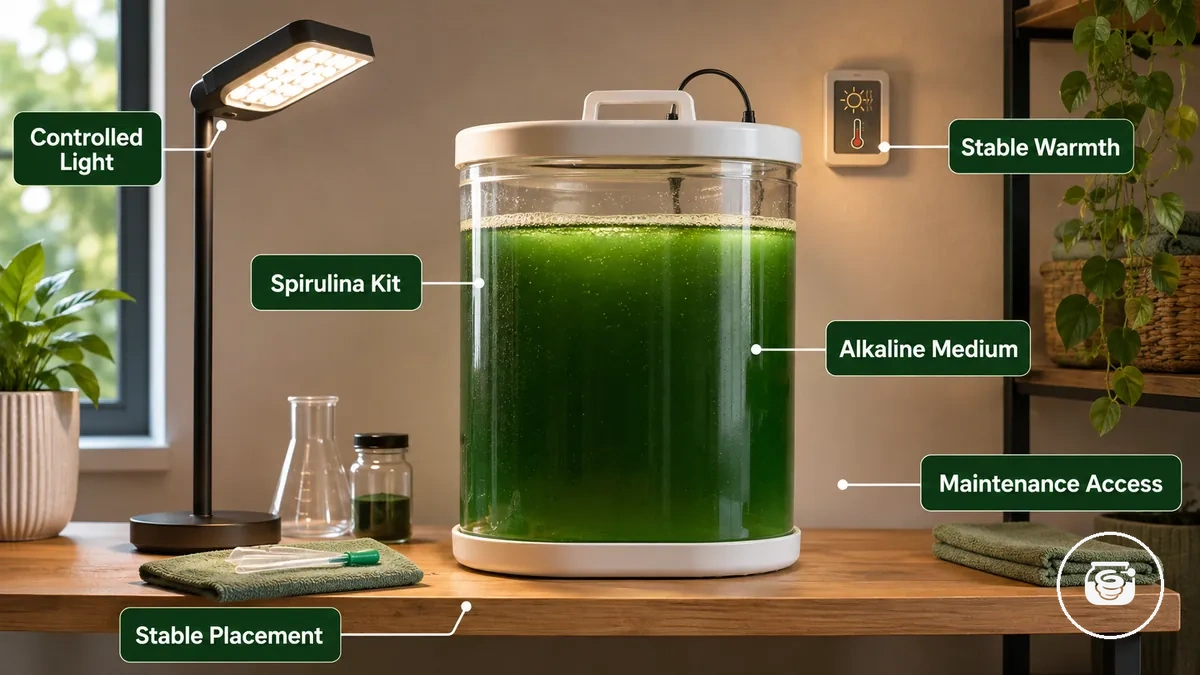
- Controlled light: Use a consistent indoor light source because spirulina depends on regular illumination rather than occasional window light.
- Stable warmth: Maintain a warm environment without frequent temperature fluctuations that can stress the culture.
- Alkaline medium: Keep the culture medium within the alkaline conditions specified for spirulina cultivation.
- Stable placement: Place the kit container on a secure surface where it can remain undisturbed.
- Maintenance access: Ensure the culture is easy to inspect, clean, and monitor throughout its growth cycle.
- Realistic expectations: Indoor feasibility confirms that cultivation is possible under controlled conditions but does not predict harvest quantity or guarantee successful growth.
A practical example is a compact indoor spirulina kit positioned on a stable shelf with consistent lighting and unobstructed access for daily observation, which satisfies the environmental conditions more effectively than a container that must be moved frequently. Readers exploring the broader category of home spirulina growing kits can use this overview to determine whether indoor cultivation is feasible before comparing individual kit features. This section evaluates indoor suitability only and does not cover kit selection, setup procedures, or expected harvest results.
Indoor Conditions That Decide Spirulina Kit Suitability
An indoor spirulina growing kit is suitable for home use only when the indoor conditions can consistently support a stable culture. The main compatibility variables are light, temperature, water chemistry, culture medium, and container access, and each condition should remain compatible with the kit design and the room where it will operate rather than meeting one universal specification. The table below shows how each condition affects culture stability and the overall buying decision.
The table below shows how each condition affects culture stability and the overall buying decision.
One weak indoor condition can reduce kit suitability even if the remaining conditions are acceptable because spirulina culture depends on the combined growing environment rather than on a single factor. According to the Food and Agriculture Organization (FAO), commercial spirulina cultivation is typically carried out in alkaline water with a pH of approximately 8.5–11.0, while laboratory studies on Arthrospira platensis commonly report cultivation at around 30 °C under controlled lighting conditions. These published values describe proven cultivation environments rather than mandatory home settings, so every compatibility variable should be evaluated together before choosing a kit.
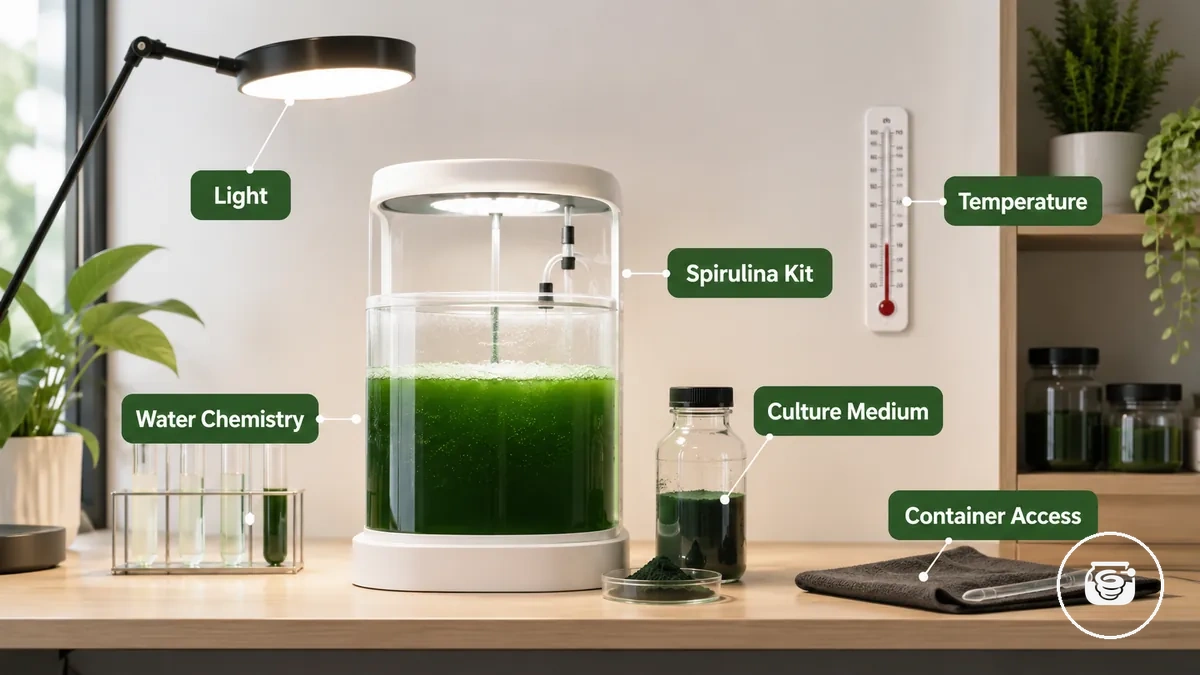
| Condition | What to check | Risk if weak | Decision signal |
|---|---|---|---|
| Light | Consistent indoor illumination that matches the kit's recommended growing method | Reduced culture stability and slower growth | Manageable when reliable natural or artificial lighting is available |
| Temperature | Room can maintain stable warm growing conditions appropriate for the kit | Culture stress caused by repeated temperature fluctuations | Difficult when room temperatures change substantially throughout the day |
| Water chemistry | Alkaline water chemistry can be prepared and maintained | Culture becomes chemically unstable | Suitable only when alkaline conditions can be maintained consistently |
| Culture medium | Required nutrient medium is available and can be replenished when needed | Reduced culture performance over time | Manageable when replacement medium is practical to obtain |
| Container access | Container remains easy to inspect and maintain without frequent relocation | Delayed detection of developing culture problems | Suitable when routine observation is convenient |
For example, a home that can maintain alkaline water within the FAO-referenced pH range of 8.5–11.0, provide a stable indoor temperature close to the 30 °C commonly used in laboratory cultivation, and keep the culture container permanently accessible presents manageable compatibility constraints. By comparison, a room with frequent temperature swings, inconsistent lighting, and difficult container access creates multiple decision risks even when one or two conditions are satisfactory.
Kit suitability depends on whether the complete indoor environment can maintain compatible growing conditions instead of relying on one favourable factor alone.
Kit suitability depends on whether the complete indoor environment can maintain compatible growing conditions instead of relying on one favourable factor alone. Before making a buying decision, review the detailed indoor growing conditions to determine whether your home can consistently support a stable spirulina culture.
Light Exposure, Temperature Stability, and Overheating Risk
Light exposure and temperature stability determine whether an indoor spirulina culture can remain stable because the culture needs consistent illumination without excessive heat buildup around the container. According to laboratory studies on Arthrospira platensis, controlled cultivation has been performed at approximately 30 °C under artificial lighting, but those conditions describe research environments rather than a universal requirement for every home kit. Insufficient light can slow culture activity, while excessive light or poorly positioned lighting can increase overheating risk by raising the temperature immediately around the culture container.
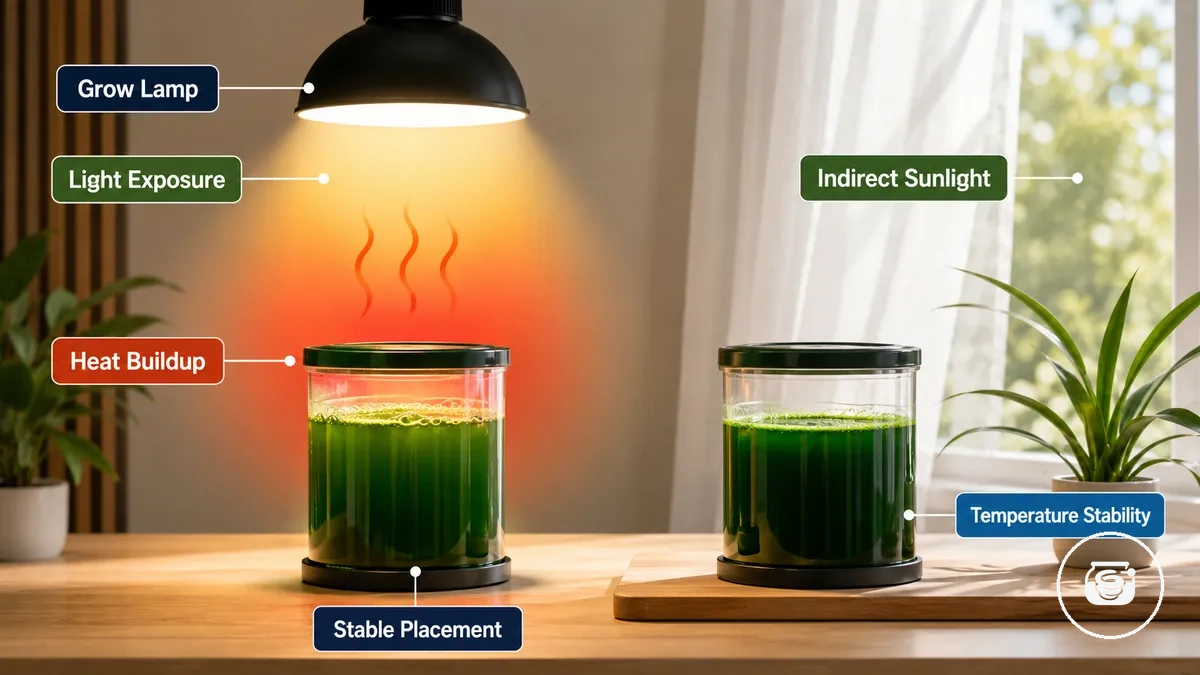
For example, a container placed in indirect sunlight may receive steady illumination with less direct heat than one positioned beneath an improperly placed grow lamp. A grow lamp can provide more consistent light exposure, but inadequate spacing or restricted airflow can increase heat buildup and reduce temperature stability around the culture. Maintaining placement stability on a secure indoor surface helps keep lighting and room conditions consistent, although the appropriate light source and positioning remain conditional on the kit design and the surrounding room environment.
Water, pH, Nutrients, and Culture Medium Control
Water chemistry and culture medium control are essential compatibility controls because an indoor spirulina culture remains stable only when water quality, alkalinity, and nutrient availability can be maintained together. According to the Food and Agriculture Organization (FAO), commercial spirulina cultivation is typically carried out in alkaline media with a pH range of approximately 8.5–11.0, while nutrient balance must be maintained throughout cultivation rather than established once at the beginning. Indoor suitability therefore depends on maintaining both pH and nutrient balance under monitored conditions rather than relying on a fixed preparation method.
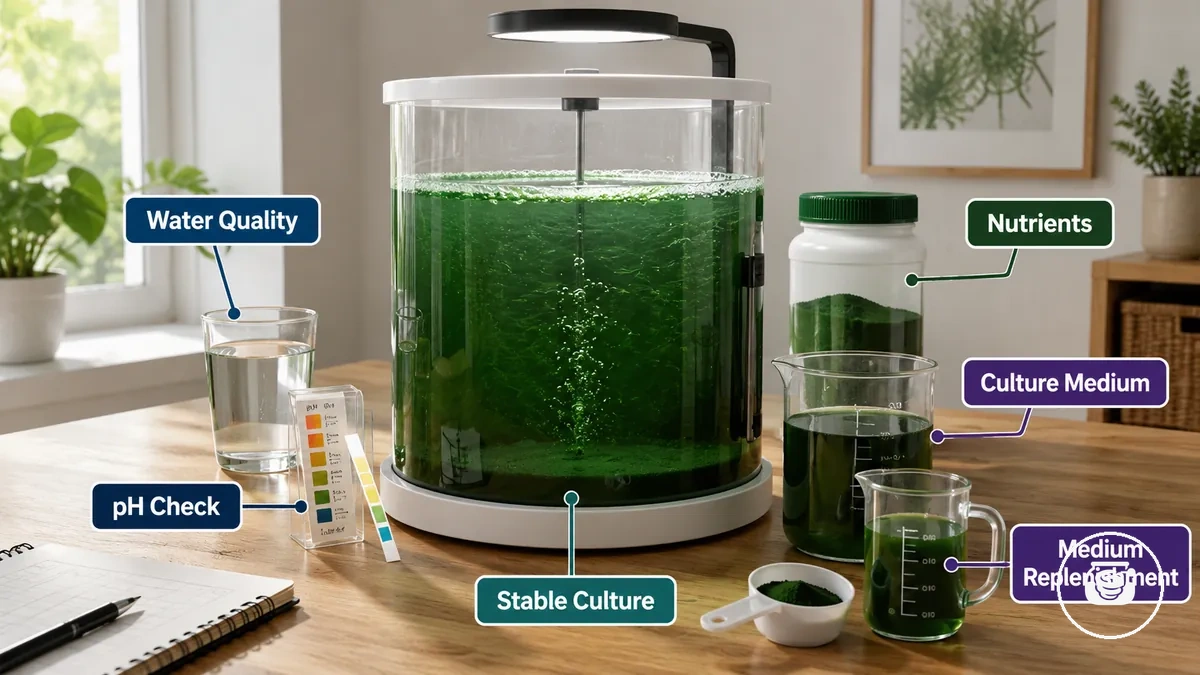
For example, a grower maintaining the culture medium within the FAO-referenced alkaline range of pH 8.5–11.0 while replacing nutrients only when routine monitoring indicates depletion is more likely to preserve a stable culture than someone treating the system as maintenance-free. This comparison illustrates that medium replenishment is a condition-based monitoring decision instead of a universal schedule. The section explains the chemistry control points only and does not provide a complete culture-medium recipe or contamination protocol.
This comparison illustrates that medium replenishment is a condition-based monitoring decision instead of a universal schedule.
Water, pH, nutrients, and culture medium should be evaluated together because each control point influences indoor culture stability.
- Water quality: Confirm that the selected water source is appropriate for the intended culture medium because unsuitable water chemistry can affect growing conditions.
- pH awareness: Monitor whether the grow medium remains within the alkaline range used for spirulina cultivation instead of assuming that pH remains constant.
- Nutrients: Maintain nutrient balance because nutrient depletion can reduce culture stability even when water appearance does not visibly change.
- Culture medium: Observe the condition of the grow medium regularly rather than relying on a fixed preparation or replacement routine.
- Medium replenishment: Use routine monitoring as the decision cue for replenishment because no universal replacement interval applies to every indoor spirulina growing kit.
Space, Container Shape, and Culture Depth for Small Homes
A small home or apartment can be suitable for an indoor spirulina growing kit when there is enough usable surface space for the container and sufficient maintenance access around it. Practical fit depends on the available shelf footprint, container shape, and culture depth rather than total room size because manufacturers do not specify a universal minimum floor area or shelf dimension for all indoor spirulina kits. The key decision is therefore whether the intended location provides accessible usable space instead of simply fitting the container onto a shelf.
The key decision is therefore whether the intended location provides accessible usable space instead of simply fitting the container onto a shelf.
Problem to solution: A container that fits the available shelf or bench while leaving space for observation, stirring, or aeration is generally easier to maintain than one that occupies the entire usable surface. A transparent container with a relatively shallow depth can improve visibility and light penetration, while a wider container footprint may require more bench space even if the total culture volume is unchanged. For example, a compact apartment shelf that supports the container while leaving clear access on at least one side for routine maintenance is a more practical placement than a shelf where the container must be removed for every inspection. Because kit dimensions differ by manufacturer, no universal footprint or container-width specification can be verified for all indoor spirulina growing kits.
Evaluate the fit using usable surface area and accessibility rather than assuming every compact container is suitable for every small home.
Direct answer: Space is generally manageable when the selected location supports the container securely, provides practical maintenance access, accommodates the chosen container shape and culture depth, and has nearby light or power if required by the kit. Evaluate the fit using usable surface area and accessibility rather than assuming every compact container is suitable for every small home.
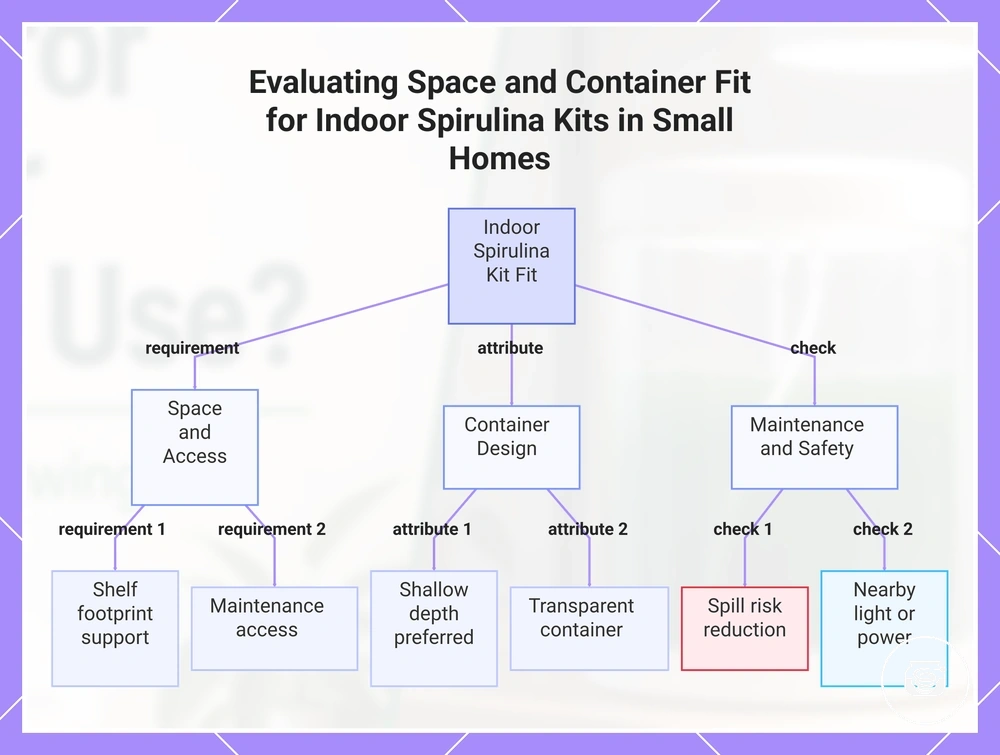
- Shelf footprint: Confirm that the shelf or bench supports the container while leaving usable working space around it.
- Container stability: Place the container on a stable surface to reduce movement during routine maintenance.
- Culture depth: Prefer a relatively shallow depth when it improves visibility and practical access without relying on a universal container design.
- Transparency: Use a transparent container so the culture remains easy to observe during routine checks.
- Spill risk: Leave sufficient surrounding space to reduce accidental spills while stirring or aerating the culture.
- Maintenance access: Ensure the container can be reached comfortably for observation and routine care without frequent repositioning.
- Nearby light or power: Verify that the intended placement can accommodate the required lighting or powered accessories without creating unnecessary cable routing or repeated relocation.
This chart shows the key factors to check when determining if a small home can accommodate an indoor spirulina growing kit, focusing on space, container design, and maintenance access.
Shallow Containers and Light Penetration
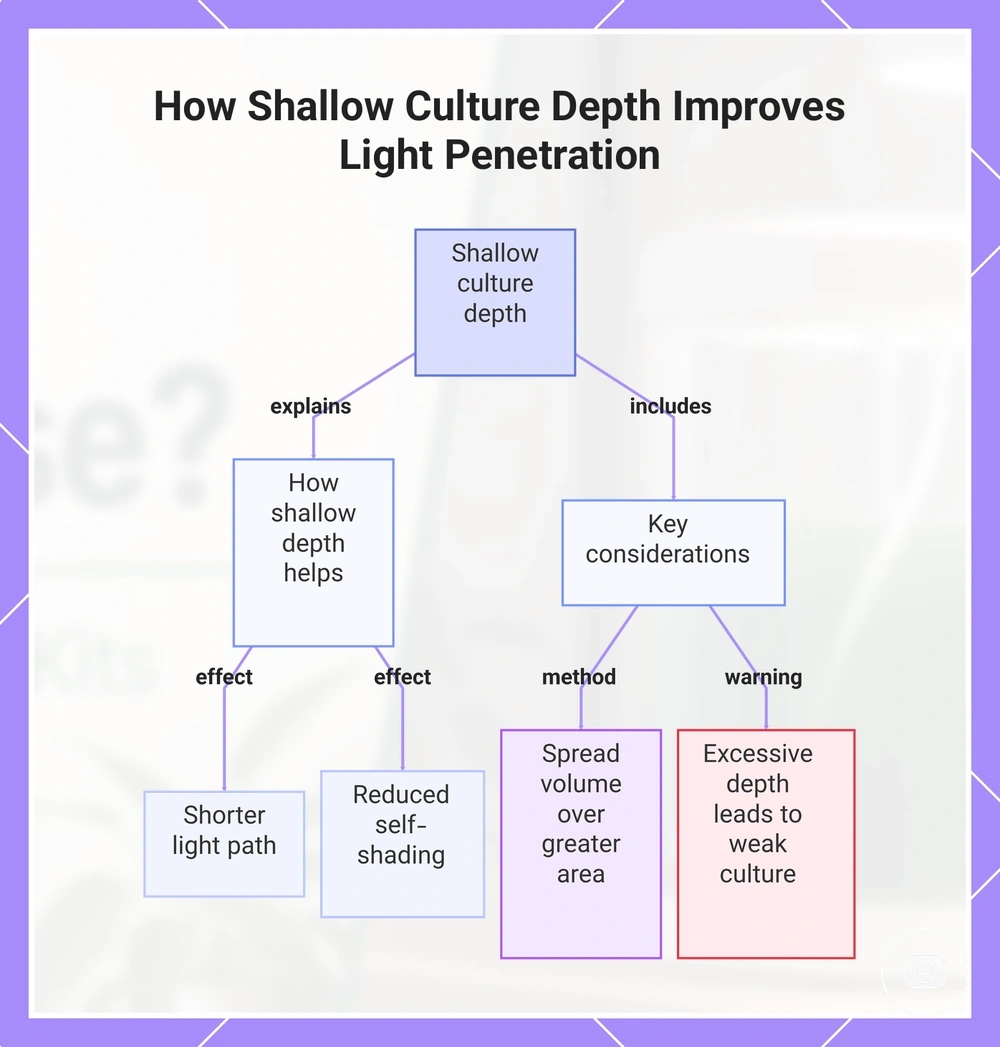
A shallow container can improve light penetration because a shorter culture depth gives light a shorter path through the spirulina suspension. Research indexed by PubMed describes how microalgal biomass absorbs incoming photons and reduces light access in inner parts of a culture through self-shading, so shallower geometry can support more even light reach while also improving culture visibility.
A shallow container can improve light penetration because a shorter culture depth gives light a shorter path through the spirulina suspension.
For example, spreading the same culture volume across greater surface area creates a shallower light path than holding it in a narrower, deeper container. A 2021 Processes study reports that large-scale Arthrospira cultivation commonly uses depths of 0.15–0.30 m because light availability affects production, but this industrial range is not a target for home kits; within the sizing decision, shallow depth offers conditional growth support, while excessive depth or dense culture can increase weak culture risk by limiting light reach.
For example, spreading the same culture volume across greater surface area creates a shallower light path than holding it in a narrower, deeper container.
This chart explains how shallow containers improve light penetration in spirulina cultivation, including the mechanism, a practical method, and a key warning.
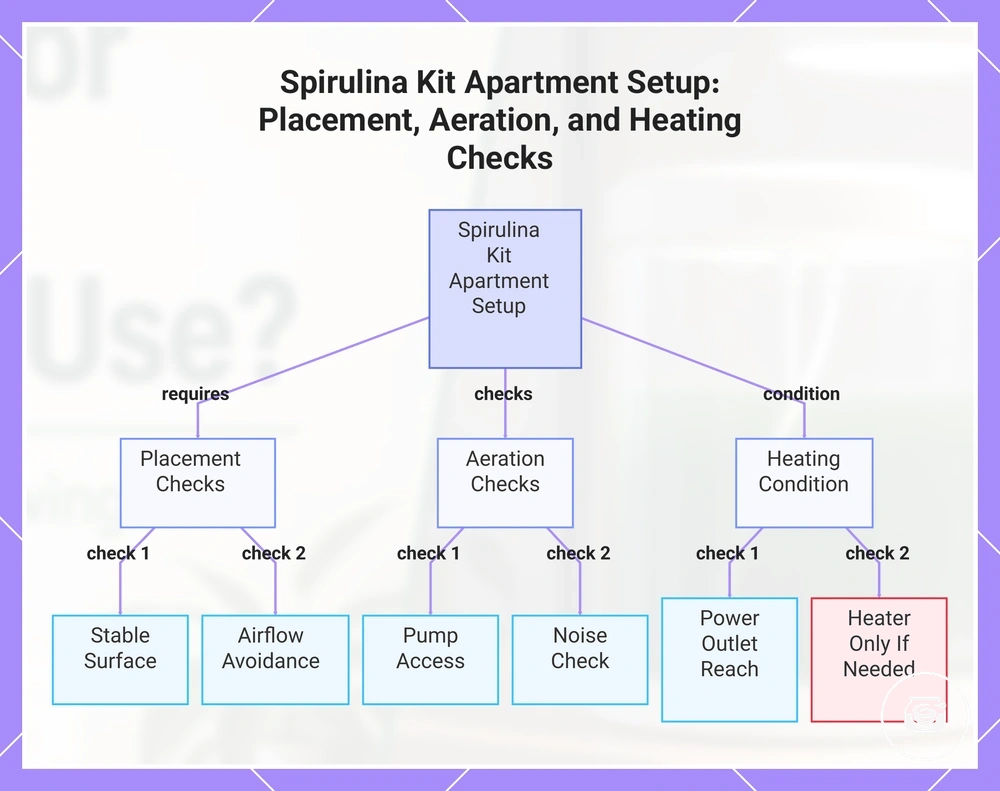
Apartment Placement, Aeration, and Optional Heating
Apartment placement is compatible with an indoor spirulina kit when the container has a stable placement, remains accessible for maintenance, and does not obstruct normal use of the room. A shelf or bench near a suitable power outlet can support optional equipment, but no universal apartment layout, pump requirement, heater requirement, or equipment-spacing value applies across all kits. The practical compatibility condition is reliable access and physical stability rather than apartment size alone.
The practical compatibility condition is reliable access and physical stability rather than apartment size alone.
Problem to solution: Aeration is condition-specific support when the selected culture system requires additional airflow, while optional heating is relevant when measured room conditions fall outside the range stated by the kit or culture supplier. Pump access, operating noise, cable routing, and outlet availability determine whether those additions remain practical in an apartment. Pumps and heaters should therefore be treated as optional equipment matched to room conditions and kit requirements, not as universal components.
- Stable placement: Use a level, secure surface that keeps the culture accessible without frequent movement.
- Airflow: Avoid tightly enclosed placement when restricted air movement could trap heat around the container or powered equipment.
- Pump access: If aeration is used, retain enough access to inspect the pump, tubing, and container connection without relocating the culture.
- Noise: Check the stated or measured output of the selected pump because no universal sound-level value applies to all apartment installations.
- Power outlet: Keep powered accessories within practical reach of an outlet without routing cables across walking or maintenance areas.
- Optional heating: Consider a heater only when room measurements fall outside the operating range specified for the selected kit or culture; a sufficiently warm room may not require one.
This chart shows the key checks for placing an indoor spirulina kit in an apartment, including placement conditions, aeration feasibility, and heating requirements.
Indoor Lighting Choices for Spirulina Kits
Indoor lighting choices determine whether spirulina kits can maintain consistent cultivation conditions by balancing light intensity, daily duration, heat risk, and placement flexibility. The practical options are natural light, indirect sunlight, and a grow lamp, each offering a different level of environmental control rather than one universally superior solution. According to the retained evidence, indoor suitability should be evaluated by consistency of illumination and heat management instead of the light source alone.
| Light option | Main advantage | Main limitation | Best-fit condition |
|---|---|---|---|
| Natural light | Uses available daylight without additional electrical equipment | Light intensity and duration change with season, weather, window orientation, and shading; direct sun can increase heat risk | Rooms with predictable daily daylight and a stable container position away from prolonged direct sun |
| Indirect sunlight | Provides diffuse daylight with lower heat exposure than direct sunlight | Light intensity may become insufficient in shaded apartments or rooms with limited window exposure | Bright indoor locations where diffuse daylight remains consistent throughout most of the day |
| Grow lamp | Provides controlled light intensity, repeatable daily duration, and greater placement flexibility | Requires electricity, suitable positioning, and monitoring because lamp placement can influence heat around the culture | Apartments or indoor spaces where natural light is inconsistent or the culture cannot remain near a suitable window |
Problem to solution: Natural light is convenient because it requires no powered lighting, but its intensity and daily duration cannot be controlled as weather, seasonal daylight length, and window orientation change. Indirect sunlight reduces concentrated heat compared with prolonged direct sun, yet heavily shaded rooms can still provide insufficient illumination for reliable culture maintenance. According to the retained evidence, selecting between these daylight options depends primarily on placement flexibility and daily lighting consistency rather than brightness alone.
This makes controlled lighting a compatibility solution rather than a universal recommendation.
Scenario: In an apartment where daylight reaches the growing area for only part of the day, a grow lamp can provide consistent artificial lighting without requiring the culture to remain beside a window. The retained evidence identifies controlled lighting as beneficial where natural light is inconsistent, but lamp-assisted setups still require appropriate positioning and routine monitoring to minimise unnecessary heat accumulation around the container. This makes controlled lighting a compatibility solution rather than a universal recommendation.
The strongest selection signal is the lighting option that consistently supports the intended container location while keeping environmental conditions stable throughout routine indoor cultivation.
Direct answer: Choose natural light when daily daylight is predictable, indirect sunlight when diffuse illumination remains consistent without excessive heat, and a grow lamp when indoor conditions require greater control over light intensity, duration, and placement flexibility. The strongest selection signal is the lighting option that consistently supports the intended container location while keeping environmental conditions stable throughout routine indoor cultivation.
Maintenance Needs for Home Spirulina Culture
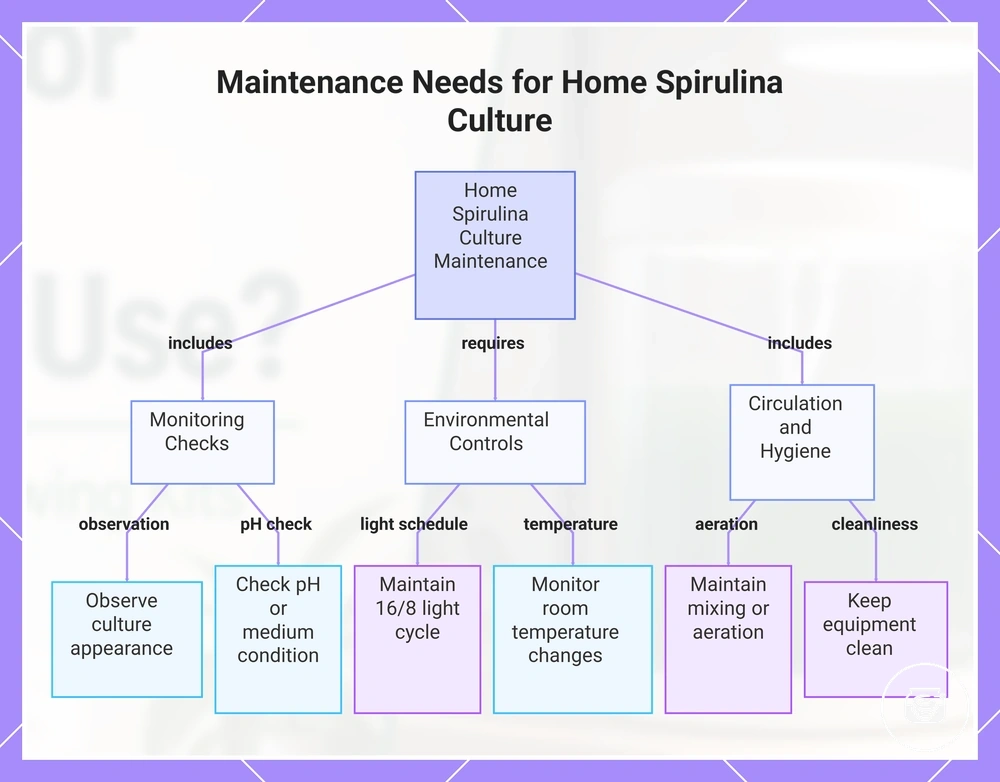
Maintenance needs are a recurring part of home spirulina culture because indoor cultivation depends on repeated condition-control tasks rather than a one-time setup. A home user should expect regular observation, mixing or aeration, light schedule monitoring, temperature awareness, pH or medium checks, and cleanliness throughout cultivation. According to the retained evidence, one commonly documented indoor example uses a 16-hour light and 8-hour dark cycle for an artificial-light setup, illustrating that recurring attention is part of indoor suitability rather than an optional task.
Maintenance needs are a recurring part of home spirulina culture because indoor cultivation depends on repeated condition-control tasks rather than a one-time setup.
Problem to solution: Regular observation helps detect changes in culture appearance, while mixing or aeration supports more consistent growing conditions in systems designed to use circulation. The retained evidence also identifies pH or medium checks, a consistent light schedule, temperature awareness, and routine cleanliness as recurring maintenance categories instead of one-time preparation steps. For example, an indoor culture following the cited 16-hour light and 8-hour dark schedule still requires ongoing observation because the lighting routine alone does not replace recurring condition checks.
- Observation: Check the culture regularly for visible changes in colour, clarity, and overall condition.
- Mixing or aeration: Confirm that circulation remains appropriate when the selected culture system uses manual mixing or an air pump.
- Light schedule: Maintain a consistent lighting routine that matches the chosen cultivation method.
- Temperature awareness: Watch for noticeable room-temperature changes that could influence indoor culture stability.
- pH or medium checks: Periodically review the condition of the culture medium instead of assuming it remains unchanged.
- Cleanliness and culture response: Keep equipment clean and use visible culture changes as signals for closer observation rather than treating maintenance as a troubleshooting routine.
Scenario: A home user who can dedicate a few minutes each day or at regular intervals to recurring checks is more likely to find the maintenance routine practical than someone expecting a set-and-forget system. The decision before purchase is therefore whether these continuing responsibilities fit your available time, because recurring maintenance is part of indoor spirulina culture suitability rather than a product-specific feature.
This chart groups the recurring maintenance tasks for home spirulina culture into three main categories: monitoring checks, environmental controls, and circulation and hygiene tasks.
This chart groups the recurring maintenance tasks for home spirulina culture into three main categories: monitoring checks, environmental controls, and circulation and hygiene tasks.
Indoor Benefits, Limits, and Suitability Trade-Offs
Indoor spirulina growing kits are a suitable purchase fit when their indoor benefits outweigh the practical limits created by recurring effort, dedicated space, lighting dependence, and uncertain reliability. The central suitability trade-offs are greater environmental control and day-to-day convenience in exchange for monitoring and condition management rather than guaranteed performance.
These advantages make the culture easier to observe and protect, but they do not remove the need for consistent care or guarantee stable growth.
Problem to solution: Indoor growing can support year-round use because light, temperature, and container placement can be managed without relying entirely on outdoor weather. Keeping the culture indoors can also provide cleaner placement by reducing exposure to rain, wind-blown debris, and uncontrolled outdoor disturbance, provided routine cleanliness is maintained. These advantages make the culture easier to observe and protect, but they do not remove the need for consistent care or guarantee stable growth.
| Benefit or limit | What it means indoors | Decision signal |
|---|---|---|
| Control | Lighting, temperature, and placement can be managed within the home rather than left entirely to outdoor conditions. | Favourable when the household can maintain the required conditions consistently. |
| Convenience | The culture remains close enough for routine observation and maintenance. | Favourable when easy access makes recurring checks realistic rather than disruptive. |
| Effort | Indoor cultivation requires observation and condition control after setup. | Manageable when recurring care fits the user's schedule; a reason to avoid indoor growing when regular checks are unlikely. |
| Lighting dependence | The culture needs a dependable natural or artificial light source at its indoor location. | Manageable when lighting is consistent; a limiting factor when suitable light cannot be maintained. |
| Space | The container needs a stable usable surface with maintenance access. | Manageable when dedicated space is available; a reason to reconsider when the container must be moved repeatedly. |
| Variable growth | Growth responds to the combined consistency of light, temperature, medium condition, and care rather than to the kit alone. | Acceptable when variable results are expected; unsuitable when predictable output is required. |
Scenario: A home with dependable lighting, a stable container location, and time for recurring checks has manageable limits because the main constraints can be controlled. A home with inconsistent lighting, no permanent surface, or insufficient time for monitoring faces a stronger avoid signal because those constraints directly reduce convenience and reliability. The distinction is whether the limitation can be managed routinely, not whether the indoor setup is completely free of constraints.
The distinction is whether the limitation can be managed routinely, not whether the indoor setup is completely free of constraints.
Direct answer: Indoor suitability is strongest when year-round control and cleaner placement provide more practical value than the required effort, lighting dependence, space commitment, and potential for variable growth. Before treating a kit as a good purchase fit, review what to expect after setup so the buying decision reflects realistic operating conditions and outcomes.
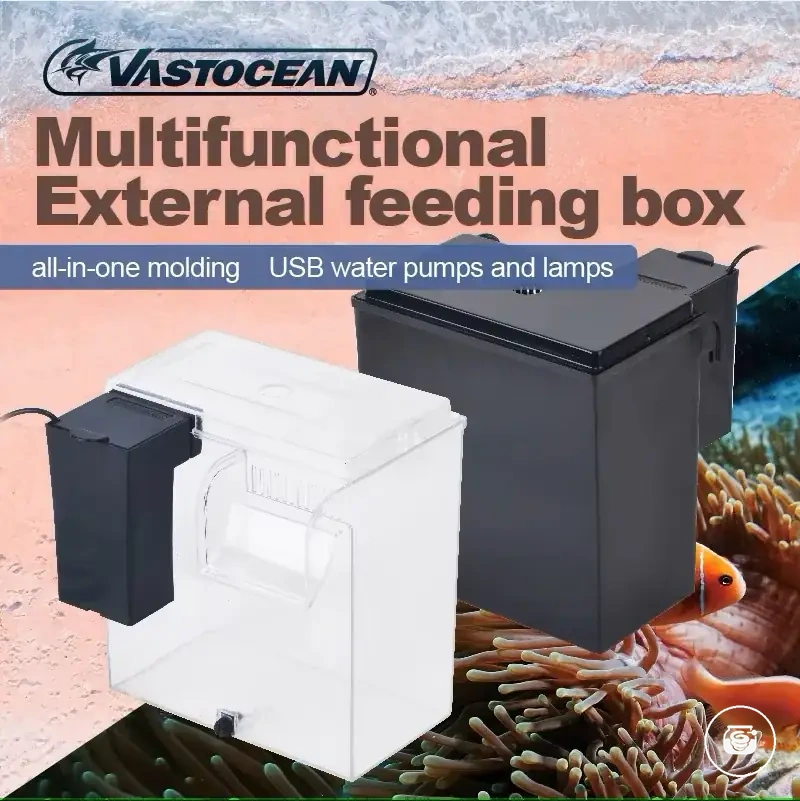
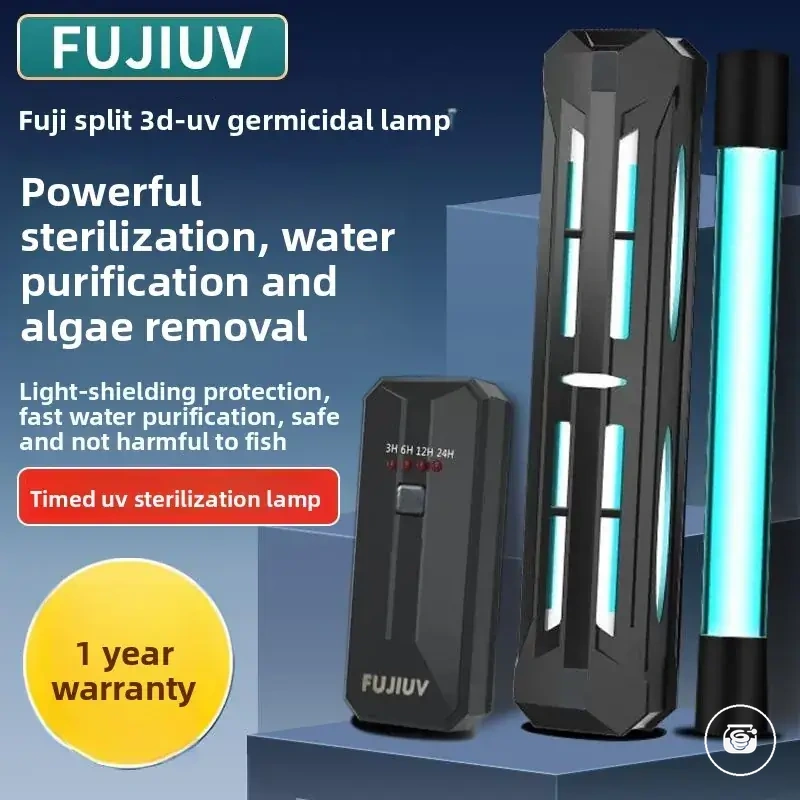
The products below are useful examples for comparing available options.
The products below are useful examples for comparing available options. Before buying, check that the compatibility criteria, key features, and product details match your needs.
When an Indoor Spirulina Growing Kit Is the Right Choice
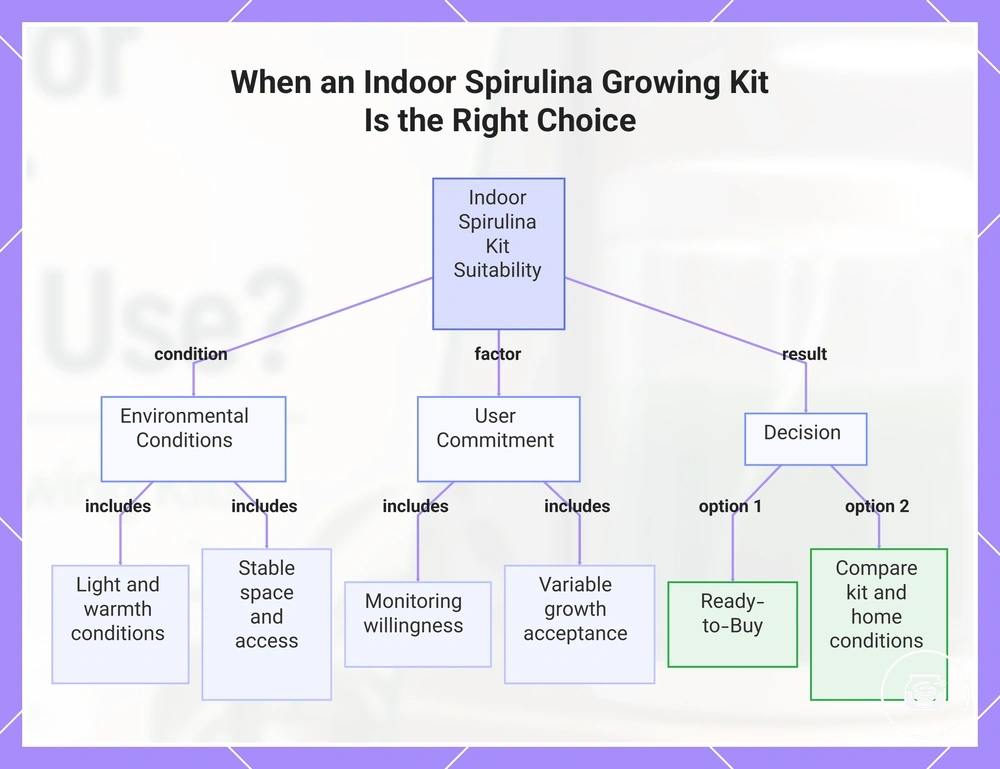
An indoor spirulina growing kit is the right choice for users whose home provides dependable light, suitable warmth, stable space, and maintenance access, and who are willing to monitor the culture while accepting variable growth.
The main required conditions are controllable light, suitable room warmth, practical access, and enough time for observation.
Scenario: Suitable users can leave the container in a stable indoor position, provide an appropriate light source, and perform recurring condition checks. The main required conditions are controllable light, suitable room warmth, practical access, and enough time for observation. Users who are comfortable adding optional lighting, aeration, or heating when their specific room conditions require support are more likely to be ready-to-buy.
- Light: A dependable natural or artificial light source is available at the intended container position.
- Warmth: The room can remain within the operating conditions stated for the selected kit or culture.
- Space: A stable surface provides enough access for observation and recurring care.
- Monitoring willingness: Routine condition checks fit the user's normal schedule.
- Variable growth: The user accepts that culture response can change when indoor conditions change.
- Equipment comfort: Optional lighting, aeration, or heating is an acceptable compromise when the home environment cannot provide the required support unaided.
- Next-step selection: The kit's container, included supplies, and operating requirements match the available home conditions.
Problem to solution: Unsuitable users include people expecting minimal involvement, predictable output, or successful cultivation without controlling light, warmth, placement, and recurring care. Limited space or inconsistent lighting can remain manageable when the user accepts equipment, scheduling, or placement compromises. When those acceptable compromises are impractical, further selection guidance is a better next step than treating the kit as an immediate purchase fit.
Apply these selection criteria to choose the right kit before making the final buying decision.
Direct answer: A user is ready-to-buy when the required conditions are available, recurring care is realistic, and variable outcomes are acceptable; otherwise, the next step is to compare kit requirements with the home environment. Apply these selection criteria to choose the right kit before making the final buying decision.
Before buying, check that the compatibility criteria, key features, and product details match your needs.
The products below are useful examples for comparing available options. Before buying, check that the compatibility criteria, key features, and product details match your needs.
This chart shows the key environmental conditions and user commitment factors that determine suitability, and the resulting decision.