Spirulina Growing Kit Troubleshooting
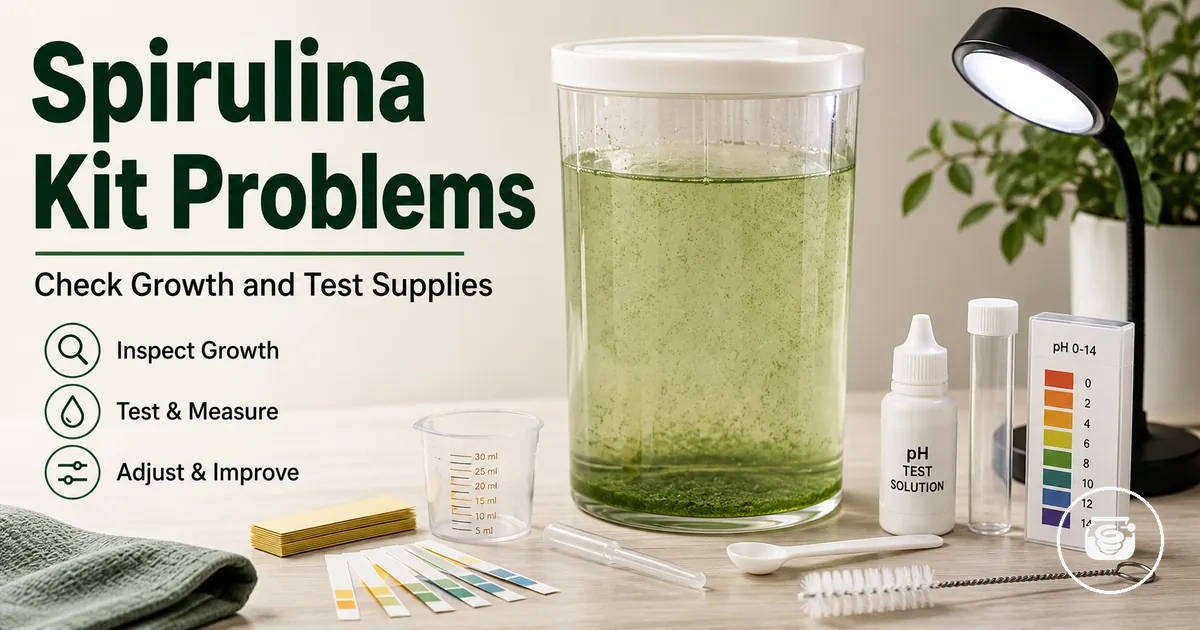
A spirulina growing kit should be troubleshot by matching observable culture symptoms to a likely cause area and a safe next check. Start with appearance, growth behaviour, smell, and surface condition; then check pH, medium condition, light, and temperature before attempting recovery or a restart.
Weak growth, fading colour, an unusual smell, or surface scum is a warning sign rather than proof of one cause.
Weak growth, fading colour, an unusual smell, or surface scum is a warning sign rather than proof of one cause. Research on Arthrospira cultivation identifies nutrient availability, temperature, light, pH, and carbon dioxide concentration as linked growth variables, so a change in one variable can produce symptoms that resemble another problem. Check the culture’s recent changes and testing results together instead of correcting several conditions at once.
Check the culture’s recent changes and testing results together instead of correcting several conditions at once.
Recovery means retaining the existing culture after its condition improves under verified kit instructions; restart means discarding that culture and beginning with uncontaminated starter material. The Food and Agriculture Organization reports that culture medium, air, the culture vessel, and starter culture are recognised contamination sources in microalgal cultivation. If abnormal smell, foreign surface growth, or continuing colour and density loss indicates possible contamination, visual inspection cannot establish that the culture is safe for harvesting or consumption.
Do not harvest a culture with unresolved contamination signs.
Do not harvest a culture with unresolved contamination signs. The World Health Organization documents that cyanobacterial contamination can involve toxins that are not reliably assessed through appearance alone, so an unsafe or unidentified culture should be isolated and handled according to the kit supplier’s disposal guidance rather than treated as a routine growth problem. The diagnostic order that follows is symptoms, likely cause, first check, and then the safest recovery or restart decision.
Table of Contents
Spirulina Culture Symptoms Before Fixes
Spirulina culture symptoms are observable changes in growth, color, smell, surface condition, or density that guide the first troubleshooting check. Each symptom is a diagnostic clue with a conditional value, not proof of one likely cause.
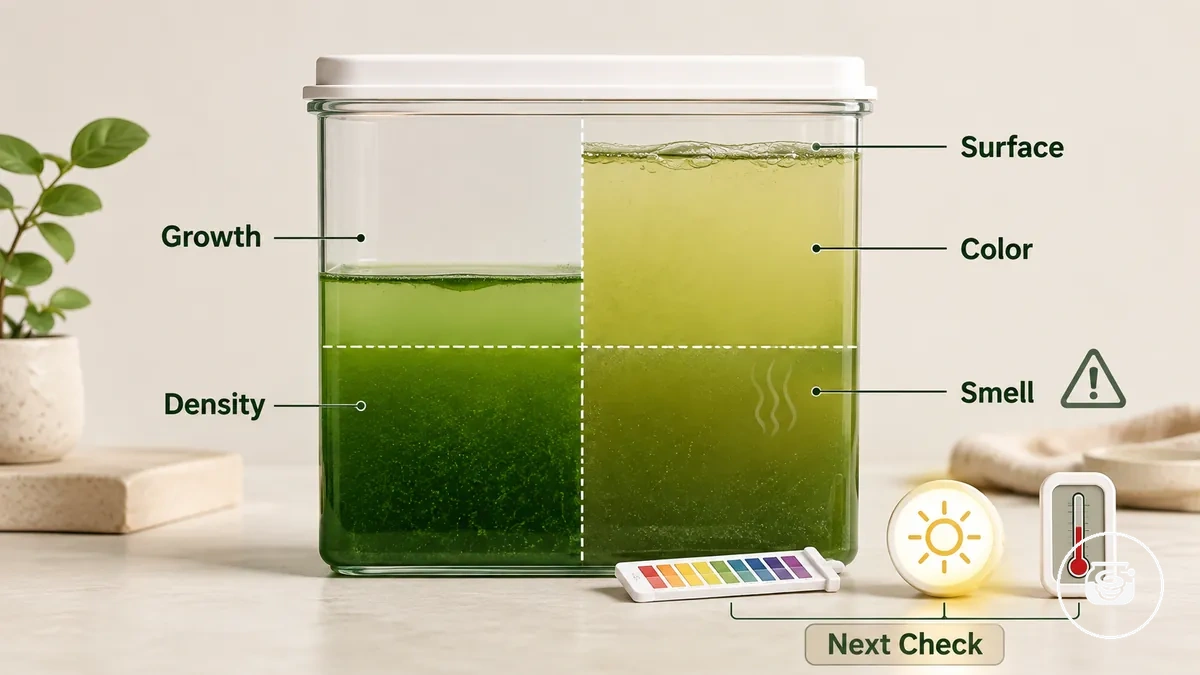
In spirulina growing kits, symptoms can be grouped as growth or density loss, color change, abnormal smell, and foreign surface material. The Food and Agriculture Organization identifies the culture medium, air, culture vessel, and starter culture as contamination sources in microalgal cultivation, while cultivation research identifies light, temperature, pH, and nutrients as variables that affect Arthrospira growth and composition. Because these cause areas can produce overlapping observations, the next check should test the relevant condition before any fix is selected.
| Visible symptom | What to check first | Possible issue area | Caution level |
|---|---|---|---|
| Growth slows or density continues to decrease | Compare the density trend with recent pH, nutrient, light, and temperature changes | Environmental stress, medium imbalance, or culture decline | Condition check required before correction |
| Color becomes pale, yellowish, olive-green, brown, or grey | Check whether the color change occurs with density loss, abnormal smell, or surface material | Light or nutrient stress, declining culture, or possible contamination | Paired symptoms determine whether monitoring or isolation is appropriate |
| Smell changes from the culture's established baseline | Inspect the surface condition, vessel cleanliness, and recent handling | Medium deterioration or possible contamination | Isolate the culture when the smell change occurs with foreign growth or scum |
| Foreign film, persistent scum, unexpected clumps, or visible organisms appear | Check the vessel, starter culture, air exposure, and medium handling | Contamination or inadequate mixing | Do not treat the symptom as a routine growth adjustment until contamination is excluded |
Grouped symptoms guide safer fixes because they connect an observed condition to a limited set of likely causes and a specific next check. For example, fading color without abnormal smell or surface material remains a culture-stress signal, whereas fading color combined with foreign scum and an unusual smell raises a contamination concern; the World Health Organization notes that cyanobacterial hazards require monitoring and assessment rather than identification by appearance alone.
Weak, Stalled, or Slow Spirulina Growth
Weak growth, stalled growth, or slow spirulina growth usually indicates a condition imbalance, culture stress, or insufficient recovery time rather than one universal cause. Scientific reviews of Arthrospira cultivation report that growth depends on linked variables including pH, nutrient availability, temperature, and light, so one symptom alone is not enough to identify the underlying cause. According to the review Tendencies Affecting the Growth and Cultivation of Genus Spirulina (2022), these variables should be evaluated together before corrective action is taken.
Weak, Stalled, or Slow Spirulina Growth should first be judged by comparing culture density with the culture's age and any recent setup changes rather than by color alone.
Weak, Stalled, or Slow Spirulina Growth should first be judged by comparing culture density with the culture's age and any recent setup changes rather than by color alone. A newly started culture can remain thin while adapting to its environment, whereas a culture that previously thickened but later loses density is more consistent with environmental stress. Published cultivation research also reports that Arthrospira grows poorly below approximately 15.5 °C and can be damaged above approximately 39 °C, showing that temperature alone can significantly reduce biomass production even when other conditions appear acceptable.
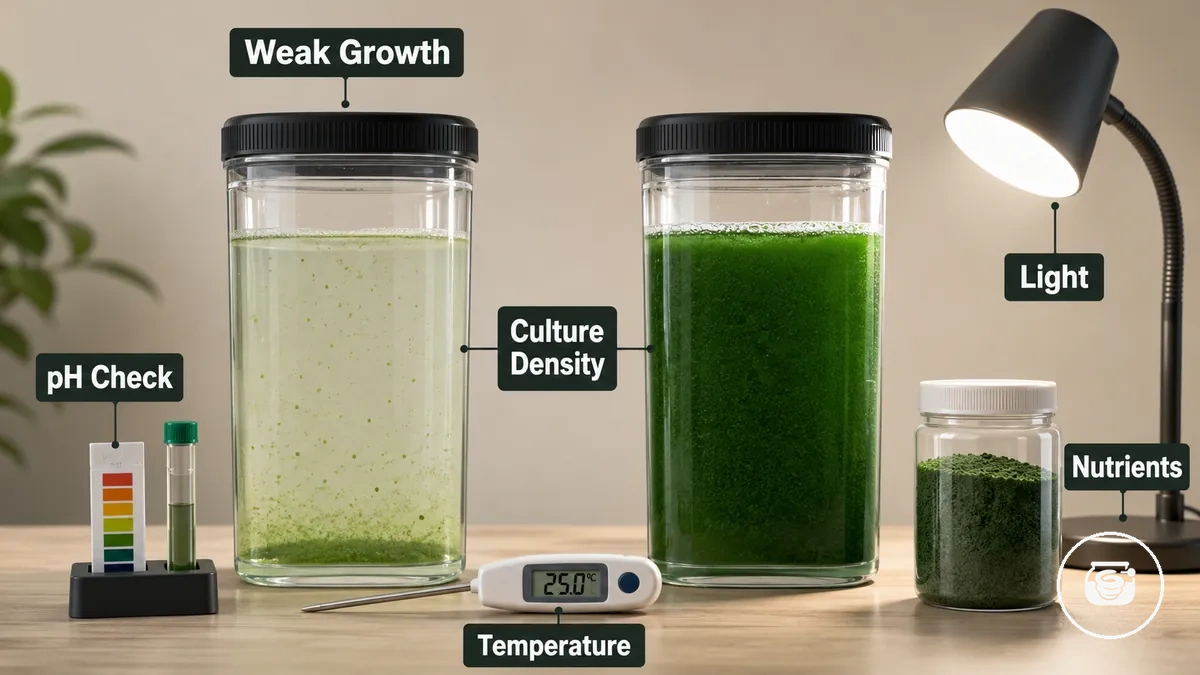
Weak, Stalled, or Slow Spirulina Growth is best checked in a fixed diagnostic order so that one variable is verified before another is changed. If the culture is still within its expected establishment period, compare its progress with normal growth time issues before assuming that growth has stopped permanently.
- Compare culture density with previous observations to determine whether biomass is increasing, stable, or declining.
- Review recent setup changes, including harvesting, water replacement, container movement, or aeration adjustments.
- Measure pH and confirm that it remains within the target range recommended for the culture medium being used.
- Check whether nutrients were added correctly and whether dilution or harvesting reduced nutrient availability.
- Verify that the temperature has remained within the cultivation range instead of falling below about 15.5 °C or rising toward damaging levels above about 39 °C, as reported in cultivation studies.
- Confirm that light exposure has remained consistent and that recent shading or excessive light intensity has not coincided with the growth slowdown.
If culture density remains stable after environmental conditions are corrected one variable at a time, recovery is more likely than if density continues to decline. When density keeps decreasing despite completing the checklist, continue with the later troubleshooting sections covering culture color, water chemistry, and contamination rather than making multiple additional changes simultaneously.
Early Growth Delay After Setup
Early growth delay after setup is often a normal adjustment period while a newly established spirulina culture stabilizes under its new growing conditions rather than evidence that the culture has failed. Early density may remain visibly low as the starter culture adapts, and published Arthrospira cultivation research identifies temperature, light exposure, nutrient availability, and culture medium composition as the principal factors affecting early biomass development instead of a universally accepted establishment timeline.
Early Growth Delay After Setup is best evaluated by confirming that the culture is still stabilizing before interpreting slow growth as a decline.
Early Growth Delay After Setup is best evaluated by confirming that the culture is still stabilizing before interpreting slow growth as a decline.
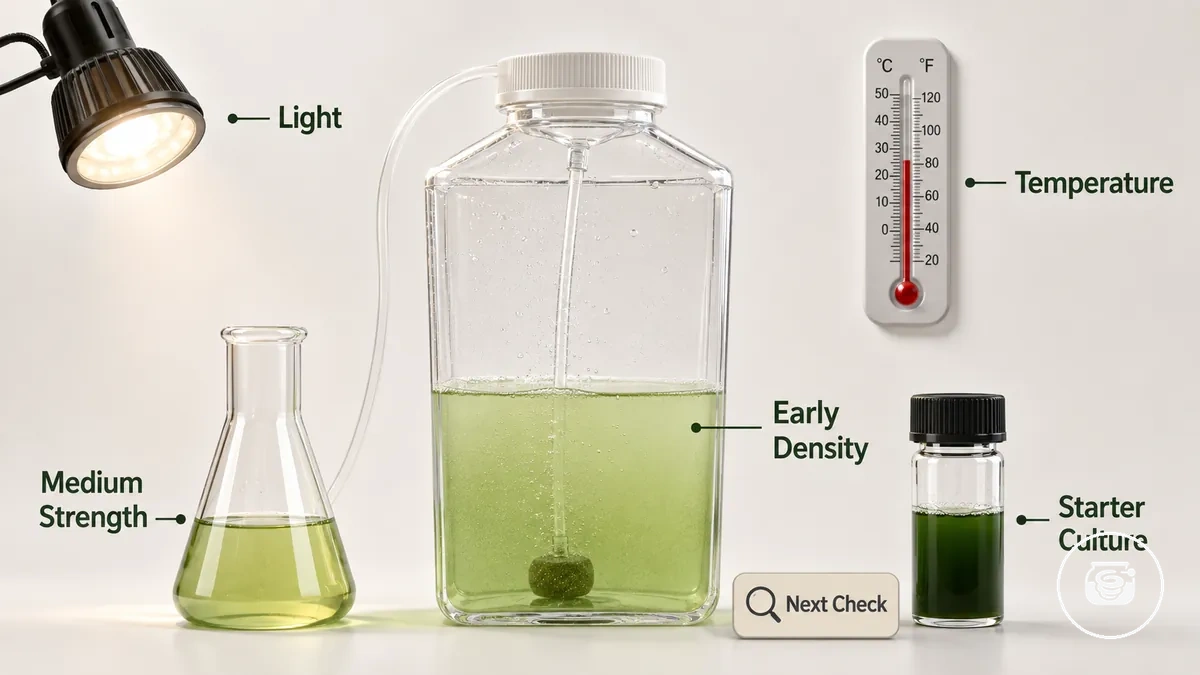
- Review the setup age together with the culture's recent density trend; the scientific literature does not define an exact day count that separates a normal adjustment period from abnormal delay.
- Confirm the starter culture appeared healthy before transfer, with a uniform green appearance and no visible contamination signs.
- Verify that the temperature has remained stable, because cultivation studies report that Arthrospira grows poorly below approximately 15.5 °C and may be damaged above approximately 39 °C.
- Check that light exposure has remained consistent after setup and that the culture has not recently been moved between substantially different lighting conditions.
- Confirm that medium strength matches the intended cultivation medium and has not been unintentionally diluted through water replacement or mixing.
- Compare the early density across successive observations. A stable or gradually increasing culture is more consistent with normal stabilization, whereas continuing density loss together with worsening symptoms should be assessed using the later troubleshooting steps rather than assuming the culture will recover without further investigation.
Thin Culture Density and Poor Recovery
Thin culture density and poor recovery mean that the spirulina culture remains visibly dilute or fails to regain density after stress, harvesting, or dilution. Visual thinness alone does not provide a universal biomass threshold or prove contamination, so the useful value is the density trend: increasing, stable, or declining.
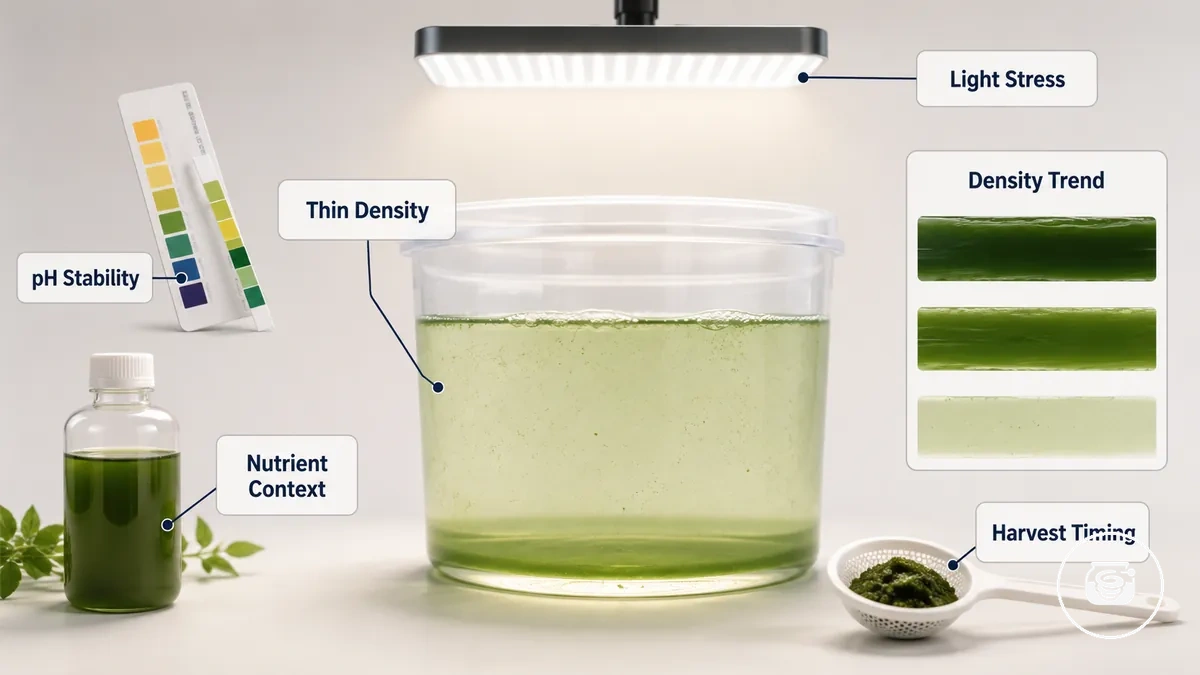
Thin Culture Density and Poor Recovery should be checked by linking the density trend to nutrient availability, pH stability, harvest timing, and light stress. Reduced nutrient availability or an unstable pH can weaken the culture response, while harvesting before density rebounds can prolong a diluted appearance. A recent change in light exposure can also coincide with a slow rebound, but poor recovery cannot be confirmed from one condition alone. Continued density loss after these variables are checked indicates that the culture needs broader troubleshooting rather than an assumed recovery.
- Density trend: Compare repeated observations and classify the culture as increasing, stable, or declining.
- pH stability: Compare current readings with the target specified for the culture medium; no universal pH value should be substituted for the kit or medium instructions.
- Nutrient context: Check whether nutrient availability changed after dilution, water replacement, or harvesting.
- Harvest timing: Determine whether biomass was removed before the culture had regained its previous density.
- Light stress: Check whether a change in light intensity, exposure duration, or container position occurred before the poor recovery appeared.
Color Changes in Spirulina Culture
Color changes in a spirulina culture can indicate stress, altered light exposure, nutrient imbalance, culture decline, or contamination risk depending on the observed shade and its progression. Color alone does not establish the likely condition, so the safest next check is to compare the shade change with smell, culture density, and surface condition.
Color Changes in Spirulina Culture are more informative when the culture is observed across repeated checks rather than judged from one inspection.
Color Changes in Spirulina Culture are more informative when the culture is observed across repeated checks rather than judged from one inspection. Pale or yellowish fading paired with declining density can be consistent with light stress or nutrient imbalance, while olive-green may reflect a change in pigment concentration or growing conditions. Brown or grey discoloration paired with unusual odor, continued density loss, or foreign surface material raises greater concern for culture decline or contamination risk, but the paired symptoms—not the color alone—determine the next diagnostic step.
| Color change | Possible condition | Paired symptom to check | Safer interpretation |
|---|---|---|---|
| Pale green | Light exposure change, nutrient imbalance, or reduced pigment concentration | Declining density or slower growth | Check recent light and nutrient changes before selecting a correction |
| Yellowish | Prolonged stress or reduced nutrient availability | Thin culture and weak growth response | Treat as a stress signal that requires a condition check rather than proof of contamination |
| Olive-green | Environmental adjustment or altered pigment balance | Recent temperature, light, or medium changes | Monitor progression and compare it with density, smell, and surface appearance |
| Brown | Culture decline or possible contamination risk | Unusual odor, surface film, or continued density loss | Pause harvesting and complete broader troubleshooting before continued use |
| Grey | Advanced stress, culture decline, or possible contamination risk | Foreign surface growth, abnormal smell, or worsening density | Treat as a warning sign requiring isolation and further assessment rather than a color-only conclusion |
No shade should be classified as safe or unsafe without its surrounding symptoms. A pale culture with stable density, normal smell, and a clean surface may indicate a condition-related stress response, whereas brown or grey discoloration combined with odor, surface abnormalities, and declining density warrants the safest next check before harvesting or continued cultivation.
Pale, Yellowish, or Olive-Green Culture
Pale culture, yellowish culture, or olive-green culture is a local sign of culture stress, not a diagnosis by color alone. Interpret the shade together with light intensity, exposure duration, nutrient balance, density, and any recent dilution; the reviewed evidence does not establish a universal color threshold for one specific cause.
Pale culture, yellowish culture, or olive-green culture is a local sign of culture stress, not a diagnosis by color alone.
Temporary paleness with stable or increasing density is more consistent with adjustment, whereas progressive fading with continued density loss indicates a worsening culture response. Check the modifiers in this order before changing more than one condition:
- Light: Compare the color shift with recent changes in light intensity and exposure duration.
- Nutrients: Treat yellowish color paired with slower density growth as a possible nutrient-balance problem rather than a color-only change.
- Dilution: An olive-green culture appearing after recent dilution can reflect reduced visible concentration; verify whether density subsequently stabilizes or increases.
- Density trend: Stable or rising density supports temporary stress, while continued fading and declining density require broader troubleshooting rather than assuming light alone is responsible.
Clear, Brown, or Grey Culture Changes
Clear culture, brown culture, or grey culture are higher-risk warning signs because they can indicate culture collapse or possible contamination, although color alone cannot determine the underlying cause. A clear culture commonly reflects substantial color and density loss, while a brown culture or grey culture requires immediate evaluation together with odor, surface material, texture, and recent handling before any recovery attempt. According to the Food and Agriculture Organization, contamination in microalgal cultivation can originate from the culture medium, air, equipment, or starter culture, making multiple warning signs more significant than color alone.
This approach reduces the risk of confusing temporary environmental stress with possible contamination and keeps troubleshooting focused on observable evidence rather than assumptions.
Clear, Brown, or Grey Culture Changes should be treated as a safety-focused diagnostic checkpoint because combining discoloration with abnormal odor, foreign surface material, altered texture, or recent handling increases concern for culture deterioration beyond routine environmental stress. For example, a culture that changes from green to brown after transfer, develops an abnormal odor, and shows new floating surface material presents more warning indicators than color change alone and warrants isolation while the cause is investigated. This approach reduces the risk of confusing temporary environmental stress with possible contamination and keeps troubleshooting focused on observable evidence rather than assumptions.
Clear, Brown, or Grey Culture Changes should be evaluated using the following safety checklist:
- Color shift: Confirm whether the culture has progressively become clear through density loss or has darkened to brown or grey.
- Smell: Check for a new sour, rotten, or otherwise abnormal odor occurring with the color change.
- Surface changes: Inspect for persistent films, floating material, unexpected growth, or other foreign surface material.
- Texture: Look for unusual slime, excessive clumping, or breakdown of the culture's previous consistency.
- Handling history: Review recent water additions, transfers, equipment contact, cleaning, or uncovered exposure before the visible change appeared.
Water Chemistry Problems in Spirulina Kits
Water chemistry problems in spirulina kits occur when pH, alkalinity, medium strength, or nutrient balance shifts from the condition intended for the culture medium. These chemistry changes can affect growth, color, density, and culture stability together, but the reviewed evidence does not support one universal pH target, nutrient dose, or correction formula for every kit and medium.
pH describes how acidic or alkaline the culture medium is, while alkalinity describes its capacity to resist rapid pH change.
pH describes how acidic or alkaline the culture medium is, while alkalinity describes its capacity to resist rapid pH change. Medium strength is the concentration state of the prepared medium, and nutrient balance is the relative availability of the nutrients required by the culture. A water change, dilution, evaporation, or preparation error can alter one or more of these variables, so the observed effect should be compared with recent handling before a correction is selected.
| Chemistry variable | What changes | Symptom it can affect | Cautious next check |
|---|---|---|---|
| pH | The culture medium becomes more acidic or more alkaline than its intended condition | Growth, color, and culture stability | Measure the current pH and compare it with the instructions for the specific medium before adjusting it |
| Alkalinity | The medium becomes less or more resistant to pH change | pH stability and repeated growth disruption | Review the water source and medium preparation when pH changes recur |
| Medium strength | The dissolved medium becomes diluted or concentrated | Culture density, color, and growth | Check recent water additions, evaporation, and preparation quantities |
| Nutrient balance | One or more nutrients become depleted, excessive, or disproportionate | Slow growth, fading color, or weak density recovery | Compare nutrient additions and harvesting history with the kit or medium instructions |
| Water change | Replacement water alters pH, alkalinity, or medium concentration | Multiple symptoms appearing after handling | Compare the timing of the water change with the first observed effect before making another adjustment |
Diagnose Water Chemistry Problems in Spirulina Kits by checking recent water changes first, then pH, alkalinity, medium strength, and nutrient balance while changing only one verified variable at a time. When those values remain consistent with the specific medium instructions but symptoms continue, assess the broader conditions that cause problems rather than assuming water chemistry is the only cause.
Low pH and Unstable Alkalinity
Low pH and unstable alkalinity can weaken spirulina culture performance because a pH drop and inadequate buffering make the medium condition less stable. A 2022 review in Foods reports that Spirulina growth was optimal at pH 9.0–10.0 under the cultivation conditions it reviewed, but this range is not a universal target for every home kit; compare each pH reading with the instructions for the specific culture medium.
Low pH and unstable alkalinity can weaken spirulina culture performance because a pH drop and inadequate buffering make the medium condition less stable.
Confirm test accuracy before applying a cautious correction, because expired strips, contaminated samples, or inconsistent methods can produce conflicting results. Repeated pH movement under comparable testing conditions indicates unstable alkalinity more strongly than one isolated reading, so review recent dilution, water additions, evaporation, and medium preparation before changing the culture. After any kit-supported adjustment, observe whether the pH becomes steadier and whether the culture response changes from declining growth or color toward stable density.
- Measurement: Repeat the pH reading with an in-date test, a clean sample, and the same testing method.
- Likely cause: Check recent dilution, water replacement, evaporation, and medium preparation for a pH drop or alkalinity swing.
- Correction caution: Use only the adjustment method and quantity specified for the particular kit or culture medium; the reviewed evidence does not support one universal dosing rule.
- Observation: Track the next readings and the culture response before making another change.
Medium Strength and Nutrient Imbalance
Medium strength and nutrient imbalance can weaken spirulina when the nutrient mix becomes diluted, concentrated, depleted, or disproportionate to the culture's water volume and biomass. The reviewed evidence identifies medium composition and nutrient availability as linked determinants of Arthrospira growth, but it does not support one nutrient concentration or feeding schedule for every strain, kit, and culture medium.
Compare the medium concentration with recent dilution, feeding, harvest history , density, and growth response before making a correction.
Compare the medium concentration with recent dilution, feeding, harvest history, density, and growth response before making a correction. Increasing water volume without the corresponding nutrient mix produces a diluted medium, while evaporation can produce a concentrated medium; harvesting biomass or culture liquid can also change the relationship between remaining nutrients and culture density. Use only the replenishment method specified for the particular kit or medium, because an unverified extra dose can add stress without identifying the original imbalance.
Diagnostic checklist: Compare the following conditions before changing the medium again.
Diagnostic checklist: Compare the following conditions before changing the medium again.
- Dilution: Check whether water volume increased without the nutrient mix required by the medium instructions.
- Feeding: Compare the latest nutrient addition with the specified quantity and timing rather than responding to color alone.
- Density: Classify the culture density as increasing, stable, or declining after the change in medium concentration.
- Recent harvest: Review how much biomass and liquid were removed and whether the specified replenishment step occurred before weak growth appeared.
Light and Temperature Stress
Light stress and temperature stress can cause a spirulina growth slowdown or color change when a grow light provides excessive or insufficient usable exposure, or when cold conditions, heat stress, or a temperature swing reduces culture activity. The reviewed evidence identifies light exposure and water temperature as linked environmental variables, but it does not support one exact universal range for every spirulina kit.
Assess grow-light intensity and exposure duration separately from temperature fluctuation before changing the culture medium.
Assess grow-light intensity and exposure duration separately from temperature fluctuation before changing the culture medium. Fading or reduced density after a lighting change can indicate inadequate usable light or excessive exposure, while cold conditions can slow culture activity and heat stress can coincide with declining density or altered color. In one controlled Arthrospira platensis study, the culture was maintained at 30 °C under a 12-hour light and 12-hour dark cycle with an irradiance of 140 µmol photons/m²/s; these values describe that laboratory method rather than a setting for all home kits.
- Light intensity: Check whether shade, lamp distance, direct sunlight, or a recent grow-light change occurred before fading, darkening, or slower density gain.
- Exposure duration: Compare the current daily light period with the instructions for the specific kit and classify the change as longer, shorter, or irregular.
- Water temperature: Measure the culture water when the growth slowdown appears and compare the reading with the range specified for the starter culture or kit.
- Daily fluctuation: Compare readings from the warmer and cooler parts of the day to identify a recurring temperature swing rather than relying on one measurement.
- Response trend: After correcting one verified variable, classify the culture response as improving, stable, or declining before altering another condition.
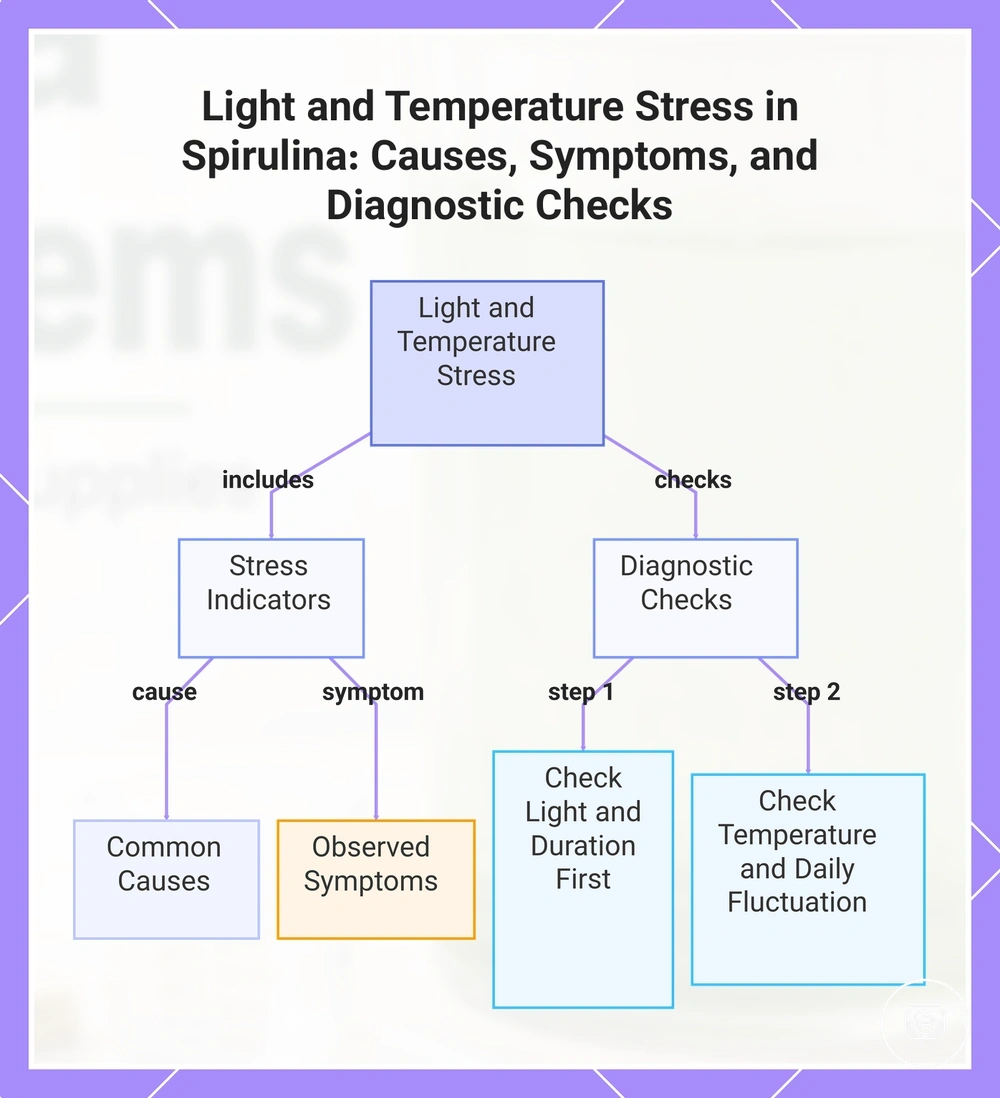
Check light intensity and exposure duration first, then water temperature and daily fluctuation while keeping the remaining variables unchanged long enough to observe the culture response. When measured light and temperature conditions match the kit instructions but symptoms continue, assess the broader conditions that cause problems rather than treating environmental stress as the only cause.
This chart shows the causes and symptoms of light and temperature stress in spirulina, along with the recommended diagnostic checks to identify the issue.
This chart shows the causes and symptoms of light and temperature stress in spirulina, along with the recommended diagnostic checks to identify the issue.
Too Much Light and Culture Fading
Too much light can contribute to culture fading when a new pale color appears after stronger sunlight exposure, a shorter grow light distance, or a longer exposure duration. Excessive light is a conditional diagnosis rather than the default explanation for every pale culture, so culture density, water temperature, pH, nutrient condition, and contamination signs should be checked before assigning the cause.
Compare the fading culture with its recent lighting and temperature history before changing the culture medium.
Compare the fading culture with its recent lighting and temperature history before changing the culture medium. A controlled reduction in exposure or partial shading provides a cautious test, whereas complete light removal can create an additional stress and does not confirm that excessive light caused the original change.
- Exposure intensity: Check whether direct sunlight, a stronger lamp, or a shorter grow light distance occurred before the pale color appeared.
- Exposure duration: Compare the current daily light period with the previous stable period and the instructions for the specific kit.
- Culture density: Classify density as increasing, stable, or declining; culture fading paired with density loss is a stronger warning than color change alone.
- Temperature interaction: Measure the culture water because sunlight exposure or a nearby grow light can raise temperature and make the fading harder to attribute to light alone.
- Shading response: After one controlled reduction in exposure, classify the recovery response as improving, stable, or declining before making another adjustment.
Low Temperature, Heat Stress, and Growth Slowdown
Low temperature can cause a spirulina growth slowdown by reducing culture activity, while heat stress can weaken the growth rate and alter the color response when the culture water moves outside the condition supported by the kit. A 2022 review published in Plants reported an optimum cultivation temperature of 30 °C under the reviewed conditions and reduced winter development as daily temperatures approached 10–15 °C; these research values are conditional observations, not a universal range for every home culture.
Measure water temperature and compare repeated readings with room variation , container placement , growth rate, and color response before diagnosing temperature stress.
Measure water temperature and compare repeated readings with room variation, container placement, growth rate, and color response before diagnosing temperature stress. Falling water temperature paired with slower density gain is more consistent with cold slowdown, whereas rising temperature paired with fading or declining density is more consistent with heat stress; compare either pattern with the instructions for the specific kit before changing one condition and observing the response.
- Temperature trend: Classify repeated water-temperature readings as stable, falling, rising, or fluctuating rather than relying on one measurement.
- Container placement: Check whether a window, grow light, heater, cold surface, or draught coincided with a temperature swing.
- Growth rate: Classify culture growth as increasing, stable, or declining after the temperature change.
- Color response: Record whether the culture remains green, becomes pale, darkens, or continues fading while temperature and density are monitored together.
Smell, Scum, and Contamination Warning Signs
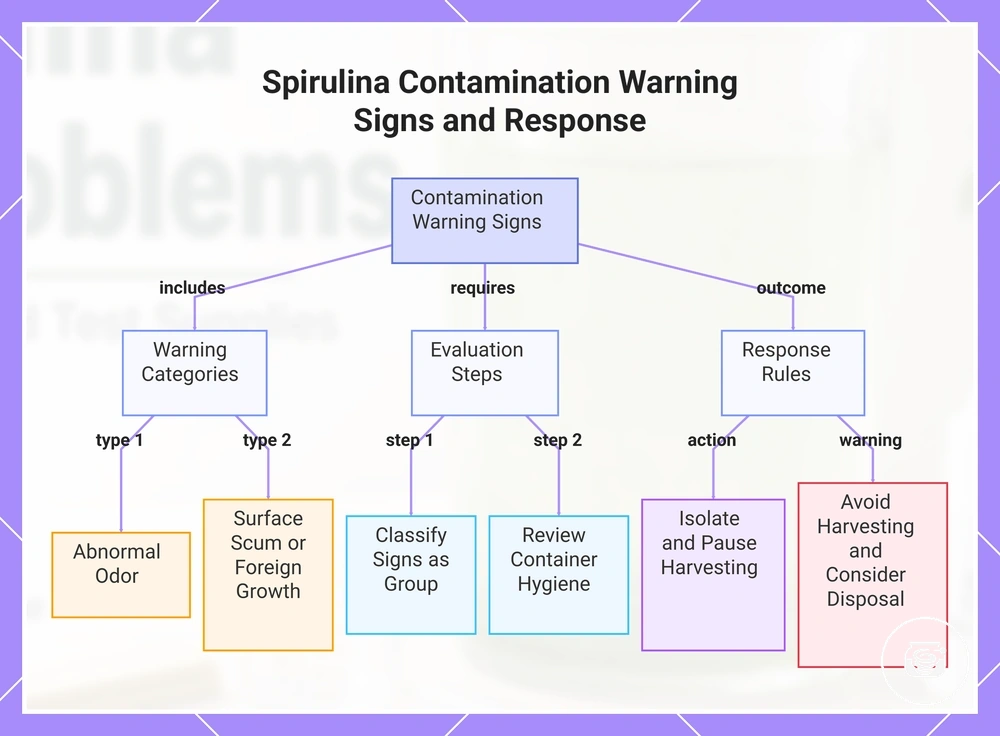
Bad smell, unusual scum, or visible contaminants are contamination warning signs that require a more conservative response than slow growth alone. When abnormal odor, altered surface texture, or foreign growth occurs together, isolate the spirulina culture and pause harvesting while the condition is assessed.
Use the separate contamination warning signs guidance when multiple indicators occur or the culture remains uncertain.
Evaluate the signs as a group before attempting recovery: classify the smell as unchanged or newly abnormal, the surface as clean or covered by persistent film, foam, clumps, or unfamiliar material, and visible growth as consistent with the culture or foreign in colour, shape, or texture. Review container hygiene and recent handling, including water additions, uncovered exposure, transfers, cleaning, and contact with tools, because these events identify possible contamination pathways without confirming a specific contaminant. Use the separate contamination warning signs guidance when multiple indicators occur or the culture remains uncertain.
- Odor: Treat a newly sour, rotten, swamp-like, or otherwise unfamiliar smell as abnormal, particularly when it occurs with surface or colour changes.
- Surface material: Record whether the surface is clean or contains persistent scum, film, foam, clumps, or unfamiliar floating matter.
- Foreign growth: Check for material that differs from the established spirulina culture in colour, shape, distribution, or texture.
- Container hygiene: Review whether the vessel, lid, utensils, hands, added water, or recent handling could have introduced foreign material.
- Uncertainty: Treat unresolved combinations of abnormal odor, altered surface texture, and foreign growth as a greater disposal risk than one isolated observation.
A recovery attempt is more defensible when the culture has one explainable handling-related change, no abnormal odor, no foreign growth, and a stable appearance after isolation. When bad smell, persistent scum, foreign growth, or uncertain hygiene occur together, the conservative interpretation is to avoid harvesting and consider disposal rather than repeatedly adjusting the culture and obscuring the warning signs.
This chart outlines the contamination warning signs, evaluation steps, and response actions for spirulina culture.
This chart outlines the contamination warning signs, evaluation steps, and response actions for spirulina culture.
Normal Earthy Smell vs Unsafe Odor
Normal earthy smell is the expected odor of a healthy spirulina culture, while an unsafe odor is a newly developed sour, rotten, sewage-like, rancid, or otherwise abnormal smell that should be treated as a contamination warning rather than a normal culture characteristic. Odor interpretation should always combine smell type, intensity, timing, surface condition, paired symptoms, and culture history, because smell alone cannot confirm either a healthy culture or contamination.
| Diagnostic factor | Expected earthy smell | Unsafe odor |
|---|---|---|
| Smell type | Mild earthy or algae-like normal odor that remains familiar over time | New sour smell, rotten, sewage-like, rancid, or otherwise unfamiliar bad smell |
| Intensity | Relatively consistent between routine observations | Suddenly stronger or noticeably different from the previous culture odor |
| Timing | Present throughout normal culture growth without other warning signs | Develops after handling, water changes, contamination events, or unexplained culture deterioration |
| Paired symptoms | No abnormal color, surface film, scum, or foreign growth | Often accompanies discoloration, abnormal surface condition, slime, scum, or foreign growth |
| Risk level | Consistent with normal culture history when no additional warning signs are present | Requires isolation and further assessment because odor alone does not identify the exact cause |
A normal earthy smell should be interpreted within the culture's history rather than as proof that the culture is safe, while an unsafe odor becomes more significant when it appears together with abnormal color, altered surface condition, or foreign growth. This comparison keeps odor as one local diagnostic variable instead of treating smell alone as complete evidence for either safety or contamination.
Surface Scum, Foaming, and Visible Contaminants
Surface scum, persistent foaming, a new surface film, or visible contaminants should be treated as local safety signals when their surface appearance, persistence, color, or odor pairing differs from the spirulina culture's previous condition. Brief bubbles after stirring or pouring are a disturbance-related state, whereas material that remains, spreads, returns, changes color, or develops an abnormal odor requires a more conservative assessment.
Visible foreign growth should not be normalised without context, particularly when it persists or appears with discoloration, density loss, or abnormal odor.
Separate each visible change before deciding how to respond: foam consists of bubbles, surface scum forms collected floating material, a surface film creates a continuous layer, and foreign particles retain a distinct shape, color, or texture. Review container cleanliness and recent disturbance, including stirring, aeration, uncovered exposure, tool contact, or water addition, because these conditions help distinguish a temporary physical change from an unresolved contamination risk. Visible foreign growth should not be normalised without context, particularly when it persists or appears with discoloration, density loss, or abnormal odor.
- Appearance: Classify the surface as temporary bubbles, collected scum, a continuous film, clumps, or distinct foreign particles.
- Persistence: Record whether the material disappears after settling or remains, spreads, or returns between observations.
- Odor pairing: Treat surface material with a newly sour, rotten, or otherwise abnormal odor as a stronger warning than an isolated visual change.
- Color: Compare the material with the established culture; white, brown, grey, black, or differently coloured growth requires conservative assessment rather than an assumption that it belongs to the spirulina.
- Container cleanliness: Review the vessel, lid, tools, added water, and recent handling for a plausible route by which foreign material could have entered.
When a Weak Spirulina Culture Can Be Recovered
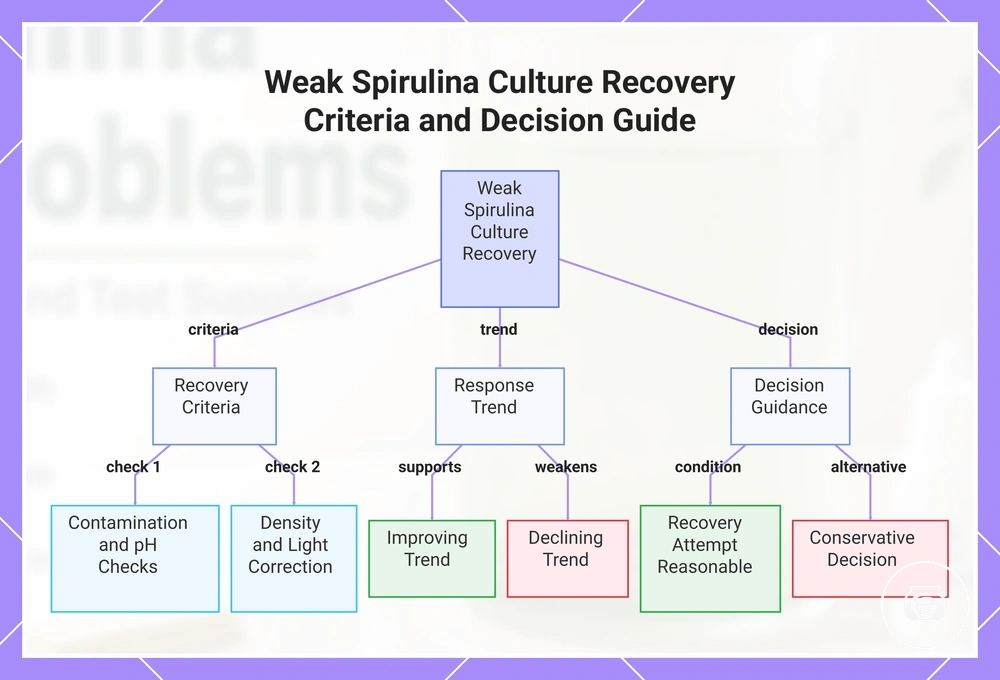
A weak culture has realistic recovery potential when it shows reversible stress, lacks strong contamination indicators, and produces a stable or improving response trend after the suspected cause is corrected. Recovery is less plausible when abnormal odor, foreign growth, persistent surface changes, or continuing density loss remain under corrected conditions.
Recovery is less plausible when abnormal odor, foreign growth, persistent surface changes, or continuing density loss remain under corrected conditions.
Judge whether weak spirulina can be recovered by combining color, odor, density, pH stability, temperature, light correction, time since stress, and the observed response. A culture with normal odor, no foreign surface material, pH readings that remain within the specific medium instructions, and density that stabilises or increases has stronger recovery signs than a culture that continues to fade, thin, or develop new warning signs. The reviewed evidence does not establish a fixed recovery timeline, so the decision should depend on observable change after corrected conditions rather than a universal number of days.
Recovery criteria:
- Contamination indicators: No abnormal odor, persistent scum, foreign growth, or unfamiliar surface film is present.
- pH stability: Repeated readings remain consistent with the instructions for the specific culture medium.
- Density: Culture density is stable or increasing rather than continuing to decline.
- Light or temperature correction: Color and density stop worsening after excessive light, cold conditions, heat stress, or a temperature swing is addressed.
- Response trend: An improving trend supports recovery, a stable trend supports continued observation, and continuing decline weakens the case for rescue.
A recovery attempt is more reasonable when the criteria indicate environmental stress and the culture improves after correction; persistent decline or combined contamination indicators support a more conservative decision. Apply only the relevant maintenance fixes after the recovery criteria are met, and avoid repeated adjustments that make the response trend harder to interpret.
Apply only the relevant maintenance fixes after the recovery criteria are met, and avoid repeated adjustments that make the response trend harder to interpret.
This chart shows the recovery criteria, response trends, and decision guidance for determining whether a weak spirulina culture can be recovered based on observable changes after correction.
When to Discard the Culture and Restart Safely
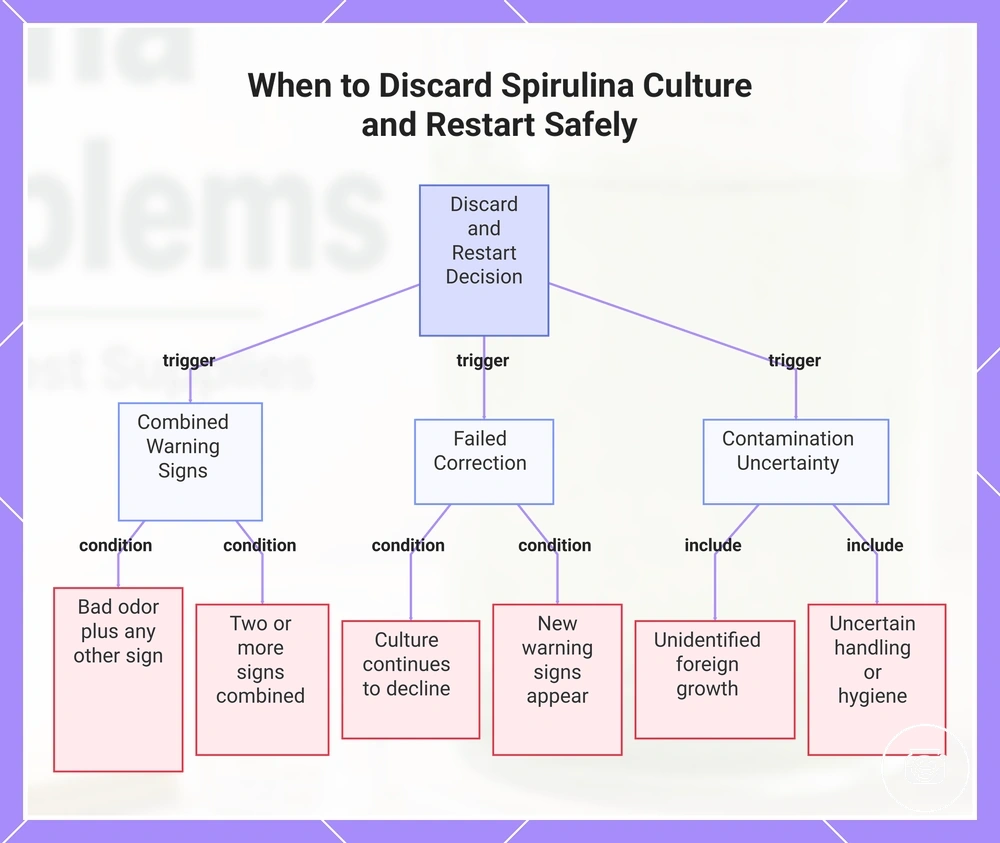
Discard the spirulina culture and restart safely when warning signs are combined, severe, or still uncertain after basic checks. A bad odor, grey culture, brown collapse, visible contamination, or persistent scum should be treated more conservatively than ordinary weak growth, especially when two or more signs occur together.
Discard the spirulina culture and restart safely when warning signs are combined, severe, or still uncertain after basic checks.
Group the evidence before making the discard decision: abnormal odor is a sensory warning, grey or brown collapse is marked culture deterioration, visible contamination is foreign material or growth, and persistent scum is surface material that remains or returns after settling. A failed correction strengthens the restart decision when light, temperature, pH, or handling conditions have been corrected but the culture continues to decline or develops new warning signs. Uncertain container hygiene, uncovered exposure, or contact with unclean tools also makes the culture harder to assess reliably.
- Combined warning signs: Discard when bad odor occurs with visible contamination, grey culture, brown collapse, or persistent scum.
- Failed correction: Restart when the culture continues to deteriorate after the suspected environmental or medium problem has been corrected.
- Contamination uncertainty: Treat unidentified foreign growth, unexplained surface material, or uncertain handling history as a reason not to continue recovery attempts.
- Restart hygiene: Use a clean container, clean tools, freshly prepared medium, and a starter culture without obvious warning signs.
Restarting is the more conservative choice when contamination remains plausible, corrections have failed, or the culture condition cannot be interpreted confidently. Keep disposal handling general, prevent contact with food-preparation surfaces, follow applicable local waste guidance, and do not reuse the affected culture as starter material.
Restarting is the more conservative choice when contamination remains plausible, corrections have failed, or the culture condition cannot be interpreted confidently.
This chart shows the three main conditions that trigger the decision to discard a spirulina culture and restart safely, including combined warning signs, failed correction, and contamination uncertainty.
Common Spirulina Growing Kit Mistakes to Prevent
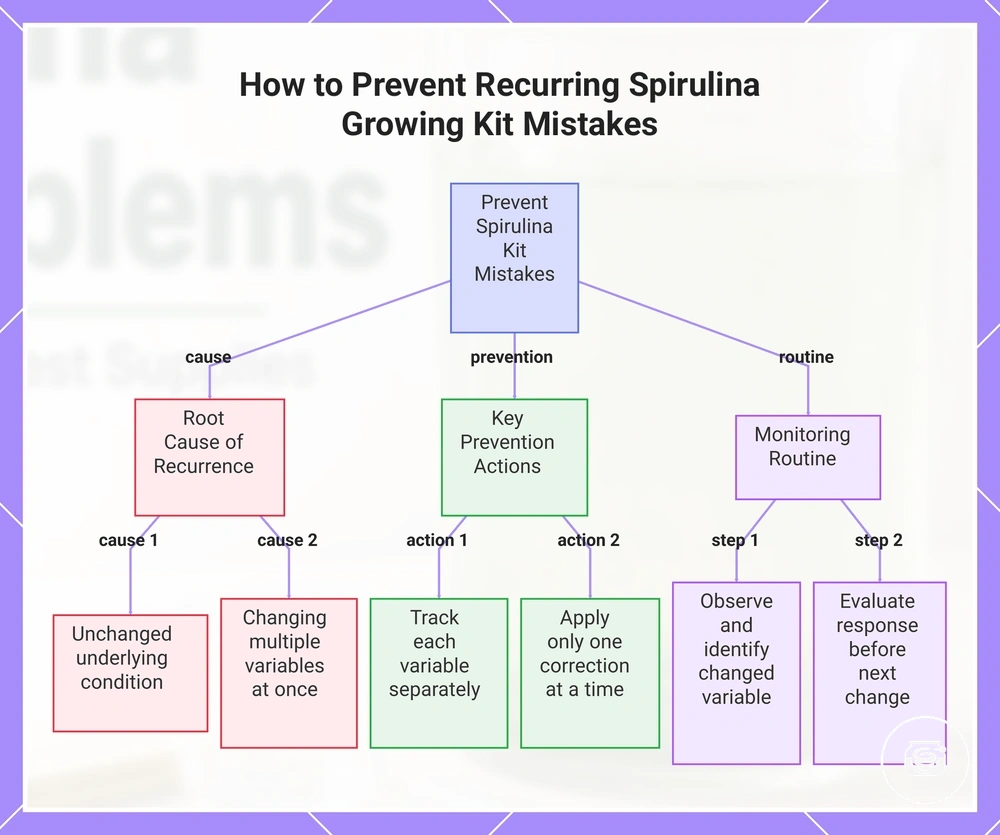
Common mistakes recur when a spirulina kit problem is corrected once but the underlying condition, handling practice, or monitoring habit remains unchanged. To prevent repeat problems, track light, temperature, pH, nutrients, tool cleanliness, harvesting, and response timing as separate variables rather than changing several conditions at once.
Common mistakes recur when a spirulina kit problem is corrected once but the underlying condition, handling practice, or monitoring habit remains unchanged.
Over-lighting and poor temperature control can repeat growth stress when exposure or water conditions remain unstable, while skipped pH checks and nutrient overcorrection can add a second chemistry problem before the first one is confirmed. Dirty tools increase contamination risk, early harvesting can remove biomass before density has stabilised, and a delayed response can make the original cause harder to identify because more conditions may change before the culture is reviewed.
Prevention checklist:
- Light: Prevent over-lighting by comparing changes in lamp distance, sunlight exposure, or daily duration with the culture's colour and density response.
- Temperature: Maintain temperature control by checking the culture water consistently and correcting repeated warming, cooling, or daily fluctuation rather than relying on room temperature alone.
- pH: Complete pH checks with the same clean method and compare readings with the instructions for the specific medium before adjusting chemistry.
- Nutrients: Avoid nutrient overcorrection by reviewing dilution, feeding, evaporation, and harvest history before adding more nutrient mix.
- Tools: Keep vessels, lids, utensils, and hands clean before contact with the culture to reduce contamination risk from dirty tools.
- Harvesting: Avoid early harvesting while density is declining, unstable, or recovering from recent stress.
- Response timing: Record and review new colour, density, odour, or surface changes promptly so one verified variable can be corrected before repeated adjustments obscure the response.
Prevention depends on consistent monitoring: observe the culture, identify the changed variable, apply only the relevant correction, and evaluate the response before making another change. Use the applicable maintenance fixes to support that routine without turning every minor variation into a full restart.
Use the applicable maintenance fixes to support that routine without turning every minor variation into a full restart.
This chart shows the root cause of recurring mistakes, the key prevention actions, and the monitoring routine to avoid repeated problems.