Beginner Spirulina Growing Kits for First Home Grows
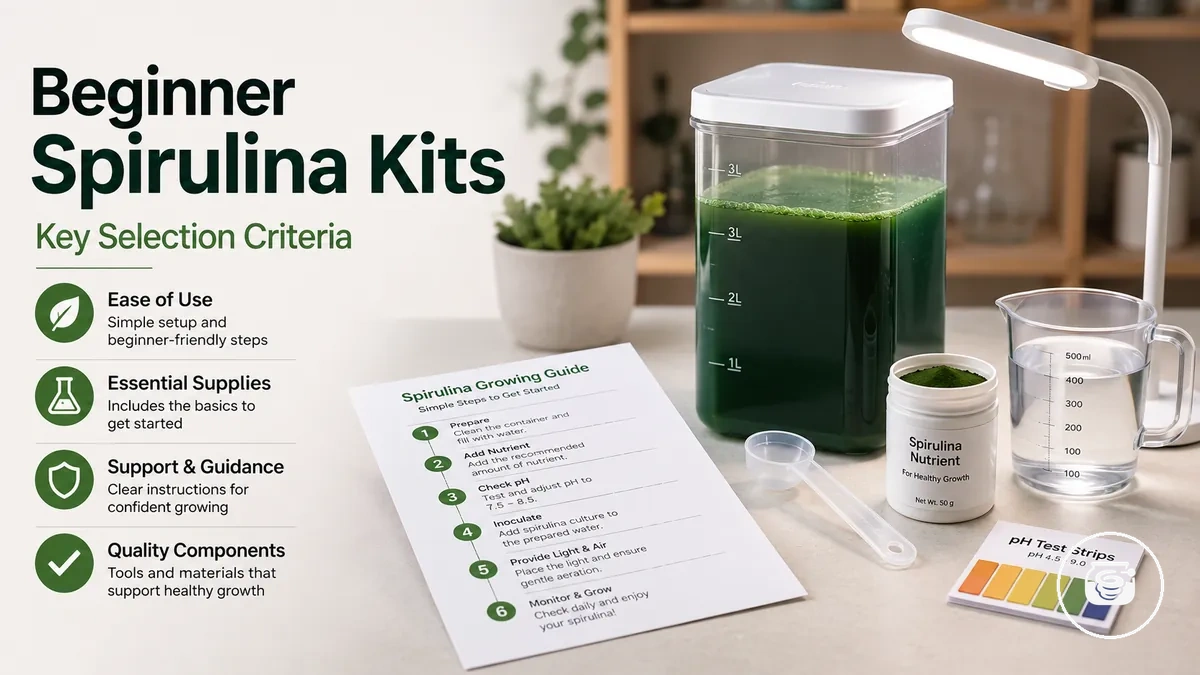
A beginner spirulina growing kit is suitable for a first home grow when it reduces setup uncertainty through clear instructions, a matched starter culture and grow medium, and manageable indoor requirements. Beginner-friendly means easier to manage, not effortless or failure-proof, so the main selection criteria are clarity, completeness, indoor fit, and realistic maintenance demands.
The practical value therefore depends on the exact configuration rather than the beginner label alone.
A first-time grower should compare whether the kit explains the indoor setup, identifies what is included, and shows how the user will monitor water, pH, light, and temperature. A kit that supplies the core culture materials but omits measuring support, light guidance, or clear instructions may still require extra equipment and more independent judgment. The practical value therefore depends on the exact configuration rather than the beginner label alone.
These checks create the basis for defining what makes a beginner spirulina growing kit genuinely beginner-friendly.
Common beginner friction starts when culture quality is unclear, the grow medium is not clearly matched, pH or light checks are difficult to understand, or maintenance expectations are understated. A stronger first-grow choice makes these conditions visible before purchase and helps the user distinguish included essentials from supplies that must be sourced separately. These checks create the basis for defining what makes a beginner spirulina growing kit genuinely beginner-friendly.
Table of Contents
What Makes a Spirulina Growing Kit Beginner-Friendly
A beginner-friendly spirulina growing kit is a kit that reduces early setup uncertainty, monitoring complexity, and culture management confusion by combining essential growing components with clear guidance for a first home grow. Its defining value is reducing beginner uncertainty through better support rather than guaranteeing successful cultivation. Beginner-friendly means easier to manage, not maintenance-free or contamination-proof.
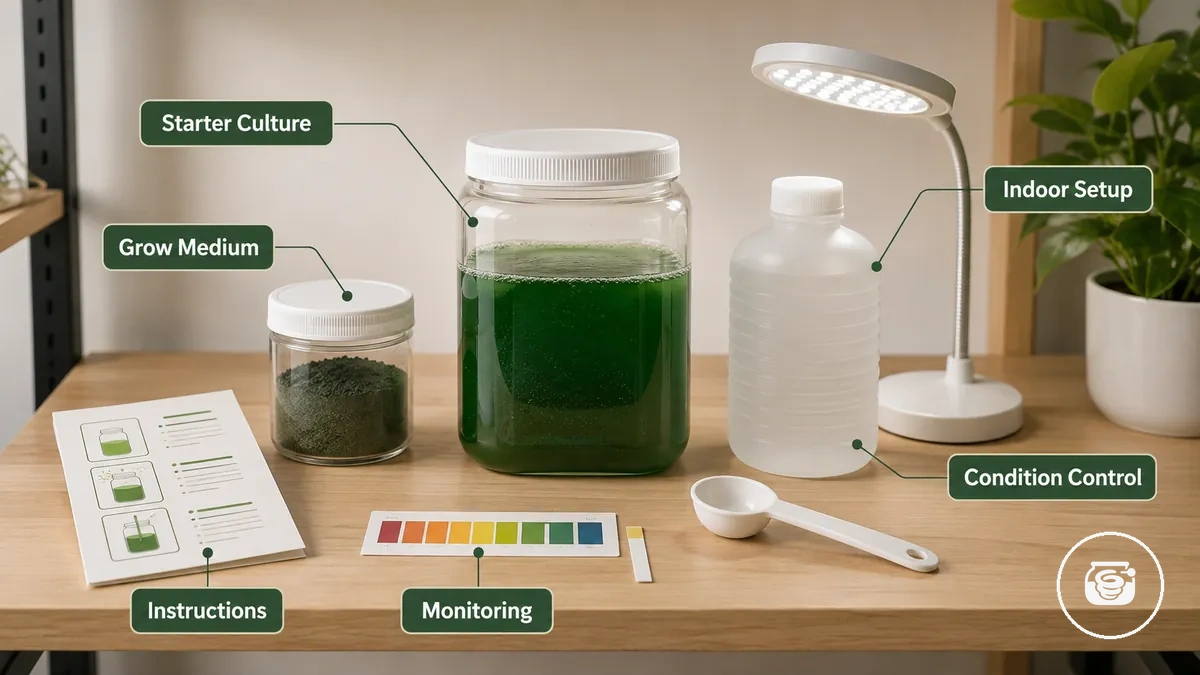
Beginner-friendly features reduce early setup and monitoring uncertainty by making important growing conditions easier to understand before problems occur. A well-designed beginner kit clearly identifies its included supplies, explains routine monitoring of pH, light, water, and culture management, and indicates which additional equipment is required for an indoor setup. Clear instructions also reduce confusion about condition control and routine maintenance without implying that contamination cannot occur. When comparing spirulina growing kits, prioritise kits that explain these support features instead of relying on beginner-focused marketing labels alone.
- Starter culture and compatible grow medium are clearly included and identified.
- Instructions explain routine monitoring of pH, light, water, and culture management.
- Included supplies and any additional equipment for indoor growing are listed before setup begins.
- Condition control is simplified to reduce beginner confusion, while regular maintenance remains necessary to lower contamination risk.
Beginner Kit Essentials That Reduce Setup Uncertainty
The essential parts of a beginner spirulina growing kit are the kit elements that reduce setup uncertainty before the first home grow begins. The highest beginner value comes from a compatible starter culture, matching grow medium, suitable container, clear instructions, practical measuring tools, pH support, and light guidance, because these components help a new grower prepare, monitor, and maintain the culture with fewer avoidable setup mistakes. The table below connects each essential kit element with its practical role and selection value.
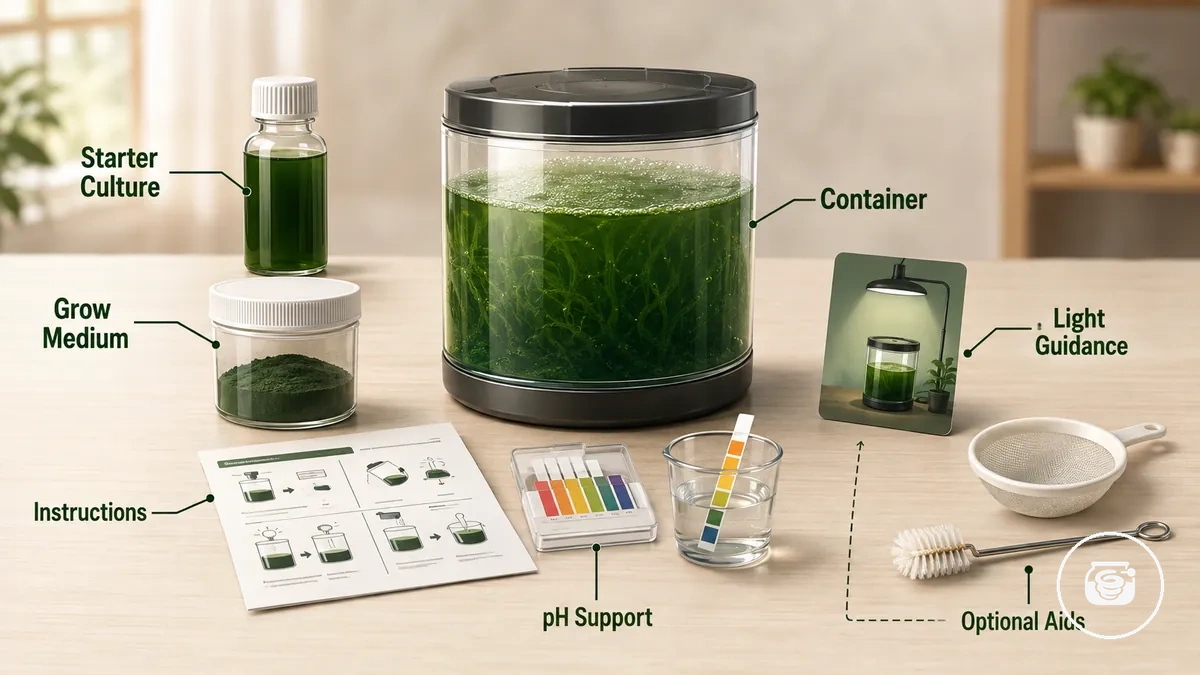
Not every included item has the same beginner value. Core components directly support early growth and condition control, while a harvesting aid or cleaning aid mainly improves convenience after cultivation has started. When comparing kits, prioritise the essentials that reduce beginner confusion and selection risk before considering optional support items.
| Kit element | Beginner role | Value or condition | Selection implication |
|---|---|---|---|
| Starter culture | Starts cultivation | Essential live culture compatible with the grow medium | Confirm the kit clearly identifies the supplied culture. |
| Grow medium | Provides nutrients | Formulated for the supplied starter culture | Choose a kit that specifies medium compatibility. |
| Container | Supports indoor growing | Suitable grow container for culture development | Reduces setup complexity for first-time growers. |
| Instructions | Guides setup | Clear preparation, monitoring, and maintenance steps | Helps prevent avoidable beginner errors. |
| Measuring tools | Supports monitoring | Basic monitoring supplies for routine checks | Makes condition control easier to follow. |
| pH support | Helps maintain water conditions | Includes pH guidance or testing supplies | Improves confidence during early culture management. |
| Light guidance | Assists indoor placement | Provides lighting recommendations for cultivation | Helps position the culture appropriately before growth begins. |
| Harvesting aid or cleaning aid | Supports routine maintenance | Convenience item rather than an essential inclusion | Useful after setup but should not outweigh missing core essentials. |
Live Starter Culture and Matched Grow Medium
A live starter culture and a matched grow medium are the core paired inputs in a beginner spirulina growing kit because they are intended to work together for a manageable first start. A suitable kit clearly identifies both components, states that the grow medium is intended for the supplied live starter culture, and includes basic use instructions. Selecting an improvised nutrient medium instead of the matched grow medium increases selection risk because compatibility between the culture and medium is no longer confirmed.
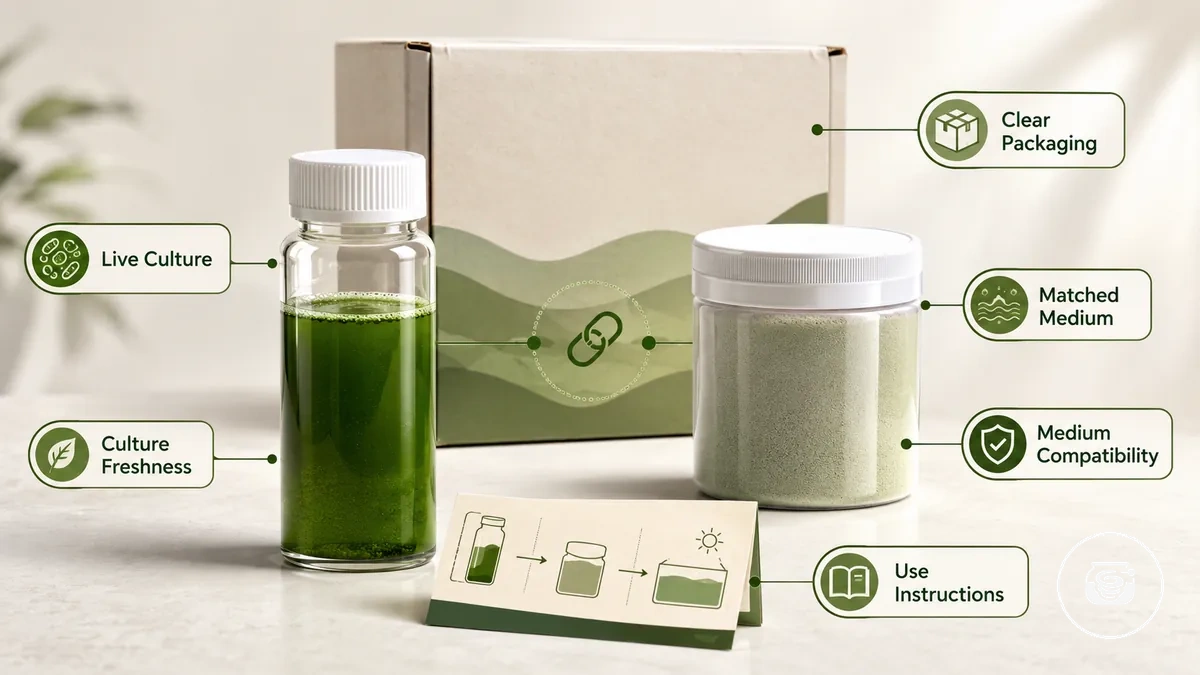
Beginner-friendly kits reduce confusion by making culture freshness, medium compatibility, packaging clarity, and use instructions easy to verify before purchase. Packaging should identify the live starter culture, explain appropriate storage before first use, distinguish each supplied component, and provide straightforward setup instructions without requiring detailed culture-maintenance knowledge. These checks help reduce selection risk while keeping the focus on choosing a compatible kit rather than diagnosing problems after setup.
- Culture freshness: Check that the kit states the starter culture is supplied live and provides storage guidance before first use. This improves confidence that the culture has been prepared for shipment.
- Medium compatibility: Confirm the matched grow medium is supplied specifically for the included live starter culture instead of requiring an improvised nutrient medium. This lowers compatibility-related selection risk.
- Packaging clarity: Choose a kit that clearly identifies every supplied component and separates setup guidance from ongoing maintenance. Clear packaging reduces beginner confusion during the first setup.
Instructions, Measuring Support, and Monitoring Basics
Clear instructions and practical measuring support reduce uncertainty after a beginner spirulina growing kit arrives by helping new growers understand which conditions to observe instead of relying on guesswork. Effective monitoring basics explain what should be checked, why it matters, and how to recognise manageable culture conditions without promising exact readings for every kit. Choosing a kit with clear beginner guidance makes early condition checks easier to understand before routine maintenance begins.
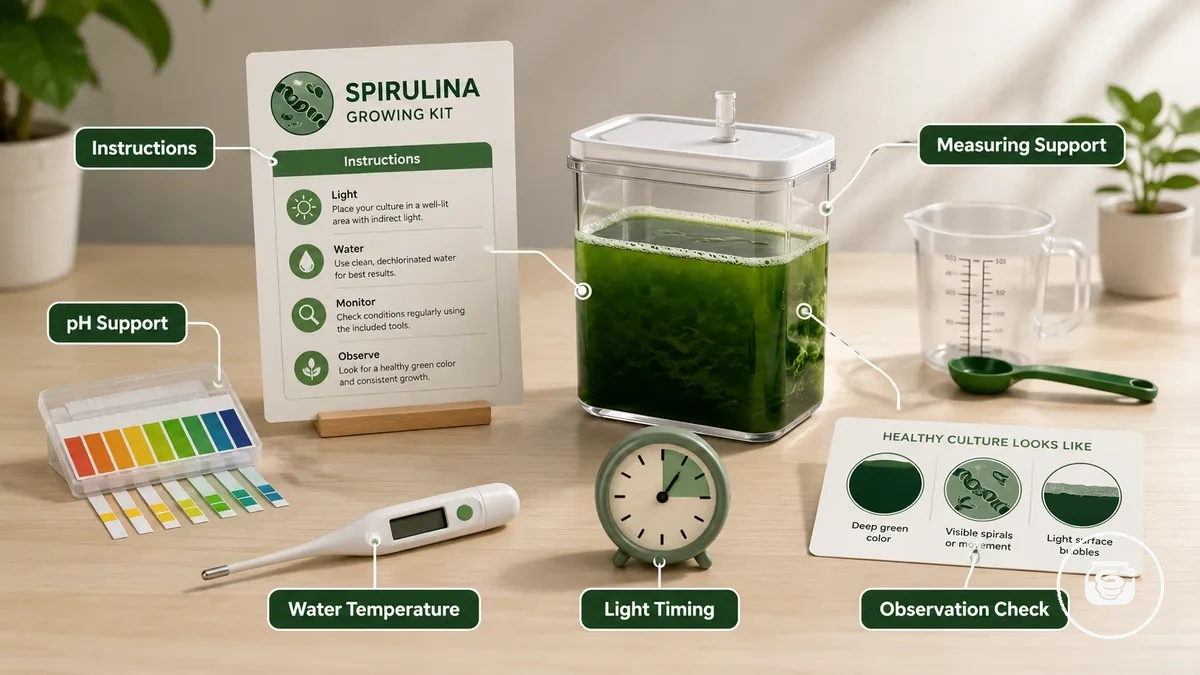
Monitoring support should make condition checks understandable rather than identical across all growing kits because equipment, culture containers, and supplied accessories differ between products. Beginner-friendly kits explain how to use pH support, water-temperature awareness, light timing, measuring tools, and observation checkpoints as practical verification aids instead of exact performance targets. When comparing beginner kits, prioritise the clarity of the instruction sheet and monitoring supplies over claims that suggest automatic or maintenance-free growing.
- Instructions: Explain each condition check clearly so beginners understand what to observe and how it supports confident monitoring.
- pH support: Provide simple pH guidance or testing supplies that help verify water conditions without requiring advanced knowledge.
- Water-temperature awareness: Show how to recognise suitable temperature conditions so avoidable environmental issues are easier to identify.
- Light timing: Include guidance for checking light exposure to help beginners confirm that illumination remains consistent.
- Measuring tools and observation checkpoints: Basic measurement aids and visual checkpoints help confirm that culture conditions remain manageable before troubleshooting becomes necessary.
Supplies Beginners May Still Need Outside the Kit
Beginner spirulina growing kits can still require supplies outside the kit because kit inclusions vary by seller configuration and package contents. Most missing extras are ordinary household or optional support items rather than specialised equipment, and they only become important selection factors when their absence increases setup difficulty or reduces early culture-handling convenience. Checking which extras are included before choosing a kit helps reduce beginner selection friction.
Checking which extras are included before choosing a kit helps reduce beginner selection friction.
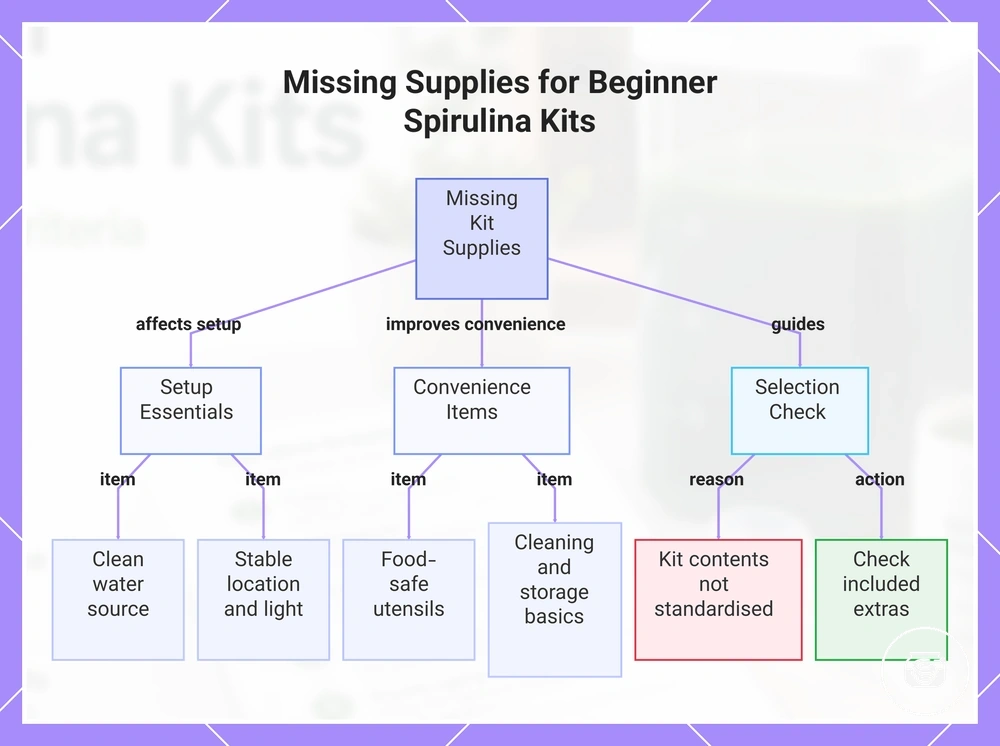
Kit contents are not standardised, so one beginner kit may include monitoring accessories or harvesting tools while another expects the user to provide them. The lead-in below separates items that affect initial setup from those that mainly improve convenience, helping beginners compare kits without treating every extra as essential.
- Clean water source: Relevant when the kit does not provide water preparation guidance or suitable water, because clean water supports initial culture preparation and reduces early setup uncertainty.
- Stable indoor location and light or timer: Important when lighting equipment or timing guidance is not included, since consistent placement and regular light exposure simplify early culture management.
- Food-safe utensils: Helpful if separate measuring or mixing tools are not supplied, allowing safe handling of the culture without relying on unsuitable household utensils.
- Cleaning items: Become a selection factor when no basic cleaning accessories or guidance are included, helping maintain clean containers and utensils during routine culture handling.
- Storage basics and harvesting basics: Useful when the kit focuses only on cultivation and does not include simple storage containers or harvesting accessories. These extras mainly improve convenience after harvesting rather than determining whether a beginner can start growing successfully.
This chart categorizes common missing supplies from beginner spirulina growing kits into setup essentials and convenience items, and highlights the importance of checking kit inclusions.
Indoor Setup Requirements a Beginner Kit Should Simplify
A beginner spirulina growing kit is suitable for an indoor setup when it simplifies the main condition controls required for a first home grow, including space, light, water, temperature, pH monitoring, and container fit. A suitable beginner kit should provide compatible growing components, clear monitoring guidance, and practical support for household use rather than eliminating the need for routine observation. Indoor success therefore depends on both the room conditions available and the kit's ability to make those conditions manageable.
Compare these conditions with the guidance provided for indoor home use when evaluating beginner kits.
A practical indoor placement is a stable shelf or kitchen counter where the culture container fits comfortably, receives consistent light, remains accessible for routine checks, and is unlikely to be disturbed during cultivation. Household practicality improves when the kit explains water preparation, temperature awareness, and pH monitoring with straightforward instructions instead of expecting prior growing experience. If lighting equipment or monitoring accessories are not included, they become selection criteria that should be confirmed before purchase rather than assumed. Compare these conditions with the guidance provided for indoor home use when evaluating beginner kits.
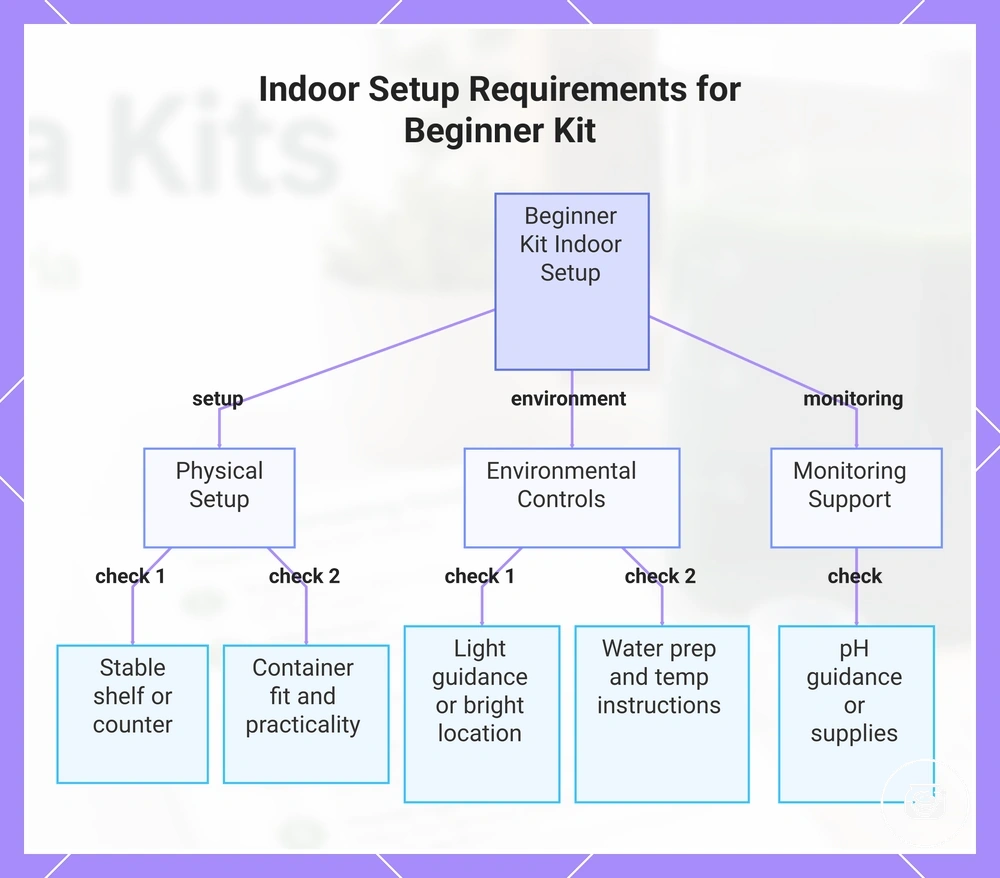
The compatibility checklist below separates the features a beginner kit should simplify from the conditions that still require user attention.
A beginner kit should simplify indoor condition management, while the grower remains responsible for maintaining a stable location and performing routine monitoring throughout cultivation. The compatibility checklist below separates the features a beginner kit should simplify from the conditions that still require user attention.
- Stable location: Choose a kit that can remain on one shelf or counter because a fixed location makes routine monitoring easier and reduces unnecessary disturbance.
- Container fit: Confirm the supplied culture container fits the available indoor space while leaving enough room for observation, stirring, and maintenance.
- Light exposure: Check whether the kit includes lighting guidance or specifies that an indoor grow light or consistently bright location is required.
- Water preparation and temperature: Prefer kits that explain suitable water preparation and temperature awareness so first-time growers can manage these conditions confidently.
- pH monitoring support: Select a kit that includes pH guidance or simple monitoring supplies because they make routine condition checks easier to understand.
- Household practicality: A compact setup that is easy to access, clean, and monitor is generally more suitable for regular indoor home use than one requiring frequent repositioning or additional specialised equipment.
This chart shows the key requirements a beginner spirulina kit should simplify for indoor setup, grouped by physical setup, environmental controls, and monitoring support.
Container Size, Water Preparation, and Light Placement
Container size, water preparation, and light placement determine whether a beginner spirulina growing kit is practical for a first home grow because these conditions must match the supplied culture volume, maintain container stability, and follow the kit instructions. No verified industry standard specifies one universal container size, water formula, or light position for all beginner kits, so compatibility is defined by the manufacturer's instructions and the intended indoor growing environment rather than a fixed rule.
If those requirements remain unclear, review the dedicated setup steps before beginning cultivation.
Beginner friction increases when the grow container is too small or unstable for the intended culture volume, the required water preparation is not explained, or light guidance does not describe how to maintain consistent indoor placement. For example, if two kits supply similar starter cultures but only one identifies the recommended culture volume, prepared water requirements, and placement consistency, the second kit is easier to evaluate before purchase because fewer setup assumptions are required. If those requirements remain unclear, review the dedicated setup steps before beginning cultivation.
| Condition | Unclear version | Beginner-friendly version | Selection implication |
|---|---|---|---|
| Container size | Culture volume and container stability are not identified. | Kit instructions explain the intended culture volume and suitable grow container. | Confirms whether the container fits the available indoor space before setup. |
| Water preparation | Water requirements are mentioned without preparation guidance. | Kit instructions specify how prepared water should be used with the supplied culture. | Reduces uncertainty when preparing the first culture. |
| Light placement | Light exposure is mentioned without placement consistency guidance. | Light guidance explains how to maintain consistent indoor placement for the supplied kit. | Makes it easier to determine whether the growing location is suitable before cultivation. |
Small Culture Volume Versus Usable Growing Capacity
Small culture volume and usable growing capacity are not the same measurement in a beginner spirulina growing kit. The starter culture amount refers to the live culture supplied to begin cultivation, while the final container volume determines the practical growth space available after setup. The reviewed evidence does not establish a standard starter culture volume or a universal usable capacity for beginner kits, so these values should be verified from each manufacturer's product specification rather than assumed.
Small culture volume and usable growing capacity are not the same measurement in a beginner spirulina growing kit.
For example, a learner whose priority is easy culture management may prefer a kit with a smaller starter culture amount if the corresponding usable growing capacity keeps the maintenance load manageable during the first grow. A user expecting more regular harvest opportunities may instead prefer a kit with greater usable growing capacity, provided they also accept the additional monitoring and maintenance that larger growing systems can require. The selection decision is therefore a trade-off between learning value and realistic yield expectations, not an assumption that larger capacity automatically produces a better beginner experience.
| Sizing point | What it means | Beginner implication |
|---|---|---|
| Starter culture amount | The quantity of live spirulina culture supplied at the beginning of cultivation. | Determines the starting culture only and should not be interpreted as the kit's future growing capacity. |
| Final container volume | The usable volume available for culture development after the starter culture is established. | Defines available growth space and helps set realistic yield expectations without predicting harvest quantity. |
| Maintenance load | The routine observation and care associated with the selected usable growing capacity. | A smaller usable capacity can simplify beginner management, while a larger capacity may require more regular attention to culture conditions. |
Selection Criteria for a First Home Spirulina Kit
The most suitable first home spirulina kit is the one whose selection criteria reduce beginner uncertainty across the core growing conditions rather than relying on promotional features or optional accessories. The reviewed evidence identifies instruction quality, live culture reliability, grow medium matching, indoor compatibility, monitoring support, missing supplies, cleaning burden, and realistic growth expectations as the stable decision criteria for comparing beginner kits, while no universal industry specification defines a single beginner standard. The criteria table below separates essential beginner support from convenience features.
For a broader decision framework, see how to choose .
These selection criteria should be evaluated by their effect on setup clarity, condition control, and maintenance tolerance, because those attributes directly influence a beginner's first growing experience. For example, a kit with compatible live culture and grow medium plus clear monitoring instructions reduces early setup uncertainty more effectively than one offering extra accessories without explaining routine culture management. Convenience features remain useful, but they should not replace core beginner support when comparing kits. For a broader decision framework, see how to choose.
| Criterion | What to check | Why it matters for beginners | Decision signal |
|---|---|---|---|
| Instruction quality (Must-have support) | Step-by-step setup, monitoring, and maintenance guidance is included. | Improves setup clarity and reduces avoidable beginner mistakes. | Prioritise kits with complete written guidance rather than brief setup notes. |
| Live culture reliability (Must-have support) | The starter culture is clearly identified and accompanied by storage guidance. | Reduces early risk and increases beginner confidence before cultivation begins. | Select kits that clearly identify the supplied live culture. |
| Grow medium matching (Must-have support) | The grow medium is supplied for the included starter culture. | Reduces compatibility problems during initial preparation. | Avoid kits that leave culture and nutrient compatibility unspecified. |
| Indoor compatibility (Must-have support) | The kit fits typical household space and explains indoor growing conditions. | Improves household practicality and routine condition control. | Choose a kit whose indoor requirements match the intended growing location. |
| Monitoring support (Must-have support) | pH guidance, light recommendations, and routine observation instructions are provided. | Helps beginners maintain consistent growing conditions. | Prefer practical monitoring guidance over additional accessories. |
| Missing supplies (Convenience support) | Identify any required household items not included with the kit. | Prevents unexpected setup delays or additional purchases. | Minor omissions are acceptable when all core growing components are included. |
| Cleaning burden (Convenience support) | Routine cleaning requirements for containers, utensils, and accessories. | Affects long-term maintenance tolerance. | Prefer kits that explain simple cleaning procedures without adding unnecessary complexity. |
| Realistic growth expectations (Convenience support) | The kit explains practical beginner outcomes without promising specific harvest quantities. | Aligns expectations with the learning process and routine culture management. | Choose kits that explain limitations as well as expected beginner use. |
Simplicity Versus Completeness
Simplicity and completeness solve different beginner problems in a spirulina growing kit. A starter kit reduces setup burden by limiting included parts, while a complete kit reduces missing extras by providing broader monitoring and handling support. The trade-off is therefore lower first-use complexity versus fewer separate purchases.
The trade-off is therefore lower first-use complexity versus fewer separate purchases.
A learner who prioritises low-friction practice may prefer a simpler starter kit with clear instructions and only the components needed to begin, provided any missing extras are clearly identified. A user who prefers fewer separate purchases may choose a more complete kit with stronger monitoring support and more included parts, even though the initial setup may require more organisation. Room for later expansion matters when the user expects to add capacity or accessories after gaining experience. The suitable choice depends on whether the main priority is simpler learning or greater completeness from the start.
| Simpler starter kit | More complete kit |
|---|---|
| Included parts: Core culture materials and basic instructions, with fewer support accessories. | Included parts: Core materials plus additional measuring, monitoring, cleaning, or harvesting support. |
| Setup burden: Fewer components make the first arrangement easier to understand. | Setup burden: More components require additional organisation before cultivation begins. |
| Missing extras: Household tools or monitoring items may need to be sourced separately. | Missing extras: Fewer outside items are required when support tools are already included. |
| Monitoring support: Relies mainly on instruction clarity and basic checking aids. | Monitoring support: Provides broader built-in guidance or tools for checking culture conditions. |
| Fit: Suits beginners who value lower setup burden, gradual learning, and optional later expansion. | Fit: Suits beginners who value fewer separate purchases and more complete support from the start. |
Starter Culture Reliability and Medium Compatibility
Starter culture reliability and medium compatibility reduce first-start risk by making the culture's condition, handling needs, and intended nutrient pairing easier to evaluate before purchase. The strongest pre-purchase signals are clear freshness indicators, explicit medium matching, readable use instructions, and stated storage sensitivity, because these details help a beginner separate preparation errors from possible culture or medium problems.
Packaging clarity and seller transparency should show what culture is supplied, which medium is intended for it, how the package should be stored before use, and which preparation steps apply.
Packaging clarity and seller transparency should show what culture is supplied, which medium is intended for it, how the package should be stored before use, and which preparation steps apply. When that information is incomplete, an unreliable culture or mismatched medium can make beginner mistakes harder to diagnose because the user cannot easily determine whether the problem came from handling, storage, or compatibility.
- Freshness indicators: Look for clear handling, dispatch, or storage information that defines how the starter culture should be kept before first use; absent freshness information increases uncertainty about its starting condition.
- Packaging clarity: The package description should identify the starter culture, the supplied medium, and the intended use of each component; vague labelling increases the chance of incorrect preparation.
- Medium matching and use instructions: The listing or kit guide should state that the medium is intended for the included culture and explain the preparation sequence; missing matching information increases compatibility risk.
- Storage sensitivity and seller transparency: Storage conditions, included contents, and known handling limits should be disclosed without implying guaranteed viability; incomplete disclosure reduces selection confidence and makes later problems harder to interpret.
Maintenance Workload Beginners Should Expect
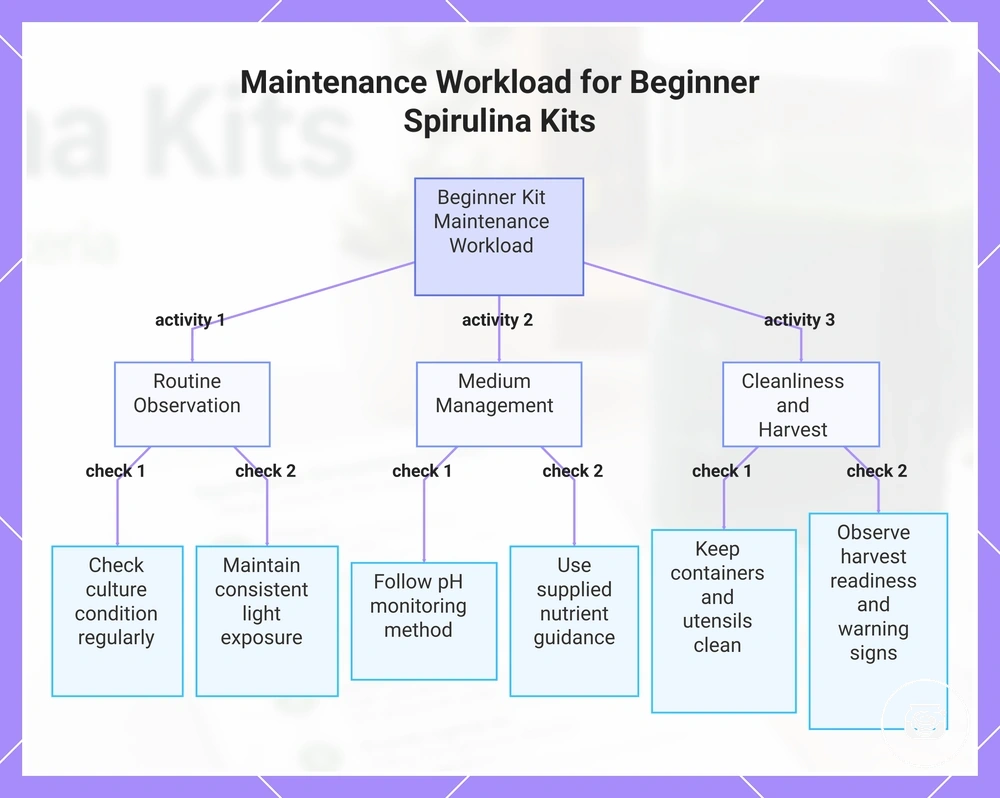
A beginner spirulina growing kit requires regular maintenance workload after setup because culture stability depends on continued routine observation, light consistency, pH checking, water quality, medium management, and cleanliness. The reviewed evidence does not define a universal maintenance frequency or time requirement for all beginner kits because workload changes with culture size, indoor conditions, and the supplied equipment. A beginner kit should therefore be regarded as requiring manageable ongoing attention rather than being hands-off.
These activities represent a manageable care workload rather than continuous maintenance.
After the initial setup, a typical beginner monitors the culture during routine checks instead of following an exact daily schedule. For example, a compact culture container generally requires less observation than a larger growing system because there is less culture volume to monitor, although the reviewed evidence does not specify a standard culture size or maintenance duration that applies to every kit. Regular observation of light consistency, pH checking, nutrient or medium management, and cleanliness helps confirm that the culture remains suitable for continued growth, while unexpected changes in appearance or water condition usually indicate that additional attention is needed. These activities represent a manageable care workload rather than continuous maintenance.
- Routine observation: Check the visible culture condition regularly because early changes are easier to recognise before they require additional care.
- Light consistency: Maintain consistent light exposure because changing the growing environment frequently can make culture conditions less stable.
- pH checking: Follow the monitoring method described by the kit rather than applying one universal testing schedule to every beginner kit.
- Nutrient or medium management: Use the supplied medium or nutrient guidance so the culture continues growing under the intended conditions.
- Cleanliness: Keep containers and utensils clean because contamination increases the maintenance workload and may require additional monitoring.
- Harvest readiness and warning signs: Observe whether the culture appears ready for harvesting according to the kit guidance, and expect extra attention if noticeable changes in colour, clarity, or overall culture condition occur unexpectedly.
This chart shows the key maintenance activities a beginner should expect after setting up a spirulina growing kit, including routine observation, medium management, and cleanliness checks.
Beginner Mistakes That Affect Kit Choice
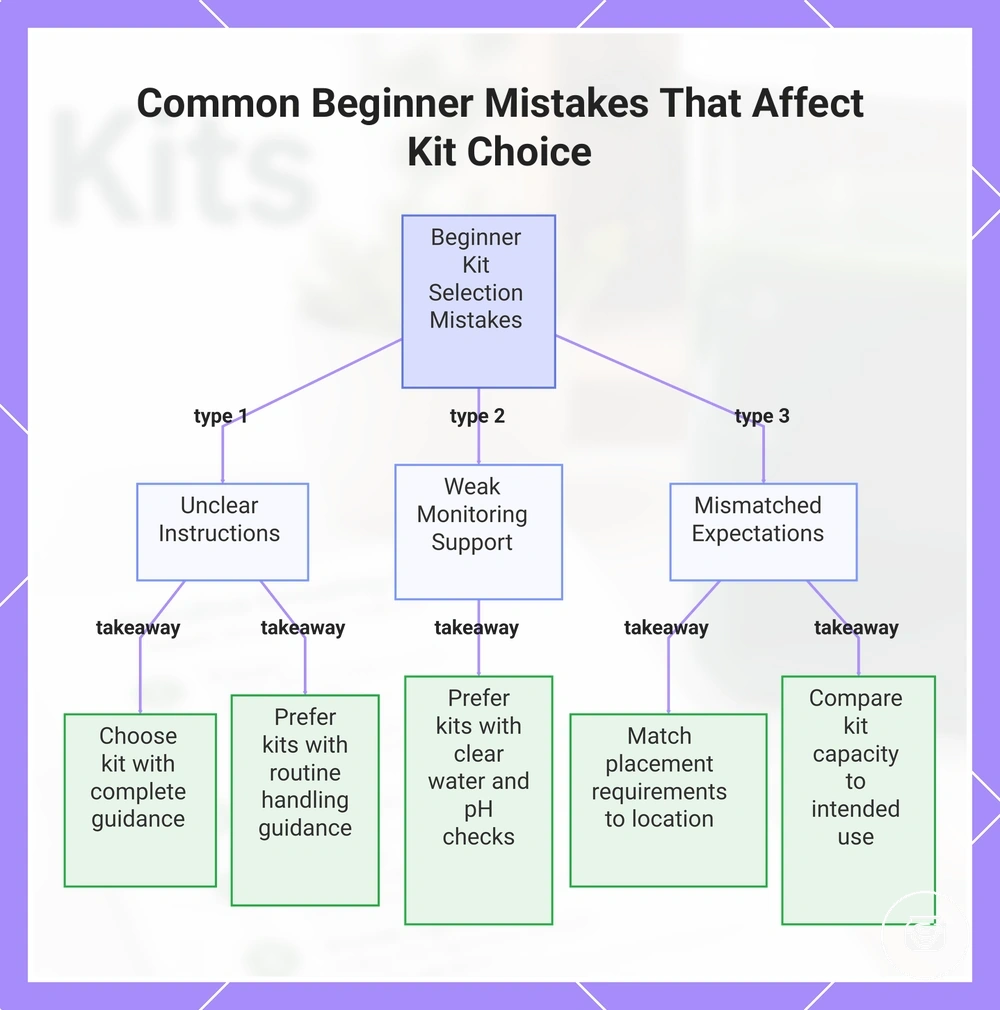
Beginner mistakes that affect kit choice usually occur before purchase because the selected kit lacks clear setup guidance, adequate monitoring support, or realistic expectations for first-time cultivation. The reviewed evidence shows that the most common selection risks are unclear instructions, weak monitoring support, and mismatched expectations, so a suitable beginner kit should explicitly explain these areas before cultivation begins rather than leaving them to trial and error.
These are selection-related risks because they often reflect missing kit guidance rather than post-purchase repair needs.
A common first-grow scenario is choosing a kit that provides little water guidance or pH guidance, then interpreting routine uncertainty as a product problem instead of a missing support feature. Another frequent issue is poor placement, unrealistic expectations from a compact starter kit, overlooking cleanliness guidance, or assuming slow growth means total failure rather than normal early culture development. These are selection-related risks because they often reflect missing kit guidance rather than post-purchase repair needs. If guidance is followed but problems continue, consult the dedicated guide to common beginner problems for diagnosis beyond kit selection.
- Overestimating ease: Beginner mistake: Expecting the kit to require almost no ongoing attention. Kit support gap: Unclear instructions about routine observation and maintenance. Selection implication: Choose a kit with complete beginner guidance.
- Ignoring water and pH guidance: Beginner mistake: Selecting a kit without checking how water quality or pH should be monitored. Kit support gap: Weak monitoring support. Selection implication: Prefer kits that clearly explain water and pH checks.
- Poor placement: Beginner mistake: Buying a kit before confirming suitable indoor light and available space. Kit support gap: Limited placement guidance. Selection implication: Select a kit whose placement requirements match the intended growing location.
- Buying too small for expectations: Beginner mistake: Expecting frequent harvests from an entry-level culture size. Kit support gap: Mismatched expectations about usable growing capacity. Selection implication: Compare kit capacity with intended household use before purchasing.
- Skipping cleanliness: Beginner mistake: Treating cleaning guidance as optional. Kit support gap: Incomplete cleanliness instructions. Selection implication: Prefer kits that explain routine culture handling and cleaning from the beginning.
- Confusing slow growth with total failure: Beginner mistake: Assuming early slow development means the culture cannot recover. Kit support gap: Weak expectation setting about early culture behaviour. Selection implication: Choose kits that explain normal early growth patterns and observation expectations.
This chart categorizes the most common beginner kit selection mistakes and provides actionable selection implications to choose a suitable kit.
Light, pH, Water Quality, and Culture Crash Risks
Light, pH, water quality, and culture stability become beginner risk points when a spirulina growing kit provides weak guidance for monitoring these conditions. The reviewed evidence does not establish a universal symptom, numerical threshold, or single indicator that reliably predicts culture crash risks across all beginner kits, so clear kit instructions remain the primary selection requirement. Because observable problems can overlap, one visible change should not be interpreted as evidence of a single cause.
This subsection supports kit selection rather than culture repair.
This subsection supports kit selection rather than culture repair. It connects common observable problems to the level of guidance included with a beginner kit and intentionally avoids exact corrective procedures because symptoms and underlying conditions can overlap.
| Factor | Weak kit support | Possible symptom or risk | Selection implication |
|---|---|---|---|
| Light | Little or no guidance on light exposure, placement, or routine observation. | Observable changes in culture appearance or slower development could have multiple explanations rather than indicating one specific problem. | Choose a kit that clearly explains light requirements and how to monitor them during routine growing. |
| pH | Missing pH monitoring guidance or no explanation of when pH should be checked. | Condition changes become more difficult to interpret because pH trends cannot be compared with kit guidance. | Prefer kits that include practical pH monitoring instructions or compatible testing support. |
| Water quality | Unclear instructions for water preparation or acceptable water condition. | Uncertainty about water quality can increase concern about culture stability without identifying a confirmed cause. | Select kits that provide clear water preparation guidance before cultivation begins. |
| Culture stability | Limited explanation of expected early culture behaviour or stability checks. | Overlapping symptoms could be mistaken for culture crash risks even when further observation is needed. | Prefer kits that explain normal culture development and define observation boundaries before purchase. |
Cleaning and Contamination Checks Before Growing
Cleaning checks and contamination checks reduce early culture risk by helping beginners start a spirulina growing kit with clean handling and by identifying observable warning signs before cultivation begins. The reviewed evidence does not define a universal visual, smell, or handling threshold that confirms a culture is suitable or contaminated, so beginners should follow the kit's handling instructions and use observable checks as an initial screening step rather than a final safety assessment. If uncertainty remains after these checks, the culture should be treated cautiously until the supplier's guidance is confirmed.
If uncertainty remains after these checks, the culture should be treated cautiously until the supplier's guidance is confirmed.
A questionable culture should not be treated as a normal variation when clear warning signs are present because visible observations alone cannot identify every possible cause. Cleaning checks reduce avoidable handling mistakes, while contamination checks provide a practical stop signal before cultivation begins. Questions involving harvesting or consumption decisions require broader safety and contamination guidance than this pre-grow checklist covers.
- Clean container: Confirm the growing container is visibly clean, free from residue, and undamaged before adding the starter culture. If the container appears unsuitable, clean or replace it before use.
- Covered storage: Check that the starter culture and supplied materials have remained covered according to the kit instructions before setup. Covered storage helps reduce unnecessary exposure during beginner handling.
- Utensil cleanliness: Use clean utensils dedicated to culture handling where practical. Visible residue or dirt is a clear indication that the utensil should be cleaned before use.
- Suspicious smell or visible contamination: If the starter culture has a suspicious smell or obvious visible contamination before cultivation, treat this as a stop signal and do not continue using that questionable culture until appropriate supplier guidance is available.
- Water preparation: Prepare water exactly as described in the kit instructions before introducing the culture because improvised or unclear water preparation increases early uncertainty.
- Questionable culture: If one or more warning signs remain after the cleaning checks and contamination checks, do not assume the culture is suitable simply because the cause is unknown.
When a Beginner Kit Is Enough and When Another Kit Type Fits Better
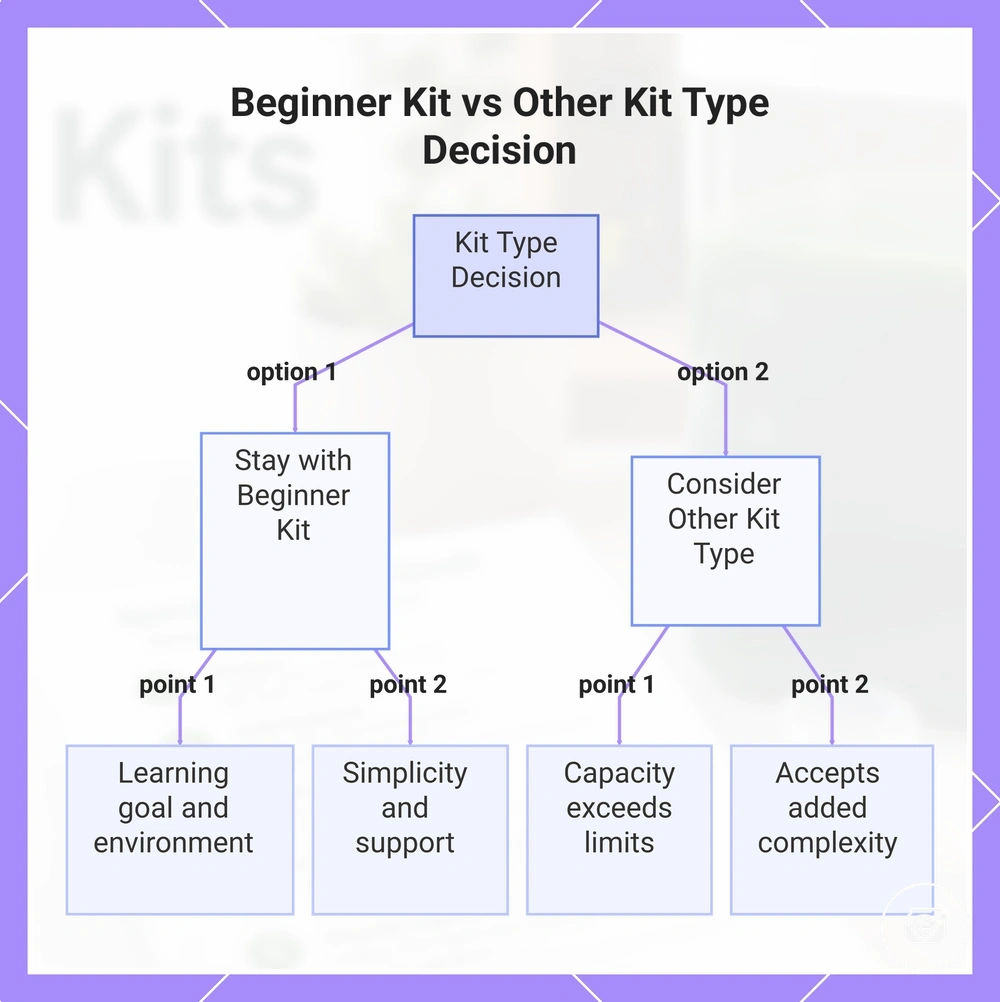
A beginner kit is enough when the user's learning goal is a first home grow, the available indoor conditions suit a compact setup, the included support covers essential monitoring, and the expected maintenance and capacity remain manageable. The reviewed evidence does not establish one universal culture volume, component count, or maintenance threshold that separates a beginner kit from another kit type, so the selection condition is whether the kit's support and limitations match the intended use.
Stable indoor conditions and a realistic maintenance tolerance make this simpler format easier to manage.
For a low-effort learner, a beginner kit fits when straightforward setup and limited equipment matter more than broader capacity. A small culture limitation is acceptable when the main objective is learning rather than frequent harvesting. Stable indoor conditions and a realistic maintenance tolerance make this simpler format easier to manage. The beginner kit therefore fits because it reduces first-grow complexity without claiming that cultivation requires no ongoing attention.
A more complex system can weaken confidence when its additional parts are not clearly explained.
For a cautious first-time grower, setup confidence should come from clear instructions, matched culture materials, and practical monitoring guidance rather than from the number of accessories. A kit with adequate included support reduces the assumptions required during preparation and routine observation. A more complex system can weaken confidence when its additional parts are not clearly explained. The beginner kit remains suitable only when its instructions and monitoring support cover the user's main uncertainties.
A kit with adequate included support reduces the assumptions required during preparation and routine observation.
For a user who wants more usable growing capacity or fewer separately sourced items, a basic starter format can create a missing-supply risk or restrict the intended scale. A complete kit can reduce separate purchases by including broader monitoring, handling, or harvesting support, but it can also increase setup and maintenance responsibilities. Another kit type becomes more appropriate when the required capacity, included equipment, or long-term use extends beyond the practical limits of a first-grow system.
- Stay with a beginner kit: The learning goal is first-grow experience, the indoor conditions suit a compact setup, and limited capacity is acceptable.
- Stay with a beginner kit: Lower setup complexity matters more than receiving every optional accessory from the start.
- Stay with a beginner kit: The included support covers instructions, basic monitoring, and routine handling well enough to maintain setup confidence.
- Consider another kit type: The expected capacity exceeds what a small culture can practically provide for the intended use.
- Consider another kit type: Reducing missing-supply risk and avoiding multiple separate purchases matter more than keeping the system minimal.
- Consider another kit type: The user accepts additional setup and maintenance in exchange for broader equipment or expansion potential.
The final decision should match the learning goal, indoor conditions, included support, maintenance tolerance, expected capacity, and acceptable trade-offs rather than a product ranking. A beginner kit is sufficient when it supports confident learning within a compact scope; another kit type fits better when capacity or completeness requirements clearly exceed that scope.
Here are product examples that may make comparison easier.
Here are product examples that may make comparison easier. Before buying, always review the compatibility criteria, essential features, and product details.
This chart shows the key conditions for deciding whether a beginner kit is sufficient or whether another kit type is more appropriate.