Spirulina Growing Kit Safety and Contamination Control
A spirulina growing kit supports culture safety only when contamination control combines clean handling, suitable equipment, monitored culture conditions, and a clear discard decision. The home spirulina culture is not proven safe by its colour, smell, growth rate, or one pH result because each check covers only part of the risk. The Food and Agriculture Organization’s review of Spirulina production identifies food-safety management during cultivation and processing as necessary for controlling health risks. Contamination control is therefore conditional risk reduction rather than confirmation that a culture is free from hazards.
Contamination control is therefore conditional risk reduction rather than confirmation that a culture is free from hazards.
The direct safety priority is to limit unwanted material entering the culture and to respond cautiously when its condition changes. Water quality, pH checks, a food-grade culture container with a suitable lid, clean tools, and harvest hygiene provide separate control conditions; none has the value of a complete safety test by itself. The World Health Organization’s guidance on toxic cyanobacteria explains that cyanobacterial hazards require risk assessment and monitoring because potentially harmful toxins cannot be evaluated reliably from appearance alone. Within this safety context, spirulina growing kits are controlled home-cultivation systems whose culture, medium, container, tools, and monitoring practices must be assessed together.
The direct safety priority is to limit unwanted material entering the culture and to respond cautiously when its condition changes.
Contamination risk increases when untreated or uncertain water, unclean contact surfaces, frequent uncovered handling, or reused harvesting equipment creates an exposure route into the home spirulina culture. A practical hygiene routine separates clean spoons, brushes, test materials, filters, and receiving containers from items that have contacted other liquids or surfaces. An abnormal change in colour, smell, surface growth, texture, or pH is a warning sign that requires combined assessment rather than an attempt to restore the culture through one corrective action. The following safety review therefore begins with contamination risks before examining equipment, monitoring conditions, harvest handling, and the discard threshold.
Table of Contents
Safety Risks in Home Spirulina Cultures
Home spirulina culture has a contamination risk when the water source, handling practices, or culture condition allows unwanted biological or chemical contaminants to enter the culture. According to the Food and Agriculture Organization (FAO), safe microalgae production depends on controlled cultivation and hygienic management because contamination risk is determined by growing conditions rather than by home cultivation alone. A home spirulina culture is therefore neither automatically safe nor automatically unsafe, and the level of risk remains conditional on how the culture is maintained.
A home spirulina culture is therefore neither automatically safe nor automatically unsafe, and the level of risk remains conditional on how the culture is maintained.
Contamination risk can originate from an unsafe water source, contaminated hands or tools, open-air exposure, or culture conditions that permit unwanted microbial growth. Scientific reviews published in 2022 and 2024 report that cyanobacteria cultures may also be affected by toxin concern or heavy metal exposure when contaminated water or unsuitable growing environments are involved, while visual inspection alone cannot confirm or exclude these hazards because laboratory analysis is required for reliable detection. For example, if two cultures appear equally green but only one is prepared with microbiologically safe water and clean equipment, the visible appearance does not provide evidence that both cultures have the same safety profile.
Safety risks in home spirulina cultures are easier to understand when the main contamination sources are separated from ordinary culture problems.
Safety risks in home spirulina cultures are easier to understand when the main contamination sources are separated from ordinary culture problems. The following diagram summarises the principal contamination routes and the practical warning signs that should be interpreted cautiously before any prevention or cleaning measures are considered.
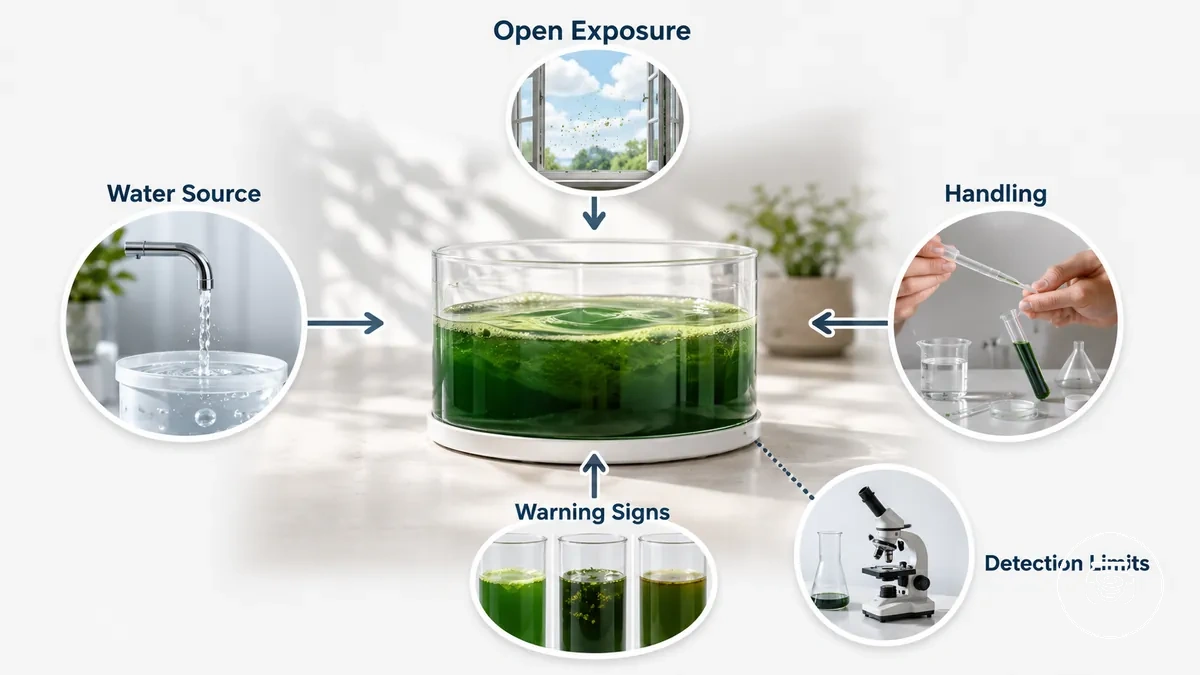
- Water source: Untreated or contaminated water increases contamination risk, while unexpected culture changes should be treated as warning signs instead of proof that contamination exists.
- Handling: Unclean hands, harvesting tools, or measuring equipment create an exposure route that can introduce unwanted microbial growth into a home spirulina culture.
- Culture condition: Abnormal colour, odour, surface films, or unexpected texture changes are warning signs that require cautious interpretation and may justify discarding the culture when multiple signs occur together.
- Toxin concern and heavy metal exposure: These hazards cannot be confirmed through colour or smell because their detection normally requires laboratory testing using validated analytical methods.
Weak growth or slow biomass production usually indicates unsuitable light, temperature, nutrients, or other culture conditions rather than contamination by itself. Likewise, reported reactions after consuming commercial spirulina supplements should not be used to judge the contamination risk of a home spirulina culture because they describe a different safety context.
How Spirulina Cultures Become Contaminated
A spirulina culture becomes contaminated only when a contamination pathway allows unwanted biological or chemical material to reach the culture surface. According to the Food and Agriculture Organization (FAO), contamination risk in microalgae cultivation is determined by cultivation conditions and handling practices rather than by home cultivation itself. The most common local entry pathways are hands, utensils, an open container exposed to airborne debris, untreated water, poor cleaning, and a stressed culture.
A spirulina culture becomes contaminated only when a contamination pathway allows unwanted biological or chemical material to reach the culture surface.
For example, repeatedly opening the culture to stir it with the same utensil used elsewhere creates more than one exposure route, but the pathway alone does not prove contamination has occurred because no visible contact point can confirm contamination without additional evidence. The annotated example below shows how spirulina cultures become contaminated by illustrating the principal exposure routes that can reach the culture during routine handling.
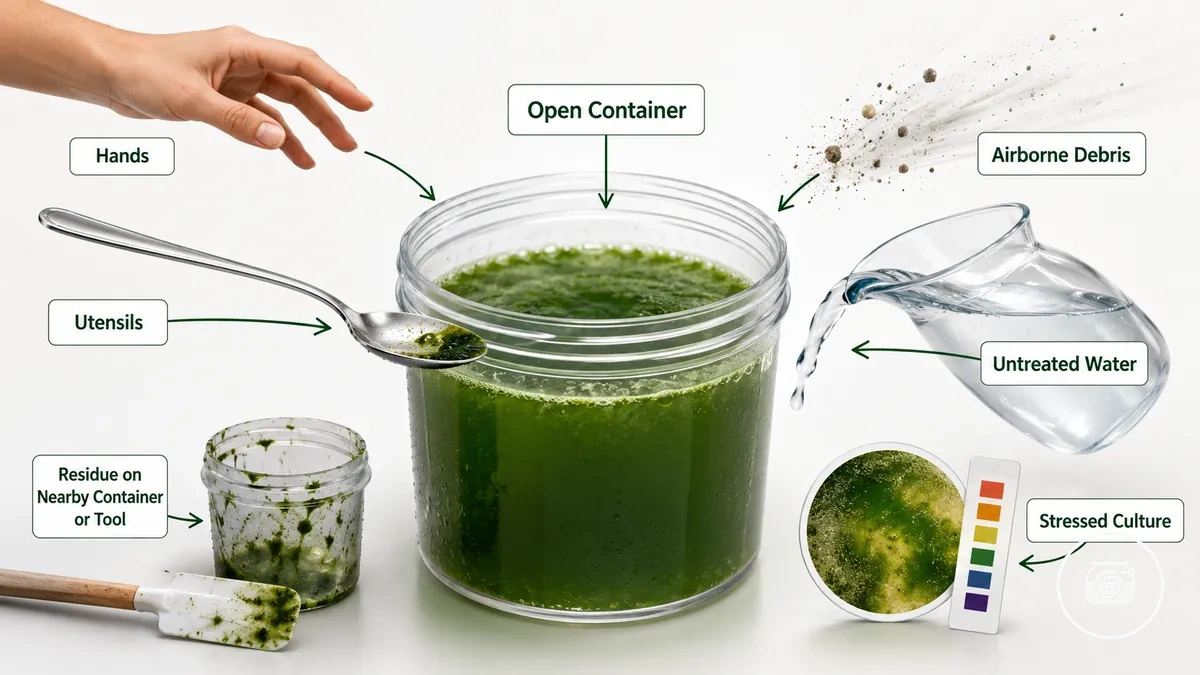
How spirulina cultures become contaminated commonly involves these local contamination pathways:
- Hands: Direct contact with the culture surface creates a contact point that can transfer microorganisms or other contaminants into the culture.
- Utensils: Reusing stirring or harvesting utensils without proper cleaning creates an exposure route that carries residue from previous contact into the culture.
- Open container: Leaving the lid off exposes the culture to airborne debris, dust, and droplets that may settle on the liquid surface, although this pathway alone does not confirm contamination.
- Untreated water: A water source of uncertain microbiological quality introduces one of the most direct contamination pathways because it mixes immediately with the culture medium.
- Poor cleaning: Residual material on containers or equipment provides a contamination pathway by transferring unwanted material during routine handling.
- Stressed culture: A stressed culture showing pH drift or weak growth is generally less resilient to repeated exposure routes, so continued handling requires greater caution even though stress alone is not evidence that contamination has occurred.
Microbial, Toxin, and Heavy Metal Risk Boundaries
Microbial contamination, toxin concern, and heavy metal exposure are separate contaminant classes because each has a different detection boundary in a home spirulina culture. Microbial contamination may produce observable changes, while cyanotoxins and dissolved metals require analytical measurement to confirm their presence or concentration. The World Health Organization’s Toxic Cyanobacteria in Water guidance distinguishes organism identification from cyanotoxin analysis, confirming that these contaminant classes require different evidence.
Visual signs cannot establish that a home spirulina culture is free from toxins or heavy metals.
Visual signs cannot establish that a home spirulina culture is free from toxins or heavy metals. An unusual smell, surface growth, cloudiness, or texture change may support concern about microbial contamination, but the World Health Organization reports that known cyanobacterial toxins do not reliably alter taste or odour; heavy metal exposure is likewise not determined by the appearance of the culture medium. Microbial, toxin, and heavy metal risk boundaries therefore require a safer decision based on the contaminant class, the available evidence, and the limits of home observation.
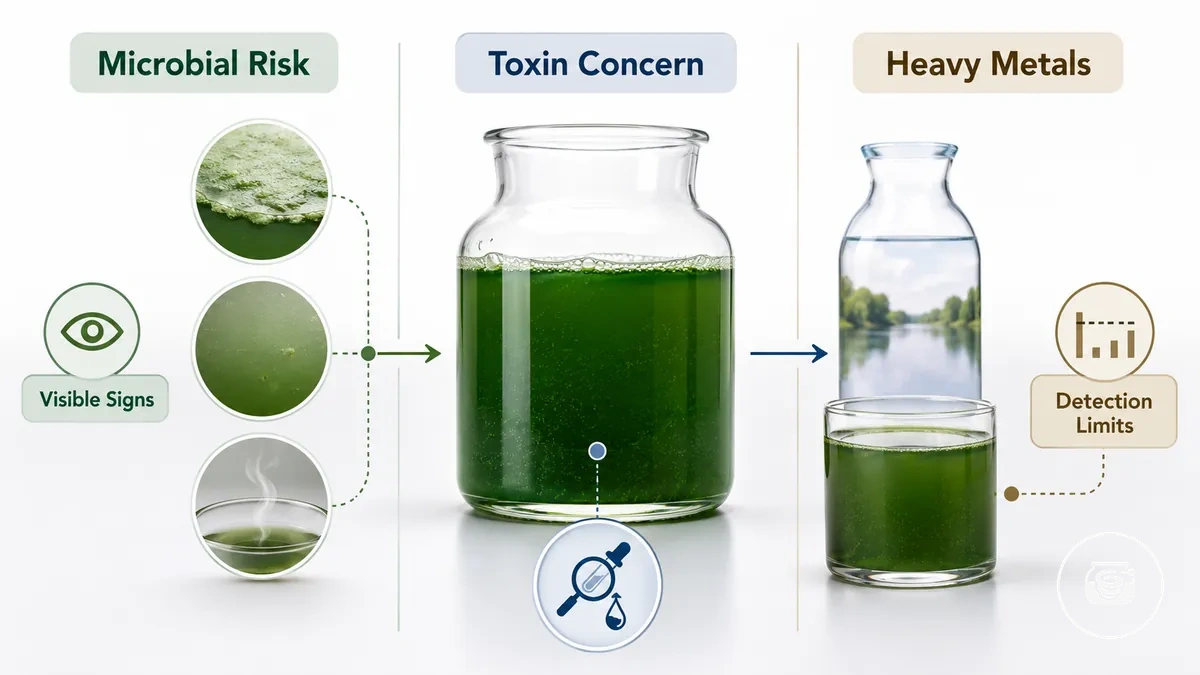
| Contaminant class | What may be observable | What is not reliably visible | Safer interpretation |
|---|---|---|---|
| Microbial contamination | Unexpected smell, surface growth, cloudiness, film, or abnormal texture | The organism’s identity, concentration, and health significance | Treat combined abnormal signs as evidence of uncertainty and discard the culture when its condition cannot be explained safely. |
| Toxin concern | No dependable visual, taste, or odour signal | The toxin type, presence, and concentration | Do not treat normal appearance as evidence that the culture is free from cyanotoxins. |
| Heavy metal exposure | No dependable visual signal in the water or culture medium | The metal type and concentration accumulated from the water source or medium | Use source-water and medium records to reduce uncertainty; appearance alone cannot verify this risk. |
Routine culture and medium checks can reveal abnormal culture conditions, but they do not measure cyanotoxins or heavy metal concentrations. The Food and Agriculture Organization identifies food-safety management during Spirulina production and processing as necessary because cultivation conditions and source materials affect contamination risk. When toxin concern or heavy metal exposure cannot be excluded with appropriate evidence, rinsing, visual inspection, or home treatment does not close the detection gap, and discard is the safer boundary decision.
Food-grade Containers and Covered Culture Handling
A food-grade container is a culture container made from materials intended for food contact, with a non-reactive surface that can be cleaned effectively and used with covered culture handling to reduce contamination opportunities. Guidance from Penn State Extension states that food should be stored in food-grade containers rather than containers previously used for chemicals or other unsuitable materials, while public food-safety guidance from Better Health Channel recommends keeping food covered to minimise contamination. For a home spirulina kit, the contamination-control effect comes from combining suitable material, lid coverage, transparency, surface condition, and cleanability instead of relying on any single container feature.
The annotated example below highlights the container attributes that contribute to contamination control, and the table organises each attribute by its practical safety role.
Food-grade containers and covered culture handling reduce exposure only when the container remains clean and the lid limits unnecessary opening without preventing routine monitoring. Transparent walls allow visual observation of the culture without frequent lid removal, while smooth, non-reactive materials are easier to inspect and clean than rough or damaged surfaces that can retain residue. The annotated example below highlights the container attributes that contribute to contamination control, and the table organises each attribute by its practical safety role.
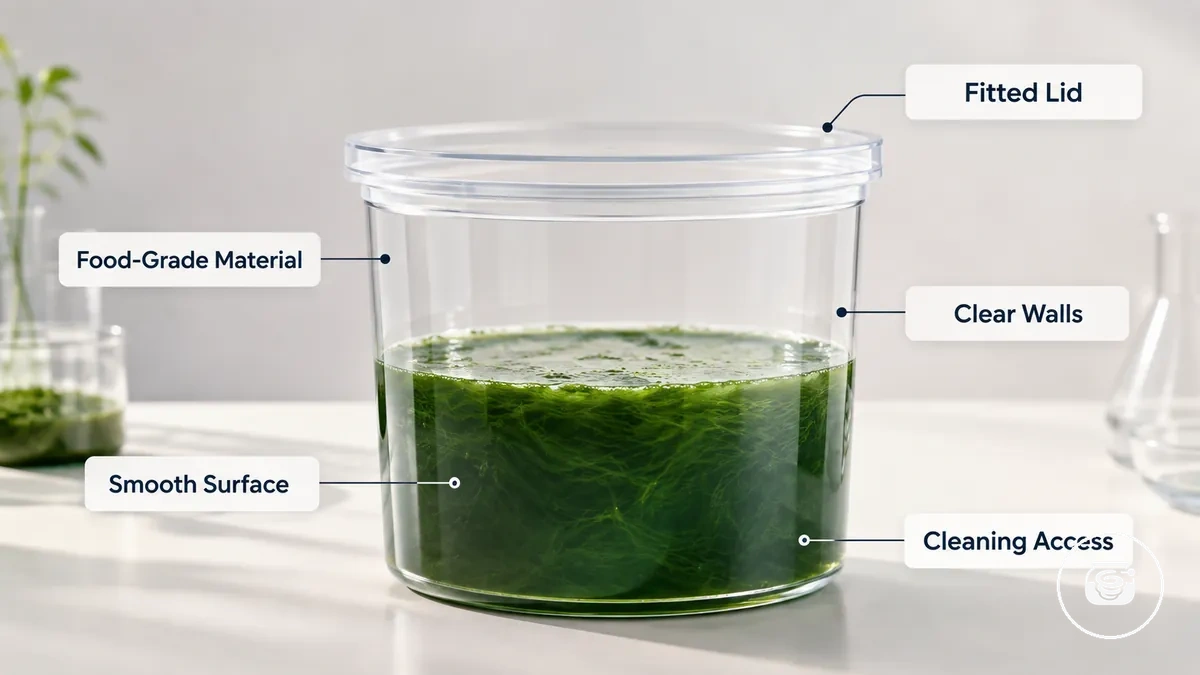
| Container attribute | Safer condition | Why it matters | Caution |
|---|---|---|---|
| Material | Food-grade, non-reactive material intended for food contact | Reduces the chance of unwanted interaction between the container and culture medium | Avoid containers previously used for chemicals or non-food substances. |
| Lid fit | Close-fitting removable lid | Limits airborne exposure while allowing routine inspection and maintenance | A covered container reduces exposure but does not eliminate contamination risk. |
| Transparency | Clear walls for visual monitoring | Supports observation without frequent opening | Good visibility does not replace hygiene checks. |
| Surface condition | Smooth, undamaged interior | Residue is easier to detect and remove | Replace containers with cracks, deep scratches, or persistent staining. |
| Cleanability | Wide enough opening for thorough cleaning | Improves access to all internal surfaces | Difficult-to-reach areas may retain residue after washing. |
For example, using a clean transparent food-grade container with a fitted lid allows the culture to be checked visually throughout the day while reducing unnecessary exposure caused by repeatedly leaving the culture uncovered. This practical combination improves contamination control because the container remains easy to inspect and clean, although it does not prove that the culture is free from contamination or safe for consumption.
Transparent, Non-reactive Containers for Spirulina Culture
A transparent container allows continuous visual monitoring of a spirulina culture, while a non-reactive container is made from a stable material that does not normally interact with the culture medium during routine cultivation. According to the Food and Agriculture Organization (FAO), cultivation containers should support hygienic handling and culture observation because contamination control depends on maintaining stable growing conditions. A transparent container therefore helps identify colour changes or surface film without frequent lid removal, improving routine monitoring while reducing unnecessary exposure.
A scratched or damaged container can make monitoring more difficult because surface marks may obscure colour changes and can retain residue after cleaning.
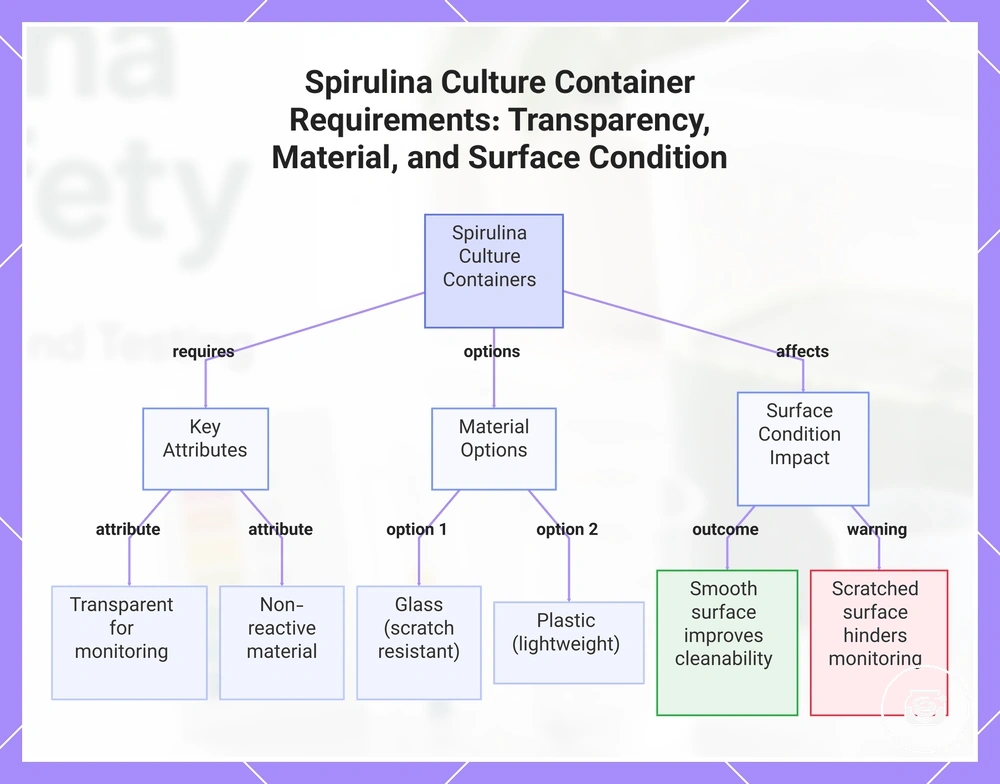
A scratched or damaged container can make monitoring more difficult because surface marks may obscure colour changes and can retain residue after cleaning. Glass generally provides greater scratch resistance than food-grade plastic during normal handling, while food-grade plastic is lighter and more resistant to breakage, although its surface condition depends on use. If either material remains smooth and non-reactive, cleanability improves and residue risk is reduced because deposits are easier to detect and remove, supporting more reliable spirulina culture monitoring over repeated cleaning cycles.
This chart shows the key attributes, material options, and surface condition impacts for spirulina culture containers based on FAO guidelines.
This chart shows the key attributes, material options, and surface condition impacts for spirulina culture containers based on FAO guidelines.
Covered Containers That Reduce External Contamination
A covered container reduces external contamination by limiting exposure to airborne particles, splashes, and unnecessary contact while still allowing routine observation and handling. According to the Food and Agriculture Organization (FAO), contamination control in microalgae cultivation depends on hygienic handling and controlled growing conditions rather than complete isolation of the culture. A covered container therefore provides exposure reduction but does not guarantee safety or prevent every contamination event.
Handle the cover carefully after removal to avoid transferring contaminants from surrounding surfaces back onto the culture.
During routine cultivation, each lid opening briefly exposes the culture to the surrounding environment, so opening frequency should be limited to necessary monitoring, stirring, or harvesting. A good lid fit provides splash protection while allowing the culture to receive the airflow required for normal management, and the contact surface between the lid and container rim should remain clean because residue can be transferred each time the container is opened or closed. Handle the cover carefully after removal to avoid transferring contaminants from surrounding surfaces back onto the culture.
During routine cultivation, each lid opening briefly exposes the culture to the surrounding environment, so opening frequency should be limited to necessary monitoring, stirring, or harvesting.
Covered containers that reduce external contamination are most effective when these conditions are followed:
- Lid fit: Use a fitted lid that covers the container securely without creating an airtight or permanent seal.
- Opening frequency: Open the covered container only when observation, stirring, harvesting, or maintenance is required to minimise unnecessary exposure.
- Splash protection: Keep the cover in place whenever practical to reduce droplets, dust, and accidental splashes reaching the culture surface.
- Airflow needs: Maintain normal culture airflow according to the growing method instead of sealing the container completely.
- Contact surface: Keep the lid and container rim clean before replacing the cover because these surfaces can transfer residue during repeated handling.
Clean Tools, Hands, and Workspace Routines
Clean tools, clean hands, and consistent workspace routines reduce contamination transfer by limiting the movement of microorganisms and residue from the grower, culture tools, and work surfaces into the spirulina culture. The World Health Organization states that hand hygiene interrupts contamination transfer, while the Food and Agriculture Organization reports that hygienic handling is a core requirement for safe microalgae cultivation. Routine consistency therefore reduces transfer opportunities more effectively than occasional deep cleaning, although it does not guarantee that a culture is safe.
Continue these pre-contact hygiene checks alongside the safe setup steps so the same handling routine is followed throughout cultivation.
Before measuring nutrients, testing pH, or harvesting spirulina, wash and dry your hands, prepare a clean workspace, and inspect the measuring spoon, cleaning brush, test strips, harvest filter, containers, and every contact surface for visible residue or damage. If returned liquid, damp residue, or debris contacts any culture tool, clean it before reuse because contamination can be transferred during the next handling step. Continue these pre-contact hygiene checks alongside the safe setup steps so the same handling routine is followed throughout cultivation.
If returned liquid, damp residue, or debris contacts any culture tool, clean it before reuse because contamination can be transferred during the next handling step.
Clean a culture tool immediately after it contacts the spirulina culture, replace it when residue cannot be removed or when cracks, worn bristles, torn filter material, or other damage prevent reliable cleaning, and keep it out of the culture whenever its cleanliness is uncertain. For example, if a measuring spoon falls onto a dirty work surface before use, exclude it from the culture until it has been cleaned because the contact surface can transfer contaminants even when no residue is visible.
For example, if a measuring spoon falls onto a dirty work surface before use, exclude it from the culture until it has been cleaned because the contact surface can transfer contaminants even when no residue is visible.
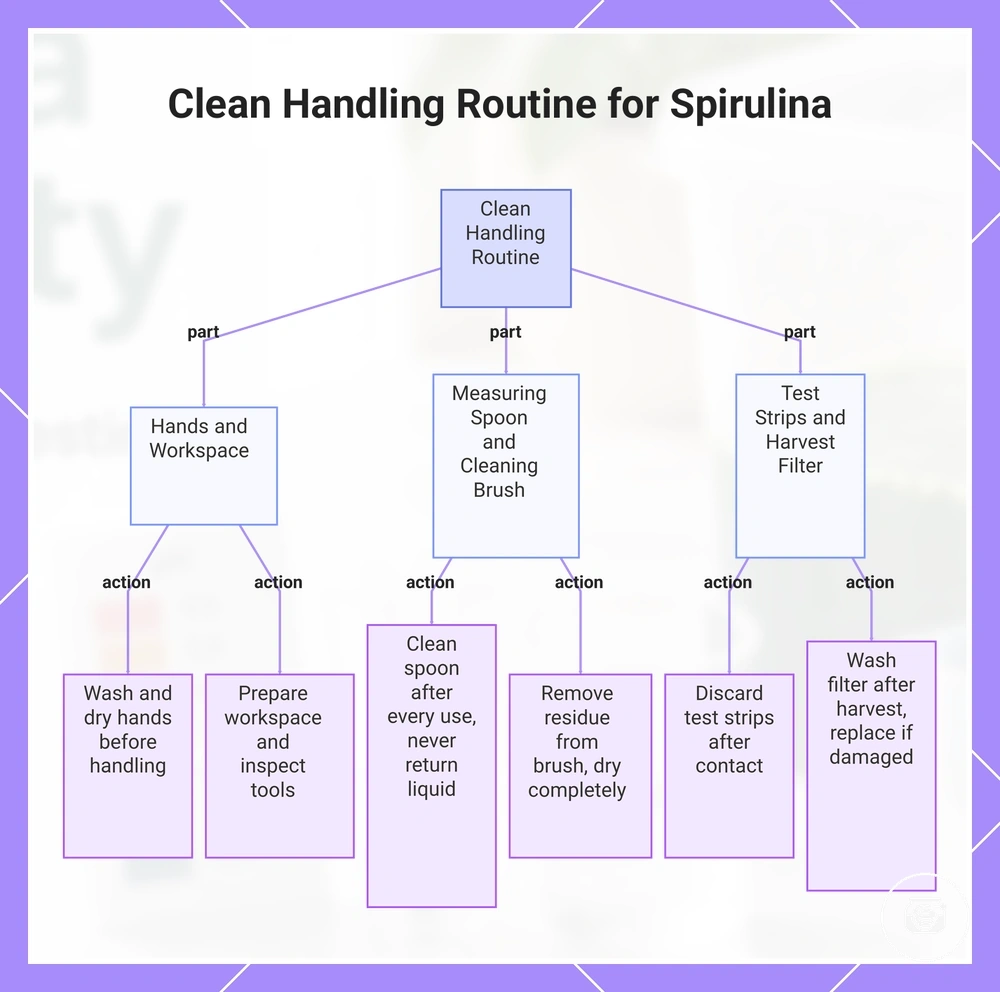
Clean tools, hands, and workspace routines are easiest to maintain when every culture-handling session follows the same sequence:
- Hands: Wash and dry hands before touching culture tools to reduce contamination transfer from skin to the spirulina culture.
- Measuring spoon: Clean the spoon after every use and never return unused culture liquid from the spoon to the main container because it increases cross-contamination risk.
- Cleaning brush: Remove visible residue after cleaning and allow the brush to dry completely before reuse so moisture and trapped debris are less likely to remain on the bristles.
- Test strips: Keep unused test strips dry and discard any strip after it contacts the culture instead of returning it to the storage container.
- Harvest filter: Wash the filter after harvesting and replace it if residue remains trapped or the filter material becomes damaged because reliable cleaning is no longer possible.
- Workspace: Wipe the work surface before culture handling so dust, spills, and residue are less likely to reach the spirulina culture through repeated contact with tools and containers.
This chart shows the key steps for maintaining clean tools, hands, and workspace during spirulina cultivation to reduce contamination transfer.
Sanitising Culture Equipment Before Use
Sanitising culture equipment before use reduces transfer risk only when every contact surface is cleaned in the correct sequence: wash, rinse, sanitise, then dry. The U.S. Centers for Disease Control and Prevention (CDC) states that cleaning removes dirt and residue before disinfection or sanitising is effective, while Food Standards Australia New Zealand (FSANZ) explains that food-contact equipment should be cleaned before sanitising because residue reduces sanitising performance. Sanitising therefore applies only before culture contact and does not make an already unsafe spirulina culture suitable for use.
Sanitising therefore applies only before culture contact and does not make an already unsafe spirulina culture suitable for use.
Sanitising culture equipment before use follows this residue-focused sequence:
- Wash: Wash culture equipment thoroughly to remove visible residue from every contact surface because residue prevents effective sanitising.
- Rinse: Rinse the equipment completely with clean water so loosened residue and cleaning agents are removed before sanitising, reducing transfer risk from remaining deposits.
- Sanitise: Apply a sanitising method that is appropriate for the equipment material and follows the product or manufacturer instructions because suitable methods differ between materials and sanitising products.
- Dry: Allow the equipment to air-dry or place it on a clean, dry surface before culture contact. Do not use culture equipment if sanitising residue or other visible residue remains on any contact surface because residue can increase transfer risk.
Preventing Cross-contamination During Handling
Preventing cross-contamination during handling requires keeping every clean contact point separate from every contaminated contact point while testing, feeding, harvesting, and repeated culture maintenance. According to the Food and Agriculture Organization (FAO), hygienic handling is a core control measure for microalgae cultivation because microorganisms and residue are transferred through contaminated equipment, hands, liquids, and contact surfaces. In a home spirulina culture, cross-contamination is the transfer of unwanted material from one contact point, tool, or liquid to another during routine handling.
In a home spirulina culture, cross-contamination is the transfer of unwanted material from one contact point, tool, or liquid to another during routine handling.
During testing, returning liquid from a measuring spoon or replacing a used test strip into its storage container creates a transfer route from a contaminated contact point back to a clean one. During feeding and harvesting, tool reuse, hand contact, shared containers, and wet surfaces increase culture risk because each additional contact provides another opportunity for residue transfer, even if contamination has not been confirmed. For example, using one harvest filter for two culture containers without cleaning it between batches transfers residue directly from one culture to the next, making harvesting and repeated handling the highest-risk contact moments.
During testing , returning liquid from a measuring spoon or replacing a used test strip into its storage container creates a transfer route from a contaminated contact point back to a clean one.
Preventing cross-contamination during handling:
- Do: Use clean tools for testing, feeding, and harvesting. Don't: Continue tool reuse after a tool has contacted another culture, container, or unclean surface.
- Do: Keep clean hands away from contaminated contact points before touching the culture. Don't: Allow unnecessary hand contact with the culture or with clean tools after touching other surfaces.
- Do: Collect harvested spirulina in a dedicated clean container. Don't: Use shared containers that already contain another culture, residue, or harvested material.
- Do: Discard used testing liquid after measurement. Don't: Pour returned liquid back into the culture because its cleanliness can no longer be verified.
- Do: Dry filters, tools, and work areas before the next handling step. Don't: Leave wet surfaces in contact with clean equipment because moisture can transfer residue between contact points.
pH and Water Checks for Safer Culture Conditions
pH checks and water quality checks help interpret whether a spirulina culture remains under expected growing conditions, but neither check proves that the culture is safe or edible. The Food and Agriculture Organization reports that culture monitoring and hygienic production controls must be considered together because cultivation measurements alone cannot confirm food safety. These checks are therefore supporting safety signals, not substitutes for contamination assessment.
The table shows how each criterion should be interpreted alongside sensory checks.
Safety-supporting criteria are conditions and observations used together to identify changes that need investigation. pH checks show whether the culture continues to maintain the alkaline conditions specified by the kit guidance, while water quality reflects the consistency and source quality of the culture water. Test frequency should support trend monitoring because one result cannot distinguish a temporary reading from an abnormal change. The table shows how each criterion should be interpreted alongside sensory checks.
| Check | What it indicates | What it cannot prove | Safer response |
|---|---|---|---|
| pH | Whether the culture remains within the alkaline conditions specified by its kit guidance and whether the reading is changing from its previous pattern | That the culture is free from contamination or suitable for consumption | Compare the result with earlier readings and the kit guidance; investigate an unexplained trend instead of relying on one test strip. |
| Water source | Whether the culture water comes from a consistent source with known handling conditions | That microorganisms, metals, or chemical residue are absent | Use a reliable source and reassess the culture if the source quality, treatment, storage, or appearance changes. |
| Clarity or odor | Whether visible or sensory conditions differ from the culture's established pattern | The cause of the change or the identity of any contaminant | Interpret unusual clarity, odor, film, or discoloration with pH results and other visible signs. |
| Test frequency | Whether repeated measurements form a stable or changing trend | That one normal reading confirms safety | Follow the kit guidance and record results consistently enough to compare each reading with the previous pattern. |
| Abnormal change | That one or more monitored conditions have moved away from the culture's established pattern | Whether the cause is contamination, water quality, handling, or another culture condition | Pause routine use, check the water source and handling history, and discard the culture when combined warning signs remain unexplained. |
An abnormal result should trigger combined interpretation rather than an immediate claim that contamination has or has not occurred. A stable pH trend and consistent source quality do not override unusual odor, surface film, discoloration, or other sensory changes. The World Health Organization explains that many biological and chemical hazards require analytical testing, so growth-condition checks support monitoring but do not replace contamination assessment.
Safe Alkaline pH Signals for Spirulina Culture
An alkaline pH is a supporting pH signal for a spirulina culture, with published strain-specific studies reporting growth-supporting conditions near pH 9.0 to 9.5. A study in the Brazilian Journal of Microbiology found enhanced dry biomass at pH 9.0, while research on Arthrospira platensis NIES-39 reported optimum growth between pH 9.0 and 9.5; these values apply to the tested strains and conditions, not every culture medium or kit. Alkaline conditions may also reduce pressure from organisms less adapted to high pH, but pH remains one condition signal rather than proof that the culture is safe.
The safer decision is based on the confirmed trend and combined warning signs rather than one pH reading.
A reading outside the range specified by the kit should be treated as a warning threshold, not an automatic contamination or discard decision. Retest the culture, compare the result with its previous trend, and review the strain, medium, recent handling, and kit guidance; for example, an isolated change from pH 9.2 to pH 8.7 requires confirmation before it is interpreted as a sustained shift. The safer decision is based on the confirmed trend and combined warning signs rather than one pH reading.
Water Quality Checks That Support Contamination Control
Water quality checks assess whether the water source, treatment history, appearance, and sensory condition create an avoidable transfer or contaminant risk for a spirulina culture. The World Health Organization identifies source protection, treatment, operational monitoring, and verification as separate parts of drinking-water risk management because appearance alone cannot establish microbiological or chemical safety. Water condition is therefore a supporting contamination-control criterion, not proof that a culture is safe.
Water condition is therefore a supporting contamination-control criterion, not proof that a culture is safe.
Questionable source water can introduce biological exposure, chemical residue, or a mineral or contaminant concern before culture contact. Check the source and treatment record first, use clarity and odor as change signals, and seek appropriate testing when the source is private, uncertain, or visibly altered; the U.S. Centers for Disease Control and Prevention advises laboratory testing because harmful germs and chemicals cannot be excluded through sensory checks. These actions remain limited to water-related contamination control rather than complete water chemistry management.
These actions remain limited to water-related contamination control rather than complete water chemistry management.
Water quality checks that support contamination control:
- Water source: Use source water with a known supplier or documented origin. Exclude it when the source, storage container, collection point, or handling history is uncertain because each change creates a new biological or chemical exposure condition.
- Treatment: Confirm that treatment matches the identified water concern and has been completed according to authoritative local guidance. Do not assume filtration, boiling, or another treatment removes every contaminant because treatment capability differs by hazard.
- Clarity: Exclude water showing new cloudiness, particles, colour, or sediment until the change is explained. The U.S. Environmental Protection Agency classifies colour and appearance mainly as aesthetic indicators, so clear water still cannot confirm the absence of harmful contaminants.
- Odor: Exclude water with a new or unexplained odor and investigate the source before use. Normal odor is not evidence of microbiological or chemical suitability.
- Chemical or mineral concern: Request testing for locally relevant hazards when the source may be affected by metals, nitrates, pesticides, volatile organic compounds, or treatment residue. The required analytes depend on the source type, location, land use, and recent contamination events.
- Testing limits: Basic observation and general-purpose test strips do not identify every biological or chemical hazard. Keep uncertain water outside the culture until an appropriate laboratory or local water authority resolves the specific concern.
Visible Signs of Contaminated Spirulina Culture
Do not consume a spirulina culture when strong visible signs or sensory changes appear, including an abnormal smell, unusual color shift, unexplained surface growth, or persistent texture change. The World Health Organization explains that visual and sensory observations cannot identify the specific microorganism, toxin, or chemical hazard involved, so appearance alone cannot confirm the cause. Signs of a potentially contaminated spirulina culture must therefore be interpreted together rather than in isolation.
Rinsing, filtering, or stirring does not resolve this uncertainty.
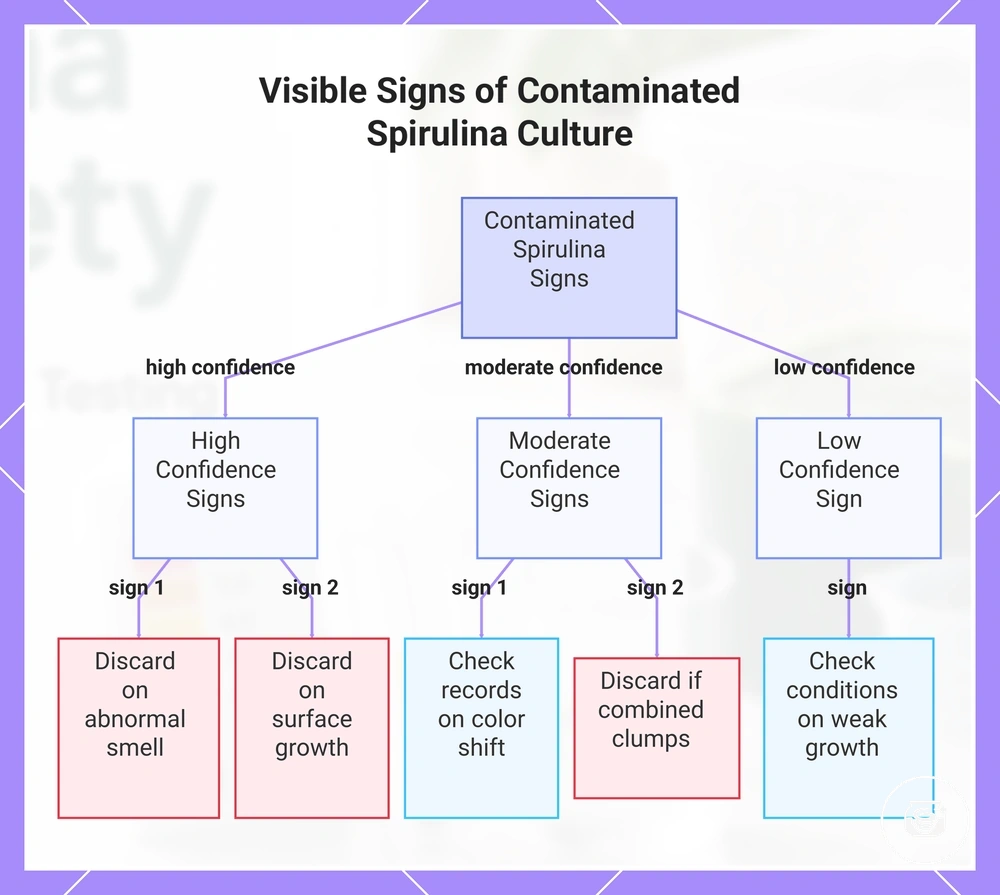
Weak growth alone has limited diagnostic confidence because unsuitable light, temperature, nutrients, mixing, or other culture conditions can produce the same symptom. Combined changes in smell, colour, surface condition, and texture create a stronger reason to stop harvesting and treat the culture as unsafe, while a normal green appearance cannot exclude hazards that lack dependable visible signals. Rinsing, filtering, or stirring does not resolve this uncertainty. The following diagnostic checklist connects each sign with its likely concern, confidence level, and safer next action.
- Abnormal smell: A strong rotten, sour, sewage-like, or otherwise unfamiliar odour indicates a major change in the culture condition. Confidence is high that the culture is abnormal but low for identifying the cause; stop consumption, isolate the container, and discard the culture when the smell remains unexplained.
- Unusual color shift: A rapid change from the established blue-green appearance to brown, grey, yellow, black, or patchy colour may indicate stressed biomass, culture decline, or unwanted growth. Confidence is moderate when colour changes alone; compare the change with pH, water, feeding, and handling records, and discard when it occurs with other warning signs.
- Surface growth or film: New fuzzy material, distinct colonies, an unfamiliar film, or growth that remains separate from the normal culture surface creates a strong contamination concern. Confidence is high that the surface condition is abnormal but insufficient to identify an organism; avoid mixing it into the culture and discard the batch.
- Persistent clumps or texture change: New slime, stringy material, unusual clumps, or a marked change in fluid texture may reflect altered biomass or foreign growth. Confidence is moderate unless smell, colour, or surface changes also occur; stop harvesting and discard the culture when the combined signs remain unexplained.
- Unusual foam, scum, or debris: New material that persists after normal mixing may indicate residue, biological activity, or another changed culture condition. Confidence is moderate because appearance cannot establish the cause; keep the culture out of use and do not assume that filtering restores safety.
- Weak growth without other signs: Slow growth or reduced density is an uncertain case rather than clear evidence of contamination. Confidence is low when smell, colour, surface, and texture remain normal; check cultivation conditions first, then escalate to discard if additional warning signs appear.
For example, a culture that grows slowly but retains its established smell, colour, surface, and texture requires condition checks, while a culture showing both a strong abnormal smell and new surface growth should not be consumed. Use troubleshooting contamination to review related culture problems after completing the immediate warning-sign assessment.
Use troubleshooting contamination to review related culture problems after completing the immediate warning-sign assessment.
This chart groups the visible signs of contaminated spirulina by confidence level and shows the recommended action for each sign.
Colour, Smell, Texture, and Surface Changes
A strong abnormal smell, unexplained surface growth, persistent texture change, or marked colour change is a stop signal for harvesting or consumption until the spirulina culture is assessed. The World Health Organization explains that sensory and appearance changes can indicate altered conditions but cannot identify the specific biological or chemical cause. These signals should therefore be interpreted together across colour, smell, texture, and surface condition.
These signals should therefore be interpreted together across colour, smell, texture, and surface condition.
For example, a culture that becomes slightly lighter after dilution may remain within normal variation when its established smell, texture, and surface remain unchanged. A rapid colour change combined with new clumps, a persistent surface film, or unfamiliar odour creates greater uncertainty and requires a stronger action cue. Mild density variation alone does not establish contamination, but combined or persistent changes require the culture to remain out of use.
Mild density variation alone does not establish contamination, but combined or persistent changes require the culture to remain out of use.
Colour, smell, texture, and surface changes:
- Colour change: A mild and explainable shift after dilution, settling, or a lighting change may fall within normal variation. A rapid brown, grey, yellow, black, or patchy shift is uncertain; stop harvesting and compare it with recent handling and culture records.
- Abnormal smell: A strong rotten, sour, sewage-like, or otherwise unfamiliar odour falls outside normal variation. Stop consumption and discard the culture when the odour remains unexplained.
- Texture change: A temporary density difference after mixing may return to the culture's established texture. Persistent slime, stringiness, or altered fluid consistency requires isolation and supports discard when another warning sign is also present.
- Surface film: A temporary layer that disperses during normal mixing may reflect routine culture behaviour. A new film that persists, thickens, changes colour, or develops an odour requires the culture to remain out of use.
- Clumps and surface growth: Soft biomass may redistribute during mixing, but distinct colonies, fuzzy material, or foreign growth that remains separate is a stop signal. Do not stir it back into the culture; discard the batch without treating appearance as proof of a specific organism.
Distinguishing Weak Growth from Unsafe Contamination
Weak growth means reduced culture development, such as slow density, pale color, or gradual pH drift, whereas unsafe contamination is indicated more strongly by abnormal smell, foreign growth, an abnormal film, or unknown exposure. Environmental stress can reduce spirulina growth without introducing a contaminant, and the World Health Organization reports that harmful microorganisms often do not change a food's appearance or smell. Weak growth is therefore not automatically unsafe, but sensory normality cannot confirm safety.
Weak growth is therefore not automatically unsafe, but sensory normality cannot confirm safety.
Poor growth and contamination concern can overlap when a stressed culture also has an uncertain handling or water history. Compare appearance, smell, surface condition, pH or condition trend, and exposure history; when unknown exposure or multiple unexplained signs prevent a clear distinction, keep the culture out of use and move toward discard or deeper troubleshooting rather than consumption. The comparison below separates weak-growth indicators from signals that require stronger contamination caution.
| Weak growth signal | Unsafe contamination signal |
|---|---|
| Appearance: Slow density or pale color without a sudden colour shift, foreign material, or another sensory change is consistent with environmental stress, although the cause remains unconfirmed. | Appearance: Rapid discoloration combined with unfamiliar clumps, foreign growth, or an unexplained texture change creates a stronger contamination concern. |
| Smell: The culture retains its established odour while growth slows; this supports a weak-growth interpretation but does not prove safety. | Smell: A new rotten, sour, sewage-like, or otherwise abnormal smell is a stop signal for harvesting and consumption. |
| Surface: The surface remains consistent with its established appearance, without a persistent film or material that stays separate after normal mixing. | Surface: A persistent abnormal film, distinct colonies, fuzzy material, or foreign surface growth requires the culture to remain out of use. |
| pH or condition trend: Gradual pH drift associated with a recorded environmental change is an uncertain condition signal rather than evidence of contamination. | pH or condition trend: Unexplained pH drift combined with abnormal smell, surface change, or unknown exposure supports a discard decision. |
| Safer action: Keep the culture out of consumption while confirming the condition trend and checking whether any additional warning signs develop. | Safer action: Isolate and discard the culture when strong warning signs, foreign growth, or unknown exposure cannot be resolved with reliable evidence. |
Safe Harvesting Hygiene for Spirulina Kits
Harvesting hygiene reduces contamination risk by keeping every culture contact point clean while harvesting spirulina from a kit. According to the Food and Agriculture Organization (FAO), hygienic handling is a core control measure during microalgae production because contamination can be transferred through hands, equipment, containers, and water that contact the culture. Using clean hands, a clean filter, a clean receiving container, and keeping handling time as short as practical supports contamination control but does not confirm that a culture is safe if warning signs are present.
The checklist below focuses only on hygiene requirements for harvesting, not the complete harvest procedure.
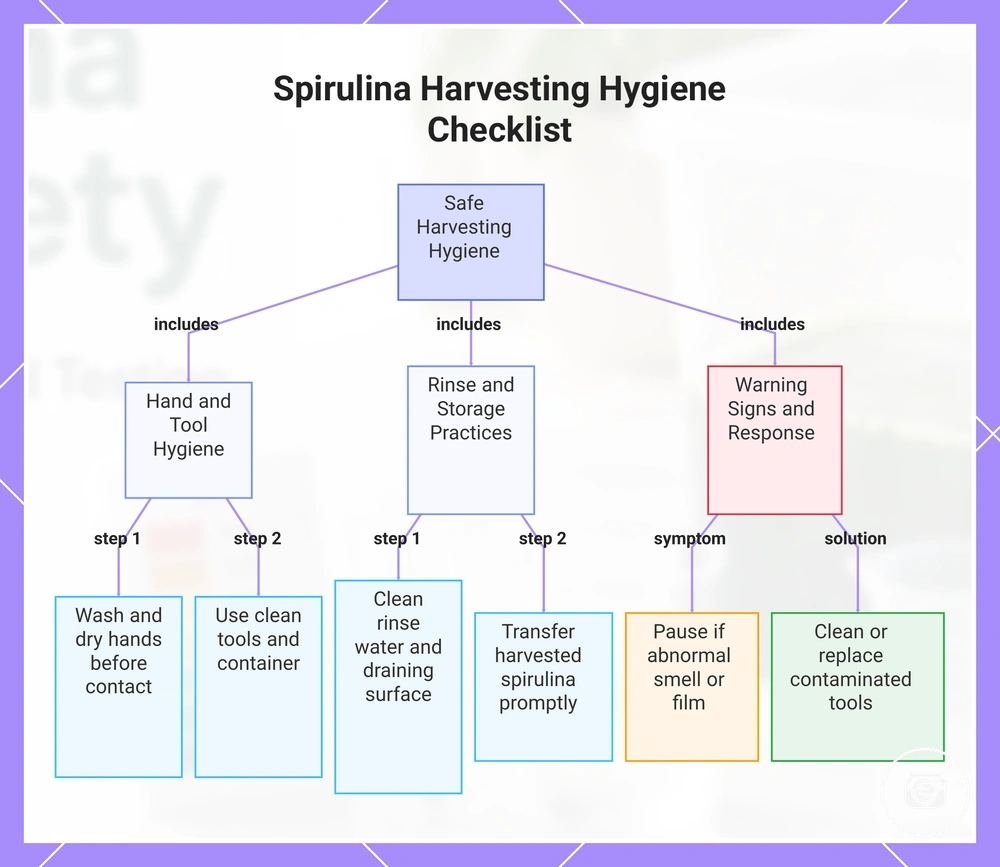
Contamination risk increases when harvest tools contact unclean surfaces or remain exposed longer than necessary before storage. Keep the harvest filter, spoon, receiving container, rinse water, draining surface, and storage timing separate from contaminated contact points, and pause harvesting immediately if warning signs such as abnormal smell, foreign growth, persistent surface film, or unexplained colour change appear. The checklist below focuses only on hygiene requirements for harvesting, not the complete harvest procedure.
- Clean hands: Wash and dry hands before touching the harvest filter, spoon, or receiving container to reduce contamination transfer from skin to the spirulina culture.
- Harvest filter and spoon: Use a clean harvest filter and spoon for harvesting, and replace or reclean them if they contact an unclean surface before returning them to the culture.
- Receiving container: Collect harvested spirulina only in a clean receiving container that has not previously contacted other food, liquids, or residue during the harvesting session.
- Rinse water and draining surface: If rinse water is used to clean harvest equipment before use, use clean water suitable for cleaning food-contact equipment, then allow tools to drain on a clean draining surface. Rinsing supports cleaner equipment but does not remove every contamination risk.
- Storage timing: Transfer harvested spirulina into its intended storage container promptly after harvesting to minimise unnecessary handling and environmental exposure.
- Warning signs: Pause harvesting immediately if abnormal smell, foreign growth, persistent film, or another unexplained culture change develops, and keep the culture out of use until a discard decision or further assessment has been completed.
If a receiving container or harvest filter accidentally touches an unclean work surface during harvesting, clean or replace it before continuing rather than relying on rinsing alone. These hygiene practices reduce contamination opportunities but do not restore a culture that already shows warning signs. Continue with safe harvesting for the complete harvesting procedure.
Continue with safe harvesting for the complete harvesting procedure.
This chart shows the key hygiene requirements for harvesting spirulina from a kit, including clean handling, rinse and storage practices, and warning signs to watch for.
Clean Filters, Spoons, and Harvest Containers
Clean filters, spoons, and harvest containers are harvest tools whose food-contact surfaces must be free of visible residue, fully dry before storage, and clean before the next use. The U.S. Food and Drug Administration's 2022 Food Code requires food-contact surfaces to be clean to sight and touch and specifies air-drying after cleaning and sanitising. During spirulina harvesting, the filter, spoon, and receiving container each function as a contact surface.
This guidance is limited to harvest-tool cleanliness before, during, and after harvesting.
Residue and wet storage create additional opportunities for contamination transfer when a tool next touches the culture or harvested biomass. Wash each tool after use, inspect its drying state, and place it in a protected storage condition; remove a damaged tool from use when trapped material cannot be cleaned away. This guidance is limited to harvest-tool cleanliness before, during, and after harvesting.
Residue and wet storage create additional opportunities for contamination transfer when a tool next touches the culture or harvested biomass.
Clean filters, spoons, and harvest containers:
- Harvest filter: Before harvesting, inspect the mesh and rim for residue. During harvesting, keep the filter away from unclean benches and utensils; after use, wash out trapped biomass, air-dry it completely, and replace it if damaged mesh or retained material prevents effective cleaning.
- Spoon: Begin with a spoon that is clean to sight and touch. If its contact surface touches an unclean surface during harvesting, remove it until it has been washed, rinsed, sanitised as appropriate, and air-dried before reuse.
- Harvest container: Use a receiving container with no visible residue on its interior, rim, or lid-contact area. After harvesting, wash and dry the container completely, then store it covered or otherwise protected from dust, splashes, and contact with used tools.
- Post-harvest washing and storage: Check all three tools after cleaning and before the next harvest. A complete drying state and clean storage condition reduce transfer opportunities, while persistent staining, cracks, trapped residue, or uncertain cleanliness require recleaning or replacement.
Rinsing and Draining Harvested Spirulina Safely
Rinsing and draining harvested spirulina should only be performed after the harvested material shows no abnormal smell, surface growth, or other visible contamination warning signs, because rinsing supports hygiene but cannot make contaminated spirulina safe. According to the U.S. Food and Drug Administration (FDA) Food Code, water used for food-contact purposes must come from a safe water supply, making rinse water quality the primary hygiene requirement during the rinse step. Rinsing is therefore limited to clean harvested spirulina collected under acceptable harvest conditions.
Rinsing is therefore limited to clean harvested spirulina collected under acceptable harvest conditions.
Extended handling time, an unclean draining surface, or delayed storage condition increase the opportunity for post-harvest contamination. Complete the rinse step promptly, allow excess water to drain on a clean draining surface, and transfer the harvested spirulina into its intended storage condition without unnecessary delay to help preserve hygiene and texture. If abnormal smell or surface growth is detected at any stage, stop the harvest and discard the culture instead of proceeding with rinsing.
If abnormal smell or surface growth is detected at any stage, stop the harvest and discard the culture instead of proceeding with rinsing.
Rinsing and draining harvested spirulina safely:
- Check harvested spirulina: If abnormal smell, surface growth, or another strong contamination sign is present, stop the harvest immediately because rinsing cannot remove or neutralise contamination.
- Use clean rinse water: Rinse briefly with water from a safe source suitable for food-contact use, then minimise handling time because unnecessary exposure increases contamination opportunities.
- Drain correctly: Allow excess rinse water to drain on a clean draining surface or into a clean receiving vessel. Do not place harvested spirulina on benches, cloths, or other surfaces that may transfer residue.
- Store promptly: Transfer the drained harvested spirulina into its intended storage condition as soon as practical after draining. Prompt storage supports hygiene and texture but does not make visibly contaminated spirulina safe for consumption.
When to Discard a Spirulina Culture
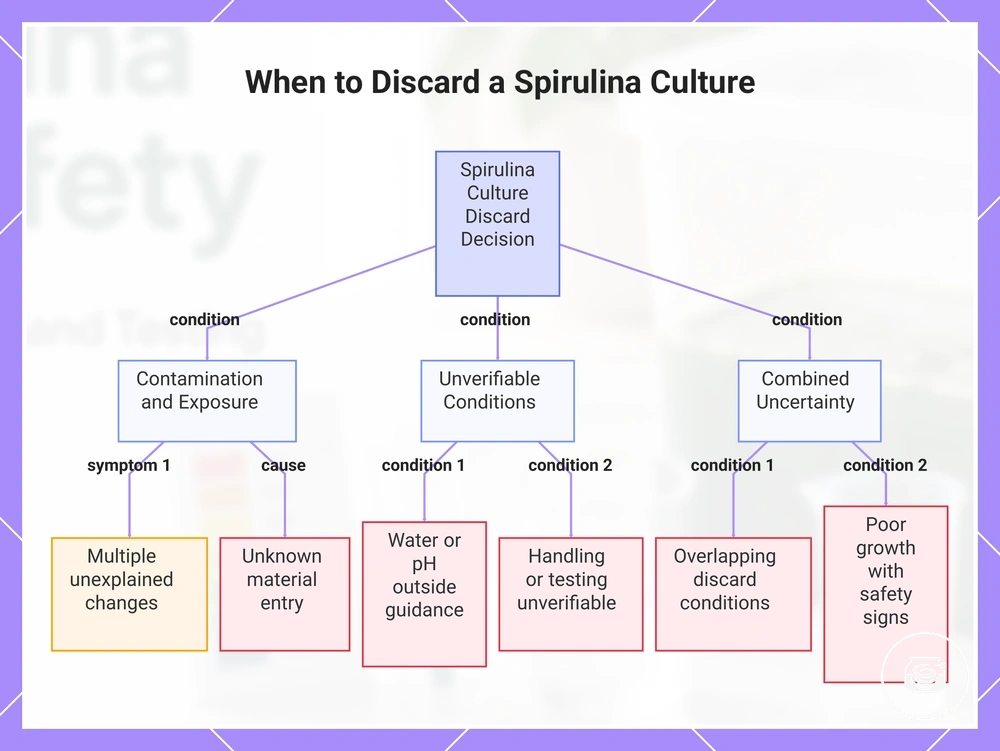
Discard a spirulina culture when strong contamination signs are present, an unknown exposure cannot be assessed, pH or water conditions fall outside the kit guidance without reliable correction evidence, or clean handling cannot be verified. The Food and Agriculture Organization’s review of spirulina production states that food-safety risks must be managed through controlled cultivation and processing, while the World Health Organization explains that cyanobacterial hazards require monitoring because appearance alone cannot verify toxin status. An unsafe or uncertain culture should not be harvested for use, so the discard decision should prioritise caution when the verification limit has been reached.
A single visible change does not identify the contaminant or prove that the spirulina culture can be retained safely. Colour, smell, surface condition, pH, water history, and handling records provide separate evidence, but none confirms the absence of microbial contamination, cyanotoxins, or chemical contaminants by itself. The World Health Organization’s Toxic Cyanobacteria in Water
- Multiple contamination signs: Discard the culture when two or more unexplained changes occur together, such as abnormal odour with surface growth or an unexpected texture change with persistent cloudiness.
- Unknown exposure: Discard the culture when untreated water, insects, debris, spills, unclean utensils, or another uncontrolled material has entered it and the exposure cannot be verified as harmless.
- Water outside kit guidance: Discard the culture when the water source or preparation method does not meet the kit guidance and its microbiological or chemical suitability cannot be confirmed.
- Unresolved pH condition: Treat a pH result outside the kit-specified operating range as a discard condition when the cause, duration, and effect on culture safety cannot be verified; no universal discard pH applies across all kits because the reviewed authoritative sources do not establish one home-culture threshold.
- Unverifiable clean handling: Discard the culture when the cleanliness of the container, harvest filter, spoon, testing equipment, or other contact surface cannot be confirmed after use or accidental contact.
- Detection limit reached: Discard the culture when safety would require laboratory identification or toxin, microbial, or heavy-metal testing that is unavailable to the home grower.
- Unsafe culture after combined uncertainty: Do not harvest when several uncertain conditions overlap, even if the culture still appears green or continues to grow.
For example, a culture left uncovered during an unknown exposure and later showing a new surface film meets two independent discard conditions: uncontrolled contact and an unexplained warning signal. Poor growth alone belongs to troubleshooting contamination, but poor growth combined with unresolved safety signs or unverifiable handling should be treated as an unsafe culture rather than harvested for use.
This chart shows the key conditions that require discarding a spirulina culture, including contamination signs, uncontrolled exposure, unverifiable conditions, and combined uncertainty.
This chart shows the key conditions that require discarding a spirulina culture, including contamination signs, uncontrolled exposure, unverifiable conditions, and combined uncertainty.