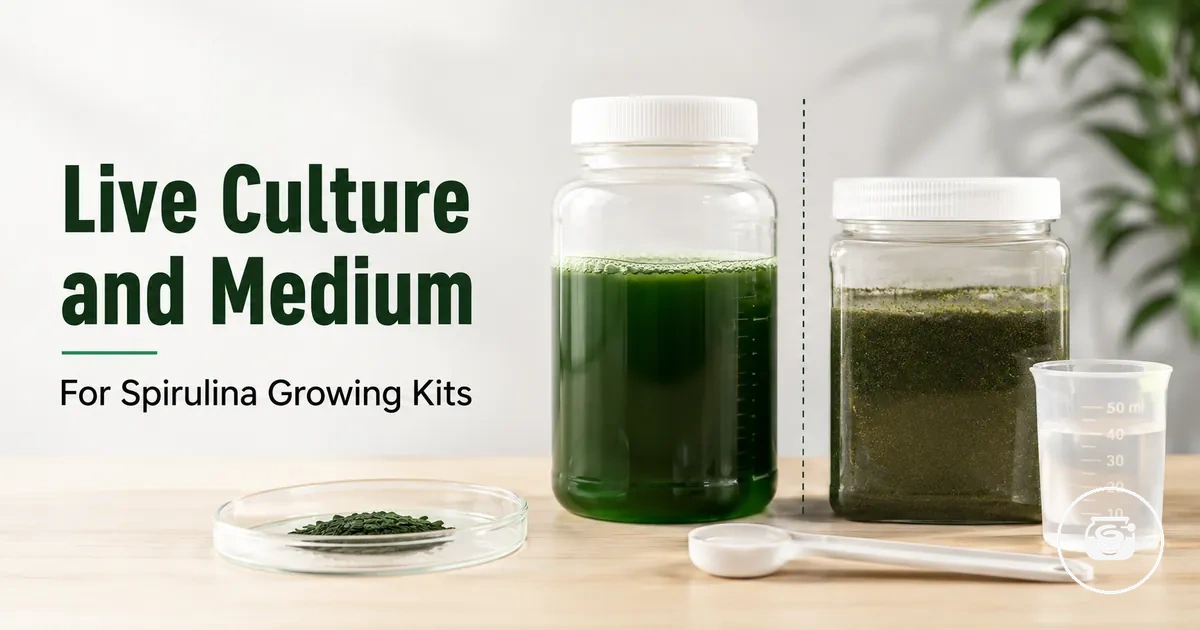
Live Spirulina Culture and Growing Medium in Growing Kits
Live spirulina culture and growing medium form the biological and chemical base of a home spirulina growing kit. The starter culture supplies living cells capable of establishing a culture when viability is retained, while the culture medium supplies the water chemistry and nutrient salts needed to support those cells. The Food and Agriculture Organization describes Spirulina cultivation in alkaline, bicarbonate-carbonate media, confirming that the organism and its supporting medium perform separate functions. Live culture and growing medium are therefore the two starting inputs.
Live culture and growing medium are therefore the two starting inputs.
A live starter should not be treated as equivalent to dried spirulina powder. The U.S. National Institutes of Health Dietary Supplement Label Database identifies spirulina powder as an ingredient in products marketed as dietary supplements; that classification does not establish that a powder contains viable cells suitable for starting growth. The growing medium also differs from the whole-kit setup because it supplies a chemical environment rather than lighting, temperature control, aeration, clean handling, or monitoring. This page therefore covers the culture and medium inputs without replacing the separate setup and growing-condition processes.
A live starter should not be treated as equivalent to dried spirulina powder.
The main starter-culture attribute is viability: the culture must retain living cells, but colour, density, smell, and container condition are selection signals rather than proof of purity, safety, or future yield. The main growing-medium attributes are alkalinity, bicarbonate-carbonate balance, salinity, and nutrient composition; for example, the FAO review reports a standard bicarbonate-carbonate culture medium at pH 9–9.5 under the stated laboratory condition, rather than presenting that range as a universal instruction for every kit. Medium powders and nutrient salts must therefore be prepared at the concentration and water volume stated in the relevant kit instructions. Early growth remains conditional because starter strength, medium preparation, cleanliness, light, and temperature can alter the result.
This evidence boundary prevents a model-specific storage claim or formulation from being generalised to every spirulina growing kit.
Storage requirements also remain product-specific because the reviewed authoritative sources do not establish one universal storage temperature or viable shelf life for all home starter cultures and medium formulations. The user should verify the supplier’s stated storage temperature, expiry or preparation period, culture volume, medium-to-water ratio, and handling instructions for the specific kit. This evidence boundary prevents a model-specific storage claim or formulation from being generalised to every spirulina growing kit.
Table of Contents
What live culture and growing medium do in a spirulina kit
Live culture and growing medium perform different but complementary roles in a spirulina kit. The live culture supplies the living spirulina organism through a starter culture containing viable cells, while the growing medium supplies the water chemistry, nutrients, alkalinity and salinity that support those cells during early growth. According to the Food and Agriculture Organization (FAO), Spirulina is cultivated in alkaline media containing bicarbonate and nutrient salts, separating the organism from its chemical growth environment. Early growth depends on both inputs rather than either one alone.
Early growth depends on both inputs rather than either one alone.
A live culture is the biological starting point because it contains the starter population of viable spirulina cells. In spirulina growing kits, the starter culture establishes the initial culture only when transferred into a correctly prepared growing medium under suitable growing conditions. For example, the FAO describes Spirulina culture media operating at approximately pH 9.0–9.5, illustrating that viable cells require an alkaline environment before growth can begin. This biological input is separate from the chemical role of the growing medium.
This biological input is separate from the chemical role of the growing medium.
What live culture and growing medium do in a spirulina kit is easier to understand when each input is compared by function. The image below labels the organism input and the water-chemistry input so their different roles are clear at a glance.
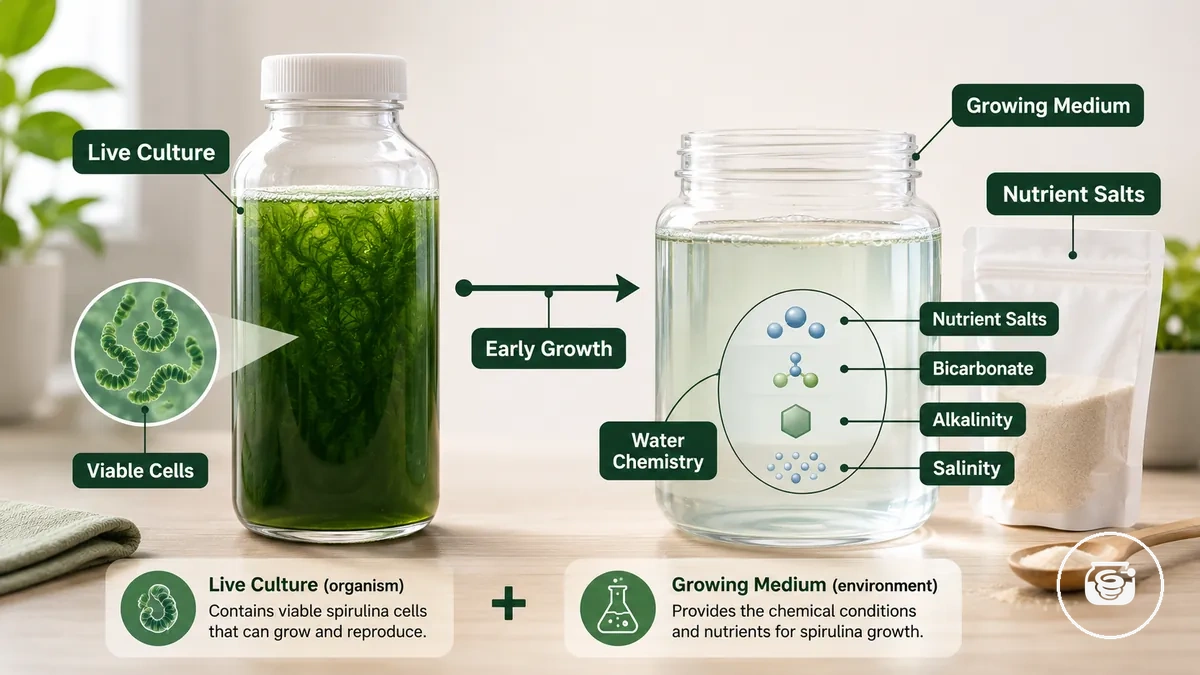
| Input | Main job |
|---|---|
| Live culture | Supplies the living starter culture containing viable spirulina cells that establish the initial organism population. |
| Growing medium | Supplies water chemistry, dissolved nutrients, alkalinity and salinity that support early growth after the starter culture is introduced. |
The growing medium provides the chemical environment rather than the organism itself. According to the FAO, bicarbonate, carbonate and dissolved nutrient salts maintain the alkaline conditions used for Spirulina cultivation, while the exact nutrient formulation differs between media and manufacturers. The kit components include more than these two inputs, but environmental controls such as light, temperature and ongoing monitoring belong to the separate growing-conditions context. Early growth is therefore conditional on a viable starter culture, correctly prepared growing medium and suitable cultivation conditions rather than the medium alone.
What a live spirulina starter culture provides
A live spirulina starter culture provides a living starting population of viable cells that can establish a new culture after being introduced into a correctly prepared growing medium. Its primary contribution is the biological inoculum rather than nutrients, and early culture establishment depends on those viable cells remaining alive under suitable cultivation conditions. This viable starter population is the foundation for early growth before the medium can support continued cell multiplication.
What a live spirulina starter culture provides is easier to understand by observing the culture's visible attributes.
What a live spirulina starter culture provides is easier to understand by observing the culture's visible attributes. The image below highlights the characteristics that can increase or reduce confidence in a starter culture while recognising that appearance alone cannot prove safety, purity, or future growth performance.
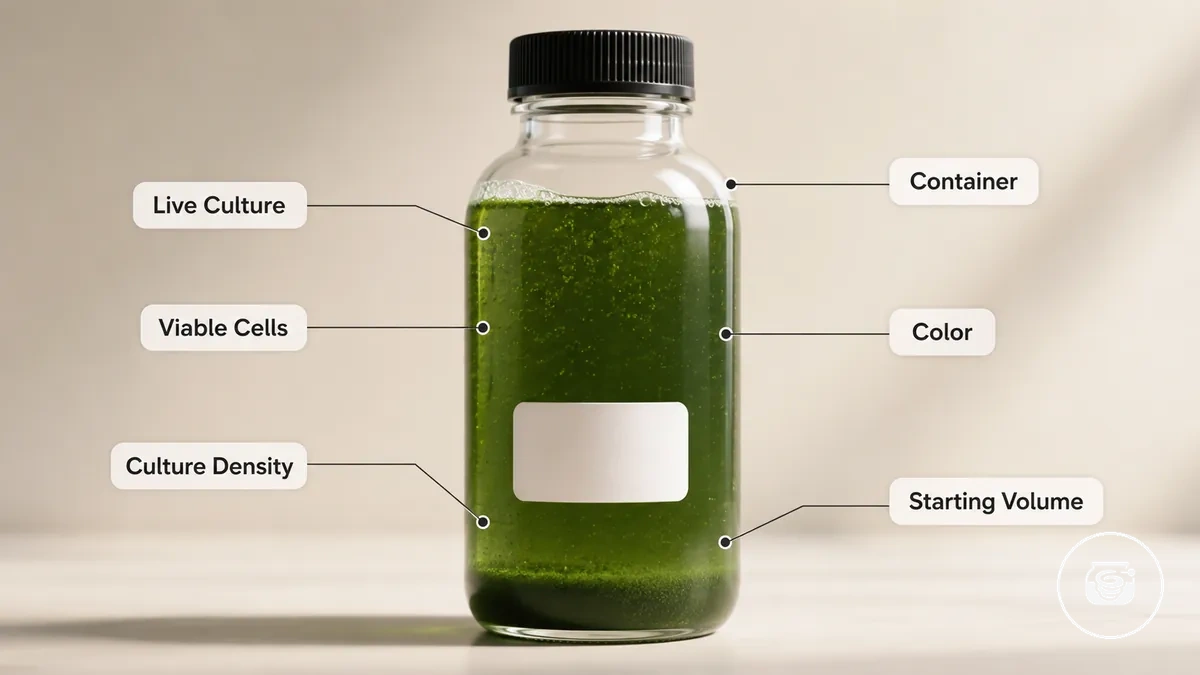
- Live spirulina cells: Indicate that the bottle contains a living starter population capable of establishing a mother culture, but they do not prove culture purity.
- Culture density: A denser green suspension can indicate a larger starting population, yet density alone cannot guarantee faster early growth because light, temperature and medium preparation also influence growth.
- Color: A consistent blue-green to green appearance can indicate healthy pigment retention, but color by itself cannot confirm viability, safety or future yield.
- Smell: A typical fresh algae odor may support confidence that the culture has remained stable during storage or shipping, although smell cannot confirm that the culture is contamination-free.
- Container condition: A clean, sealed culture bottle without visible damage helps protect the starter culture during transport, but the container condition alone cannot verify culture quality.
- Starting volume: Commercial live spirulina starter cultures are supplied in manufacturer-specific volumes, commonly from approximately 250 mL to 1 L, so bottle size should be interpreted only as the amount of inoculum supplied rather than a universal indicator of performance.
Culture density and starting volume influence how many viable cells enter the prepared medium at the beginning of cultivation. For example, two starter cultures with equal viability but supplied in 250 mL and 500 mL bottles provide different inoculum volumes, while neither volume alone predicts growth rate because culture strength and growing conditions remain important. Manufacturers specify the supplied volume, but no recognised cultivation authority defines a universal minimum starter volume for all home spirulina kits.
Handle the culture according to the supplier's instructions before concluding that recovery has failed.
A live spirulina starter culture can appear temporarily less dense after shipping because cells often settle during transport and may require a short recovery period before normal activity resumes. A recently shipped or recovering mother culture should therefore be interpreted using its color, smell, culture density and container condition together instead of relying on a single visual sign. Handle the culture according to the supplier's instructions before concluding that recovery has failed.
Viable culture, mother culture, and starting strength
A viable starter contains living cells capable of resuming growth, a mother culture is the maintained parent culture from which an inoculum is taken, and starting strength describes the initial amount or concentration of viable culture introduced into fresh medium. Starting strength is therefore an inoculum condition, while the mother culture is the source and the viable starter is the living material transferred.
The image compares these three terms visually before the practical signals are considered together.
Viable culture, mother culture, and starting strength can be compared through density, activity, dilution ratio, settling, odor, and color, but no single signal establishes viability by itself. The image compares these three terms visually before the practical signals are considered together.
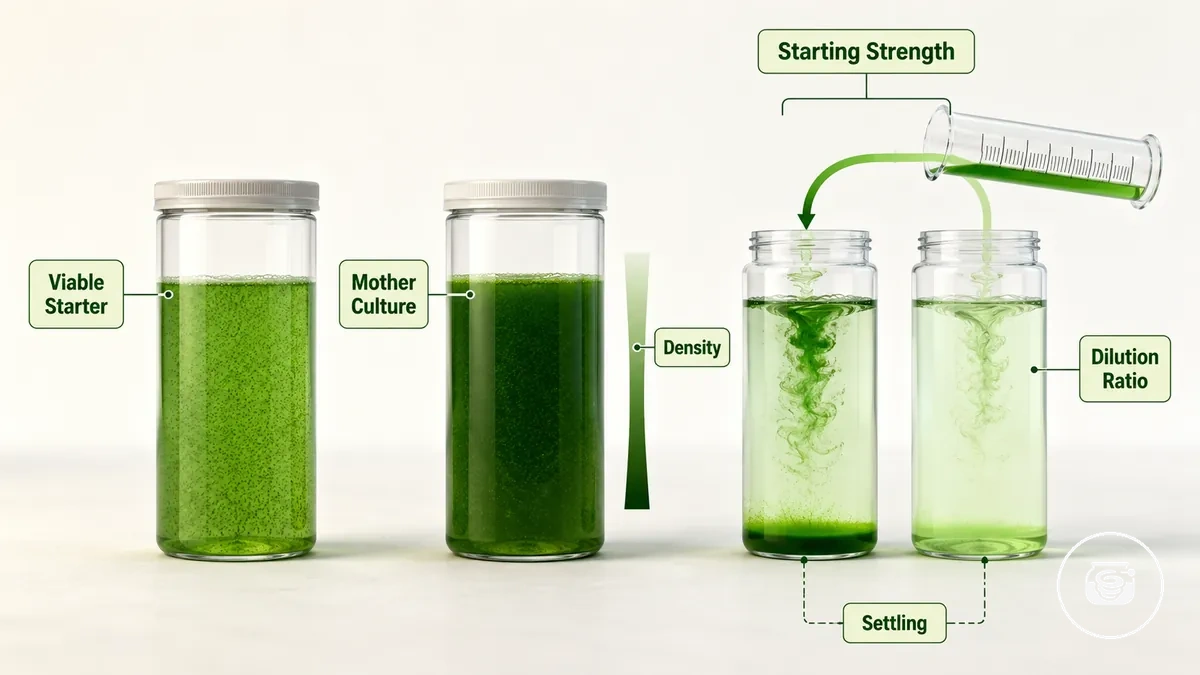
- Density: Greater visible biomass can indicate more inoculum per unit of medium, but it does not show how many cells remain viable.
- Activity: Resumed suspension or growth after transfer can indicate recovery, but delayed activity can also reflect acclimation rather than culture loss.
- Dilution ratio: Greater dilution places fewer starter cells into each unit of fresh medium, which can extend the period before visible biomass increases; the appropriate ratio remains culture- and method-specific.
- Settling: Material at the bottom can reflect temporary separation during storage or transport, but settling alone does not distinguish an active culture from an unsuitable one.
- Odor and color: Odor and blue-green or green color provide condition signals, but neither attribute confirms viability, purity, or growth capacity without additional observation.
Starting strength can affect early growth even when the mother culture remains viable. A study indexed by FAO AGRIS compared initial Spirulina inoculum concentrations of 50, 100, 150, and 200 mg/L, showing that inoculum concentration is a measurable cultivation variable rather than a visual label such as weak or strong. For an illustrative home-kit example, transferring 250 mL of starter into 1 L of prepared medium creates a 1:4 starter-to-medium volume ratio, while 500 mL into the same medium creates a 1:2 ratio; these calculated ratios explain relative dilution but are not universal recommendations or proof of a specific growth rate.
Live culture versus dried spirulina powder
Live culture is the appropriate starter for a spirulina growing kit because it contains viable spirulina cells intended to establish new growth, whereas dried spirulina powder is generally a processed form manufactured for storage and consumption rather than a reliable cultivation starter. According to the U.S. National Institutes of Health Dietary Supplement Label Database, spirulina powder is marketed as a dietary supplement ingredient rather than a cultivation starter, while cultivation references such as the Food and Agriculture Organization describe spirulina propagation using live cultures. This comparison is limited to starting growth in a spirulina kit.
This comparison is limited to starting growth in a spirulina kit.
Live culture versus dried spirulina powder is often confusing because both originate from spirulina biomass and usually have a similar green appearance after processing or cultivation. The key difference is that live culture is maintained to preserve viable cells for propagation, while dried spirulina powder is processed for stable storage and normal consumption. For example, if two identical home kits are prepared but one receives a live starter culture and the other receives only dried spirulina powder, only the kit supplied with viable cells is intended to establish new culture growth under suitable cultivation conditions. This comparison does not evaluate supplement use or nutritional value.
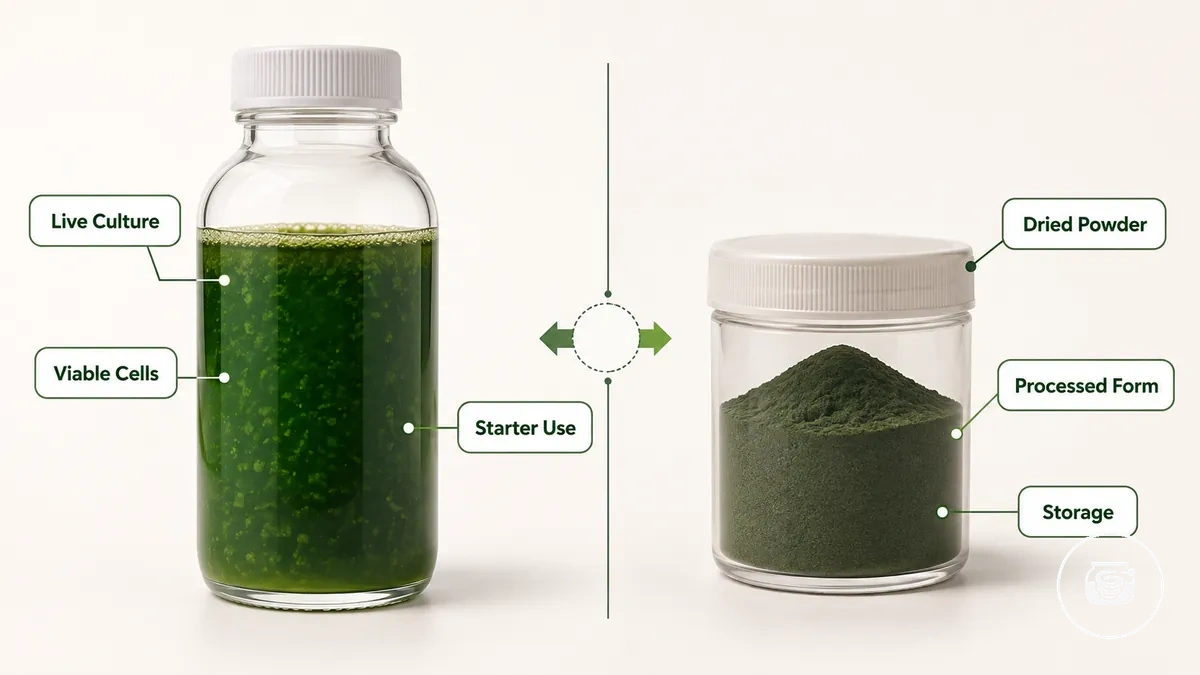
Live culture versus dried spirulina powder becomes clearer when the two forms are compared by their suitability for starting a spirulina kit rather than by their appearance.
| Attribute | Live culture | Dried spirulina powder |
|---|---|---|
| State | Liquid culture containing viable spirulina cells maintained for propagation. | Processed dried biomass prepared for storage and consumption. |
| Purpose | Starter used to establish a new spirulina culture when viability is retained. | Normally intended for consumption rather than as a reliable starter. |
| Viability | Contains living cells when handled and stored according to supplier instructions. | Commercial powders normally do not specify viable-cell content, so they should not be assumed to function as reliable starters. |
| Storage | Stored under the supplier's recommended conditions to preserve living cells. | Designed for dry storage as a processed form with no cultivation purpose. |
| Expected outcome | Can establish culture growth when transferred into correctly prepared growing medium. | Expected to remain a processed consumable product rather than initiate dependable culture growth. |
What spirulina growing medium provides
Spirulina growing medium is the chemical environment that enables a live spirulina culture to survive, remain suspended, and multiply by supplying alkaline water chemistry together with dissolved nutrient salts. According to the Food and Agriculture Organization (FAO), Spirulina is cultivated in alkaline culture media containing bicarbonate and essential nutrients rather than in plain water. A spirulina growing medium therefore functions as a complete nutrient environment instead of a single ingredient, while its exact formulation and concentration remain dependent on the kit design and cultivation method.
The table below groups the principal components by function and the conditions that qualify their contribution.
What spirulina growing medium provides is easier to understand when each medium element is viewed by its role in supporting the culture instead of as an ingredient list. The table below groups the principal components by function and the conditions that qualify their contribution. Maintaining the correct balance between these elements is more important than increasing any individual ingredient because culture stability depends on the overall chemical environment rather than one nutrient alone.
| Medium element | Function | Condition |
|---|---|---|
| Alkalinity | Maintains the alkaline environment that supports culture stability. | Established through the prepared culture medium according to kit instructions. |
| Bicarbonate | Provides the principal dissolved carbon source and buffering capacity. | Functions as part of the complete medium rather than as an independent additive. |
| Salinity | Supports the overall water chemistry used for cultivation. | Should remain consistent with the intended prepared-medium formulation. |
| Nitrogen and phosphorus | Supply essential nutrients required for cell growth and metabolism. | Delivered through balanced nutrient salts rather than individual dosing. |
| Trace nutrients | Provide micronutrients needed for normal biological activity. | Included as part of a complete culture medium. |
The spirulina growing medium is the nutrient environment, whereas medium powder or nutrient salts are preparation formats used to create that environment after mixing with water. Commercial kits commonly provide medium powder or dry nutrient salts that are dissolved into a stated water volume before the live culture is introduced. For example, if a kit supplies one packet intended for 1 L of water, using that packet in 2 L would halve the intended concentration as a calculated illustration rather than a manufacturer recommendation, demonstrating why the supplier's specified water volume should be followed. Because formulations differ between kits, there is no universal recipe or exact formula that applies to every spirulina growing medium.
This evidence boundary prevents one manufacturer's formulation from being generalised to all spirulina growing media.
Source water and concentration also influence the prepared medium, but no authoritative source specifies one concentration or nutrient formulation that applies to all home spirulina kits. If the kit manufacturer specifies a particular water type or preparation ratio, those instructions define the intended chemical environment for that product. This evidence boundary prevents one manufacturer's formulation from being generalised to all spirulina growing media.
Alkaline water, bicarbonate, and salinity
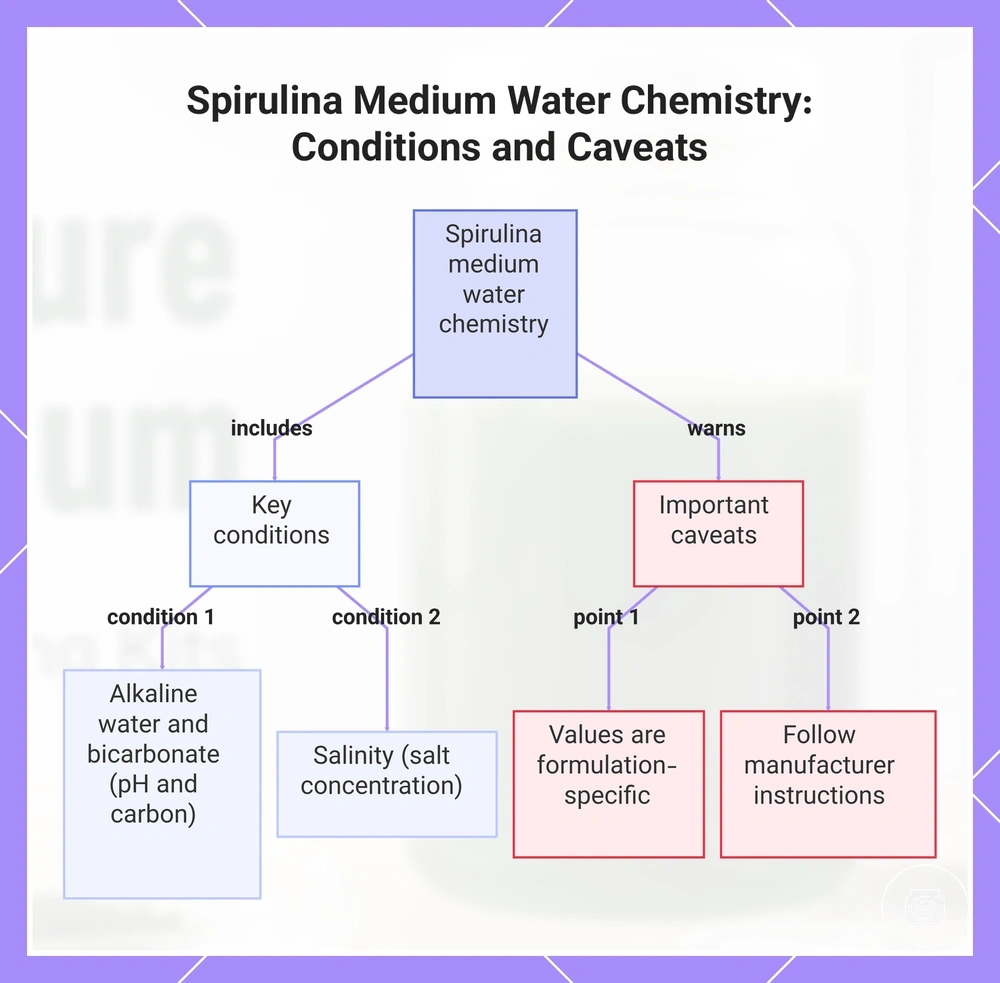
Alkaline water, bicarbonate, and salinity are the local water-chemistry conditions that support a spirulina growing medium. Alkaline water provides the medium's pH tendency, bicarbonate functions as both a carbon source and a buffer, and salinity defines the dissolved salt concentration surrounding the culture. According to the Food and Agriculture Organization (FAO), Spirulina is cultivated in alkaline, bicarbonate-containing media, making these conditions collectively responsible for supporting medium and culture stability rather than serving as interchangeable ingredients.
Alkaline water , bicarbonate , and salinity are the local water-chemistry conditions that support a spirulina growing medium.
Bicarbonate supplies dissolved inorganic carbon for photosynthesis while buffering the medium against rapid pH changes, and salinity influences osmotic conditions that affect culture stability. For example, a cultivation study indexed by FAO AGRIS used an experimental medium containing 3.0 g/L sodium bicarbonate with 0.7% salinity at pH 9.1 ± 0.4 and 25 °C; these values describe that specific research medium and should not be interpreted as universal targets for home spirulina kits. This illustrates that bicarbonate concentration, salt concentration, and alkaline water chemistry are formulation-specific attributes rather than fixed values for every growing medium.
This illustrates that bicarbonate concentration, salt concentration, and alkaline water chemistry are formulation-specific attributes rather than fixed values for every growing medium.
Because kit formulations differ, the appropriate pH tendency, bicarbonate level, and salinity should follow the manufacturer's preparation instructions instead of a universal correction recipe. Altering bicarbonate or mineral salts independently can change both buffering capacity and salt concentration, so any adjustment should remain qualified within the broader growing-conditions context rather than being treated as a household chemical shortcut.
This chart shows the key water chemistry conditions for spirulina growing medium and the important caveats about their formulation-specific values.
This chart shows the key water chemistry conditions for spirulina growing medium and the important caveats about their formulation-specific values.
Nitrates, phosphates, sulfates, and trace nutrients
Nitrates, phosphates, sulfates, and trace nutrients are nutrient groups in spirulina culture medium that provide nitrogen, phosphorus, sulfur, minerals, and trace elements for biomass growth. The Food and Agriculture Organization describes spirulina cultivation media as balanced mixtures of major nutrient salts and micronutrients rather than isolated additives. These nutrients support biomass growth only when the culture is viable and the wider medium conditions remain suitable.
- Nitrates: Provide a nitrogen source for producing proteins and other cellular material, but deficiency can restrict biomass growth while excess changes the intended concentration balance.
- Phosphates: Provide a phosphorus source for energy transfer and cell development, but their concentration must remain balanced with nitrogen and the other nutrient salts.
- Sulfates: Provide a sulfur source and associated minerals used in cellular compounds, but sulfate salts also contribute to the total dissolved-mineral concentration.
- Trace nutrients: Provide trace elements required in comparatively small amounts, but both deficiency and excess can affect nutrient uptake or culture response.
Concentration balance matters because a deficient nutrient can become the limiting input for biomass growth, while an excessive nutrient can alter the prepared medium without delivering a proportional growth benefit. No single nitrate, phosphate, sulfate, mineral, or trace-element concentration applies to every home kit because formulas differ by nutrient mix, water volume, source water, and culture conditions. The appropriate values should therefore come from the kit instructions or its specified culture-medium formula rather than an assumed dosage or fertilizer substitute.
How culture and medium work together during early growth
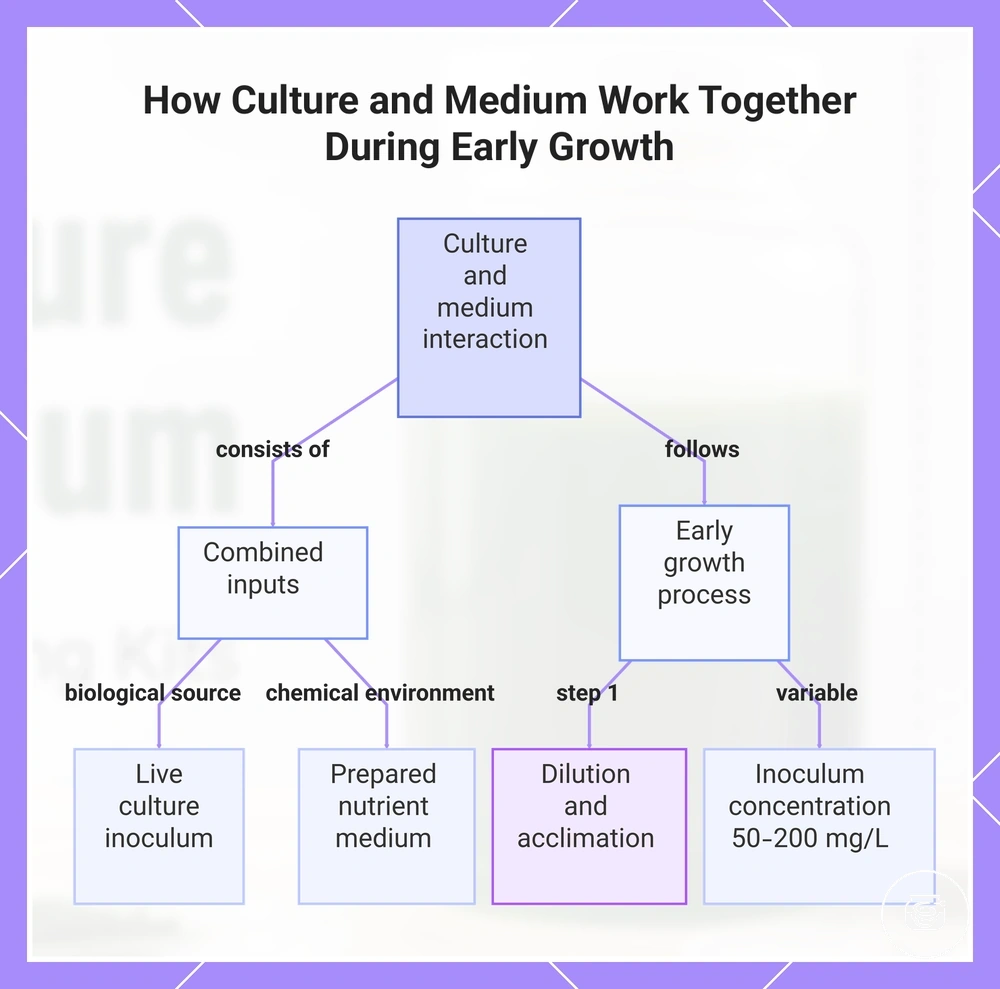
Live culture and prepared medium work together during early growth by combining a viable spirulina inoculum with a chemically balanced nutrient environment that supports initial cell adaptation. According to the Food and Agriculture Organization (FAO), spirulina cultivation begins by introducing living cells into an alkaline nutrient medium containing bicarbonate and essential dissolved nutrients rather than plain water. The live culture provides the biological starting population, while the prepared medium provides the water chemistry needed for that population to acclimate and begin growth. This interaction defines the first stage after both inputs are combined before environmental conditions become the dominant growth influences.
Early growth therefore depends on both inoculum concentration and successful acclimation rather than either factor alone.
After the live culture enters the prepared medium, dilution distributes the inoculum through the full medium volume and acclimation begins as the cells adjust to their new chemical environment. A cultivation study indexed by FAO AGRIS evaluated initial Spirulina inoculum concentrations of 50, 100, 150, and 200 mg/L, demonstrating that starting culture concentration is a measurable cultivation variable rather than a fixed universal value. For example, if the same viable starter is distributed through twice the prepared medium volume, the initial cell concentration is reduced, so visible early growth may take longer even though the culture remains viable. Early growth therefore depends on both inoculum concentration and successful acclimation rather than either factor alone.
Following acclimation, the live culture begins nutrient uptake by using bicarbonate, nitrogen, phosphorus, sulfur, and trace nutrients supplied by the prepared medium.
Following acclimation, the live culture begins nutrient uptake by using bicarbonate, nitrogen, phosphorus, sulfur, and trace nutrients supplied by the prepared medium. At the same time, the prepared medium maintains water chemistry stability through its intended alkalinity, buffering capacity, salinity, and nutrient balance, although these values remain formulation-specific rather than universal. As nutrient uptake continues under stable water chemistry, control of culture performance progressively shifts toward light, temperature, aeration, and other environmental conditions that influence continued biomass growth.
Clean handling reduces contamination exposure but does not diagnose or guarantee culture quality.
Contamination exposure remains a boundary condition during the early interaction because introducing the live culture into the prepared medium temporarily exposes both inputs to the surrounding environment. Clean handling reduces contamination exposure but does not diagnose or guarantee culture quality. After this initial interaction stage, continued culture development is governed primarily by growing conditions, including light, temperature, aeration, and monitoring.
This chart shows the key inputs and early growth stages when live spirulina culture and prepared nutrient medium are combined.
This chart shows the key inputs and early growth stages when live spirulina culture and prepared nutrient medium are combined.
Preparing culture medium from kit salts or powder
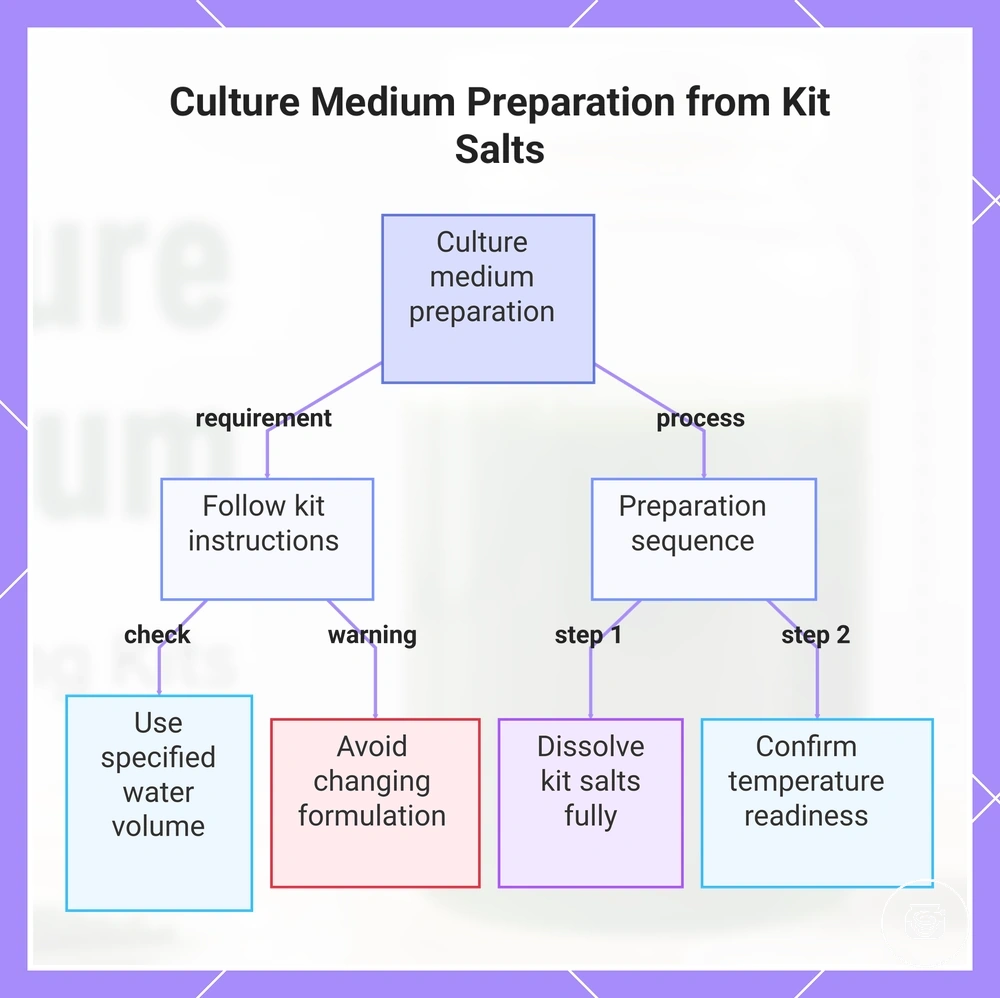
Preparing culture medium means dissolving the supplied kit salts or medium powder into suitable water according to the kit instructions before introducing the live culture. The prepared medium provides the intended nutrient environment for the starter culture, while the preparation method, water volume, and mixing sequence remain specific to the supplied kit rather than a universal formula. Follow the kit instructions whenever they specify a preparation method or condition.
Follow the kit instructions whenever they specify a preparation method or condition.
Water choice and concentration accuracy determine whether the prepared medium matches the formulation intended by the kit manufacturer. Using the water volume stated on the label keeps the supplied nutrient concentration consistent with the product design, while changing the water volume changes the final concentration. For example, if one packet is intended for 1 L of suitable water but is dissolved into 2 L, the resulting concentration is reduced by one-half as an illustrative calculation rather than a preparation recommendation. Preparation should therefore remain consistent with the label instructions whenever a water volume or preparation condition is specified.
Each step below identifies an action, a readiness check, and a safety qualification.
Preparing culture medium from kit salts or powder follows a high-level sequence that organises the process without replacing the manufacturer's instructions. Each step below identifies an action, a readiness check, and a safety qualification.
- Measure the suitable water. Check that the water type and volume match the kit instructions, and do not estimate or substitute the specified amount.
- Dissolve the kit salts or medium powder. Check that the supplied material has fully dissolved, and do not add unverified household chemicals or extra ingredients.
- Allow the prepared medium to settle if instructed. Check for undissolved particles or incomplete mixing, and use only the settling or checking time described in the label instructions.
- Confirm temperature readiness. Check that the prepared medium has reached the condition specified by the kit instructions, and avoid introducing the live culture before that condition is met.
- Handle the prepared medium with clean tools. Check that containers and utensils are visibly clean, and keep handling consistent with the manufacturer's preparation guidance.
Using clean tools helps reduce contamination exposure during handling, but it does not guarantee culture quality or replace the manufacturer's instructions. Avoid changing the supplied formulation unless the label instructions specifically direct that adjustment. Introduce the live culture only after the culture medium has been prepared, checked, and confirmed ready according to the kit instructions.
Avoid changing the supplied formulation unless the label instructions specifically direct that adjustment.
This chart shows the key requirements and steps for preparing culture medium from kit salts or powder, emphasizing adherence to kit instructions and critical preparation checks.
Choosing culture and medium formats for a home kit
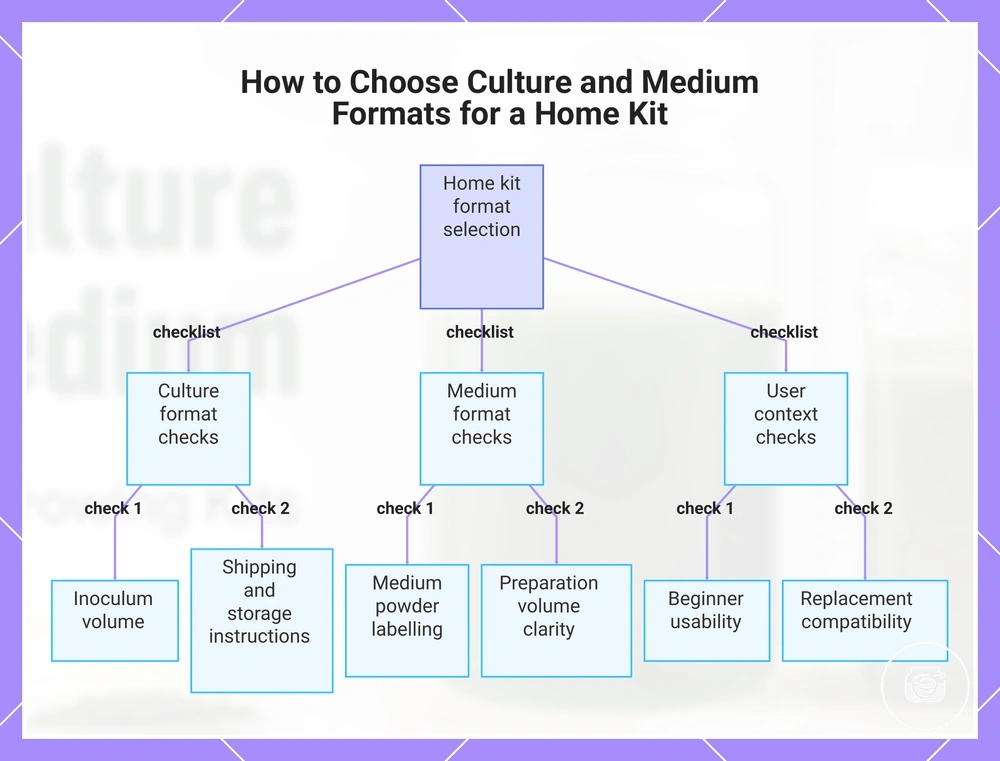
Choosing the appropriate culture format and medium format for a home kit depends on four practical criteria: viability, preparation convenience, storage requirements, and instruction clarity. A suitable format is one that provides a viable live culture, a clearly identified growing medium, and preparation instructions that match the user's experience and available equipment. Because commercial kits differ in packaging and included components, the most suitable format depends on user context and kit clarity rather than a universal product type.
Shipping suitability should therefore be judged from the supplier's storage and transport instructions rather than bottle size alone.
Culture format should be evaluated by its live culture volume, packaging, shipping resilience, storage needs, and viability guidance. Commercial suppliers offer different bottle sizes, commonly ranging from approximately 250 mL to 1 L, but no recognised cultivation authority specifies a universal starter volume for home spirulina cultivation. For example, a 500 mL live culture supplies twice the inoculum volume of a 250 mL bottle, yet this calculated difference does not indicate better viability because viability depends on the condition of the living cells and correct handling after transport. Shipping suitability should therefore be judged from the supplier's storage and transport instructions rather than bottle size alone.
Culture format should be evaluated by its live culture volume , packaging, shipping resilience , storage needs, and viability guidance.
Medium format should be evaluated by whether the kit provides clearly labelled medium powder or medium salts, identifies the intended water volume, and explains the preparation sequence. Dry medium components normally require mixing with the stated amount of water before the live culture is introduced, while pre-measured packets reduce preparation uncertainty for beginners. For example, if one packet is labelled for 1 L of water, preparing it with 2 L creates an illustrative half-strength solution rather than the intended formulation. Shelf life and storage needs should also be checked separately for the live culture and dry medium because they are different product formats with different handling requirements.
The checklist below organises those criteria for beginners, replacement culture buyers, and users who already have a compatible container or medium supply.
Choosing culture and medium formats for a home kit becomes easier when each option is compared using the same decision criteria instead of comparing products. The checklist below organises those criteria for beginners, replacement culture buyers, and users who already have a compatible container or medium supply.
- Live culture volume: Check that the stated bottle volume matches the intended culture size; bottle volume identifies the supplied inoculum quantity but does not prove viability.
- Shipping resilience: Check the packaging method, transport guidance, and storage instructions because these affect how the live culture is expected to arrive.
- Medium powder or medium salts: Check that every packet is clearly labelled and linked to a stated preparation volume to reduce mixing errors.
- Included bottle or container: Check whether the home kit includes a suitable culture container or whether an existing compatible container will be reused.
- Shelf life: Check the storage period or expiry information separately for the live culture and the dry medium rather than assuming both have the same usable life.
- Storage needs: Check that the required storage conditions for both the culture and medium can be maintained before choosing the format.
- Beginner usability: Check that preparation instructions clearly describe water volume, mixing order, and culture addition so the complete process can be followed with confidence.
- Replacement suitability: Users replacing only the culture should verify compatibility with their existing medium and container, while users who already have medium supplies may only need a replacement live culture.
This chart organizes the key checks for evaluating culture format, medium format, and user context when selecting a home spirulina kit.
Freshness, storage, and handling limits
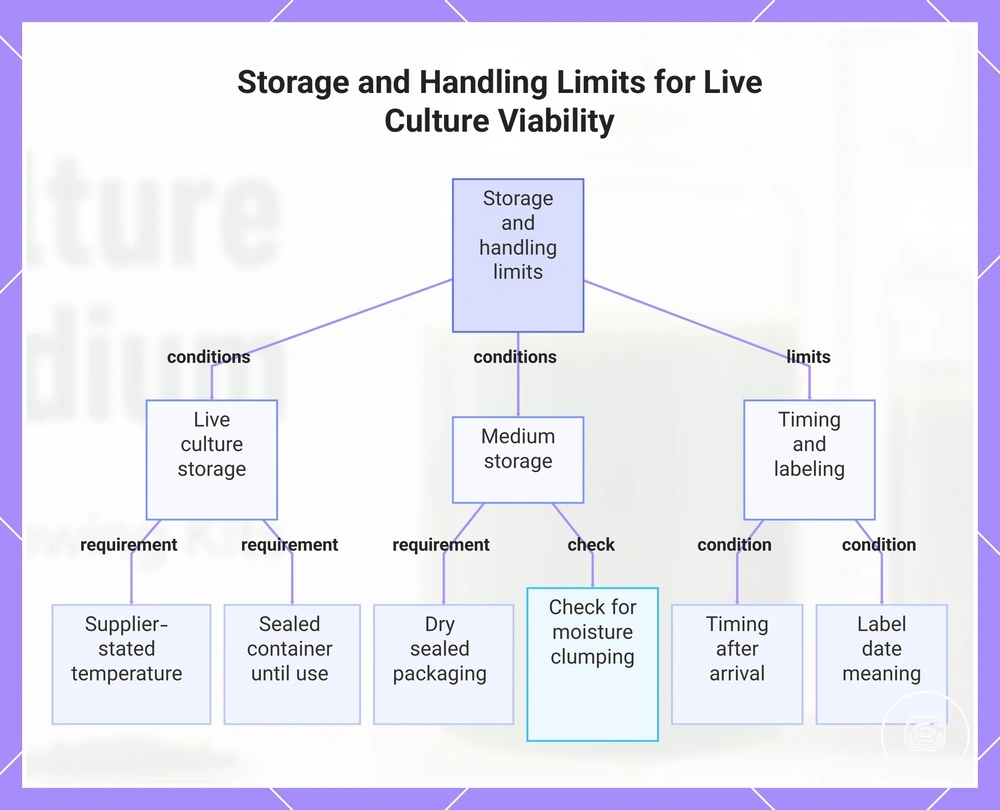
Freshness, storage, and handling affect live culture viability and medium reliability by changing the conditions around living cells and dry nutrient materials. The relevant conditions include storage temperature, light exposure, container closure, moisture exposure, and timing after arrival. The reviewed evidence does not establish one storage temperature or storage duration for every spirulina starter, so product-specific limits must come from the label or supplier instructions. Storage therefore protects viability and medium reliability only when the stated conditions are maintained.
Storage therefore protects viability and medium reliability only when the stated conditions are maintained.
A live culture should remain in its sealed container, protected from unintended light exposure, and kept at the storage temperature stated by the supplier until use. Timing after arrival should be judged against the dispatch guidance, label date, and any unpacking or recovery instructions rather than an assumed deadline. Changes in colour, density, settling, leakage, or container condition are handling signals, but they do not prove viability or contamination. The acceptable storage period and response after delivery remain qualified by the supplier instructions for that specific live culture.
The acceptable storage period and response after delivery remain qualified by the supplier instructions for that specific live culture.
Medium powder and dry salts remain more reliable when their packaging stays sealed and dry because moisture can cause clumping, premature dissolution, or uncertainty about the original concentration. A label date may identify manufacture, packing, expiry, or recommended use timing, so its meaning must be read from the accompanying label. The following freshness, storage, and handling limits organise what storage can help protect without implying that packaging or appearance confirms culture quality.
- Storage temperature: Keep the live culture within the supplier-stated temperature condition, check the label after delivery, and do not substitute a general refrigeration or room-temperature rule.
- Light exposure: Protect the stored culture from unintended direct light, check whether the supplier specifies darkness or indirect light, and treat storage lighting separately from cultivation lighting.
- Sealed container: Keep culture bottles and medium packets closed until use, check seals for damage or leakage, and recognise that an intact seal limits exposure without proving viability.
- Timing after arrival: Review the unpacking and storage directions when the package arrives, check any stated use or recovery period, and do not assume one delivery-to-use interval applies to every starter.
- Medium moisture: Store medium powder and salts in dry packaging, check for moisture entry or unusual clumping, and do not assume that dry appearance alone confirms the original formulation.
- Label dates: Identify whether the printed date is a packing, manufacture, expiry, or use-by date, follow its stated meaning, and do not apply the dry medium's date limit to the live culture.
- Visible change: Note changes in colour, density, settling, packaging, or leakage, compare them with supplier guidance, and treat them as conditional signals rather than a diagnosis.
- Contamination risk: Use clean hands, tools, and contact surfaces when opening either component, limit unnecessary exposure, and treat these actions as risk reduction rather than proof that contamination is absent.
Once the live culture has been opened, transferred, and placed under active growing conditions, initial storage guidance gives way to ongoing culture maintenance. When repeated handling exposure or suspected contamination becomes the central concern, follow separate contamination prevention guidance rather than using visible change as a diagnosis.
This chart organizes the main storage conditions and timing limits that protect live culture viability and medium reliability, as described in the section.
This chart organizes the main storage conditions and timing limits that protect live culture viability and medium reliability, as described in the section.