Spirulina Growing Kit After Setup Expectations
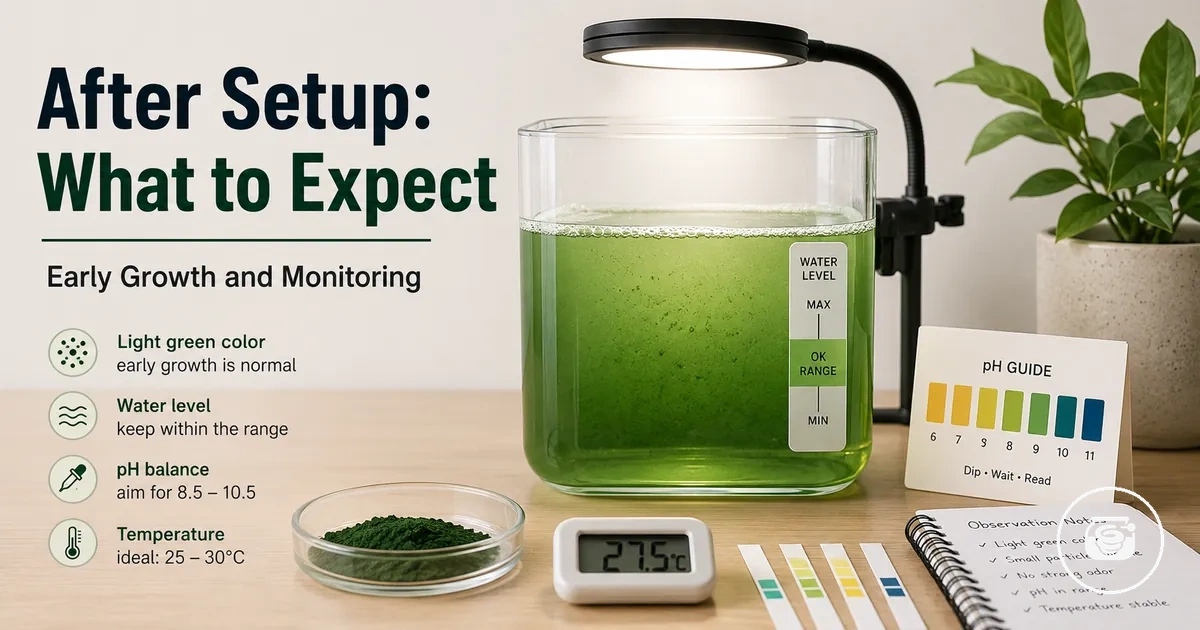
A spirulina growing kit after setup enters an early-establishment stage in which the new spirulina culture adjusts to its culture container and growth conditions before increased density becomes obvious. Phydrotec’s cultivation guidance describes the first week as an establishment period in which the water can develop a deeper green colour as the culture multiplies. The same guidance identifies a pH of 8–10, a water temperature of 20–35°C, and a light schedule of about 12–16 hours followed by 8–12 hours of darkness as cultivation conditions to monitor, although the kit instructions should control model-specific settings. Early growth is therefore conditional on the culture, light, temperature, pH, nutrients, and water level remaining within the applicable kit guidance rather than following a fixed outcome.
During the first week, a home kit may show a gradual increase in green colour without an immediate or uniform increase in visible density.
During the first week, a home kit may show a gradual increase in green colour without an immediate or uniform increase in visible density. Spirulina growing kits are culture systems that combine a live culture, growth medium, container, and condition-control supplies; Algae Research Supply, for example, specifies a kit configuration with 1 litre of starter culture and nutrient salts for two 5-gallon batches of medium. Routine checks should compare the current pH, temperature, light exposure, water level, and culture appearance with the instructions for that specific kit rather than add nutrients solely because the culture still looks thin. Visible changes should lead to monitoring first, while fading colour, an unexpected water-level change, or unusual settling should prompt a closer review of conditions.
The next section explains how a new spirulina culture settles before visible growth becomes pronounced.
The realistic expectation after setup is early establishment with condition-based observation, not an exact growth or harvest timetable. Keep nutrients tied to the kit’s stated schedule, treat stable readings and a progressively greener culture as continued-growth signals, and reserve conditional troubleshooting for persistent decline or multiple warning signs. The next section explains how a new spirulina culture settles before visible growth becomes pronounced.
Table of Contents
How a New Spirulina Culture Settles After Setup
A new spirulina culture settles after setup by entering an early stabilization stage in which the culture acclimates before visible growth becomes obvious. According to Phydrotec's spirulina cultivation guidance, the first week is an establishment period during which gradual changes in green colour and culture density are expected rather than immediate thickening. This settling stage represents normal early stabilization, provided suitable growth conditions remain stable, instead of the full growing process.
How a new spirulina culture settles after setup is best understood by watching gradual visual changes rather than expecting rapid growth.
How a new spirulina culture settles after setup is best understood by watching gradual visual changes rather than expecting rapid growth. The image below illustrates typical early settling signs, including a light green culture, a clear container, and calm movement that helps explain normal culture response before higher density develops. Research published in Aquaculture and Fisheries reports that continuous gentle mixing improves light distribution and reduces cell sedimentation, supporting a more even culture suspension during early establishment.
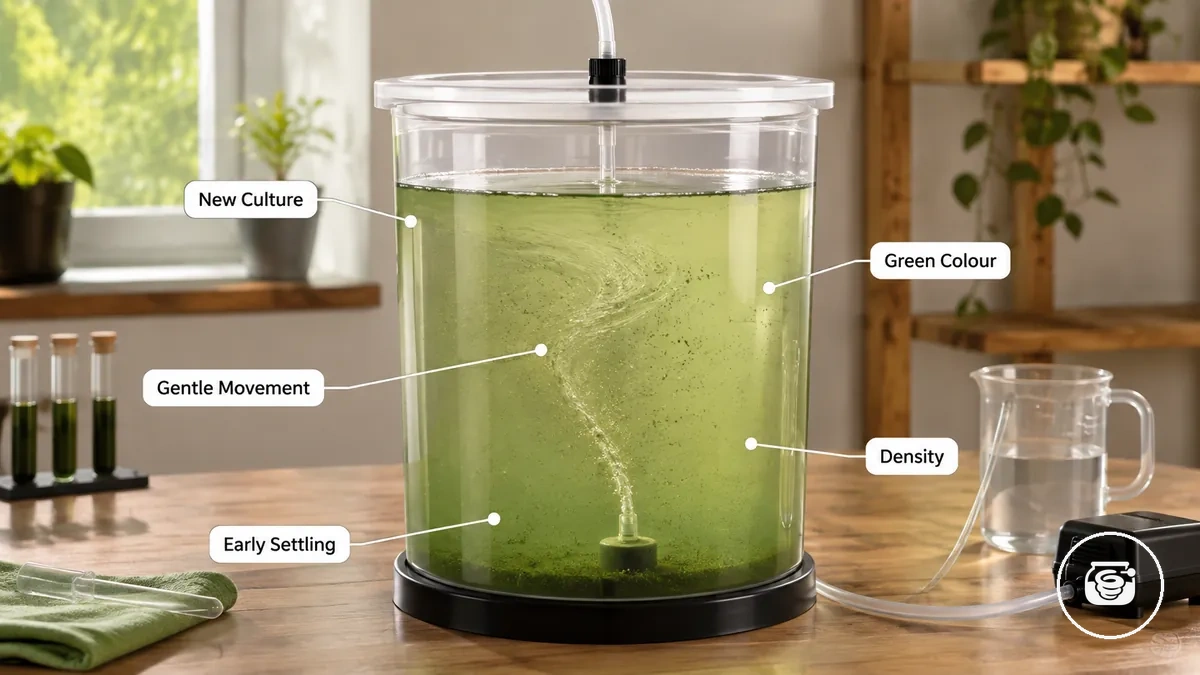
- Green colour normally becomes deeper as cell density gradually increases during the establishment period described by Phydrotec.
- Visible density often changes more slowly than colour, so limited thickening during the first week is not, by itself, an early concern.
- Gentle movement from aeration or circulation helps keep spirulina cells suspended instead of allowing prolonged settling at the bottom of the container.
- Persistent fading colour, heavy clumping, or continued sediment despite suitable light, temperature, and pH differs from normal settling and deserves closer observation.
A common misconception is that slow settling means a culture has failed. In practice, new spirulina culture response does not follow a fixed schedule because acclimation precedes visible growth under stable conditions. For broader guidance beyond post-setup settling, see home use expectations.
Early Colour, Density, and Movement Changes
Early colour, density, movement, opacity, and suspended particles should be interpreted together because a new spirulina culture normally shows multiple visible changes during early establishment rather than one definitive indicator. According to Phydrotec's spirulina cultivation guidance, the first week is an establishment phase in which the culture commonly develops a deeper green appearance over time while remaining evenly suspended under suitable growing conditions. These early signs should be read together instead of individually.
These early signs should be read together instead of individually.
The image below highlights the visible culture attributes that are most useful to observe together. Colour, density, and movement provide better context when assessed as one combined pattern rather than as isolated observations, so avoid judging the culture from a single visible sign.
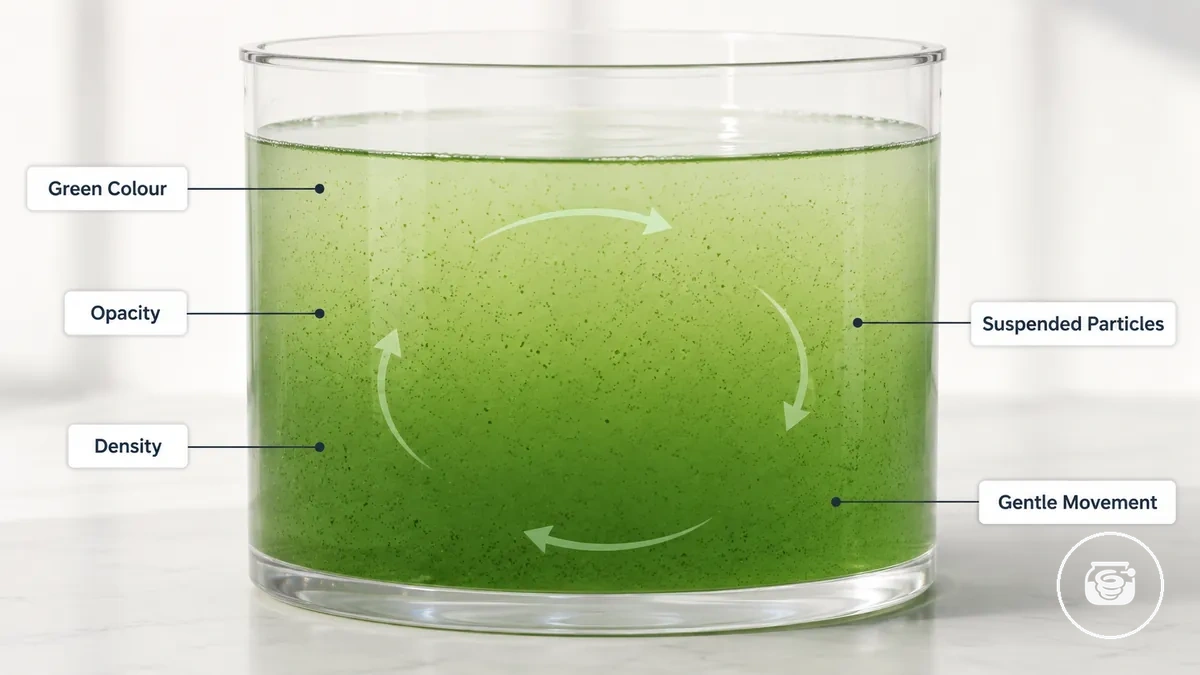
- Green colour: A gradually deeper green tint may indicate increasing culture concentration when opacity and movement remain consistent.
- Opacity: Slightly increased opacity can reflect more suspended spirulina cells rather than an immediate change in culture health.
- Suspended particles: Evenly distributed suspended particles during gentle circulation usually indicate that the culture remains dispersed instead of forming persistent sediment.
- Movement: Gentle movement helps maintain an even culture appearance, whereas prolonged stillness combined with heavy settling should be interpreted alongside colour and opacity before suggesting an early risk signal.
Why Early Growth Can Look Slow at First
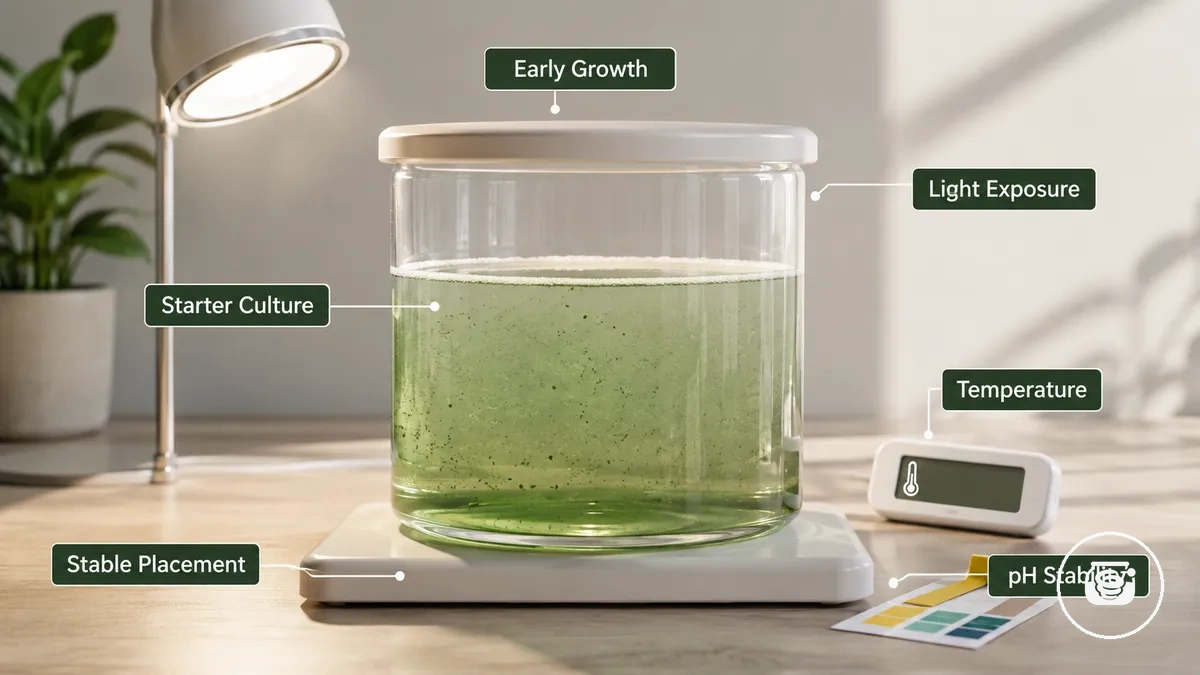
Early growth in a new spirulina culture can look slow because the culture first adapts to stabilizing conditions before a noticeable increase in visible density occurs. According to Phydrotec's spirulina cultivation guidance, the first week is an establishment phase in which culture response depends on starter culture strength, light exposure, temperature, pH stability, nutrient availability, and stable container placement rather than a single visible change. Slow visible change during this period can therefore remain consistent with normal early stabilization.
Slow visible change during this period can therefore remain consistent with normal early stabilization.
The image below illustrates why early growth can look slow at first by showing a lightly green culture in a stable home-growing environment instead of a culture that has failed. According to Phydrotec, recommended cultivation conditions include a temperature of approximately 20–35°C, a pH of 8–10, and about 12–16 hours of light followed by 8–12 hours of darkness; when these conditions remain stable, gradual culture response is expected even if visible thickening is limited during the first week. Observe the starter culture, light exposure, temperature, pH stability, nutrients, and container placement together before making major changes because one slow visible response alone is not sufficient to judge early culture development.
First-Week Checks for a Spirulina Growing Kit
First-week checks for a spirulina growing kit should verify that stable growth conditions are maintained while a new culture establishes. According to Phydrotec's cultivation guidance, first-week monitoring includes a light schedule of approximately 12–16 hours of light followed by 8–12 hours of darkness, a water temperature of 20–35°C, a pH of 8–10, a stable water level, normal culture appearance, container cleanliness, and gentle circulation. These first-week checks should confirm stable conditions rather than trigger unnecessary adjustments.
These first-week checks should confirm stable conditions rather than trigger unnecessary adjustments.
First-week checks for a spirulina growing kit help distinguish normal early establishment from changes that deserve closer review. The image below groups the main conditions to verify so that observation-only signs can be separated from warning signals before changing the growing conditions. Use the checklist as a practical first-week monitoring routine instead of a full maintenance schedule.
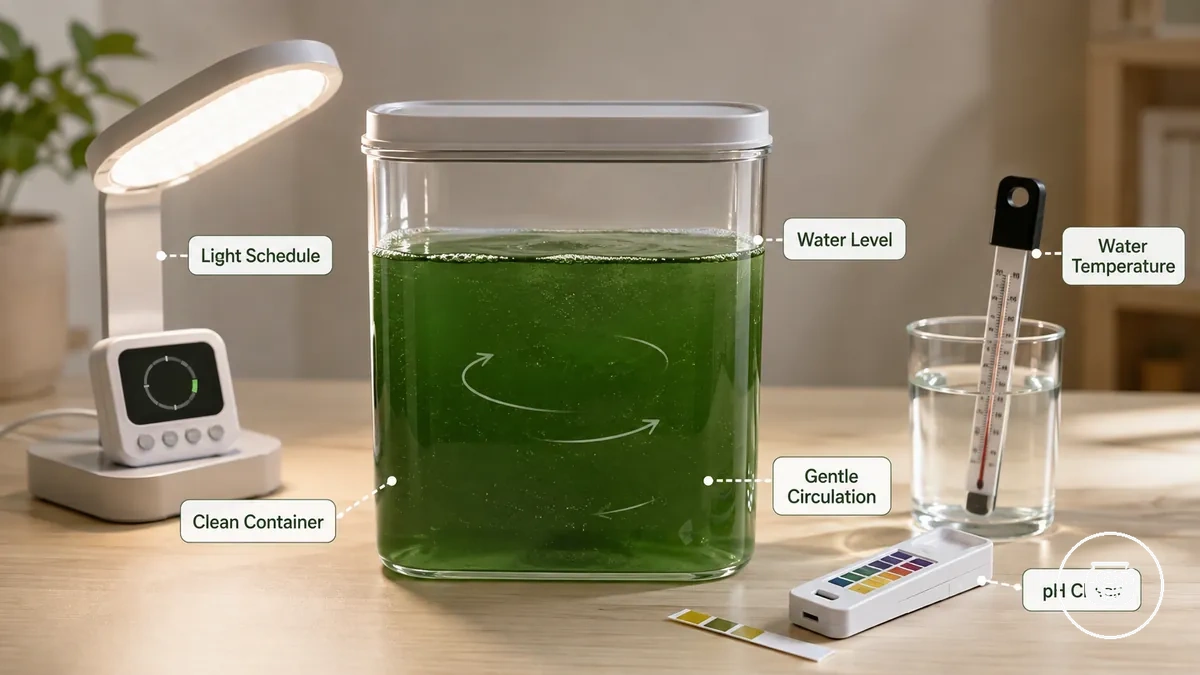
- Light schedule: A consistent daily cycle of about 12–16 hours of light followed by 8–12 hours of darkness matches Phydrotec's guidance. Missed lighting periods or prolonged darkness should prompt a review of the light source or timer.
- Water temperature: According to Phydrotec, maintaining approximately 20–35°C supports cultivation. Temperatures outside this range should trigger closer monitoring and adjustment according to the kit instructions.
- pH: Phydrotec recommends maintaining a pH between 8 and 10. Readings outside that range should be reviewed before concluding that the culture is failing.
- Water level and culture appearance: A stable water level together with a gradually deepening green colour is consistent with normal first-week establishment. Rapid evaporation, unexpected cloudiness, or fading colour should receive closer review.
- Container cleanliness: Clean container walls and equipment without unusual residue or foreign growth indicate normal monitoring conditions. Unexpected deposits or contamination signs should be inspected before continuing routine growth.
- Gentle circulation: Mild circulation that keeps spirulina evenly suspended is a stable observation. Persistent stillness combined with heavy settling is a warning signal to review aeration or circulation guidance for the kit.
Light, Temperature, pH, and Water Level Checks
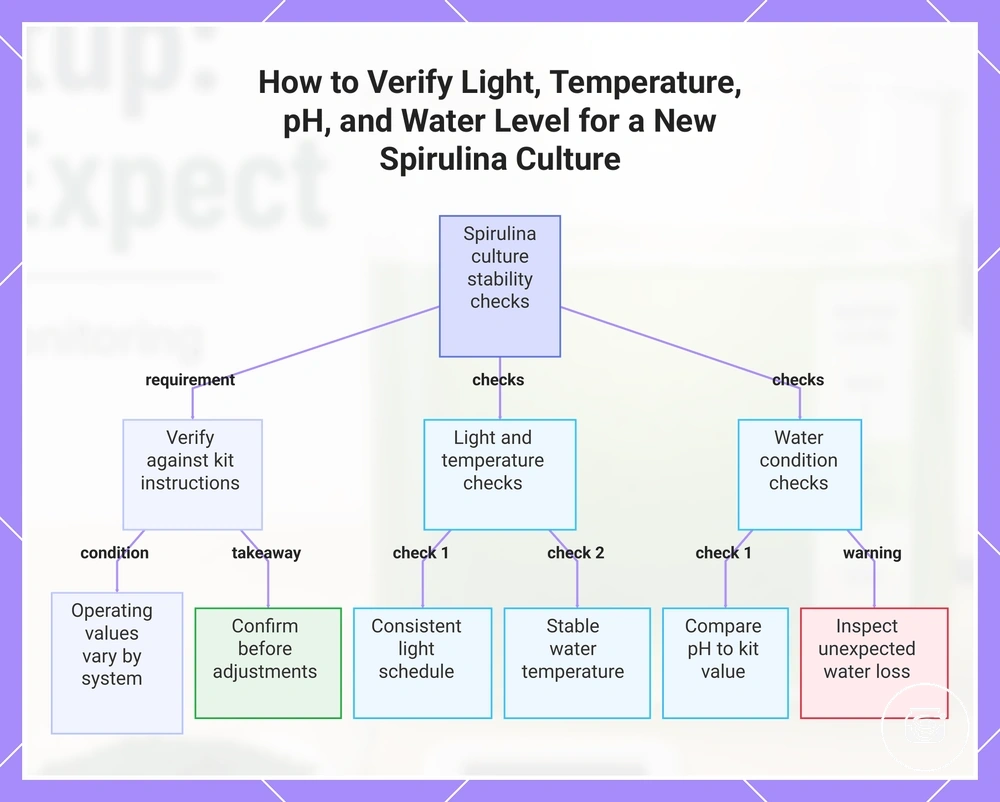
Light, temperature, pH, and water level are the four condition checks that most directly indicate whether a new spirulina culture remains in a stable state during early growth. According to Phydrotec's cultivation guidance, these conditions should be verified against the kit instructions because recommended operating values depend on the specific growing system rather than a universal standard. Use the following condition checks to confirm culture health before making any adjustments.
- Light: Check that the light schedule remains consistent with the kit instructions. A stable light routine supports normal culture response, while missed lighting periods should prompt a review of the lighting schedule before changing other conditions.
- Temperature: Confirm that the water temperature remains stable according to the kit instructions. Sudden temperature changes can affect early growth, so verify the temperature before assuming another condition is responsible for slower culture development.
- pH: Compare the pH reading with the value specified for the kit. According to the U.S. Geological Survey (USGS), pH measures how acidic or basic water is on a scale from 0 to 14, making routine pH readings a practical way to detect changes that could influence culture health.
- Water level: Monitor the water level for a stable state with only normal evaporation. If the culture container loses water unexpectedly or the level changes quickly, inspect the container and verify the cause before altering nutrients or other growing conditions.
This chart shows which early-growth condition checks confirm whether a new spirulina culture is stable before adjustments.
Culture Concentration and Container Condition
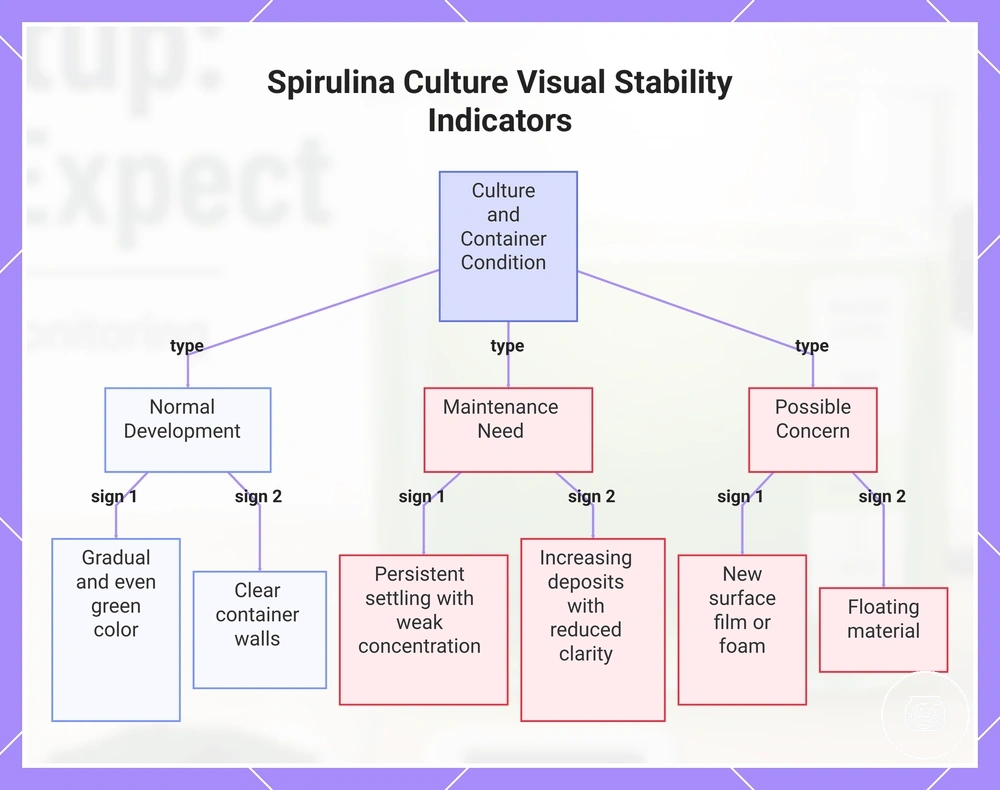
Culture concentration describes the visible density of the spirulina culture, while container condition describes the clarity, residue, settling, and surface changes visible around it. Early stability is more consistent with gradual colour depth, an evenly dispersed culture, clear container walls, and no new surface film than with any single sign alone. Culture concentration and container condition should therefore be evaluated together as indicators of visual stability.
The following container signs need combined interpretation.
Visible changes can suggest normal development, a maintenance need, or a possible concern, but appearance alone does not establish contamination or culture health. The following container signs need combined interpretation.
- Colour depth: Gradually increasing green colour with evenly distributed density is consistent with normal development when the container condition remains stable.
- Residue and container clarity: Clear walls with no expanding residue support routine observation, while increasing deposits together with reduced container clarity justify closer review.
- Settling: Temporary settling after movement stops may require observation only; persistent settling combined with weak visible concentration or new residue may indicate a maintenance need.
- Surface changes: An unchanged liquid surface supports early stability, while a new film, foam, or floating material should be assessed alongside colour depth, residue, settling, and container clarity.
This chart shows the three categories of visual signs that indicate whether a spirulina culture is developing normally, needs maintenance, or may be a concern.
Normal Growth Progression After the First Week
Growth progression after the first week normally continues from establishment toward a deeper green colour, increased density, and gradual culture thickening when stable growing conditions are maintained. According to Phydrotec's spirulina cultivation guidance, the first week is an establishment phase, so visible progression is expected to develop afterward rather than immediately. The direction of growth is therefore more important than any fixed timetable because culture development depends on stable light exposure, temperature, pH, and nutrient conditions rather than an exact schedule.
According to Phydrotec, the expected observation after establishment is continued culture development rather than a guaranteed growth rate or harvest date.
A fast-growing culture may develop a deeper green appearance and visibly higher density sooner than a moderate or slow-but-stable culture, while a slow-but-stable culture can still represent healthy growth progression if colour continues to deepen instead of fading. For example, if two cultures begin under the same recommended conditions, the culture that steadily becomes darker green and denser over successive observations demonstrates positive visible progression even if it does not match another culture's pace. According to Phydrotec, the expected observation after establishment is continued culture development rather than a guaranteed growth rate or harvest date.
The broad progression below summarises the usual direction of development after the first week without assigning fixed dates.
The broad progression below summarises the usual direction of development after the first week without assigning fixed dates.
| Stage cue | What may change | What it can mean | When to keep watching |
|---|---|---|---|
| Post-establishment | Green colour gradually deepens and visible density increases. | Growth progression is continuing under stable conditions. | Continue routine observation while colour and density keep improving. |
| Culture thickening | The culture appears less transparent as suspended cell concentration increases. | Normal culture development is becoming more visible. | Maintain routine care without assuming harvest readiness. |
| Slow-but-stable progression | Visible changes remain gradual but continue in a positive direction. | Healthy culture development can continue even with a slower growth pace. | Keep monitoring unless colour fades or visible density declines. |
Once growth progression becomes consistently visible, routine care replaces first-week observation as the main focus. For broader expectations beyond this post-first-week overview, see the growth timeline.
Establishment, Thickening, and Stronger Green Colour
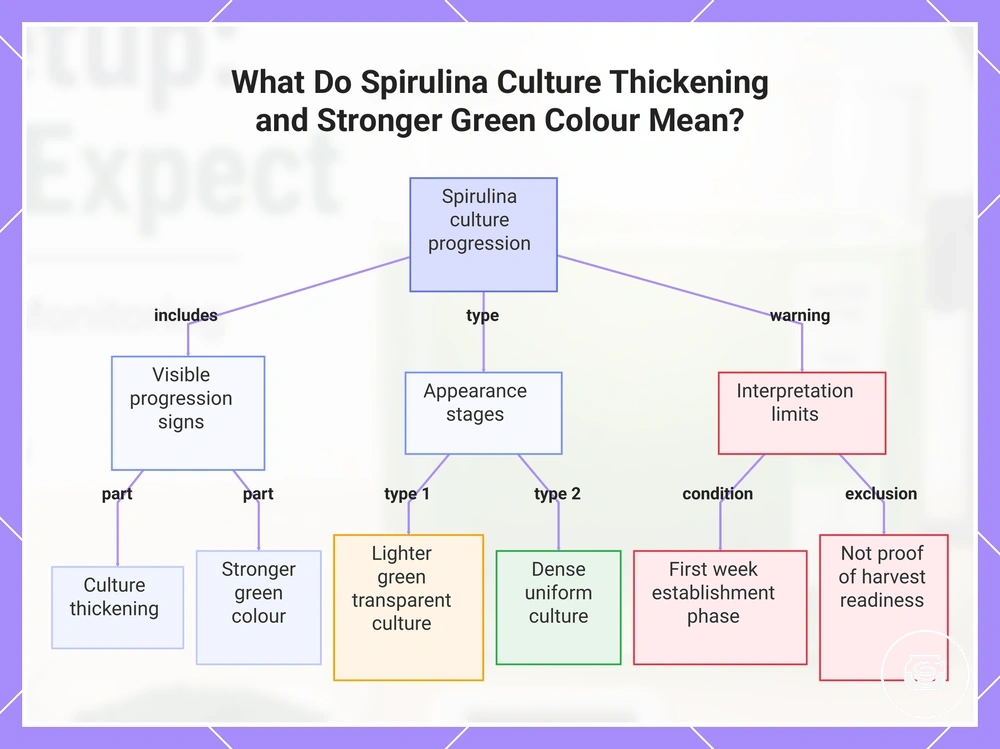
A spirulina culture that has moved beyond establishment normally develops culture thickening, a stronger green colour, higher culture density, greater visible colour saturation, more evenly suspended biomass, and improved consistency when growing conditions remain stable. According to Phydrotec's cultivation guidance, the first week is primarily an establishment phase, so these appearance changes are expected to develop progressively afterward rather than immediately. A stronger green colour should therefore be interpreted together with increased culture density, suspended biomass, and consistency instead of being treated as proof of full culture health or harvest readiness.
The observations below compare appearance within the same established culture rather than fixed growth stages.
The observations below compare appearance within the same established culture rather than fixed growth stages.
- Weaker appearance: Lighter green colour, lower visible culture density, lower colour saturation, and a more transparent culture while suspended biomass remains relatively sparse.
- Moderate appearance: Deeper green colour with increased visible density, more evenly suspended biomass, and improved consistency throughout the culture.
- Stronger appearance: Stronger green colour accompanied by noticeable culture thickening, higher visible density, more uniform suspended biomass, and consistent appearance across the container. These combined attributes indicate visible progression under stable conditions but do not, on their own, confirm harvest readiness or complete culture health.
This chart shows the main visible signs of spirulina culture progression, compares weaker and stronger appearance, and highlights why these signs are not proof of harvest readiness.
Why Growth Timing Varies Between Home Kits
Growth timing in home kits varies because spirulina responds to growing conditions after setup rather than to correct assembly alone. According to Phydrotec's cultivation guidance, maintaining a water temperature of approximately 20–35°C, a pH of 8–10, and a light schedule of about 12–16 hours of light followed by 8–12 hours of darkness supports normal culture establishment, while differences in these conditions can change the culture's growth pace even when two kits are prepared correctly. Variable home conditions therefore explain timing differences more reliably than the kit itself.
Variable home conditions therefore explain timing differences more reliably than the kit itself.
For example, suppose two home kits are started with the same setup and one receives about 12–16 hours of daily light while the other receives only 8 hours because of an interrupted timer. Based on Phydrotec's recommended lighting schedule, the first culture is more likely to continue normal establishment, whereas the second may show slower visible progression even though both kits were assembled correctly. Growth expectations should therefore remain conditional on the growing environment rather than an assumed growth rate.
Growth expectations should therefore remain conditional on the growing environment rather than an assumed growth rate.
The following home conditions commonly influence growth timing:
- Starter culture amount: The starter culture amount supplied according to the kit instructions affects how quickly visible culture density begins to develop after setup.
- Light duration: Phydrotec recommends approximately 12–16 hours of light followed by 8–12 hours of darkness. Shorter or inconsistent lighting periods can delay visible culture response.
- Temperature stability: Keeping the culture within approximately 20–35°C, as recommended by Phydrotec, supports continued establishment, while repeated temperature fluctuations can slow growth timing.
- pH: Maintaining a pH between 8 and 10, according to Phydrotec, helps sustain suitable growing conditions. Readings outside that range may reduce visible culture development.
- Nutrients: Nutrients added according to the kit schedule help maintain normal culture response, whereas delayed or omitted additions can reduce visible progression.
- Container size and room conditions: Container size, indoor temperature, airflow, and natural light exposure can influence evaporation, heat retention, and culture response, contributing to timing differences between otherwise similar home kits.
When Nutrients and Routine Maintenance Become Relevant
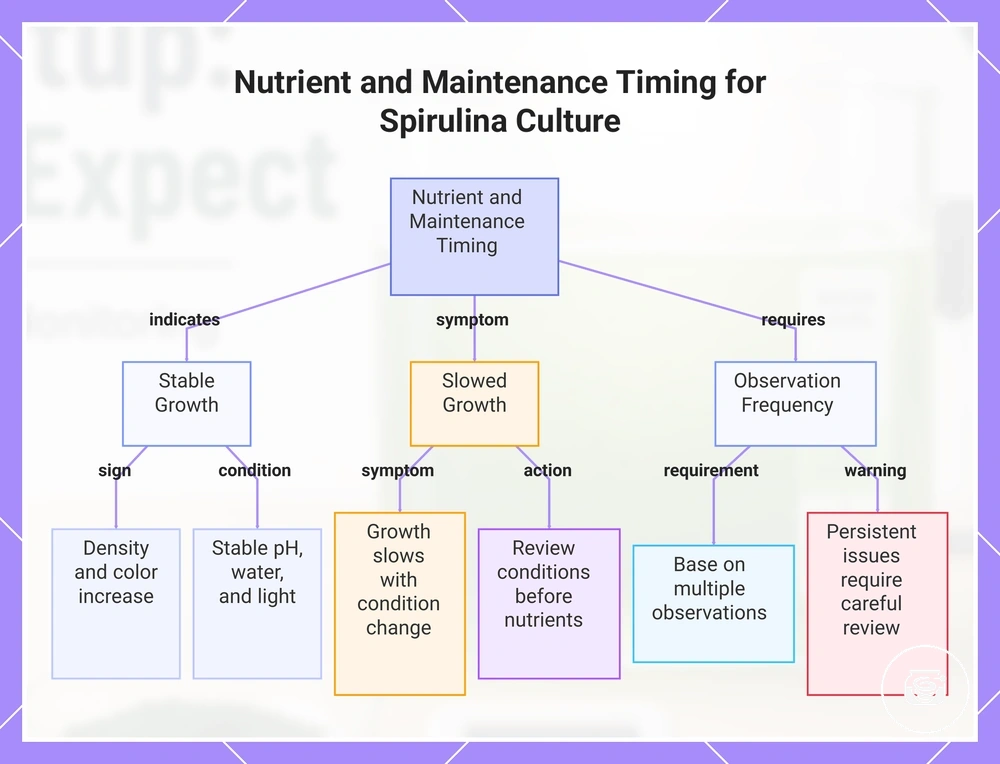
Nutrients and routine maintenance become relevant after initial setup once a spirulina culture has progressed beyond its establishment phase and its condition indicates the need for ongoing support rather than faster growth. According to Phydrotec's cultivation guidance, stable growth is supported by maintaining a water temperature of approximately 20–35°C, a pH of 8–10, and a light schedule of about 12–16 hours of light followed by 8–12 hours of darkness. Nutrient additions should therefore be based on observable culture conditions instead of being used to accelerate growth unnecessarily.
Nutrient additions should therefore be based on observable culture conditions instead of being used to accelerate growth unnecessarily.
If culture density gradually increases, the green colour becomes deeper, and pH monitoring, water level, and light consistency remain stable, routine observation is generally sufficient. If visible growth slows while one or more of these conditions changes, review those maintenance signals before considering nutrient additions because the underlying condition, rather than nutrient availability alone, may explain the slower response. For example, a culture receiving the recommended 12–16 hours of daily light but showing a pH outside the recommended 8–10 range should have its growing conditions reviewed before any nutrient adjustment is made.
As the culture becomes established, observation frequency becomes the main guide for deciding when routine maintenance is appropriate.
As the culture becomes established, observation frequency becomes the main guide for deciding when routine maintenance is appropriate. Comparing changes in culture density, water level, pH, and light consistency over multiple observations provides a more reliable basis for maintenance decisions than reacting to a single day's appearance.
After these condition-based checks indicate that routine care is appropriate, refer to ongoing maintenance for detailed maintenance procedures beyond the scope of this setup expectation guide.
After these condition-based checks indicate that routine care is appropriate, refer to ongoing maintenance for detailed maintenance procedures beyond the scope of this setup expectation guide.
- Stable growth: Culture density continues to increase, green colour gradually deepens, and pH, water level, and light consistency remain within the recommended conditions. Continue routine observation without unnecessary adjustments.
- Slowed growth: Visible culture development slows while one or more maintenance signals changes. Review pH, water level, light consistency, and nutrient timing before making any adjustment.
- Careful maintenance review: Persistent colour fading, declining culture density, repeated pH instability, or unexpected water-level changes indicate that a more careful maintenance review is appropriate before adding nutrients.
- Observation frequency: Base maintenance decisions on consistent observations collected over time instead of a single visual change because temporary fluctuations do not necessarily indicate that nutrient additions are required.
This chart shows the condition-based approach for deciding when to add nutrients and perform routine maintenance for a spirulina culture, based on stable growth, slowed growth signals, and observation frequency.
When Adding Nutrients Supports Continued Growth
Adding nutrients supports continued growth only after the spirulina culture has progressed beyond its initial culture stage of establishment and its observed condition indicates that additional nutrients are appropriate. According to Phydrotec's cultivation guidance, continued growth depends on maintaining a water temperature of approximately 20–35°C, a pH of 8–10, and a 12–16-hour daily light period; nutrient additions should therefore follow the kit instructions and the culture stage rather than being used as an automatic response to slow early growth.
Adding nutrients is most appropriate when the culture's condition indicates that routine support, rather than further establishment, has become the priority.
Adding nutrients is most appropriate when the culture's condition indicates that routine support, rather than further establishment, has become the priority.
- Culture density: If culture density continues to increase and the culture remains evenly suspended, continue following the kit instructions instead of adding nutrients earlier than recommended.
- Colour stability and growth rate: A progressively deeper green colour together with an ongoing growth rate indicates continued development. If both colour stability and growth slow unexpectedly, review growing conditions before considering nutrient addition.
- pH context: If the pH context falls outside the kit's recommended range of 8–10, correct the growing conditions before assuming additional nutrients are needed, as specified in Phydrotec's cultivation guidance.
- Kit guidance: Add nutrients only when both the culture stage and the manufacturer's kit instructions indicate that condition-based support is appropriate. Avoid assuming that additional nutrients alone will improve continued growth.
When to Avoid Changing the Culture Too Early
Avoid changing the culture too early when it has been set up recently and continues to show normal early variation under stable growing conditions. According to Phydrotec's cultivation guidance, maintaining a water temperature of approximately 20–35°C, a pH of 8–10, and a 12–16-hour daily light period followed by 8–12 hours of darkness supports early establishment, so continued observation is generally safer than an immediate adjustment while these conditions remain stable. Waiting applies only to normal early variation and should not replace careful review when clear intervention triggers appear.
Waiting applies only to normal early variation and should not replace careful review when clear intervention triggers appear.
Use the comparison below to distinguish when to avoid changing the culture too early from when reviewing the growing conditions is more appropriate.
| Keep observing when | Review conditions when |
|---|---|
| The culture was set up recently, the colour changes are mild, the smell remains stable, the water level is unchanged apart from expected evaporation, and there is no obvious contamination. | Clear intervention triggers appear, including an unexpected change in smell, a rapid water-level change, visible contamination, or other warning signs that justify careful review instead of continued observation. |
Early Warning Signs After Spirulina Kit Setup
Early warning signs after spirulina kit setup include fading colour, weak density, persistent unpleasant smell, unusual settling, surface changes, pH instability, and a poor culture response despite otherwise stable conditions. According to Phydrotec's cultivation guidance, maintaining a water temperature of approximately 20–35°C, a pH of 8–10, and about 12–16 hours of light followed by 8–12 hours of darkness supports normal cultivation, so these warning signs become more meaningful when they occur together while those conditions are being maintained. A single symptom does not identify a definite cause, but multiple symptoms appearing at the same time provide a stronger basis for careful troubleshooting.
Use the diagnostic checklist below to determine whether continued observation or cautious troubleshooting is the more appropriate response.
Evaluate each symptom as part of the overall culture condition instead of treating it as a standalone diagnosis because different condition changes can produce similar observations. For example, a culture that remains within the recommended 20–35°C temperature range and pH 8–10 but develops both fading colour and weak density over several observations deserves closer review than a culture showing only temporary settling after circulation stops. Use the diagnostic checklist below to determine whether continued observation or cautious troubleshooting is the more appropriate response.
| Sign | Condition to check | What it may mean | Next cautious action |
|---|---|---|---|
| Fading colour | Confirm that the light schedule, temperature, and pH remain within the recommended conditions. | A possible reduction in culture activity or a change in growing conditions. | Verify growing conditions before making adjustments. |
| Weak density | Compare culture density across multiple observations rather than a single day. | Slower culture development or reduced growth response. | Continue monitoring and review conditions if the trend persists. |
| Persistent unpleasant smell | Check whether the odour has changed noticeably from the normal culture smell. | A culture condition change that warrants further investigation. | Inspect the culture and verify environmental conditions before changing nutrients or maintenance. |
| Unusual settling or surface changes | Observe whether settling persists or whether new films, foam, or floating material continue to develop. | A possible condition change rather than evidence of a specific cause. | Assess this symptom together with other warning signs before troubleshooting. |
| pH instability or poor response under stable conditions | Measure whether pH remains within the recommended 8–10 range while temperature and lighting stay consistent. | The culture may require condition-based troubleshooting. | Review the kit instructions and reassess all growing conditions before making major adjustments. |
Fading Colour, Weak Density, Smell, or Settling
Fading colour, weak density, an unusual smell, and persistent settling are local warning signs when they continue across observations or occur together despite otherwise stable growing conditions. According to Phydrotec's cultivation guidance, each symptom should be interpreted within its wider condition pattern before any cautious action is taken. Symptom combinations justify closer review more strongly than an isolated sign.
- Fading colour: A culture that becomes progressively paler while light exposure, temperature, and pH remain stable may be showing a reduced culture response. Compare the colour across successive observations, then review the kit instructions before changing nutrients or lighting.
- Weak density: Culture density that remains visibly thin or declines together with fading colour may indicate slower establishment. Confirm that the change persists across multiple observations before reviewing the growing conditions as a group.
- Unusual smell: A new or persistent odour that differs from the culture's previous smell may indicate a condition change, particularly when it appears with colour loss or surface changes. Inspect the container and compare the symptom with the kit guidance without assigning a definite cause from smell alone.
- Abnormal settling: Spirulina that continues collecting at the bottom despite normal circulation may indicate uneven suspension or another condition change. Observe whether gentle movement redistributes the culture, and seek a more careful review when settling persists alongside weak density, fading colour, or an unusual smell.
Condition Changes That Need Troubleshooting
Condition changes warrant moving from observation into troubleshooting when they persist outside the kit's intended operating conditions or coincide with a weaker culture response. According to Phydrotec's cultivation guidance, spirulina is generally maintained at approximately 20–35°C, a pH of 8–10, and about 12–16 hours of light followed by 8–12 hours of darkness; repeated movement outside those ranges is a condition trigger for closer review rather than continued waiting. The checklist below identifies the main changes that justify a diagnostic check.
- Unstable pH: Repeated readings outside pH 8–10 may be associated with a weaker culture response and justify troubleshooting before nutrients or other settings are changed.
- Low light: A daily light period below the recommended 12–16 hours may contribute to slower visible growth, particularly when colour and density also stop improving.
- Excessive light: Lighting that removes the recommended 8–12-hour dark period or exceeds the kit instructions should be reviewed when growth, colour, or surface condition deteriorates.
- Unsuitable temperature: Water temperatures repeatedly below 20°C or above 35°C fall outside Phydrotec's stated cultivation range and justify closer review when the culture stops progressing.
- Water loss or residue: Unexpected water loss, increasing deposits, or new residue on the container may indicate a maintenance or setup change that should be checked before broader adjustments are made.
- Repeated lack of improvement: When the culture shows no visible improvement across successive observations despite stable pH, light, temperature, and water level, move from routine observation to troubleshooting while following the kit-specific instructions.
What Changes Before Regular Growing and Harvesting
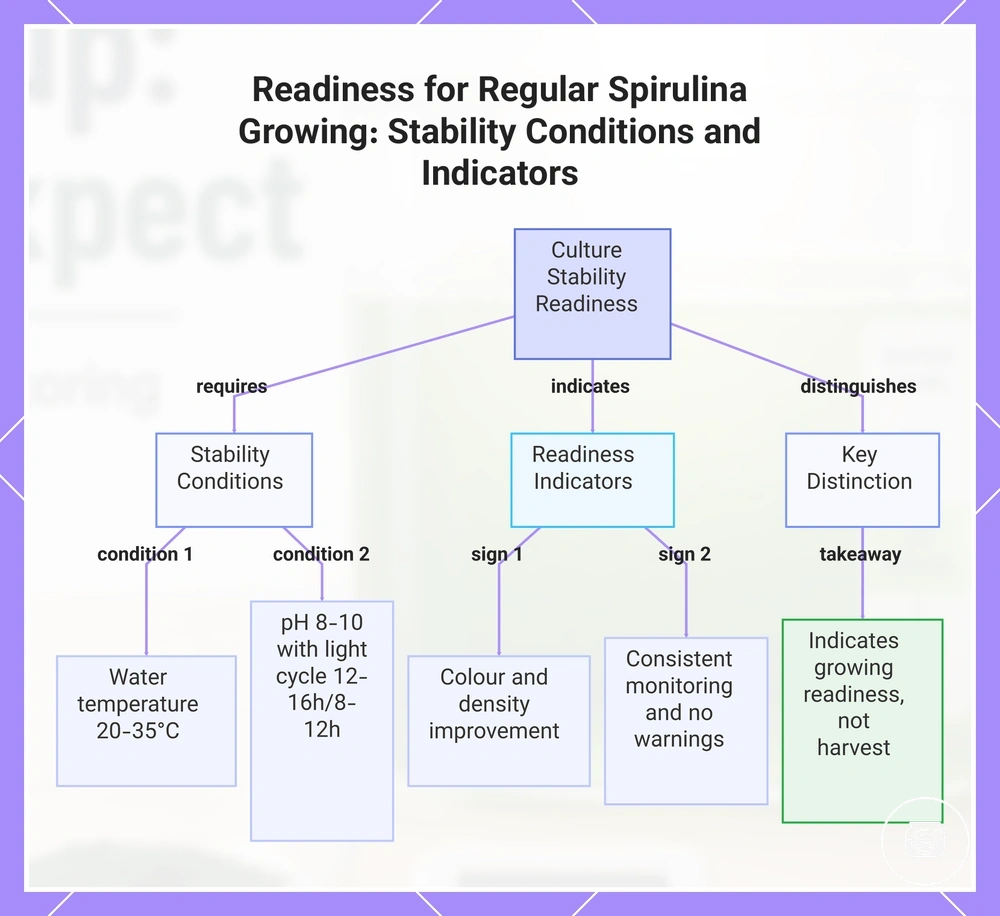
Readiness for regular growing and eventual harvesting is indicated by culture stability rather than by reaching a fixed number of days after setup. According to Phydrotec's cultivation guidance, stable cultivation is supported by maintaining a water temperature of approximately 20–35°C, a pH of 8–10, and about 12–16 hours of light followed by 8–12 hours of darkness. Readiness therefore depends on sustained culture stability instead of a single date or milestone.
These combined changes indicate readiness for ongoing growth, not harvesting.
As the culture moves toward its regular growing phase, a stronger colour, steadier density, and predictable condition checks should become consistent across repeated observations. For example, if the culture continues to remain within the recommended 20–35°C temperature range, pH 8–10, and recommended light cycle over several observation periods while colour and density continue improving, the culture demonstrates increasing stability rather than proving that harvesting should begin. Routine nutrient awareness also becomes part of normal observation instead of a response to early establishment. These combined changes indicate readiness for ongoing growth, not harvesting.
Routine nutrient awareness also becomes part of normal observation instead of a response to early establishment.
Use the readiness checklist below to distinguish stable development from conditions that still require continued observation. The checklist identifies what each readiness sign suggests and what it does not confirm, helping separate early post-setup expectations from later growing and harvesting guidance.
- Stronger colour: Suggests continued culture development but does not confirm harvesting readiness.
- Steadier density: Indicates a more consistent suspended culture but does not prove that growth has reached its final stage.
- Predictable condition checks: Stable temperature, pH, light schedule, and water level suggest improving culture stability but do not eliminate the need for routine monitoring.
- Routine nutrient awareness: Indicates the culture has progressed beyond early establishment but does not mean nutrients should be added outside the manufacturer's schedule.
- Absence of early warning signs: Continued lack of fading colour, persistent unpleasant smell, repeated residue changes, or unstable conditions supports readiness for regular growing but does not establish an exact harvest date or guarantee yield.
This section defines the boundary between early post-setup expectations and ongoing culture management without replacing detailed growing or harvesting guidance. For the next stage of development, continue with growing spirulina with a kit.
For the next stage of development, continue with growing spirulina with a kit .
This chart shows the conditions and signs that indicate a spirulina culture is ready for regular growing, and clarifies that these signs do not confirm harvesting readiness.