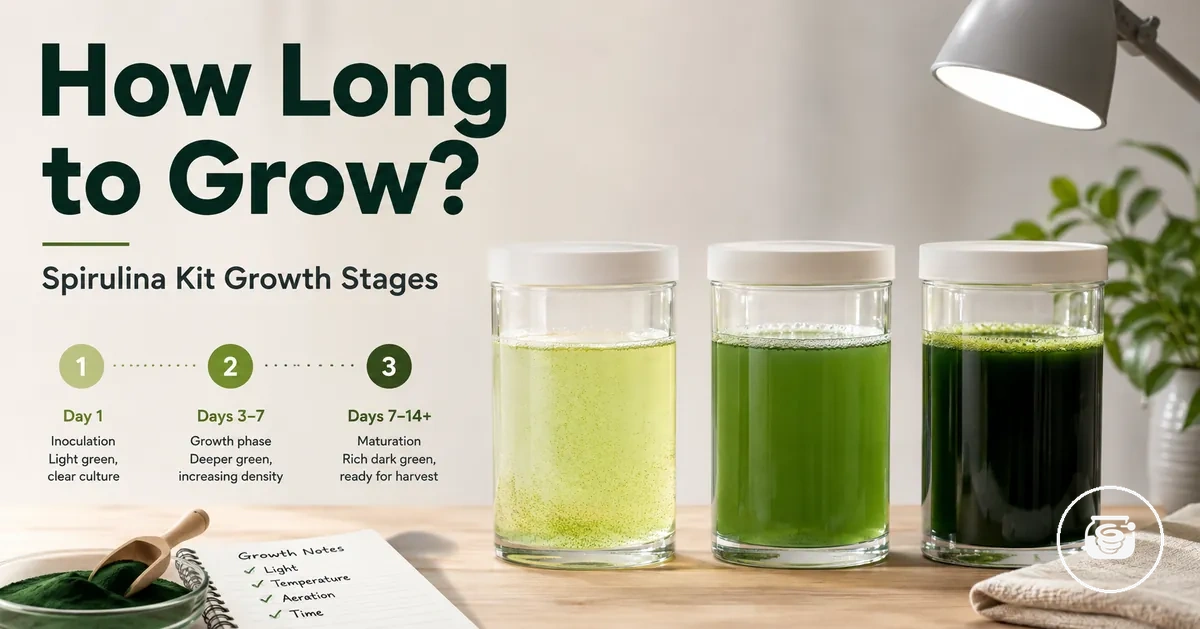
How Long Do Spirulina Growing Kits Take to Grow?
Spirulina growing kit growth time is typically about 7 to 10 days from a healthy starter culture to initial harvest readiness when the culture is maintained under the supplier's recommended growing conditions. According to Grow Spirulina, this timeframe applies to a live starter culture grown at approximately 30–35°C, with at least 12 hours of light per day, an alkaline pH around 10.5, and adequate nutrients. Growth time is conditional rather than guaranteed because culture strength and growing conditions directly influence how quickly the culture reaches harvest readiness.
Growth time is conditional rather than guaranteed because culture strength and growing conditions directly influence how quickly the culture reaches harvest readiness.
For a home spirulina growing kit, growth time refers only to the period between adding the starter culture to the prepared growing medium and reaching sufficient culture density for a first harvest. Harvest readiness is identified by a noticeably darker green colour and a visibly denser culture than at the starting point rather than by a universal density measurement. No recognised scientific standard defines a single harvest-ready density that applies to every home spirulina growing kit, so the kit manufacturer's instructions remain the appropriate model-specific reference.
Light, temperature, pH, nutrients, water quality, and starting density are the primary variables controlling culture speed.
Light, temperature, pH, nutrients, water quality, and starting density are the primary variables controlling culture speed. According to the 2022 review by AlFadhly and colleagues published in Plants, Spirulina productivity is strongly influenced by cultivation temperature, light intensity and duration, alkaline pH, nutrient availability, water quality, and inoculation density. For example, if two identical home spirulina kits are both maintained at 30°C for 10 days, the culture started with a higher starting density will generally reach harvest readiness sooner because more Spirulina cells are present at the beginning of the growth cycle, while the other culture may require additional growing time under the same conditions.
This page focuses only on the expected growth timeline from starter culture to harvest readiness.
This page focuses only on the expected growth timeline from starter culture to harvest readiness. If your spirulina growing kit has not reached the expected culture density within the supplier's stated timeframe, compare the actual temperature, light exposure, pH, nutrients, water quality, and starting density with the kit's recommended conditions before considering harvesting techniques or troubleshooting procedures.
Table of Contents
How Long Spirulina Growing Kits Usually Take
Spirulina growing kits usually require about 7 to 14 days to develop a visibly dense, dark-green culture under the supplier-defined conditions for a healthy live starter culture. Grow Spirulina states that a home culture can become harvestable after approximately 7 to 14 days, but the growth range is model-specific rather than a universal timetable. Culture condition and the growing environment determine whether harvest readiness occurs near the beginning or end of that interval.
The image shows the visible density difference that helps distinguish developing culture from a harvest-ready culture.
spirulina growing kits use growth time as the interval between inoculating the prepared medium and reaching the kit supplier’s stated harvest-readiness condition. The image shows the visible density difference that helps distinguish developing culture from a harvest-ready culture.
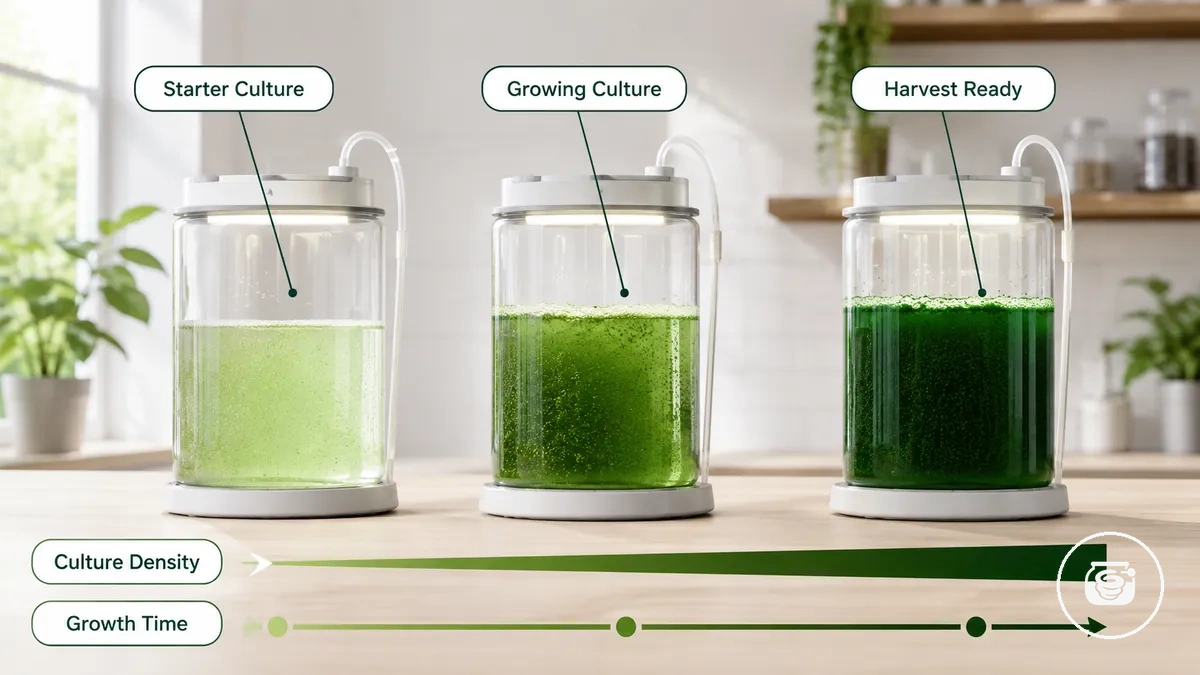
The 7-to-14-day interval reported by Grow Spirulina assumes suitable light, temperature, alkaline medium, nutrients, and starting density; the reviewed source does not specify a universal numerical threshold for fast, normal, or delayed home-kit growth. The scenarios below therefore use that supplier-stated interval as a timing reference, while harvest readiness remains tied to the kit’s own density and colour criteria.
| Timing scenario | Culture condition | What it usually means |
|---|---|---|
| Fast growth | Visible harvest readiness near day 7 under the supplier-defined conditions for a healthy starter culture | The culture reaches the early boundary of Grow Spirulina’s reported 7-to-14-day growth range. |
| Normal growth | Visible harvest readiness between days 7 and 14 under suitable light, temperature, alkaline medium, nutrients, and starting density | The culture develops within Grow Spirulina’s reported home-growing interval. |
| Delayed growth | No harvest-ready density by day 14 under the same supplier reference | The culture has moved beyond the reported interval, so its timing expectation should be reassessed against the kit-specific growing conditions rather than treated as a fixed failure. |
Growth Timeline After a Spirulina Kit Is Set Up
The growth timeline after a spirulina kit is set up is a sequence of observable culture changes from starter culture adjustment to harvest-ready culture density rather than a fixed calendar schedule. According to the 2022 review by AlFadhly and colleagues published in Plants, Spirulina culture development is influenced by cultivation conditions including light, temperature, pH, nutrient availability, water quality, and inoculation density, so each stage progresses conditionally instead of on a universally defined day. If you want the complete cultivation workflow rather than the visible timeline, see how to grow spirulina.
If you want the complete cultivation workflow rather than the visible timeline, see how to grow spirulina .
The staged timeline below organises the visible growth signals that appear after the kit is set up and shows how culture density progresses toward harvest readiness. The image highlights the visible thickening and colour change that help distinguish one growth stage from the next without implying a guaranteed schedule.
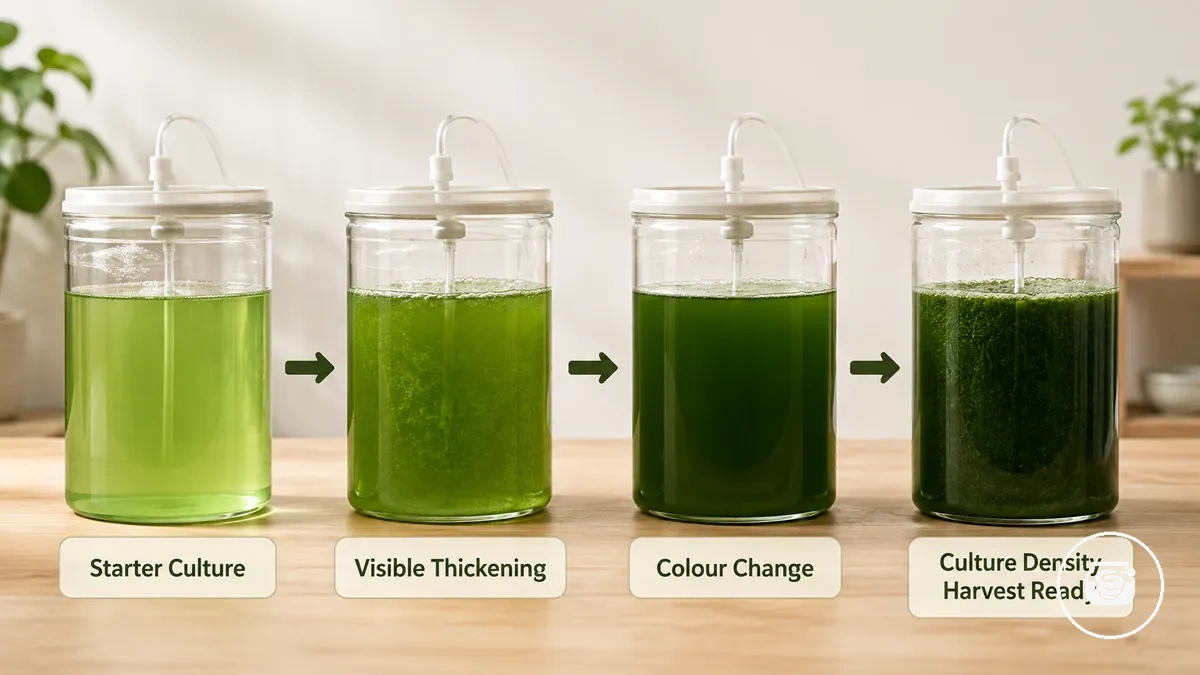
According to the reviewed cultivation literature, no scientific source defines a universal number of days for the individual stages below because progression depends on the initial starter culture and growing conditions. For example, two home cultures prepared on the same day may reach visible thickening at different times if one begins with a higher inoculation density under suitable light and alkaline conditions, while the other starts with a more diluted culture.
| Stage | What changes | What to watch | Timing note |
|---|---|---|---|
| Starter culture adjustment | The starter culture adapts to the prepared growing medium. | Even green appearance with little visible thickening. | Occurs immediately after the kit is set up; no universal duration is defined in the reviewed evidence. |
| Visible thickening | Biomass increases and the culture becomes progressively less transparent. | Noticeably higher culture density than at the starting point. | Appears earlier when inoculation density and growing conditions remain suitable. |
| Colour change | The green colour gradually darkens as biomass accumulates. | Uniform darker green colour across the culture rather than isolated darker areas. | Progresses alongside increasing biomass under suitable cultivation conditions. |
| Harvest-ready density | The culture reaches the density specified by the kit supplier for the first harvest. | Dense, dark-green culture matching the supplier's harvest-ready guidance. | No universal density threshold or fixed day applies across all home spirulina growing kits. |
Starter Culture Adjustment
Starter culture adjustment is the first stage after the starter culture is introduced into the prepared growing medium. During this adjustment period, the starter culture adapts to its new environment, so stable colour with temporary slow change is a normal early sign that requires monitoring rather than an immediate conclusion about culture health. According to the 2022 review by AlFadhly and colleagues published in Plants, Spirulina culture development depends on cultivation conditions such as inoculation density, light, temperature, pH, nutrient availability, and water quality, and the review does not define a universal duration for this early adaptation stage.
Starter culture adjustment is the first stage after the starter culture is introduced into the prepared growing medium.
The image below highlights the appearance of a starter culture during its adjustment period before visible thickening begins. It focuses on the stable colour and limited early change that should be monitored while the culture settles into the growing medium.
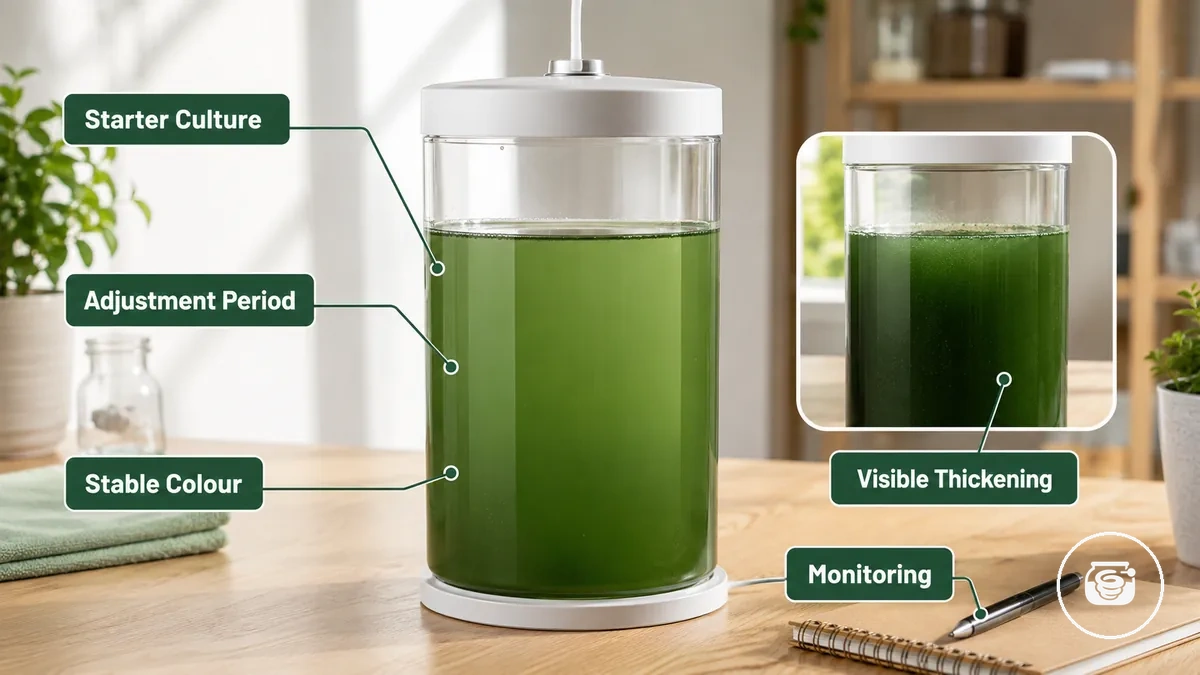
- Normal early signs: The starter culture shows an even green appearance with little visible increase in culture density.
- Temporary slow change: Limited visual change alone is not automatically an unhealthy sign when the stable colour is maintained during the adjustment period.
- Monitoring: Continue observing the starter culture for a consistent green appearance before the later stage of visible thickening develops.
- Boundary cue: The reviewed scientific literature does not specify a fixed number of days for starter culture adjustment, so continued monitoring is a more reliable indicator than judging the culture from early appearance alone.
Visible Thickening and Deeper Green Colour
Visible thickening and deeper green colour indicate that spirulina biomass is increasing when the visual change is accompanied by greater opacity, density, and evenness. Colour alone does not confirm growth progress because lighting, container depth, and viewing angle can change how green the culture appears. The 2022 review by AlFadhly and colleagues in Plants identifies biomass concentration and cultivation conditions as linked measures of Spirulina growth, but it does not establish a universal colour or opacity threshold for home cultures.
This comparison supports a qualified assessment of growth progress rather than a conclusion based on colour alone.
The image below shows the local visual change from a lighter, more transparent culture to a darker and less transparent culture with more even density. This comparison supports a qualified assessment of growth progress rather than a conclusion based on colour alone.
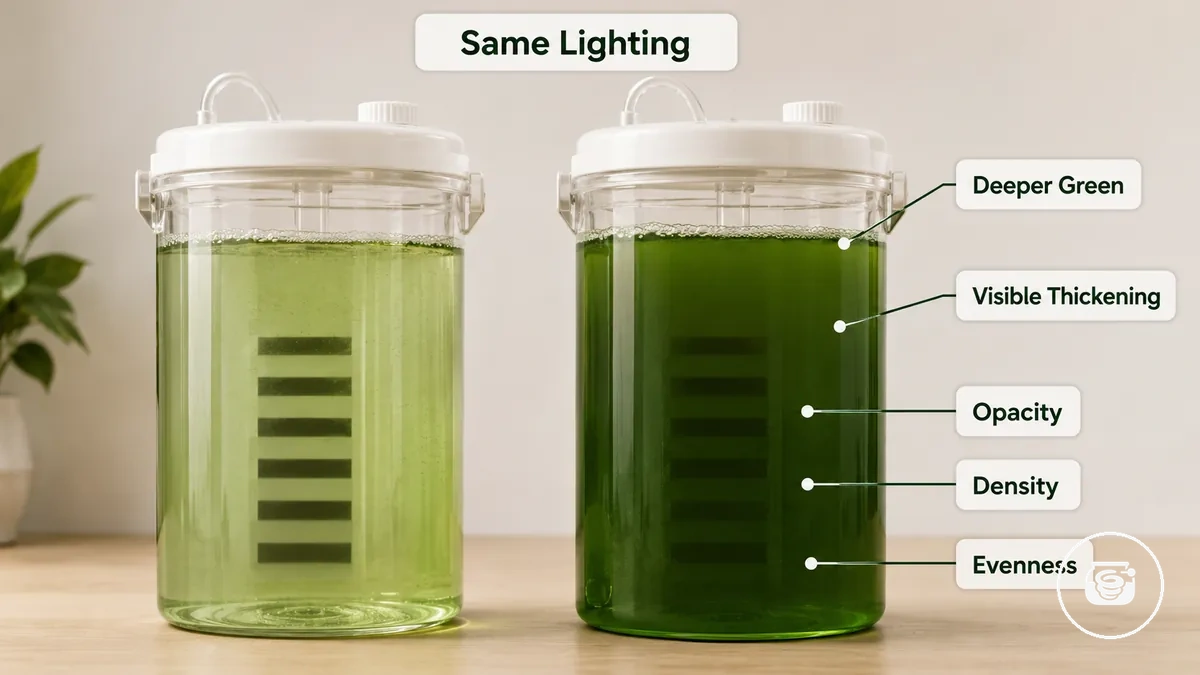
For example, suppose two identical containers are viewed under the same light and against the same background: the culture that appears darker, blocks more of the background, and has an even colour throughout shows stronger visual evidence of increased biomass than the culture that remains lighter and transparent. This is an illustrative comparison, not a numerical harvest threshold.
- Colour: Check for a deeper green colour under the same viewing conditions.
- Opacity: Check whether the background is less visible through the culture.
- Density: Confirm that visible thickening accompanies the colour change.
- Evenness: Look for consistent colour and thickness across the container.
- Consistency: Use the same lighting, container position, and viewing angle for each comparison.
Harvest-Ready Culture Density
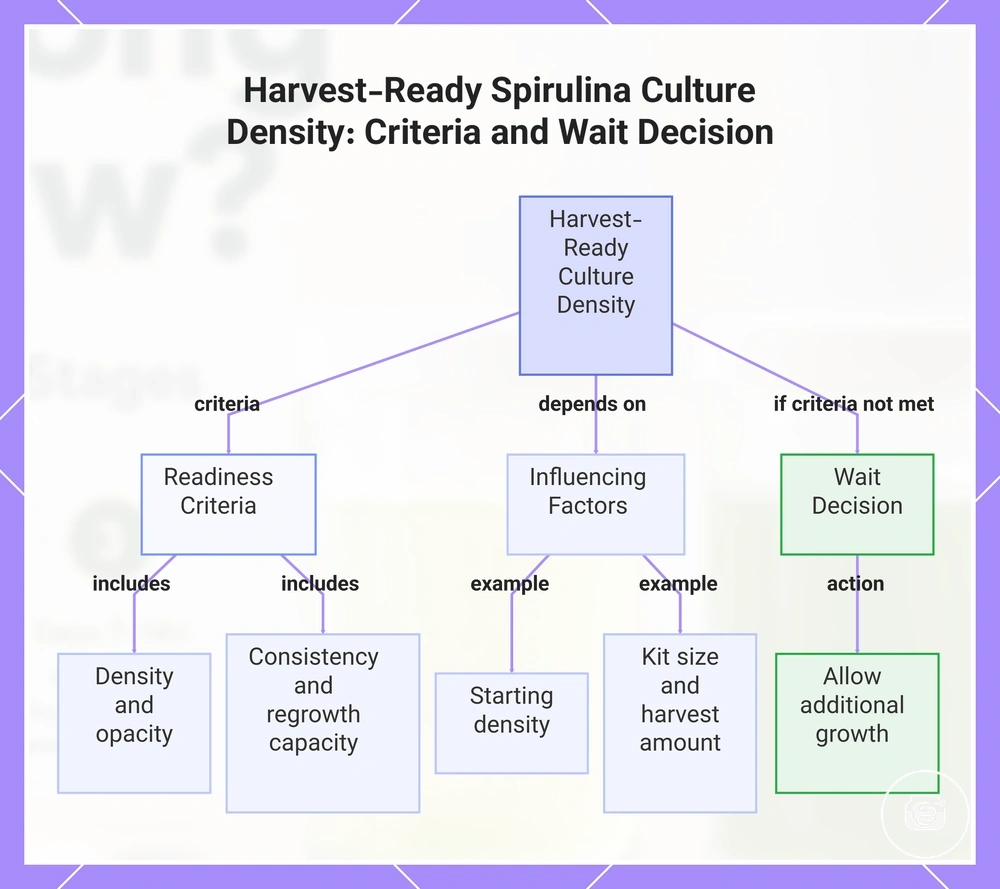
Harvest-ready culture density is the point at which a spirulina culture has sufficient opacity, consistency, and visible biomass for the intended harvest while preserving enough culture for continued regrowth capacity. The reviewed scientific literature and typical home-growing guidance do not define an exact numerical density threshold that applies to every spirulina growing kit. Instead, readiness is a conditional criterion influenced by kit size, starting density, and the intended harvest amount.
Instead, readiness is a conditional criterion influenced by kit size , starting density , and the intended harvest amount .
According to the 2022 review by AlFadhly and colleagues published in Plants, Spirulina biomass production depends on cultivation conditions such as light, temperature, nutrient availability, pH, water quality, and inoculation density rather than a universal harvest-density measurement. As a result, harvest-ready culture density is assessed by combining culture density, opacity, consistency, and expected regrowth capacity instead of relying on a single visual signal or exact density threshold.
This example illustrates the effect of starting density only and is not a manufacturer-defined harvesting specification.
For example, suppose two identical 2-litre home cultures are started on the same day, but one begins with approximately twice the inoculation density of the other under the same growing conditions. The denser culture can reach harvest-ready culture density earlier while still retaining sufficient biomass for continued regrowth, whereas the less-dense culture may require additional growing time before the same readiness criteria are satisfied. This example illustrates the effect of starting density only and is not a manufacturer-defined harvesting specification.
The following criteria organise the readiness or wait decision before harvesting begins.
The following criteria organise the readiness or wait decision before harvesting begins.
- Culture density: The culture appears uniformly dense instead of noticeably thin or transparent.
- Opacity: Reduced transparency accompanies increased biomass and supports the readiness assessment.
- Consistency: Colour and culture thickness remain even throughout the container rather than appearing patchy.
- Regrowth capacity: Enough living culture remains after the intended partial harvest to continue normal growth.
- Wait decision: If opacity, consistency, or culture density have not reached the kit's intended harvest condition, allowing additional growth is more appropriate than harvesting early.
This chart shows the criteria for determining harvest-ready spirulina culture density, the factors that influence readiness, and the decision to wait if criteria are not met.
Readiness Signs Before the First Harvest
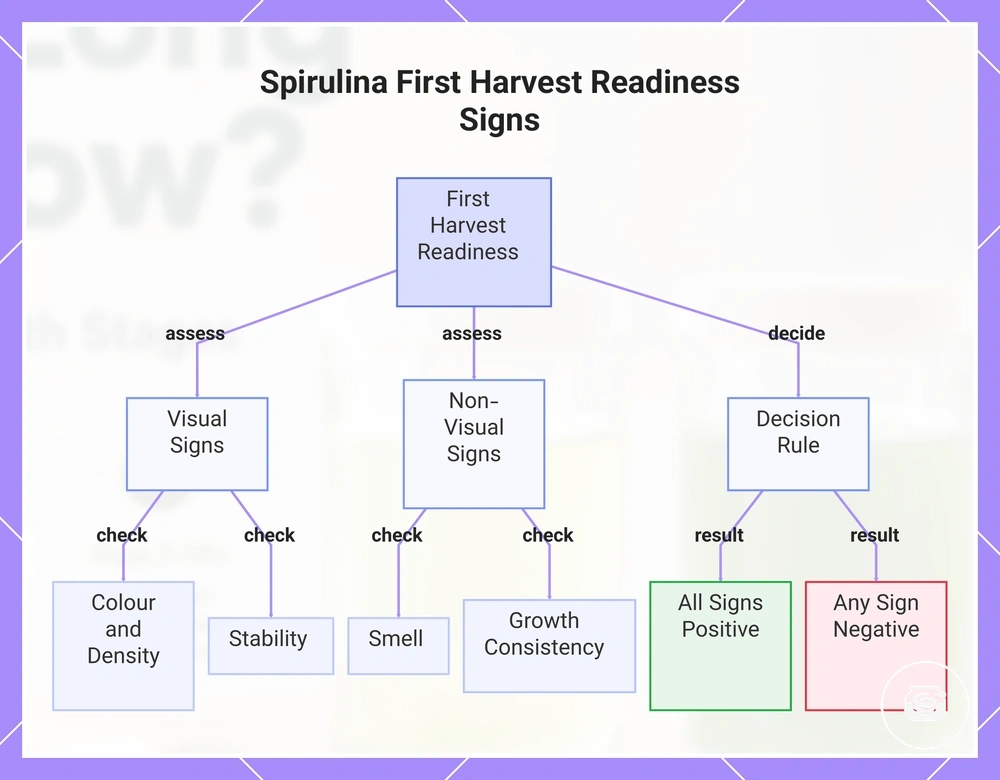
Readiness signs before the first harvest indicate whether a spirulina culture is ready for a first harvest or whether waiting is the better decision. No single observable sign provides a universal harvest threshold. Instead, the harvest-or-wait decision should be based on the combined assessment of colour, density, smell, stability, and growth consistency, because the reviewed evidence does not establish a single measurable density or colour value that applies to every home spirulina growing kit.
No single observable sign provides a universal harvest threshold.
Evaluating multiple readiness signs together reduces the risk of premature harvesting because each criterion reflects a different aspect of culture condition. A culture that shows a uniform deep green colour, visibly increased density, a normal fresh algae-like smell, stable appearance between observations, and consistent recent growth provides stronger evidence of readiness than a culture meeting only one or two of these criteria.
- Colour: A uniform deeper green colour supports a harvest decision, while uneven or noticeably pale colour is a wait signal.
- Density: The culture should appear visibly denser and less transparent than when the starter culture was introduced. A thin or highly transparent culture supports waiting.
- Smell: A normal fresh algae-like smell supports normal culture condition. An unexpected odour is a reason to postpone the harvest-or-wait decision and reassess the culture rather than treating smell alone as a contamination diagnosis.
- Stability: The culture should maintain a consistent appearance over recent observations without unexplained changes in colour or density.
- Growth consistency: Colour and density should continue improving between observations instead of remaining unchanged for multiple checks under the same growing conditions.
For example, suppose a culture appears uniformly dark green but still allows the background to remain clearly visible through the container. In that situation, colour supports readiness but density does not, so the combined readiness signs favour waiting rather than harvesting. If you need guidance on harvest timing, use these readiness criteria before making the first harvest decision.
If you need guidance on harvest timing , use these readiness criteria before making the first harvest decision.
This chart shows the key readiness signs to assess and the combined decision rule for determining whether to harvest spirulina for the first time.
Growth Speed Variables in a Spirulina Growing Kit
Growth speed variables in a spirulina growing kit are the culture conditions that support, slow, or make visible growth less predictable. The main variables are light, temperature, pH, nutrients, water quality, starting density, and culture volume; no single variable provides an exact growth-time formula. The 2022 review by AlFadhly and colleagues in Plants identifies all seven attributes as influences on Spirulina productivity.
Compare the actual kit instructions with the conditions that affect growth time before changing the timing expectation.
The first decision signal is whether several conditions have changed together or whether one measurable condition is outside its intended range. The review reports example cultivation conditions of a 12-hour light and 12-hour dark cycle at 4 kilolux, a temperature of 30°C, pH from 8.5 to 10.5, and dissolved solids from 10 to 60 g/L; these are literature values, not universal settings for every home kit. Compare the actual kit instructions with the conditions that affect growth time before changing the timing expectation.
| Variable | Condition to check | Likely growth effect | What to do with the timing expectation |
|---|---|---|---|
| Light | Check the kit's required duration and intensity; the reviewed literature includes 12 hours of light at 4 kilolux as one cultivation condition. | Insufficient duration or intensity limits photosynthetic biomass production, while excessive exposure can make a single timing estimate unreliable. | Review light first when the culture remains pale or shows little visible density change. |
| Temperature | Compare the measured culture temperature with the supplier's range; the review reports 30°C as one productive cultivation condition. | Movement away from the intended temperature condition can reduce the visible growth pace. | Adjust the timing expectation only after confirming the actual culture temperature. |
| pH | Measure the culture against the kit guidance; the review identifies pH 8.5 to 10.5 as a reported cultivation range. | A value outside the intended alkaline range can limit biomass development. | Treat an out-of-range reading as a stronger decision signal than colour alone. |
| Nutrients | Confirm that the specified growing medium and nutrient additions were used in the stated amounts. | Missing or imbalanced nutrients limit sustained biomass production. | Do not expect normal timing until the culture has the nutrient composition specified for that kit. |
| Water quality | Check that the water source matches the supplier's preparation requirements and does not introduce an unsuitable mineral or disinfectant load. | Unsuitable water quality can restrict growth even when light, temperature, and pH appear acceptable. | Review water quality when several measured conditions are within range but growth remains inconsistent. |
| Starting density | Compare the initial culture concentration or dilution with the amount specified for the kit. | A more diluted starter requires more biomass accumulation before visible thickening reaches the same level. | Allow a longer timing expectation when starting density is lower, without assigning a universal number of extra days. |
| Culture volume | Check whether the container depth and total culture volume still provide comparable access to light and mixing. | Increasing volume without proportionally suitable light distribution can reduce the visible pace of density change. | Interpret culture volume together with light and starting density rather than as an isolated cause. |
A controlled photobioreactor study illustrates the directional effect of starting density: an initial biomass concentration of 0.50 g/L reached 1.5 g/L in about 10 to 15 days, compared with about 20 days from 0.15 g/L under the study's stated light and temperature conditions. These values demonstrate that starting density can change the time required to reach the same biomass concentration, but they are not home-kit timing specifications.
Light and Temperature Timing Effects
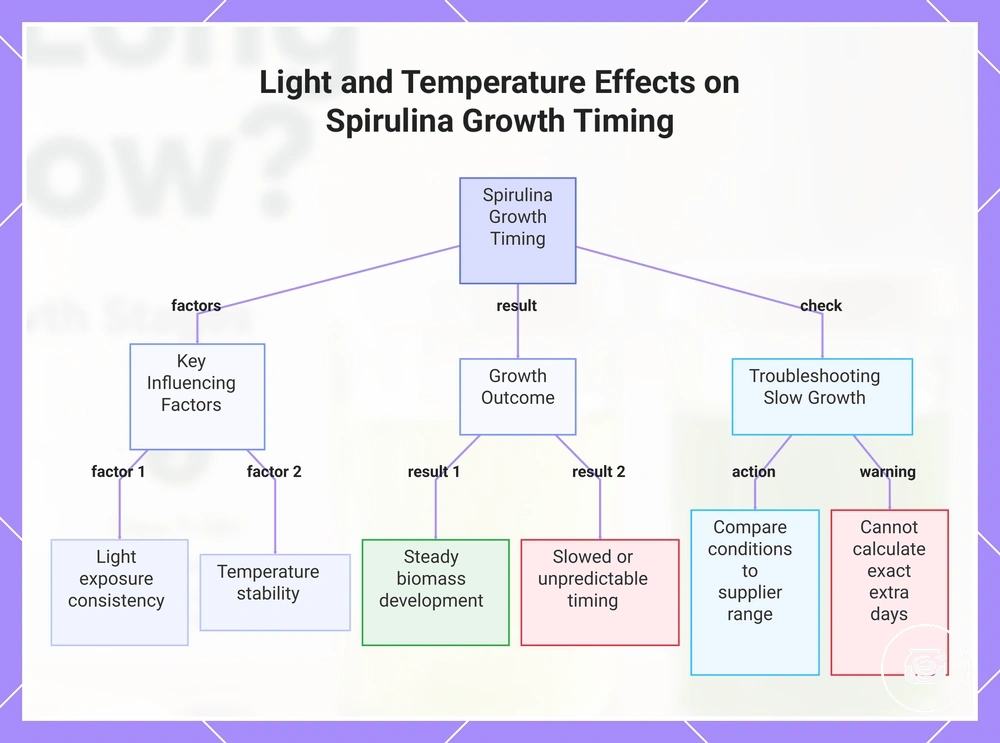
Light exposure and temperature influence spirulina growth pace through light duration, light consistency, and temperature stability. Suitable conditions support steady biomass development, whereas insufficient exposure, excessive exposure, or unstable temperature can slow growth or make the timing less predictable. The reviewed evidence does not establish one light-and-temperature setting that applies to every home culture.
The reviewed evidence does not establish one light-and-temperature setting that applies to every home culture.
The 2022 review by AlFadhly and colleagues in Plants reports that light intensity, photoperiod, and temperature affect Spirulina productivity and that excessive light can cause photoinhibition. One cultivation study summarised in the review used approximately 4.5 kilolux and 30 ± 2°C, but these values describe that study's conditions rather than a universal home-kit prescription.
One cultivation study summarised in the review used approximately 4.5 kilolux and 30 ± 2°C, but these values describe that study's conditions rather than a universal home-kit prescription.
For timing interpretation, consistent daily light exposure and a stable temperature within the kit-specific range provide a more dependable growth expectation than alternating long dark periods, irregular lighting, or repeated temperature changes. When growth appears slower than expected, compare recent light duration, light consistency, and temperature stability with the supplier's suitable conditions; neither variable alone supports calculating an exact number of additional growth days.
This chart shows the key factors influencing spirulina growth timing, the resulting growth outcomes, and a troubleshooting check for slow growth.
This chart shows the key factors influencing spirulina growth timing, the resulting growth outcomes, and a troubleshooting check for slow growth.
pH, Nutrients, and Water Quality
pH, nutrients, and water quality affect spirulina growth speed by determining whether the culture medium remains chemically balanced enough to support continued biomass production. According to the 2022 review by AlFadhly and colleagues published in Plants, Spirulina grows in an alkaline culture medium, but the reviewed evidence does not establish one exact universal pH value or water specification that guarantees growth speed for every home-growing kit. Instead, pH stability, nutrient availability, and water suitability should be interpreted as condition-based growth variables.
Instead, pH stability, nutrient availability, and water suitability should be interpreted as condition-based growth variables.
A balanced culture medium supports normal growth, whereas an imbalanced condition can produce slow growth or visible culture stress. The table below organises the relationship between medium condition, growth signal, and practical interpretation without implying that one measurement alone predicts growth speed.
| Medium factor | Condition | Growth signal | Interpretation |
|---|---|---|---|
| pH | Stable alkaline culture medium | Normal growth | pH stability supports continued biomass production, while an imbalanced condition can slow visible culture development. |
| Nutrients | Adequate nutrient availability | Steady increase in culture density | Balanced nutrient availability supports normal growth, whereas nutrient depletion or imbalance can reduce growth speed. |
| Water quality | Water suitability matches the prepared culture medium | Stable culture response | Suitable water quality helps maintain medium balance, while unsuitable water can contribute to culture stress and slower visible growth. |
For example, suppose two identical home cultures are prepared with the same light and temperature, but only one maintains stable pH and adequate nutrient availability throughout growth. The culture with the balanced medium is expected to continue normal visible biomass development, while the culture with an imbalanced medium is more likely to show slow growth or stress. This example illustrates a condition-to-effect relationship rather than a universal performance guarantee.
Starting Density and Culture Volume
Starting density and culture volume affect when noticeable growth becomes visible by changing the initial concentration of spirulina cells in the culture. A greater starter culture amount in the same culture volume produces higher initial visible opacity, whereas the same starter amount mixed into a larger culture volume creates greater dilution and a less opaque starting culture. Neither the reviewed evidence nor the scientific literature specifies a universal starter-culture-to-volume ratio for home spirulina kits, so these variables qualify visible timing rather than predict an exact growth rate.
Starting density and culture volume affect when noticeable growth becomes visible by changing the initial concentration of spirulina cells in the culture.
The comparison below shows how starting density and culture volume influence the perception of visible growth without implying that a larger volume always grows slower or that a higher starting density always represents a healthier culture. According to optical-density guidance used in microbiology, turbidity should be interpreted relative to the culture's own starting condition because initial concentration changes how quickly visible opacity develops.
| Starting condition | Visible timing effect |
|---|---|
| More starter culture amount in the same culture volume | Higher starting density produces greater initial visible opacity, so noticeable growth can become apparent sooner if the remaining growing conditions stay suitable. |
| The same starter culture amount in a larger culture volume | Greater dilution lowers initial visible opacity, requiring more biomass accumulation before noticeable growth becomes easy to observe. |
| The same starter-density proportion in different container volumes | Comparable starting density can produce similar initial opacity, although container depth and light distribution may still influence how quickly opacity changes become visible. |
For example, suppose an illustrative 200 mL starter culture is mixed with 800 mL of prepared medium to produce a total culture volume of 1 L. Mixing the same 200 mL starter with 1.8 L of medium produces a total volume of 2 L, reducing the initial concentration by half. This calculated example demonstrates how dilution delays the appearance of the same visible opacity and noticeable growth, but it does not indicate a healthier culture or an exact multiplication rate.
Why Growth Time Varies Between Home Spirulina Kits
Growth timelines vary between home spirulina kits because kit design, container size, light consistency, starting culture strength, room conditions, and monitoring create different starting and growing conditions. No universal number of days applies across all home kits because the reviewed evidence does not define a standardised design, culture strength, container volume, or environmental condition for every setup.
A possible concern is more likely when monitoring shows little or no visible change even though the kit-specific conditions have remained stable and suitable.
Normal timing variation has an identifiable setup-related cause, such as a more diluted starter culture, a deeper container, inconsistent daily light, or changing room temperature. A possible concern is more likely when monitoring shows little or no visible change even though the kit-specific conditions have remained stable and suitable.
| Normal variation | Possible concern |
|---|---|
| Kit design or container size changes culture depth, light distribution, or the visibility of opacity changes. | The culture shows no progressive change after the setup has remained within its specified conditions. |
| Lower starting culture strength requires more biomass accumulation before visible thickening becomes noticeable. | Monitoring records an unexpected loss of colour, density, or stability rather than gradual development. |
| Light consistency or room conditions change between observations and shift the visible growth timeline. | Multiple conditions remain outside the kit guidance, making timing alone an unreliable explanation. |
For example, suppose two illustrative 2-litre home spirulina kits start on the same day, but one receives a stronger starter culture and 12 consistent hours of daily light while the other receives a more diluted starter and an irregular light period. The first culture can show visible opacity sooner, but this comparison does not prove that its kit design is superior or that the second culture has failed. The practical distinction is whether monitoring links the timing difference to identifiable kit or room conditions.
Why a Spirulina Culture Grows Slower Than Expected
Slow growth in a spirulina culture indicates that one or more growth conditions may be limiting biomass development; it does not by itself confirm culture failure. Common likely causes are weak light, low temperature, unstable pH, nutrient imbalance, poor starting density, and culture stress, which can appear as delayed thickening or weak colour change. The 2022 review by AlFadhly and colleagues in Plants identifies light, temperature, pH, nutrient availability, water quality, and inoculation density as factors affecting Spirulina growth.
Assess slower-than-expected growth by matching the visible symptom to a likely cause and checking the relevant condition against the kit-specific guidance.
Assess slower-than-expected growth by matching the visible symptom to a likely cause and checking the relevant condition against the kit-specific guidance. Gradual improvement in colour or opacity indicates continuing development, whereas an unchanged or declining appearance under stable suitable conditions is a stronger signal that further diagnosis is required.
| Symptom | Likely attribute issue | Check | What it means |
|---|---|---|---|
| Delayed thickening with weak colour change | Weak light or inconsistent exposure | Compare recent light duration and consistency with the kit instructions. | Insufficient usable light can limit photosynthetic growth and delay visible density change. |
| Growth slows during cooler room conditions | Low temperature or unstable warmth | Check whether the culture temperature has remained within the supplier-defined range. | Temperature outside the intended condition can reduce growth pace without confirming failure. |
| Uneven colour or inconsistent development | Unstable pH or nutrient imbalance | Compare the culture-medium preparation and current pH with the kit guidance. | An imbalanced medium can restrict biomass development and contribute to culture stress. |
| Culture remains transparent while other conditions appear stable | Poor starting density or excessive dilution | Review the starter culture amount relative to the total culture volume. | A diluted starting culture requires more biomass accumulation before visible thickening becomes noticeable. |
| Colour or density declines instead of gradually improving | Culture stress requiring further diagnosis | Check whether multiple growing conditions changed together rather than relying on one reading. | A declining pattern is more concerning than slow but progressive development. |
Slow growth remains within a plausible normal range when monitoring shows gradual improvement and identifies a condition-based reason for the delay. When the culture shows no progressive improvement after the specified growing conditions have been restored, use the dedicated guidance for slow growth problems.
Growth-Time Expectations Before Ongoing Harvest Cycles
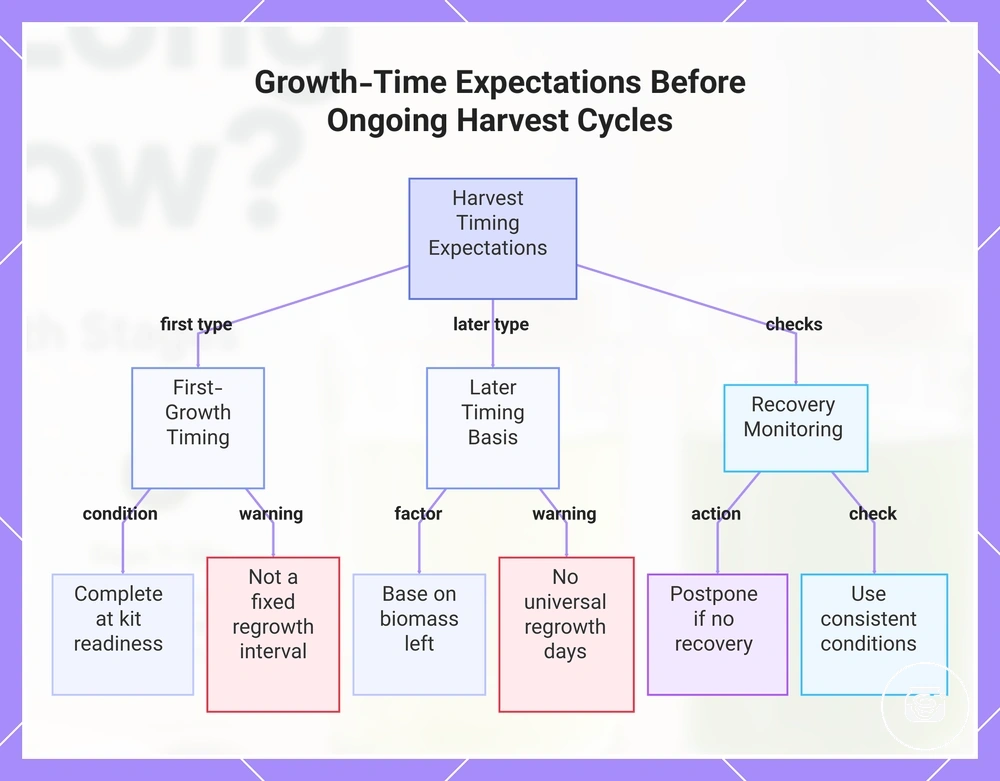
First-growth timing sets the initial expectation for when a spirulina culture can move from first-harvest readiness into ongoing harvest cycles, but it does not create a fixed regrowth interval for later harvests. After partial harvesting, the next timing decision should be based on visible culture recovery, restored density, and stable monitoring. The reviewed section evidence does not establish one universal regrowth interval for every home spirulina culture.
The reviewed section evidence does not establish one universal regrowth interval for every home spirulina culture.
The first harvest begins from the original starter condition, whereas later cycles begin with the living culture that remains after a partial harvest. This difference means that later timing expectations depend on how much culture remains, how consistently density returns, and whether monitoring shows progressive recovery rather than on repeating the first-growth timeline.
The checklist below defines the timing signals that matter before repeated harvests without turning them into a harvesting or maintenance procedure.
The checklist below defines the timing signals that matter before repeated harvests without turning them into a harvesting or maintenance procedure.
- First-harvest readiness: Treat first-growth timing as complete only when the culture reaches the kit-specific readiness condition.
- Partial harvesting: Base later timing on the biomass left in the culture rather than on the original starter amount.
- Regrowth interval: Measure the interval from the partial harvest until the expected density and colour have returned; no universal number of days is specified for all home cultures.
- Culture recovery: Postpone the next harvest when opacity or colour has not progressively recovered after the previous removal.
- Stable monitoring: Compare the culture under consistent viewing and growing conditions so that a genuine recovery trend can be distinguished from a temporary visual change.
This section sets timing expectations before ongoing harvest cycles; it does not provide a full harvest tutorial or maintenance schedule. The practical boundary is recovery: later harvests remain conditional on the culture regaining its expected density and stable appearance after each partial harvest.
This section sets timing expectations before ongoing harvest cycles; it does not provide a full harvest tutorial or maintenance schedule.
This chart explains the key timing logic for spirulina harvests, contrasting first-growth expectations with later recovery-based timing and the monitoring checks required before ongoing cycles.