
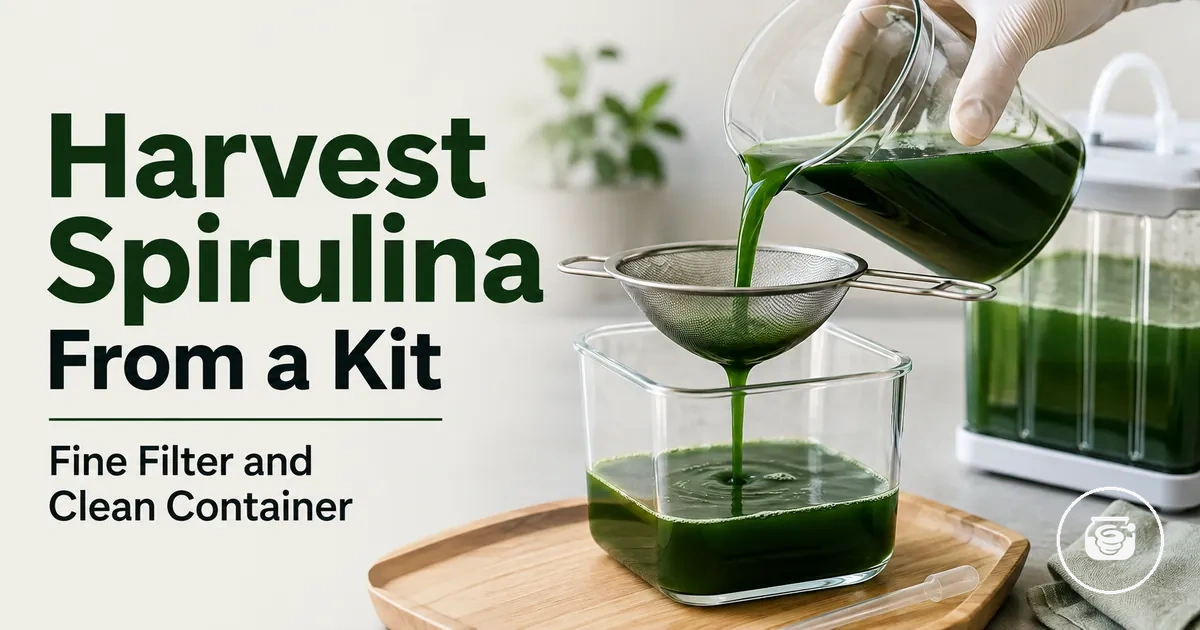
Harvesting Spirulina from a Growing Kit
A spirulina growing kit is harvested by confirming culture readiness, transferring part of the culture through a clean filter, rinsing and draining the retained biomass, and returning the remaining culture to growing conditions. In spirulina growing kits, this process requires a visibly established culture, clean tools, gentle filtration, a clean-water rinse, and protection of culture recovery.
In spirulina growing kits , this process requires a visibly established culture, clean tools, gentle filtration, a clean-water rinse, and protection of culture recovery.
For a home kit, collect only the portion that the kit instructions identify as harvestable, because no independently verified removal percentage applies to every container, culture strain, or growth condition. Use a clean cloth or fine filter that retains the biomass without forcing the culture through it, then place the fresh spirulina in a clean container; this section covers home-kit harvesting rather than setup, long-term maintenance, or contamination remediation.
Harvest timing and yield have no universal numerical value for home spirulina kits.
Harvest timing and yield have no universal numerical value for home spirulina kits. The Food and Agriculture Organization's 2008 review reports that biomass doubled in three to four days in one semi-natural cultivation process, while a published long-term production study reported a 30% biomass loss during harvesting and post-processing when concentration efficiency varied; neither figure is a universal home-kit target, so the specific kit instructions must define the usable timing and removal amount.
Begin by checking the spirulina culture's density, green colour, visibility, smell, and recent condition.
Begin by checking the spirulina culture's density, green colour, visibility, smell, and recent condition. Harvest only when those observations match the kit provider's readiness criteria; otherwise, wait or stop before filtering because appearance alone does not establish food safety.
- Confirm that the culture meets the kit's stated readiness criteria before removing any liquid.
- Prepare clean tools, a supported filter or cloth, and a clean receiving container.
- Transfer the instructed portion slowly so the filter retains biomass without excessive clogging or pressure.
- Rinse the retained fresh spirulina with the water quality specified by the kit, then allow it to drain without hard pressing.
- Restore the remaining culture's instructed water level, light, temperature, nutrients, and agitation so recovery can begin.
Table of Contents
When a Spirulina Culture Is Ready to Harvest
A spirulina culture is ready to harvest when it has developed sufficient density, a consistent green colour, reduced visibility through the culture, and a stable surface concentration after normal growth. No authoritative source defines a universal harvest day or density threshold for all home spirulina growing kits, so readiness remains conditional on kit size, light, temperature, culture health, growth stage, and recent maintenance.
Visual readiness should be assessed before filtration rather than by counting days.
Visual readiness should be assessed before filtration rather than by counting days. According to Phydrotec's home spirulina cultivation guidance, a culture is harvested after it becomes dense enough that objects behind the container are difficult to distinguish through the liquid, indicating sufficient biomass for harvesting. For broader information about growth duration before this decision point, see when spirulina is ready.
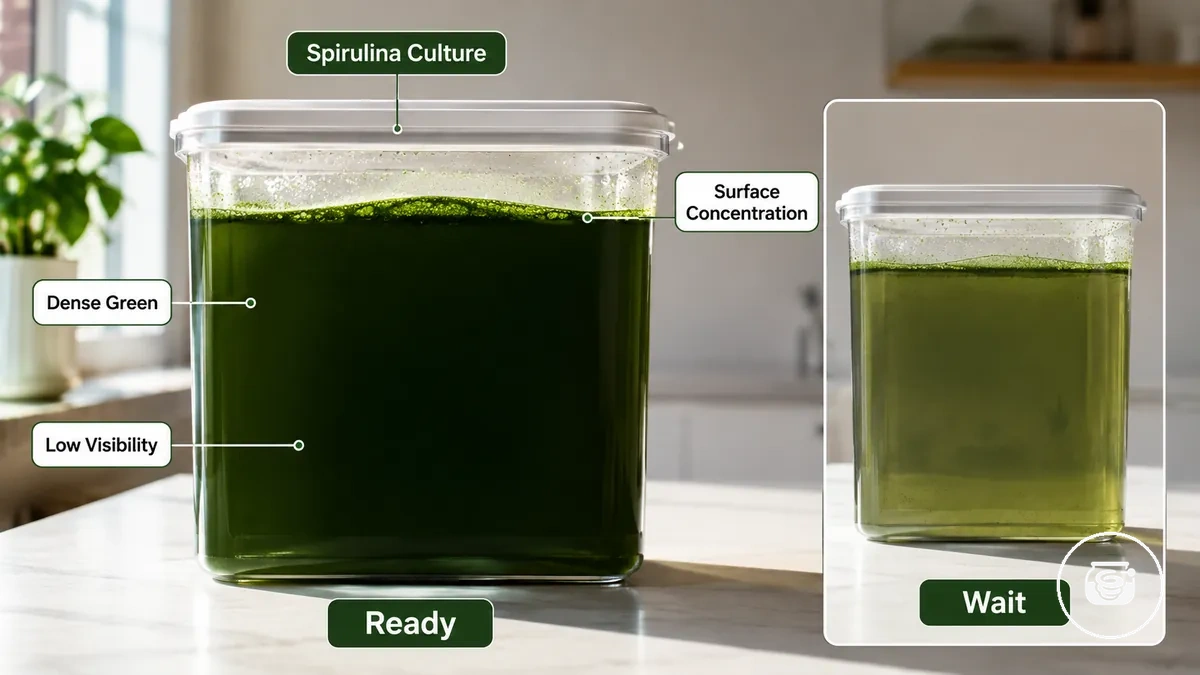
When a Spirulina Culture Is Ready to Harvest, use the checklist below to confirm the culture's readiness signals before filtering. Each observation leads to one practical decision: ready, wait, or do not harvest.
- Dense green colour with limited visibility: Ready to harvest. The spirulina culture has accumulated enough biomass for normal harvesting.
- Thin culture that remains easy to see through: Wait. Low surface concentration indicates additional growth is still needed before filtration.
- Pale green colour, recent stirring, or visible clumps: Wait. Allow the culture to stabilise because recent disturbance can temporarily change its appearance without reflecting true growth stage.
- Unusual smell, abnormal colour, or signs of declining culture condition: Do not harvest. Investigate the culture before proceeding because these observations do not represent normal harvest readiness.
- Recent nutrient replacement or water adjustment: Wait. Reassess the spirulina culture after normal growth resumes instead of harvesting immediately.
For example, two identical 5-litre home growing kits can reach different harvest readiness if one receives consistent light while the other has been shaded for part of the day. This comparison illustrates why recognised home-growing guidance recommends using culture density and visibility instead of an exact-day schedule to decide when harvesting should begin.
Culture Density and Visibility Checks
Culture density and visibility are local visual checks that help determine whether a spirulina culture has accumulated enough biomass to filter, but they are not proof that the culture is safe or fully ready to harvest. No authoritative home-growing source specifies an exact density score or water-transparency threshold for harvest, so these checks are interpreted together as visual criteria rather than precise measurements.
No authoritative home-growing source specifies an exact density score or water-transparency threshold for harvest, so these checks are interpreted together as visual criteria rather than precise measurements.
Culture density and visibility checks organise the main visual readiness signals by comparing biomass concentration, water transparency, green culture uniformity, and the distribution of suspended or settled material. A culture that is difficult to see through because of evenly suspended green biomass is generally closer to a harvestable condition than a thin, transparent culture, while isolated colour changes or floating material should be interpreted alongside the overall appearance rather than treated as a standalone indicator.
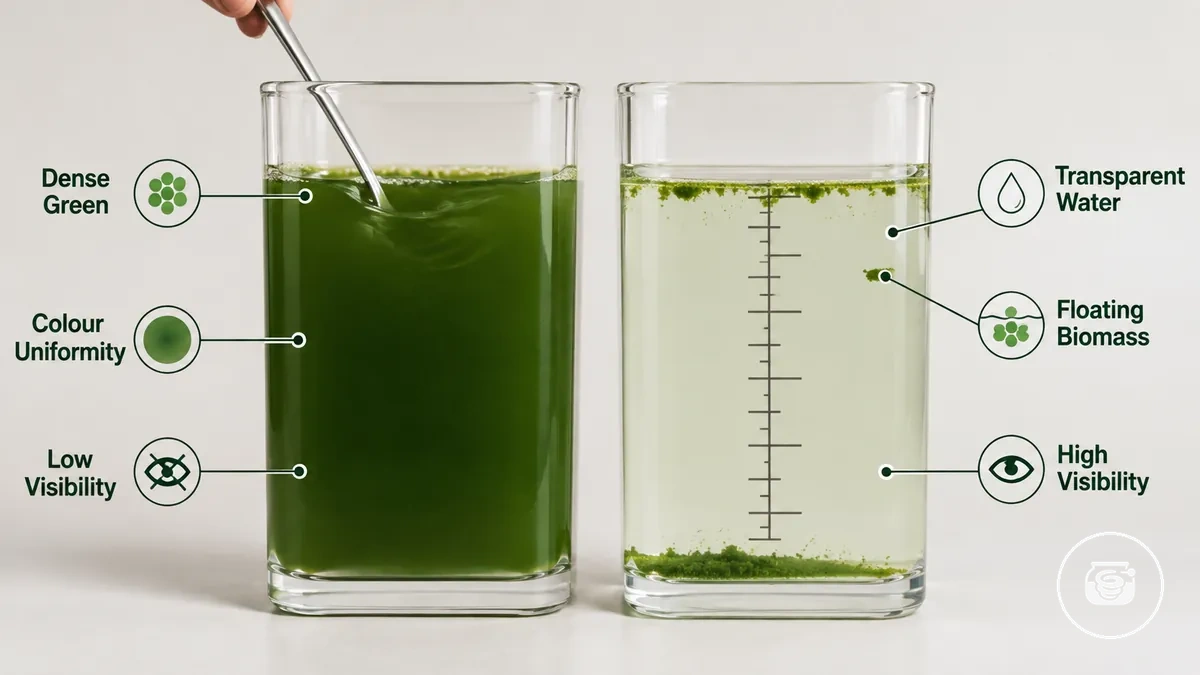
- Dense green culture: Limited visibility through the container indicates that suspended biomass has increased and the culture may be suitable for harvesting if other readiness checks are also satisfactory.
- Transparent water: A thin green culture with high visibility indicates insufficient biomass, so additional growth is usually needed before filtration.
- Colour uniformity: Even green colour across the container is a more reliable visual sign than isolated patches or streaks of different shades.
- Floating spirulina or settled biomass: Gently mix the culture before assessing visibility because biomass can separate naturally while the container remains undisturbed.
For example, two identical 5-litre home growing containers can appear different after the same growing period if one develops enough suspended biomass to obscure the opposite wall while the other remains easy to see through. This comparison shows how culture density and visibility work together as local visual checks without confirming overall culture safety or harvest readiness on their own.
Harvest Timing and Culture Removal Amount
Harvest timing and removal amount should protect the remaining culture so it can recover after a partial harvest while still producing fresh spirulina. No authoritative home-growing guidance specifies a universal harvest fraction, exact daily harvest amount, or fixed harvest interval for all kits, so the appropriate harvest portion remains conditional on the kit instructions, culture condition, and recent growth history.
Harvest timing and culture removal amount determine whether harvesting should begin immediately or be delayed to support culture recovery .
Harvest timing and culture removal amount determine whether harvesting should begin immediately or be delayed to support culture recovery. Harvest when the culture has stabilised under its normal light cycle and gentle agitation rather than immediately after nutrient replacement or heavy mixing, because an undisturbed culture is easier to filter and places less stress on the remaining culture. Removing a smaller harvest portion generally supports quicker recovery than removing most of the culture at once, but recognised home-growing sources do not define a universal percentage or volume that applies to every home spirulina growing kit.
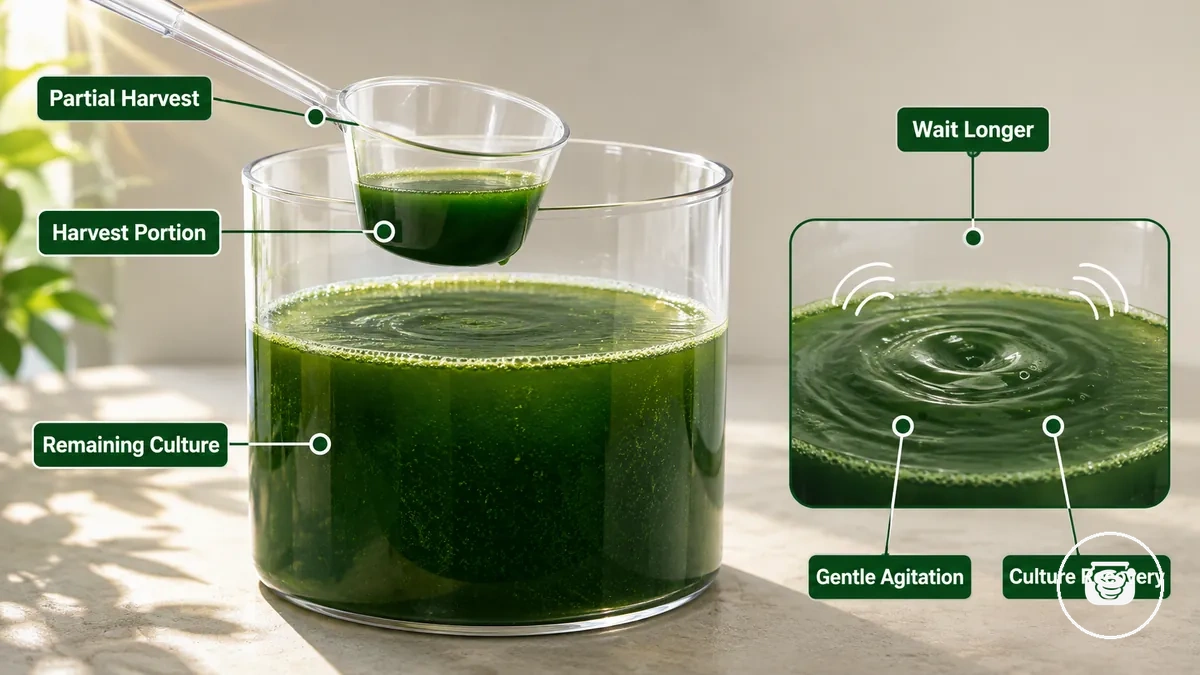
Harvest timing and culture removal amount checklist:
- Harvest a little: Choose a partial harvest when the culture is healthy, stable, and you want to preserve the remaining culture for continued recovery.
- Wait longer: Delay harvesting if the culture has been recently disturbed, nutrient-adjusted, or has not yet recovered from the previous harvest.
- Protect the remaining culture: Return the retained culture to its normal light, nutrient, temperature, and gentle agitation conditions immediately after harvesting.
- Avoid excessive removal: Removing a larger harvest portion can increase culture recovery time and reduce the next immediate yield, although no universal removal fraction is specified for all kits.
Detailed growth speed expectations belong to the growing stage rather than the harvesting procedure because recovery depends on the continuing growing environment after harvesting. For guidance on those conditions, see growing before harvest.
Harvesting Tools and Clean Preparation
Harvesting tools and clean preparation reduce contamination risk by ensuring that every tool contacting the spirulina culture is clean, intended for food contact, and suitable for gentle filtration. According to the University of Minnesota Extension, cleaning harvest tools and containers before use helps reduce post-harvest contamination, so preparation should be completed before the culture is opened for harvesting.
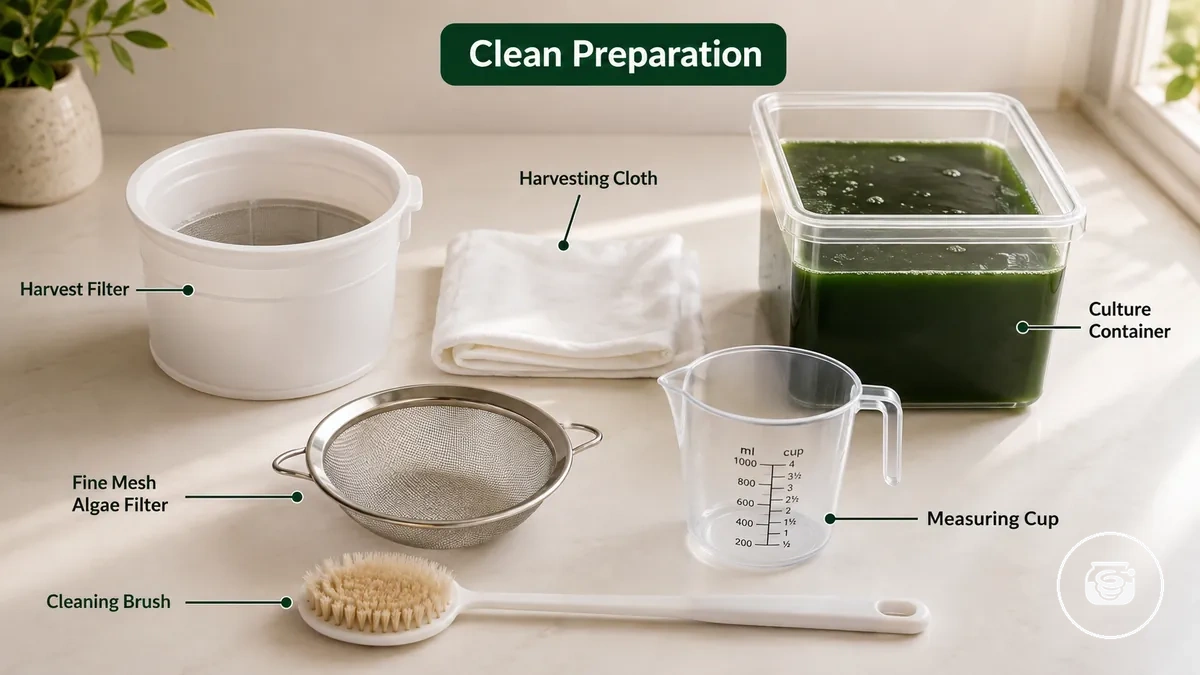
A suitable home harvesting setup includes a harvest filter or harvesting cloth, a fine mesh algae filter, a clean culture container, a food grade measuring cup, and a cleaning brush. Each tool should be visibly clean, free from residue, appropriate for repeated food contact, and correctly sized for the home culture container to support smoother filtration without unnecessary handling. No authoritative home-growing source specifies one universal mesh size or one superior tool design for every spirulina growing kit, so filter material and fit should follow the kit manufacturer's harvesting guidance.
Harvesting Tools and Clean Preparation checklist verifies that each tool is suitable and clean before it contacts the culture.
Harvesting Tools and Clean Preparation checklist verifies that each tool is suitable and clean before it contacts the culture.
- Harvest filter: Clean, undamaged, and able to support gentle drainage without forcing the culture through the filter.
- Harvesting cloth or fine mesh algae filter: Intended for food-contact use, free from visible residue, and suitable for retaining spirulina biomass according to the kit instructions.
- Culture container: Clean, dry, and large enough to receive the harvested culture without overflow.
- Food grade measuring cup: Used to remove a controlled harvest portion while limiting unnecessary disturbance to the remaining culture.
- Cleaning brush: Reserved for cleaning harvesting equipment before and after use to remove visible residue from reusable tools.
- Work surface: Clean, uncluttered, and organised so prepared tools remain separated from unclean items throughout harvesting.
Simple home harvest tools are appropriate when they satisfy cleanliness, food-contact suitability, and container fit. Commercial-scale harvesting machinery is unnecessary for most home spirulina growing kits because manual filtration provides sufficient control for small culture volumes.
Filter Cloth, Mesh Size, and Container Choice
Filter cloth, mesh size, and container choice determine how effectively a home spirulina harvest balances biomass retention, drainage, and clean handling. According to filtration guidance from Micronics, filter performance depends on matching the filter cloth and mesh fineness to the material being retained rather than using one universal mesh specification, so no exact mesh size is recommended for every home spirulina growing kit.
The table below summarises the main filtration attributes and their practical effects during a small home harvest.
Filter cloth, mesh size, and container choice work together because mesh fineness influences drainage speed and biomass retention, while the container supports stable, clean collection during filtration. The table below summarises the main filtration attributes and their practical effects during a small home harvest.
| Entity/Part | Attribute/Criterion | Value/Condition | Effect/Risk/Decision |
|---|---|---|---|
| Filter cloth | Material | Clean, food-contact suitable cloth with no visible residue | Supports retained spirulina while reducing contamination risk. |
| Mesh size | Drainage and biomass retention | Finer mesh generally retains more biomass but drains more slowly; a coarser mesh drains faster but can increase biomass loss. No universal mesh size is specified. | Select mesh fineness according to the harvesting cloth and culture characteristics rather than a fixed specification. |
| Filter cloth | Surface area | Larger filtering area distributes the culture over more cloth | Helps reduce local clogging and the need for excessive pressure during filtration. |
| Container | Cleanliness and fit | Clean harvest container positioned securely beneath the filter cloth | Improves handling, collects filtered liquid efficiently, and reduces spill risk. |
For example, in an illustrative home harvest of 1 litre of spirulina culture, a finer filter cloth can retain more biomass than a coarser cloth but may require a longer drainage time before filtration finishes. This example demonstrates the practical trade-off between biomass retention, drainage, and clogging without implying that one mesh size is universally correct.
Clean Handling Before the Harvest
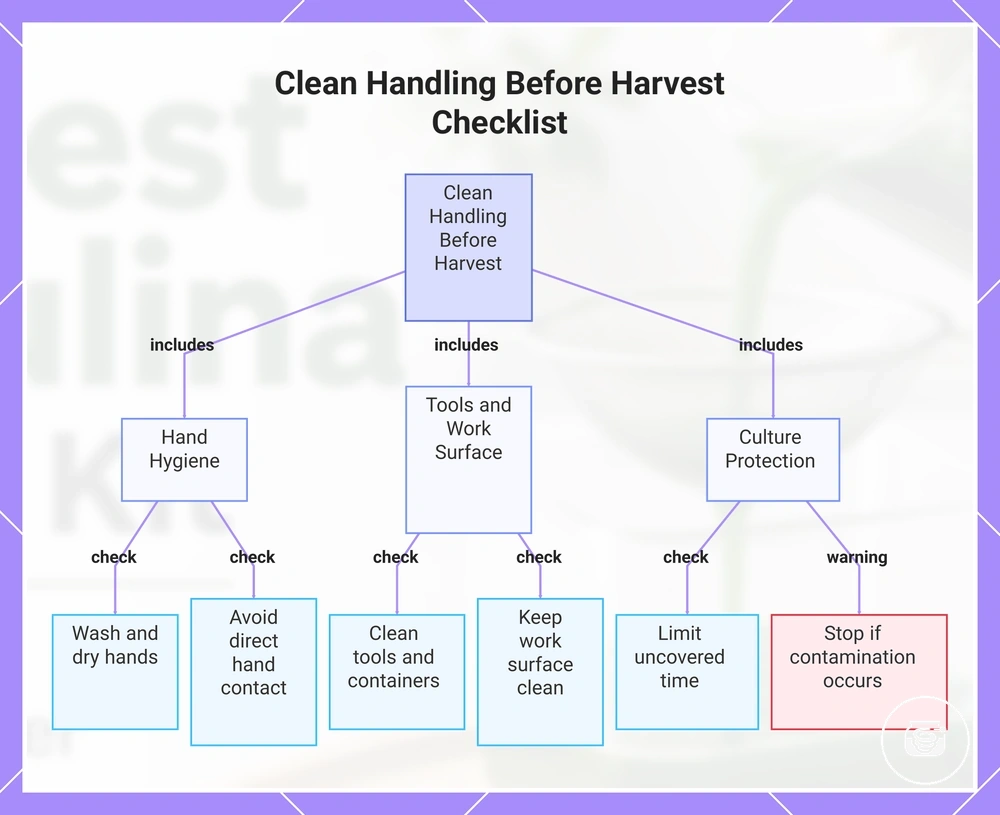
Clean handling before harvesting means keeping hands, tools, containers, the work surface, and the exposed culture clean while limiting unnecessary contact to reduce contamination risk. According to the U.S. Food and Drug Administration Food Code, food-contact equipment and utensils should be clean before use, so the immediate pre-harvest priority is clean contact control rather than medical-grade sterility.
Use the checklist below to verify that every direct contact point is ready before filtration begins.
Clean handling before the harvest confirms that the exposed culture is protected from avoidable contamination during the short harvesting period. Use the checklist below to verify that every direct contact point is ready before filtration begins.
- Hands: Wash and dry hands before touching the exposed culture, harvesting cloth, tools, or containers, and avoid direct hand contact with the spirulina whenever possible.
- Tools and containers: Use only clean, food-contact suitable tools and containers that are free from visible residue before they contact the culture.
- Work surface: Keep the work surface clean and separate clean equipment from used cloths or other items that could transfer contamination.
- Exposed culture: Leave the culture uncovered only for the time needed to complete harvesting, then return it to its container to limit unnecessary environmental exposure.
- Contact control: Normal harvest drips or splashes on the work surface can be cleaned after harvesting, but stop if a dirty tool, reused unclean cloth, or contaminated container touches the exposed culture because those items should be cleaned or replaced before harvesting continues.
For example, if a clean harvesting cloth accidentally touches an unclean bench before filtration, replacing or washing the cloth before it contacts the exposed culture reduces contamination risk more effectively than continuing with the contaminated cloth. This local precaution helps protect both the harvested spirulina and the remaining culture without implying a sterile guarantee.
This chart shows the key contact points to verify before harvesting spirulina to reduce contamination risk.
This chart shows the key contact points to verify before harvesting spirulina to reduce contamination risk.
Filtering Spirulina from the Culture Water
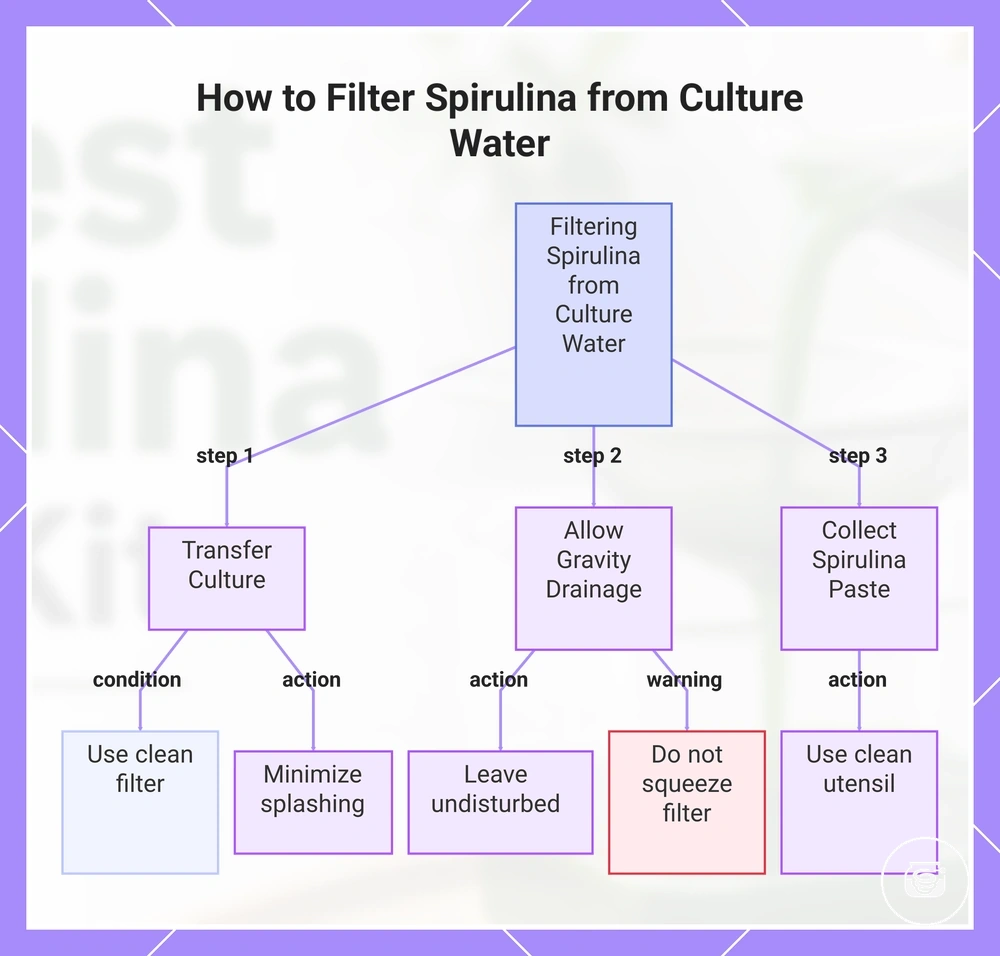
Filtering spirulina from the culture water separates the collected biomass from the culture water by transferring the culture gently onto a clean filter, allowing gravity drainage, and collecting the resulting spirulina paste. The reviewed home-growing evidence does not specify a universal filtration time, drainage rate, or culture volume, so filtration should continue only until free culture water has drained naturally without forceful pressing.
Follow the ordered steps below to complete the filtering sequence while keeping the retained culture water and collected biomass separate.
Gentle filtration protects biomass structure and reduces contamination risk by keeping filter contact clean and controlled throughout the separation process. Follow the ordered steps below to complete the filtering sequence while keeping the retained culture water and collected biomass separate.
- Transfer the culture: Pour or ladle the culture onto a clean filter slowly so the transfer method minimises splashing and unnecessary disturbance, reducing contamination risk.
- Allow gravity drainage: Leave the filter undisturbed so culture water drains naturally into a clean container while the collected biomass remains on the filter. Do not accelerate drainage by squeezing the filter.
- Collect the spirulina paste: After drainage slows naturally, transfer the retained biomass into a clean container using a clean utensil, leaving the separated culture water below the filter.
- Avoid forceful pressure: Do not press the filter or use dirty tools because excessive pressure can force fine biomass through the filter and unclean contact can increase contamination risk.
For example, suppose an illustrative home kit filters 1 litre of culture through a clean harvest cloth. Allowing gravity alone to complete the drainage produces a separated spirulina paste and retained culture water without implying that 1 litre is a recommended harvest volume, because no authoritative home-growing source specifies a standard filtration volume for every spirulina growing kit.
For example, suppose an illustrative home kit filters 1 litre of culture through a clean harvest cloth.
This chart shows the three main steps to filter spirulina from culture water, with key conditions and warnings.
Separating Spirulina Biomass with a Fine Filter
Separating spirulina biomass with a fine filter is performed by passing the culture water through a supported fine filter using steady pouring so the spirulina biomass remains on the filter while the liquid drains into a clean container. The reviewed home-growing evidence does not specify a universal flow rate, drainage time, filter pore size, or filtration volume for all spirulina growing kits, so controlled pouring and gravity-assisted drainage are the supported operating conditions.
Cleaner biomass separation depends on keeping the filter fully supported, distributing the culture across the available filter surface , and allowing uninterrupted drainage .
Cleaner biomass separation depends on keeping the filter fully supported, distributing the culture across the available filter surface, and allowing uninterrupted drainage. Concentrating the biomass layer in one small area can increase clogging and slow drainage, whereas spreading the flow across the filter surface helps maintain more consistent liquid movement.
- Support the fine filter: Position the fine filter securely above a clean container so the filter surface remains stable during separation, reducing the risk of uneven drainage or accidental spills.
- Pour with a steady flow: Transfer the culture water in a slow, continuous stream across the filter surface instead of pouring into one point, helping the spirulina biomass spread more evenly and reducing local clogging.
- Allow natural drainage: Leave the fine filter undisturbed until gravity drains the culture water into the clean container while the biomass layer remains on the filter, avoiding unnecessary interruption of separation.
- Pause if drainage slows: If the biomass layer begins to restrict flow, stop pouring temporarily until more liquid has drained rather than adding additional culture water that could increase clogging.
- Avoid pressing the filter: Do not squeeze or force liquid through the fine filter because pressure can push fine spirulina biomass through the filter cloth and reduce biomass retention.
For example, suppose an illustrative home harvest filters 1 litre of spirulina culture in four separate pours of approximately 250 millilitres each. This hypothetical example demonstrates how dividing the transfer into smaller steady pours can help maintain drainage and reduce local clogging without implying that these volumes are recommended values, because no authoritative home-growing source specifies a standard filtration volume or pour size for all spirulina growing kits.
Rinsing, Draining, and Pressing the Harvested Spirulina
Harvested spirulina should be rinsed with clean rinse water, allowed to drain under gravity, and pressed lightly to reduce residual culture medium while preserving the fresh paste. The reviewed home-growing evidence does not specify a universal rinse-water volume, drain time, or pressing force for all spirulina growing kits, so clean rinse water, natural drainage, and gentle pressure are the supported operating conditions.
Rinsing removes residual culture liquid from the harvested biomass, while draining and light pressing reduce excess moisture before further handling.
Rinsing removes residual culture liquid from the harvested biomass, while draining and light pressing reduce excess moisture before further handling. A clean food-contact surface helps preserve the condition of the fresh paste after filtration, but rinsing does not guarantee food safety or remove every unwanted residue.
- Rinse the harvested spirulina: Pour clean rinse water gently across the harvested biomass so residual culture medium is reduced while avoiding unnecessary disturbance to the fresh paste.
- Allow gravity draining: Leave the harvested spirulina on the filter or draining surface until excess rinse water drains naturally, reducing free liquid without increasing unnecessary handling.
- Press lightly: Apply gentle, even pressure only after draining has slowed to remove additional surface moisture while avoiding excessive pressure that could increase biomass loss.
- Transfer onto a clean handling surface: Move the fresh paste immediately onto a clean food-contact container or surface to minimise unnecessary exposure and preserve paste quality during handling.
For example, suppose an illustrative harvest produces 100 grams of wet spirulina biomass after filtration. After rinsing, gravity draining, and light pressing, the paste contains less free liquid than immediately after filtration, whereas applying heavy pressure could increase biomass loss; the 100-gram quantity is a hypothetical example for explaining the handling sequence because no authoritative home-growing source specifies a standard harvested biomass weight, drain time, or pressing force for every spirulina growing kit.
Using or Storing Fresh Spirulina After Harvest
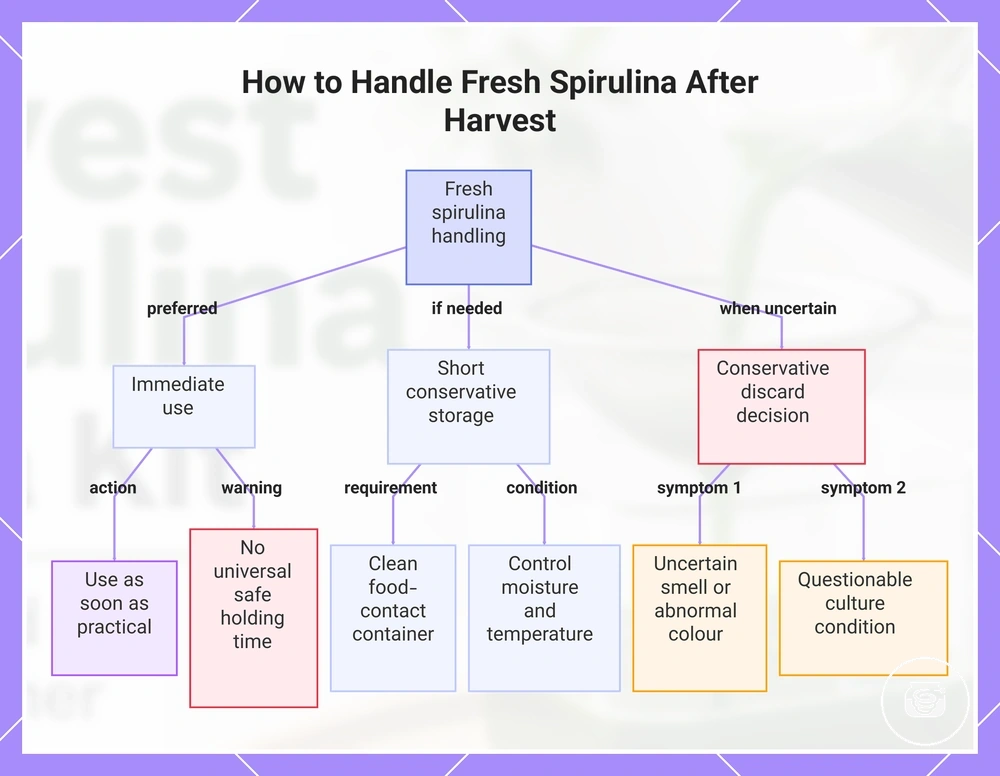
Fresh spirulina should be used immediately after harvesting whenever practical or transferred into a clean container for short storage under controlled temperature conditions. The reviewed home-growing evidence does not establish a universal storage time, refrigeration temperature, or guaranteed shelf life for freshly harvested spirulina, so immediate use is the preferred handling condition and any storage period should remain short and conservative.
Using or storing fresh spirulina after harvest depends on controlling moisture , temperature , container cleanliness , and time before use .
Using or storing fresh spirulina after harvest depends on controlling moisture, temperature, container cleanliness, and time before use. These handling conditions help preserve the harvested paste during short storage, but they do not guarantee food safety or a fixed storage duration because no authoritative home-growing source defines a universal storage limit for all spirulina growing kits.
Using or storing fresh spirulina after harvest checklist verifies whether the harvested biomass remains suitable for immediate use or whether a conservative discard decision is more appropriate.
Using or storing fresh spirulina after harvest checklist verifies whether the harvested biomass remains suitable for immediate use or whether a conservative discard decision is more appropriate.
- Immediate use: Use fresh spirulina as soon as practical after harvesting because no authoritative source specifies a universal safe holding time at room temperature.
- Short storage: If immediate use is not possible, transfer the harvested paste into a clean, food-contact storage container and keep the storage period as short as practical because no evidence-based shelf-life applies universally.
- Moisture and temperature: Protect fresh spirulina from unnecessary warming and moisture loss during short storage, although the reviewed evidence does not specify one storage temperature suitable for every home-growing kit.
- Container cleanliness: Store the harvested biomass only in a clean container that is free from visible residue before transfer.
- Discard decision: If fresh spirulina develops an uncertain smell, abnormal colour, or questionable culture condition before use, make a conservative discard decision instead of consuming it.
For example, suppose an illustrative harvest produces 100 grams of fresh spirulina. Using the entire amount immediately removes storage uncertainty, whereas storing the same 100 grams in a clean container requires continued observation of smell, colour, moisture, and overall condition because no authoritative home-growing source specifies a universal storage duration or shelf-life for freshly harvested spirulina.
For example, suppose an illustrative harvest produces 100 grams of fresh spirulina.
This chart shows the preferred immediate-use route, short-storage conditions, and conservative discard decision for freshly harvested spirulina.
Returning the Remaining Culture to Growing Conditions
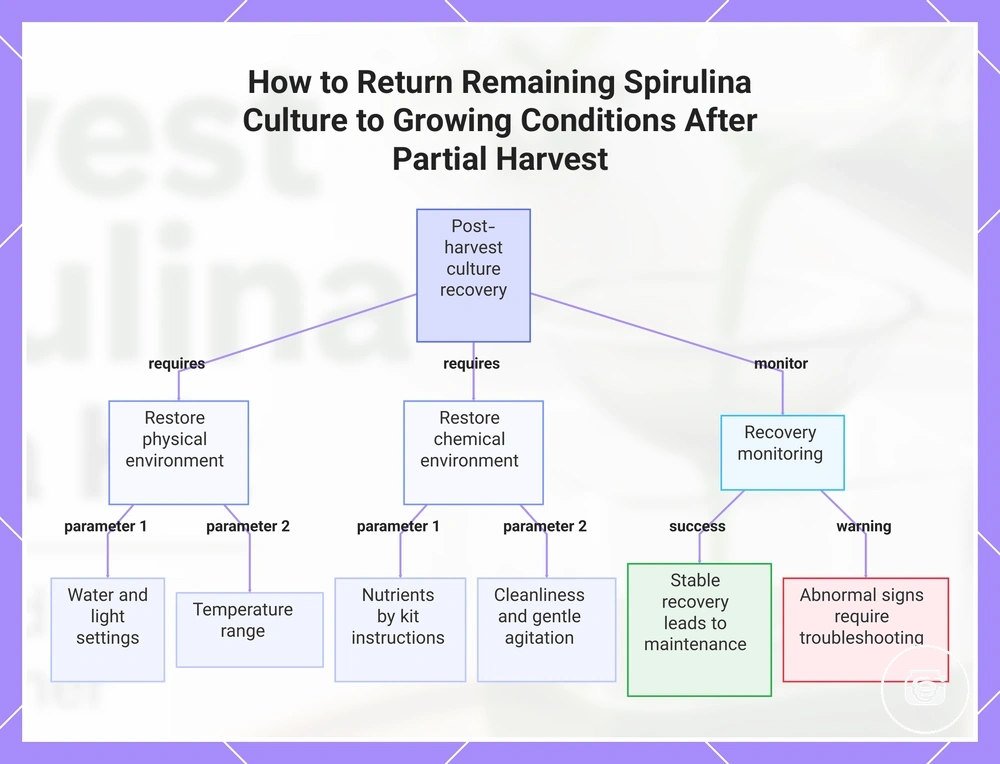
The remaining culture should be returned immediately to stable growing conditions after a partial harvest by restoring the kit-specified water level, light, temperature, nutrients, cleanliness, and agitation. These conditions support recovery, while an incorrect water level or abrupt environmental change can stress the culture and slow subsequent growth.
Returning the remaining culture to growing conditions requires checking every recovery condition against the instructions for the specific kit.
Returning the remaining culture to growing conditions requires checking every recovery condition against the instructions for the specific kit. The reviewed evidence does not establish one universal replacement-water volume, temperature range, light duration, nutrient dose, agitation rate, or recovery time for all home spirulina cultures, so the applicable values remain kit-specific.
- Water level: Restore the remaining culture only to the kit's marked or instructed level using the specified water type; an unverified volume can alter the culture-medium concentration and increase stress.
- Light: Return the culture to its normal kit-specified light position and schedule; a sudden increase or decrease in exposure can slow recovery.
- Temperature: Keep the remaining culture within the kit's stated operating range and avoid rapid temperature changes after harvesting.
- Nutrients: Add nutrients only when the kit instructions require them and use the stated amount for the restored culture volume rather than estimating from the harvested portion.
- Cleanliness and agitation: Keep the container and contact tools clean, then resume the kit-specified gentle agitation so the culture remains distributed without unnecessary disturbance.
- Recovery check: Treat stable colour, even distribution, and resumed growth as conditional recovery signals; if the culture becomes pale, settles abnormally, or develops an unusual smell, pause further harvesting and follow the kit's troubleshooting instructions.
Once immediate post-harvest recovery is complete, follow the broader routine for maintenance before harvesting. This keeps short-term recovery separate from ongoing maintenance and avoids unsupported nutrient dosing or regrowth guarantees.
Once immediate post-harvest recovery is complete, follow the broader routine for maintenance before harvesting .
This chart shows the essential recovery conditions to restore and the monitoring steps to follow after a partial harvest to ensure the remaining culture recovers effectively.
Safe Harvesting Checks and Filtering Mistakes
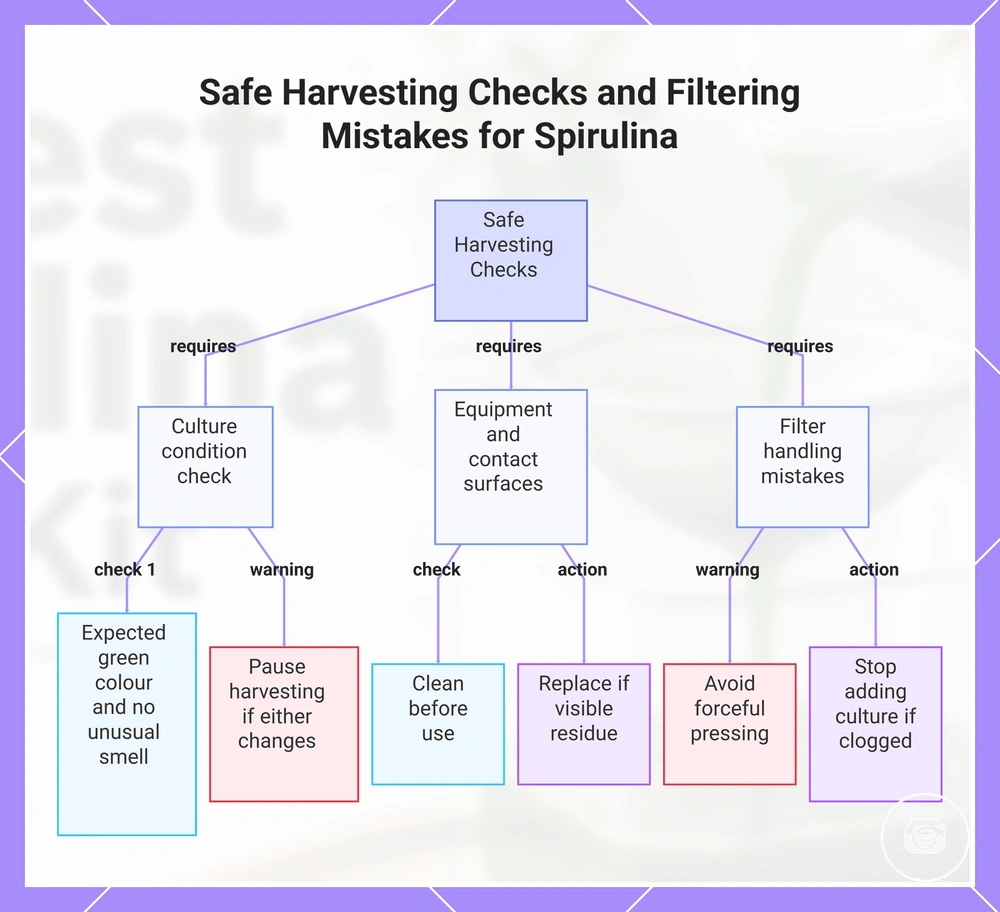
Safe harvesting checks determine whether the harvested spirulina should be used, corrected, or discarded by evaluating culture condition and filtering behaviour. Proceed only when the culture retains its expected green colour, has no unusual smell, the harvesting equipment is clean, and filtration has been completed without contamination or excessive pressure; otherwise pause harvesting until the problem is corrected.
Safe harvesting checks and filtering mistakes verify that the final harvest has remained clean throughout filtration.
Safe harvesting checks and filtering mistakes verify that the final harvest has remained clean throughout filtration. Normal harvest messiness includes green splashes, damp filter cloth, and temporary clogging that slows drainage, whereas an unexpected colour change, unusual smell, dirty contact surfaces, or forceful filter pressing should be treated as stop signals. According to the U.S. Food and Drug Administration Food Code, food-contact equipment and utensils should be clean before use, supporting cleanliness as a key harvesting criterion. For broader contamination guidance, review these safe harvesting checks before deciding that the harvested biomass is suitable for use.
For broader contamination guidance, review these safe harvesting checks before deciding that the harvested biomass is suitable for use.
Safe harvesting checks and filtering mistakes checklist:
- Culture condition: Proceed only when the culture shows its expected green colour and no unusual smell; pause harvesting if either characteristic changes unexpectedly because no authoritative home-growing source defines a universal colour or odour threshold for safe use.
- Tools and contact surfaces: Clean or replace any filter, container, utensil, or work surface that has visible residue or has contacted an unclean surface before it touches the harvested spirulina.
- Filter clogging: If clogging slows drainage, stop adding more culture and allow gravity to complete filtration before continuing instead of forcing additional liquid through the filter.
- Filter pressure: Avoid squeezing or pressing the filter firmly because excessive pressure can force fine spirulina biomass through the filter and increase the chance of contamination from surrounding contact surfaces.
- Final decision: Ordinary splashes and green staining can be cleaned after harvesting, but pause, clean, or discard the affected biomass if abnormal culture condition, dirty equipment, or unresolved filtering mistakes create uncertainty about the harvest.
This chart shows the three main areas to check before and during spirulina harvesting to avoid contamination and ensure safe biomass.
Signs the Culture Should Not Be Harvested
Do not harvest when the culture shows one or more significant warning signs, including unusual colour, persistent abnormal odour, visible foreign growth, pronounced sliminess, or an unexplained change from its normal appearance or behaviour. According to the reviewed home-growing evidence, these conditions should trigger a stop-harvest decision and further investigation before the harvested spirulina is used, while a single visual clue alone does not confirm contamination.
Signs the culture should not be harvested distinguish a questionable culture from normal density variation that can occur during routine growth or after mixing.
Signs the culture should not be harvested distinguish a questionable culture from normal density variation that can occur during routine growth or after mixing. Normal differences in culture thickness do not necessarily indicate a problem, whereas unusual colour, odour, foreign growth, sliminess, or another unexplained change should be treated as warning signs because no single observation reliably identifies contamination with certainty.
Signs the culture should not be harvested checklist confirms whether harvesting should stop until the culture has been investigated.
Signs the culture should not be harvested checklist confirms whether harvesting should stop until the culture has been investigated.
- Unusual colour: Do not harvest if the culture develops an unexpected colour that cannot be explained by normal mixing or density variation.
- Odour: Do not harvest when the culture develops an unusual or persistent odour because it is a warning sign that requires investigation before use.
- Foreign growth: Do not harvest if visible foreign growth appears on the culture surface or inside the container because the culture should be treated as questionable.
- Sliminess: Do not harvest when the culture becomes unusually slimy or develops a texture that differs noticeably from its normal consistency.
- Unexplained change: Do not harvest when multiple warning signs occur together or the culture changes unexpectedly without an obvious cause; stop harvesting until the culture condition has been investigated rather than assuming it is safe.
Mistakes That Reduce Yield or Contaminate the Culture
Filtering mistakes that most often reduce yield or contaminate the culture include incorrect mesh fit, unresolved clogging, excessive pressure, dirty cloths or containers, and rushed handling. According to the reviewed section evidence, no universal mesh size, pressing force, or drainage time applies to every home spirulina growing kit, so these settings must follow the specific filter and kit instructions while maintaining clean tools throughout harvesting.
These observable conditions provide practical correction points without repeating the complete harvesting procedure.
Filtering mistakes should be corrected by matching the filter to the harvested biomass, allowing gravity drainage instead of forceful pressing, and preventing contact between fresh biomass and unclean surfaces. Biomass visibly passing through the filter indicates poor mesh fit, standing liquid above the filter indicates clogging, and contact with a dirty cloth or container increases contamination risk. These observable conditions provide practical correction points without repeating the complete harvesting procedure.
Filtering mistake and correction checklist verifies the most common causes of yield loss and contamination before harvesting continues.
Filtering mistake and correction checklist verifies the most common causes of yield loss and contamination before harvesting continues.
- Incorrect mesh fit: If visible green biomass passes through the filter, replace the filter or cloth with the kit-specified filtration material because poor biomass retention can reduce yield.
- Ignoring clogging: If liquid accumulates above the filter, stop adding more culture and allow gravity drainage before continuing instead of forcing additional liquid through the clogged filter.
- Excessive pressure: Do not squeeze or press the filter firmly because excessive pressure can force fine biomass through the mesh and increase yield loss.
- Dirty cloth or container: Replace or clean any cloth, filter, container, or utensil that has visible residue or has contacted an unclean surface before it touches the harvested biomass.
- Rushed handling: Complete rinsing and biomass transfer using clean tools rather than rushing the process, because unnecessary contact with contaminated surfaces can introduce contamination into the harvested spirulina or the remaining culture.
For example, suppose an illustrative harvest filters 1 litre of culture and visible spirulina begins passing through the mesh after forceful pressing. Replacing the filter with the correct mesh and allowing gravity drainage instead of applying additional pressure improves biomass retention; the 1-litre volume is a hypothetical example for explaining the correction because the reviewed evidence does not specify a standard harvest volume, mesh size, or pressure value for every spirulina growing kit.