Growing Spirulina with a Home Growing Kit
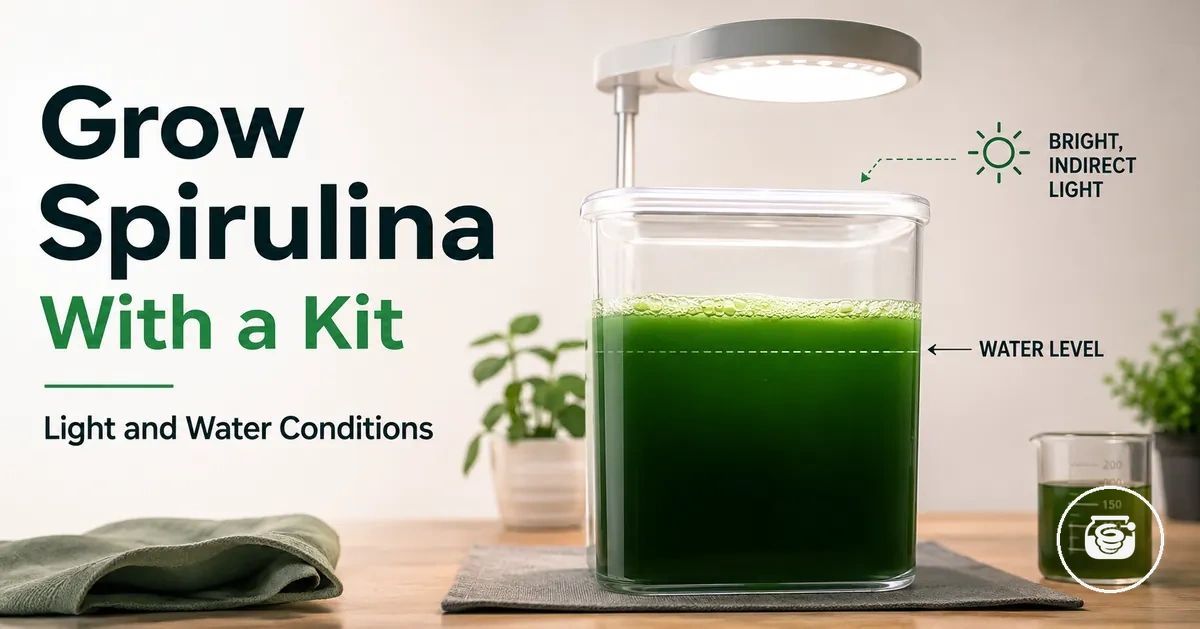
If your spirulina growing kit has already been assembled, successful growth depends on maintaining a stable spirulina culture through consistent light, the correct grow medium and nutrient mix, regular pH checks, clean equipment, and routine observation. The growing phase is continuous culture care rather than repeated setup or harvesting. Healthy growth is influenced by the kit design and the manufacturer's maintenance instructions, so changes should be gradual and deliberate.
For broader background on home systems, see spirulina growing kits .
Growing spirulina after setup means maintaining an active culture under suitable conditions so it continues multiplying instead of restarting the kit. This stage focuses on culture stability rather than assembly, including preserving the grow medium, nutrient balance, cleanliness, and lighting schedule. According to commercial spirulina culture guidance published by Algae Research Supply and AlgenAir, stable environmental conditions help maintain an active spirulina culture throughout routine home cultivation. For broader background on home systems, see spirulina growing kits.
This numerical example reflects a model-specific maintenance condition rather than a universal requirement.
A typical daily routine includes checking that the grow light follows the kit's recommended light schedule, confirming the nutrient mix has been added according to the supplied instructions, observing the colour and density of the spirulina culture, inspecting the culture bottle for cleanliness, and performing pH checks with a pH meter or test strips if required by the kit manufacturer. For example, if a kit specifies maintaining the culture at a pH between 9 and 11, readings within that range indicate that the growing conditions remain consistent for that specific kit, while readings outside the specified range signal that corrective maintenance should follow the manufacturer's guidance. This numerical example reflects a model-specific maintenance condition rather than a universal requirement.
A controlled approach makes it easier to identify which condition affected the spirulina culture and provides a clear starting point before completing the readiness checks used for the ongoing growth routine.
If healthy growth signs begin to change, such as slower colour development or reduced culture density, adjust only one variable at a time instead of changing the grow light, nutrient mix, and pH simultaneously. A controlled approach makes it easier to identify which condition affected the spirulina culture and provides a clear starting point before completing the readiness checks used for the ongoing growth routine.
Table of Contents
Growth Readiness After Setup
Growth readiness means a spirulina growing kit is prepared to support active spirulina culture because the starter culture, grow medium, water level, light placement, and baseline pH are stable according to the manufacturer's kit instructions. Readiness is verified by checking these conditions after setup rather than repeating the assembly process.
This section verifies setup before growing instead of explaining initial assembly.
Growth readiness is the condition in which the culture can move from setup into routine monitoring without correcting obvious stability issues. According to home spirulina kit manufacturers such as Algae Research Supply and AlgenAir, the starter culture should be established in the supplied grow medium, the culture container should remain clean, and baseline operating conditions should follow the kit documentation before routine cultivation begins. Manufacturers also specify that baseline pH and temperature guidance are formulation-specific rather than universal, so no single readiness value applies to every spirulina growing kit. This section verifies setup before growing instead of explaining initial assembly.
The image below highlights the main conditions that should remain stable before active growth.
Before beginning daily monitoring, inspect the culture container, confirm that the grow medium remains clear, verify that the water level matches the starting level recommended by the kit, check that the grow light is positioned as instructed, and measure the baseline pH if the kit requires it. For example, many home spirulina culture systems specify a target pH of approximately 9.0 to 11.0 for active cultivation, but that range applies only when stated by the manufacturer for the supplied nutrient formulation. The image below highlights the main conditions that should remain stable before active growth.
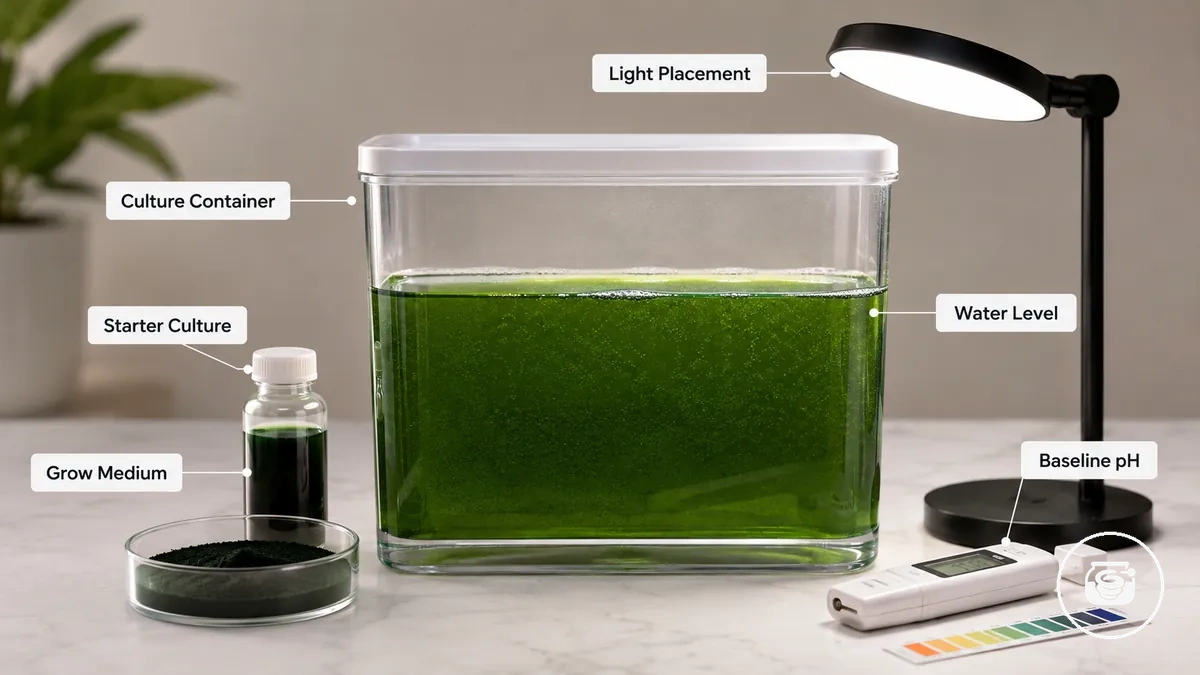
Use the checklist below to confirm Growth Readiness After Setup before starting the routine growing phase. If one or more conditions fall outside the manufacturer's specified operating range, correct them before relying on the conditions for growth used during ongoing culture care.
- Culture container: Clean, undamaged, and free from visible contamination before routine monitoring.
- Starter culture: Evenly distributed throughout the grow medium without unusual colour changes or contamination.
- Grow medium: Prepared with the nutrient mix specified for the kit and fully mixed before use.
- Water level: Maintained at the manufacturer's recommended starting level so evaporation has not significantly reduced culture volume.
- Light placement: Positioned according to the kit instructions with the recommended distance and lighting schedule for that model.
- Baseline pH: Confirmed within the kit's specified operating range before active spirulina growth monitoring begins.
The Active Spirulina Growing Routine
The Active Spirulina Growing Routine is the recurring process of daily culture care that keeps a spirulina culture actively growing after readiness has been confirmed. It combines repeated observation, light exposure, nutrient timing, pH monitoring, gentle movement, cleanliness, and record-keeping rather than frequent corrections or a rigid universal schedule. According to home cultivation guidance published by Algae Research Supply and AlgenAir, stable routine care supports culture stability more effectively than making multiple adjustments at the same time.
Each day begins with observation before any action is taken.
Each day begins with observation before any action is taken. Check the colour, density, and overall appearance of the spirulina culture, confirm that the grow light is operating according to the kit instructions, and verify that the culture container remains clean. The Active Spirulina Growing Routine organises these recurring checks into a simple sequence before any maintenance decision is made.
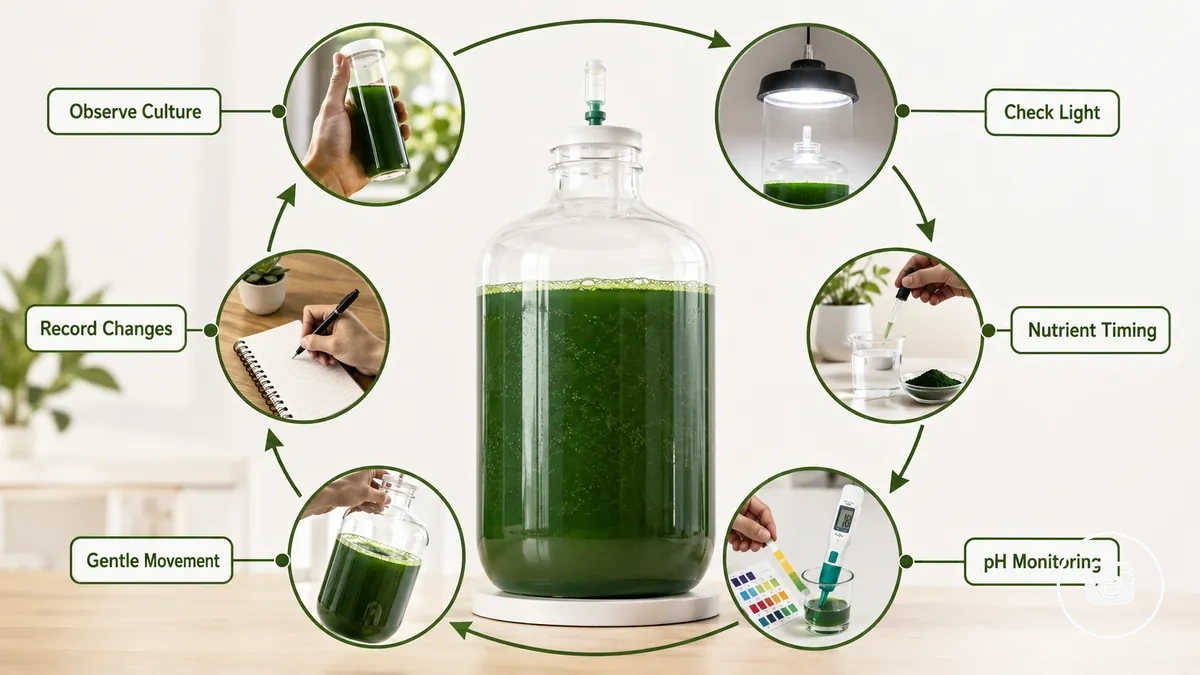
The ordered routine below helps maintain culture stability while avoiding unnecessary overcorrection.
- Observe the culture. Check the colour, density, and visible growth behaviour each day. If the appearance remains consistent, continue monitoring instead of changing multiple growing conditions.
- Check light exposure. Confirm that the grow light follows the schedule specified for the kit. For example, Algae Research Supply recommends approximately 12 to 16 hours of light each day for its home cultivation systems, while the manufacturer's schedule for your specific kit remains the controlling reference.
- Follow nutrient timing. Add nutrients only according to the manufacturer's feeding schedule or when the instructions indicate that the culture requires replenishment. Avoid adding extra nutrients simply because one day's growth appears slower than expected.
- Perform pH monitoring. Measure pH only at the frequency recommended for the kit and compare the result with the manufacturer's specified operating range before making any adjustment. For example, many home spirulina systems specify an operating pH of approximately 9.0 to 11.0 for active cultivation, but that range applies only when stated for the supplied nutrient formulation.
- Use gentle movement. Gently swirl or circulate the culture if the kit instructions recommend it so nutrients and light remain evenly distributed. Avoid vigorous shaking because unnecessary disturbance can interrupt stable culture conditions.
- Maintain cleanliness and record-keeping. Keep the culture container and tools clean, then record pH checks, nutrient additions, observation dates, and visible growth behaviour. A simple log makes gradual changes easier to recognise than relying on memory alone.
The frequency of daily and occasional checks depends on the kit instructions, culture density, room conditions, and visible growth behaviour rather than one universal timetable. If one condition changes unexpectedly, adjust only one growing variable before changing another so the effect of each correction can be observed more clearly.
If one condition changes unexpectedly, adjust only one growing variable before changing another so the effect of each correction can be observed more clearly.
Routine records become increasingly valuable during longer cultivation cycles because they reveal gradual trends that are difficult to detect from daily observation alone. As ongoing care becomes more detailed, continue with the dedicated guidance for maintenance while growing without replacing this recurring active growing routine.
Light and Darkness During Growth
Light and Darkness During Growth means providing consistent light exposure while preserving dark periods specified by the home growing kit so the spirulina culture maintains activity, culture colour, and growth consistency. According to manufacturer guidance from home spirulina cultivation systems such as Algae Research Supply and AlgenAir, lighting should follow the instructions supplied with the kit because the recommended light duration and grow light distance are model-specific rather than universal. A practical example is that some home kits recommend approximately 12 to 16 hours of light followed by a dark period, but this value applies only when stated for that specific system.
Place the grow light so the culture receives even illumination without excessive heat reaching the culture container.
Place the grow light so the culture receives even illumination without excessive heat reaching the culture container. If the culture colour becomes lighter than expected, the container feels noticeably warm, or condensation increases around the vessel, increase the distance between the grow light and the culture or reduce heat exposure according to the kit-specific guidance instead of increasing light intensity. Light and Darkness During Growth is most effective when lighting adjustments respond to visible culture behaviour rather than following a fixed schedule.
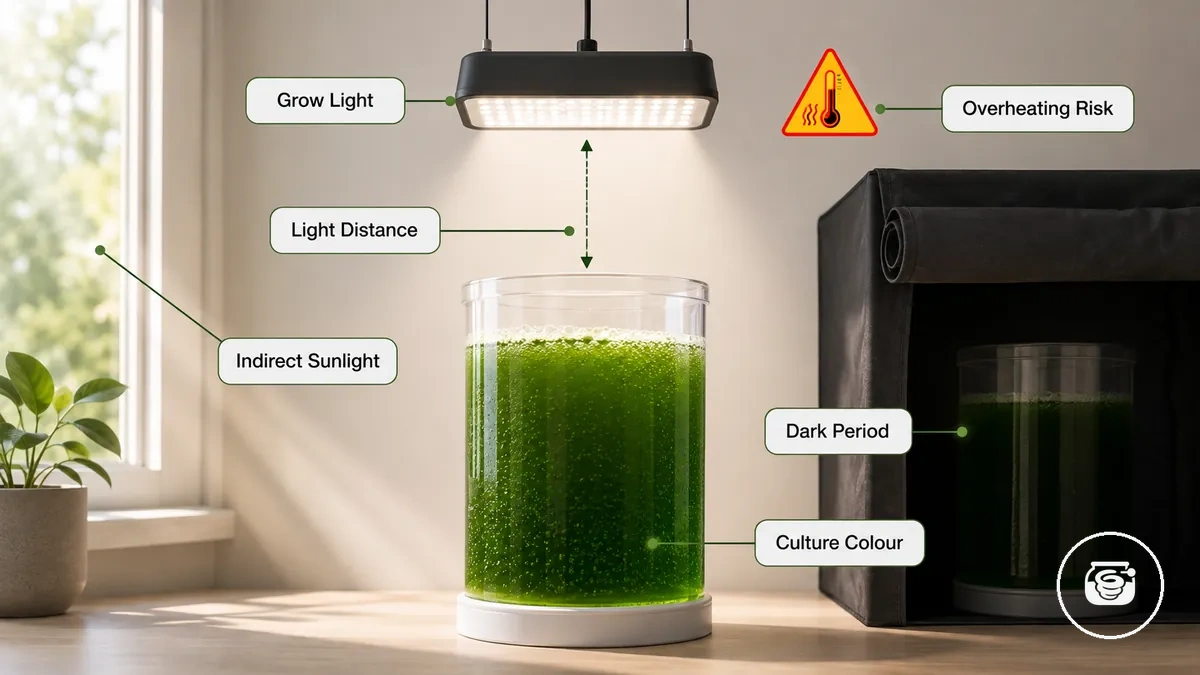
Light and Darkness During Growth uses the checks below to organise the most important lighting conditions during the active growing routine.
- Grow light distance: Position the grow light at the manufacturer's recommended distance so the culture receives even light without unnecessary heat build-up.
- Light duration: Follow only the light schedule supplied with the kit because recommended lighting periods differ between home cultivation systems.
- Indirect sunlight: Prevent direct sunlight from combining with the grow light if it raises the culture temperature or causes uneven heating.
- Dark periods: Allow the darkness cycle specified for the kit because continuous lighting is not universally recommended for home spirulina cultivation.
- Culture response: Monitor culture colour, growth consistency, and temperature together before changing light placement or lighting duration.
- Overheating risk: If heat increases during lighting, adjust the light distance before changing nutrients, pH, or other growing conditions.
Lighting should always be evaluated alongside the conditions for growth because temperature, nutrients, and pH influence how the culture responds to light. This condition-based approach keeps the guidance focused on the active growing routine without expanding into a separate troubleshooting process.
Nutrients and Mineral Support for the Culture
Nutrients and Mineral Support for the Culture means adding the nutrient mix only according to the home growing kit's instructions so the grow medium continues supplying the mineral support needed for healthy spirulina growth. According to home cultivation guidance from manufacturers such as Algae Research Supply and AlgenAir, nutrient formulations and feeding timing are specific to each kit, so there is no universal nutrient recipe or feeding interval. Exact nutrient amounts should therefore follow the manufacturer's instructions supplied with the kit.
Exact nutrient amounts should therefore follow the manufacturer's instructions supplied with the kit.
If visible density decreases or growth slows, first verify that feeding timing matches the kit instructions before adding more nutrient mix. Conversely, adding nutrients more frequently than instructed increases the overfeeding risk because excess nutrients can contribute to cloudiness, unnecessary pH changes, and culture stress. For example, some home spirulina kits specify adding nutrients only after a defined growth stage rather than every day, so following the manufacturer-defined schedule helps maintain stable culture response instead of repeatedly changing the grow medium.
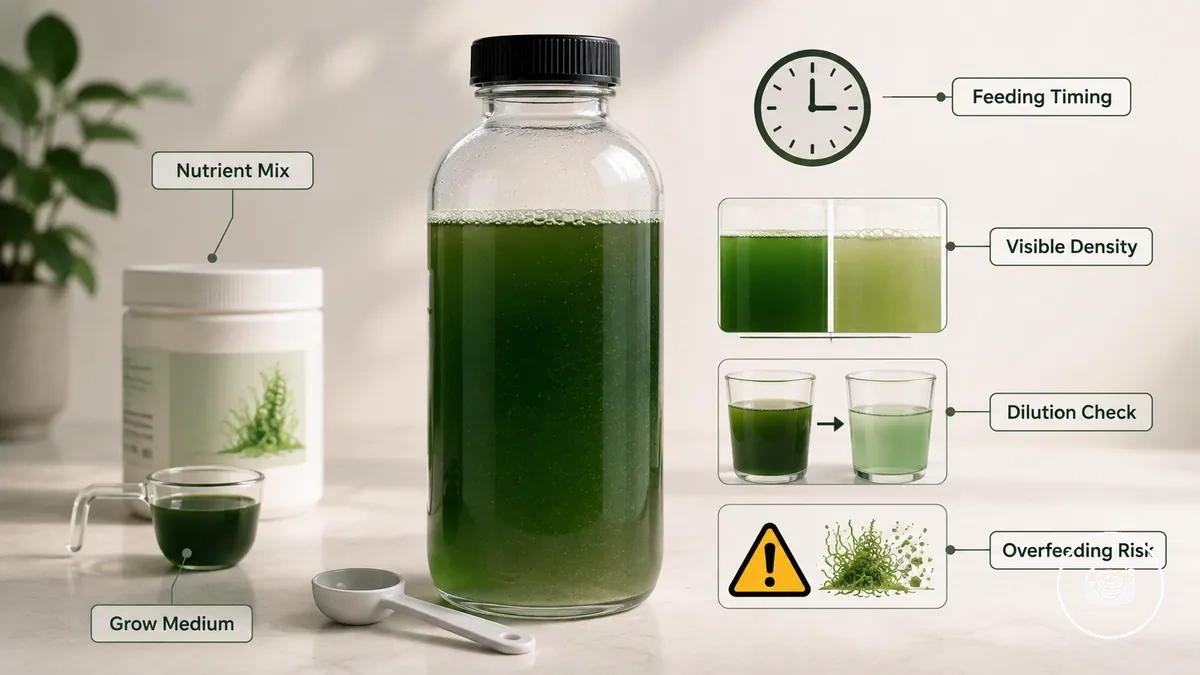
Nutrients and Mineral Support for the Culture can be checked with the list below before making any feeding adjustment.
- Nutrient mix: Use only the nutrient mix supplied or specified for the home growing kit.
- Grow medium strength: Maintain the grow medium using only the concentration prepared according to the kit instructions instead of increasing nutrient strength.
- Feeding timing: Add nutrients only at the interval or growth stage defined for the specific kit rather than using a universal schedule.
- Visible density: Observe gradual changes in culture density before deciding whether nutrient support is required.
- Dilution: If evaporation or maintenance requires dilution, restore the grow medium exactly as instructed before adding additional nutrients.
- Overfeeding risk: Avoid repeated nutrient additions because excessive nutrient levels can increase cloudiness and alter normal culture response.
Mineral support works together with light exposure, pH, and temperature rather than replacing them. Small, kit-guided adjustments based on routine observation provide a more reliable culture response than increasing nutrient additions alone.
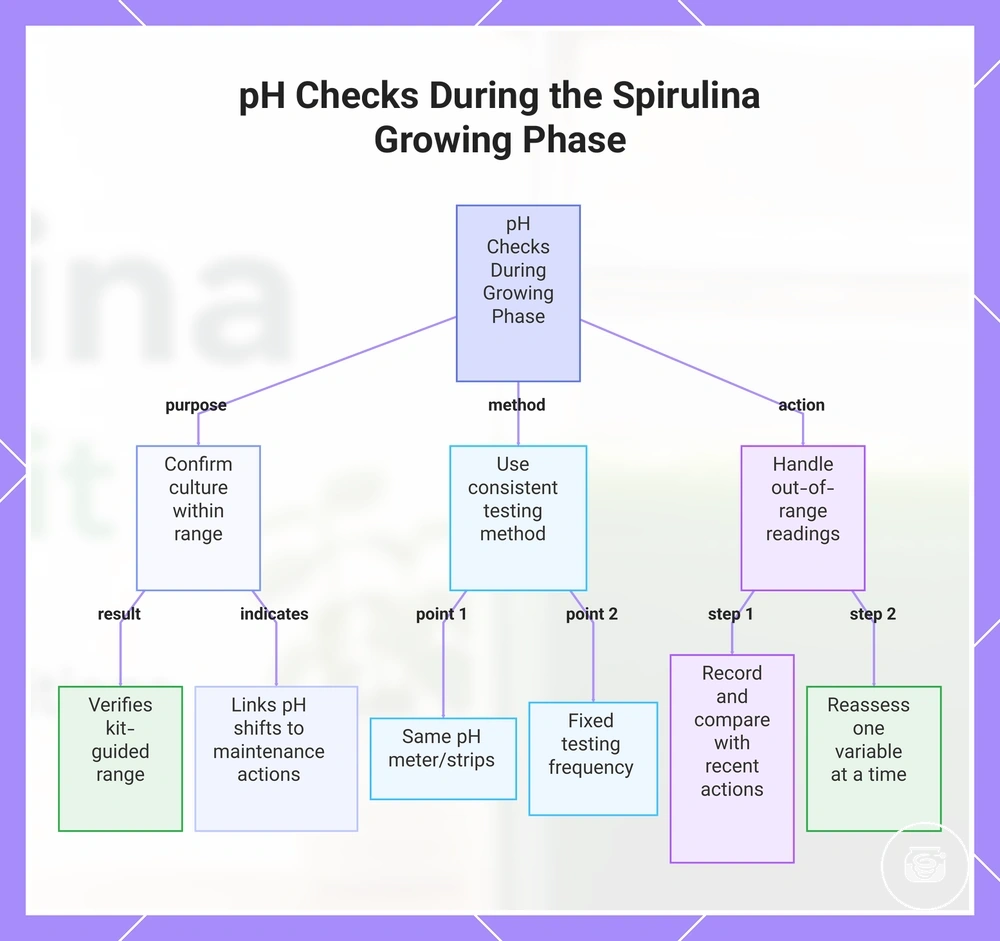
pH Checks During the Growing Phase
pH checks help confirm that a spirulina culture remains within the kit-guided range specified for the home growing kit throughout active growth. Because nutrient formulations differ between manufacturers, home cultivation guidance from manufacturers such as Algae Research Supply and AlgenAir recommends using the kit's stated pH operating range instead of applying a universal pH value. Regular pH monitoring supports culture stability by showing whether nutrient additions or water changes coincide with changes in culture conditions.
Recording the same testing frequency and measurement method each time makes gradual pH trends easier to interpret than isolated readings.
If a pH meter or pH strips indicate a reading outside the kit-guided range, record the result before making further adjustments and compare it with recent nutrient additions, water changes, and visible culture response. For example, if pH testing is performed every 24 hours according to a manufacturer's routine and the first out-of-range reading appears immediately after a nutrient addition, the recorded sequence helps identify when the change occurred without assuming the nutrient mix caused it. Recording the same testing frequency and measurement method each time makes gradual pH trends easier to interpret than isolated readings.
If a pH meter or pH strips indicate a reading outside the kit-guided range, record the result before making further adjustments and compare it with recent nutrient additions, water changes, and visible culture response.
pH Checks During the Growing Phase become more valuable when each reading is recorded alongside routine observations because the combined record helps verify whether pH stability is changing gradually or after a specific maintenance action.
- Testing method: Use the same pH meter or pH strips recommended for the kit so readings remain comparable over time.
- Testing frequency: Measure pH at the interval specified in the manufacturer's instructions and record the date with each reading.
- Sudden shifts: If an unexpected pH change follows nutrient additions or water changes, document both events before making another adjustment.
- Visible culture response: Record changes in culture colour, density, or cloudiness beside each pH reading to identify linked condition signals.
If repeated pH checks continue to fall outside the kit-guided range, reassess growing conditions one variable at a time rather than making multiple changes together. The same record-keeping practice continues during maintenance while growing, where long-term observation supports stable culture care without expanding into full troubleshooting.
This chart shows the purpose, proper testing method, and steps to handle out-of-range pH readings for a spirulina culture during the growing phase.
This chart shows the purpose, proper testing method, and steps to handle out-of-range pH readings for a spirulina culture during the growing phase.
Gentle Mixing and Culture Movement
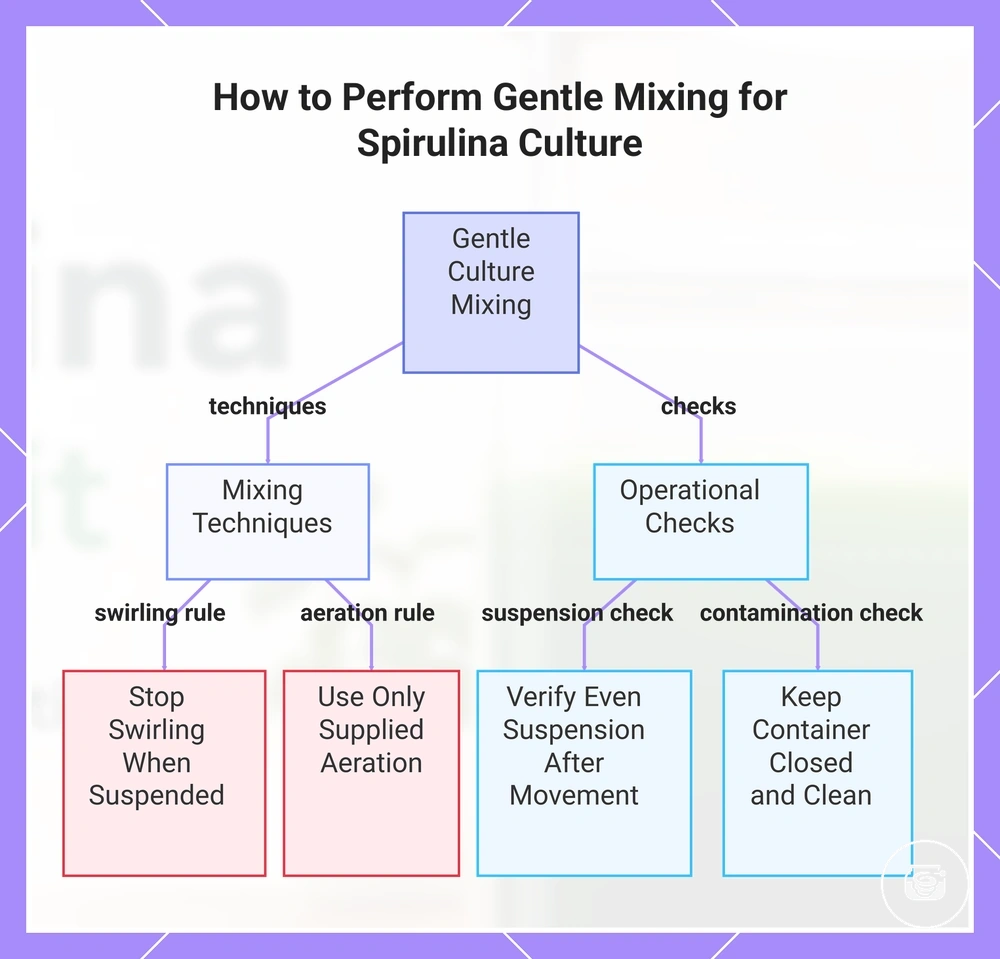
Gentle Mixing and Culture Movement should keep the spirulina culture evenly exposed to light and nutrients while preserving stable culture density. Use gentle swirling or the kit's included aeration only within the handling limits stated in the kit instructions. Gentle movement supports circulation and sediment avoidance without relying on force.
Gentle movement supports circulation and sediment avoidance without relying on force.
If culture density becomes uneven or material begins settling at the bottom of the container, use the specified gentle movement and then observe whether the culture returns to an even suspension. Gentle swirling can improve surface exposure and redistribute settled culture, while included aeration should continue only at the setting supplied for that system. Keep the container closed where possible and avoid unnecessary handling so contamination prevention remains part of the movement routine.
Gentle Mixing and Culture Movement should prevent overmixing as well as uneven settling.
Gentle Mixing and Culture Movement should prevent overmixing as well as uneven settling.
This chart shows the key techniques and handling rules for gentle mixing of spirulina culture to maintain even exposure and prevent contamination.
Healthy Spirulina Growth Signals
Healthy spirulina growth signals are a combination of visible and measurable observations that indicate whether a spirulina culture appears to be growing normally under the home growing kit's recommended conditions. Healthy growth should be assessed by culture colour, density, smell, surface appearance, pH stability, response to light, culture movement, and gradual thickening together rather than by any single observation. Assessing one signal in isolation can lead to an unreliable interpretation of the culture's condition.
Healthy growth signals fall into two categories: visible signals and measurable signals.
Healthy growth signals fall into two categories: visible signals and measurable signals. Visible signals include an even green culture colour, gradual thickening, a smooth surface appearance, and uniform culture movement after gentle swirling, while measurable signals include pH stability within the operating range specified by the kit manufacturer. For example, if a kit specifies maintaining a pH between 9.0 and 11.0, readings that remain within that range while culture colour gradually deepens over several daily observations provide stronger evidence of stable growth than either observation alone. This numerical example reflects a manufacturer-specified operating condition rather than a universal requirement.
This numerical example reflects a manufacturer-specified operating condition rather than a universal requirement.
Healthy Spirulina Growth Signals are easier to interpret when visible and measurable observations are considered together. The table below organises the most common signals into practical observation categories without treating any individual sign as a diagnosis.
| Signal | What to check | What it may mean | Safer next step |
|---|---|---|---|
| Culture colour | Even green colour throughout the culture | May indicate stable healthy growth when consistent with other signals | Compare with previous daily observations |
| Density | Gradual thickening without sudden clumping | May indicate continued culture development | Observe together with pH stability and culture movement |
| Smell | Mild algae-like smell without sudden change | An unexpected change may become a warning sign when combined with other changes | Record the observation before adjusting growing conditions |
| Surface appearance | Smooth surface without persistent films or unusual patches | Supports healthy growth when consistent with other signals | Continue routine observation instead of relying on one visual sign |
| pH stability | Readings remain within the kit's specified operating range | Supports stable growing conditions | Measure using the same method and compare with earlier records |
| Response to light | Consistent culture colour during the recommended lighting routine | May indicate balanced light exposure | Continue monitoring alongside density and pH |
| Culture movement | Even suspension after gentle swirling or approved aeration | Supports uniform light and nutrient exposure | Follow the kit's normal movement routine only |
Normal day-to-day variation in one signal is common, whereas multiple warning signs appearing together deserve closer observation before conclusions are drawn. Healthy spirulina growth signals describe the culture's present condition rather than predicting harvest timing, and guidance about growth time expectations explains how visible growth differs from expected cultivation duration.
Culture Adjustments During Active Growth
Culture adjustments during active growth should be limited to small, observation-based changes when the spirulina culture shows weak growth, slow growth, or uneven growth. The safest maintenance approach is to evaluate one growing variable at a time, such as light level, nutrient support, pH, dilution, water level, temperature, mixing, or cleanliness, before making another adjustment. Observation should always precede correction so that the culture response can be linked to a single condition instead of guesswork.
Observation should always precede correction so that the culture response can be linked to a single condition instead of guesswork.
If slow growth appears after several days of otherwise stable development, change only one variable and monitor the culture before making additional adjustments. For example, if the manufacturer's instructions specify maintaining a pH between 9.0 and 11.0 and the measured pH remains within that operating range after a water top-up, review dilution, water level, or light level before adding more nutrients. This numerical example reflects a manufacturer-defined operating range used by many home spirulina kits rather than a universal correction value, allowing the effect of one adjustment to be observed more reliably.
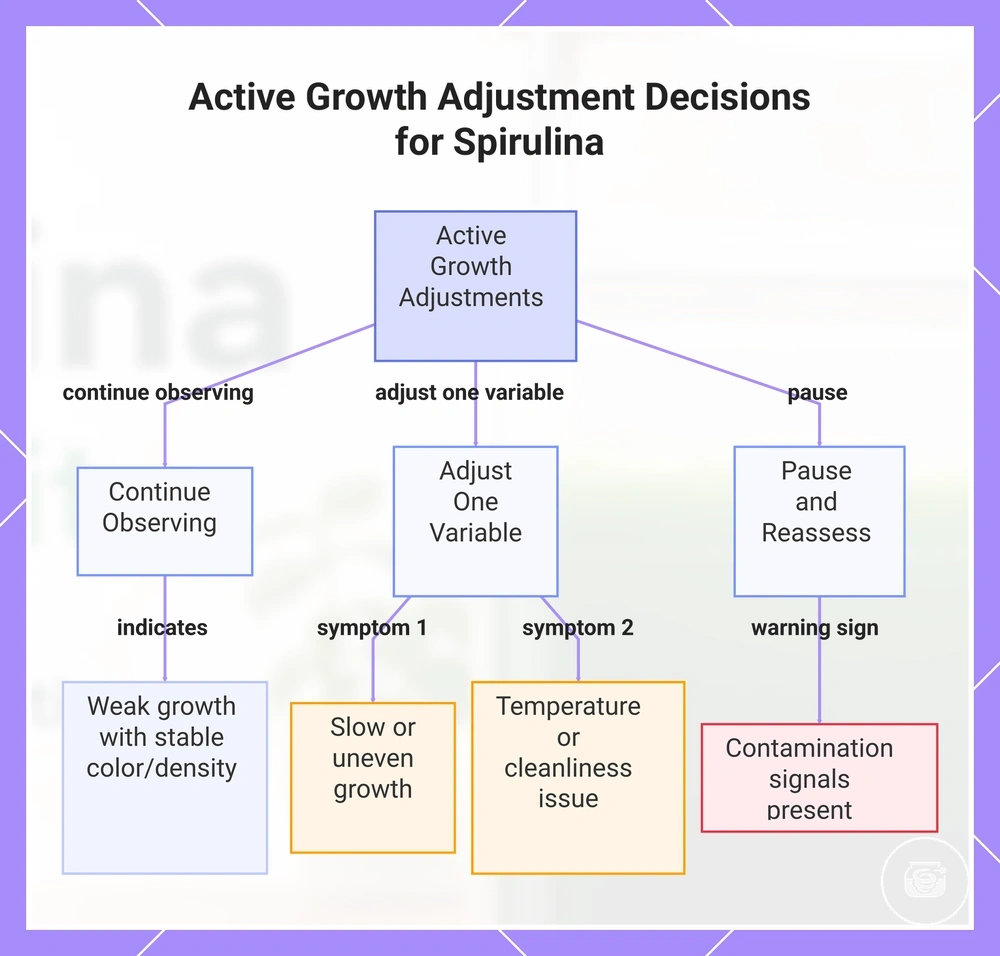
Culture Adjustments During Active Growth should follow consistent decision criteria instead of reacting to every visible change.
Culture Adjustments During Active Growth should follow consistent decision criteria instead of reacting to every visible change. The checklist below helps determine whether to continue observing, adjust one variable, or pause while maintaining the recommended conditions for growth.
- Weak growth: If culture colour and density remain generally stable, continue observing for another routine monitoring cycle before making further adjustments.
- Slow growth: Review light level, nutrient support, and pH, then adjust only one variable before reassessing the culture response.
- Uneven growth: Check dilution, water level, and mixing; restore even circulation or the recommended water level before changing nutrient support.
- Temperature change: If the culture becomes noticeably warmer than during previous observations, reduce heat exposure according to the kit instructions before altering other growing conditions.
- Cleanliness concern: Clean handling tools and inspect the culture container before changing nutrients or pH if contamination from equipment is suspected.
- Contamination risk: If unusual smell, unexpected colour change, persistent surface films, or multiple abnormal signals appear together, pause further adjustments and reassess the culture instead of making repeated corrections.
Small, sequential adjustments provide clearer information than changing multiple conditions simultaneously and help preserve stable culture growth without becoming a full troubleshooting process. If repeated observations indicate that routine care should continue rather than additional adjustments, follow the guidance for maintenance while growing before making further condition changes.
If repeated observations indicate that routine care should continue rather than additional adjustments, follow the guidance for maintenance while growing before making further condition changes.
This chart shows the three main decision outcomes when adjusting a spirulina culture during active growth: continue observing, adjust one variable, or pause and reassess, based on observed growth issues and warning signs.
Mistakes That Slow or Stress a Spirulina Culture
Growing mistakes can reduce spirulina culture stability when they disturb light exposure, nutrient timing, pH, cleanliness, or handling. The most common preventable stressors are overfeeding, underfeeding, unstable pH, excessive light, poor darkness balance, dirty tools, harsh mixing, neglected observation, and delayed correction. The safer response is to identify the observed pattern, check one likely variable, and avoid changing several conditions at once.
Compare recent changes in light, feeding, pH readings, darkness balance, and handling before selecting one limited response.
If the culture becomes pale, thin, or slow-growing, that visible sign can have multiple causes rather than one certain explanation. The reviewed section evidence indicates that insufficient movement can increase self-shading, while excessive agitation can stress the culture; underfeeding, unstable pH, or excessive light can also produce weak-growth signals. Compare recent changes in light, feeding, pH readings, darkness balance, and handling before selecting one limited response.
The table supports pattern recognition without treating any single symptom as a certain diagnosis.
Mistakes That Slow or Stress a Spirulina Culture are easier to recognise when each mistake is connected to a likely stress signal and a safer response. The table supports pattern recognition without treating any single symptom as a certain diagnosis.
| Mistake | Likely stress signal | Why it matters | Safer response |
|---|---|---|---|
| Overfeeding | Cloudiness, an unexpected pH shift, or weaker culture response after feeding | Excess nutrient input can disturb the grow medium and obscure the original cause of slow growth | Pause further nutrient additions, record the change, and compare it with the kit's feeding timing |
| Underfeeding | Slow growth or limited increase in culture density | Insufficient nutrient support can restrict growth even when other conditions remain stable | Check the kit instructions and restore only the specified feeding schedule |
| Unstable pH | Repeated readings outside the kit-guided range with changes in colour or density | pH shifts can alter nutrient availability and increase culture stress | Verify the reading with the same pH meter or strips and review recent water or nutrient additions |
| Excessive light | Fading culture colour, excess warmth, or weaker growth near the brightest area | Excess light or heat can stress the culture instead of supporting consistent growth | Return to the kit-specified light placement and schedule, then continue observation |
| Poor darkness balance | Uneven growth despite otherwise stable conditions | A light-and-dark cycle outside the kit instructions can disturb the intended growing routine | Restore the manufacturer-specified lighting cycle rather than extending illumination |
| Dirty tools | Unexpected smell, surface film, or unusual colour change after handling | Unclean equipment increases contamination risk and makes later signals harder to interpret | Stop unnecessary handling, clean permitted tools, and reassess before changing nutrients or pH |
| Harsh mixing | Foaming, uneven culture response, or stress after movement | Excessive agitation can stress the culture, while insufficient movement can contribute to settling and self-shading | Use only gentle swirling or included aeration within the kit's handling limits |
| Neglected observation | Several changes appear before any useful record exists | Missing observations remove the sequence needed to distinguish between multiple possible causes | Record culture colour, density, pH, light, feeding, and handling during each routine check |
| Delayed correction | A minor change develops into several overlapping warning signs | Waiting too long can make cause-and-effect relationships harder to identify | Respond to repeated changes with one measured adjustment, then reassess before acting again |
Light, pH, and Nutrient Mistakes
Light, pH, and nutrient mistakes are routine errors that can create culture stress when changes to light exposure, pH stability, or nutrient support are made without confirming which condition has changed first. The reviewed home spirulina cultivation guidance indicates that these growing variables interact, so one visible symptom does not reliably identify one cause. A safer approach is to reassess one condition at a time rather than changing light, pH, and nutrients together.
A safer approach is to reassess one condition at a time rather than changing light, pH, and nutrients together.
For example, if a spirulina culture is monitored every 24 hours and weak growth appears after a routine nutrient addition while pH remains within the kit's specified operating range, reassessing light exposure before adding more nutrients provides a clearer comparison than changing multiple variables simultaneously. Likewise, a pale culture colour may follow excessive light, insufficient light, skipped pH checks, or nutrient neglect, while sudden pH correction or overfeeding can produce cloudiness or additional instability. This comparison-based approach helps separate one condition issue from another without turning routine observation into full troubleshooting.
This comparison-based approach helps separate one condition issue from another without turning routine observation into full troubleshooting.
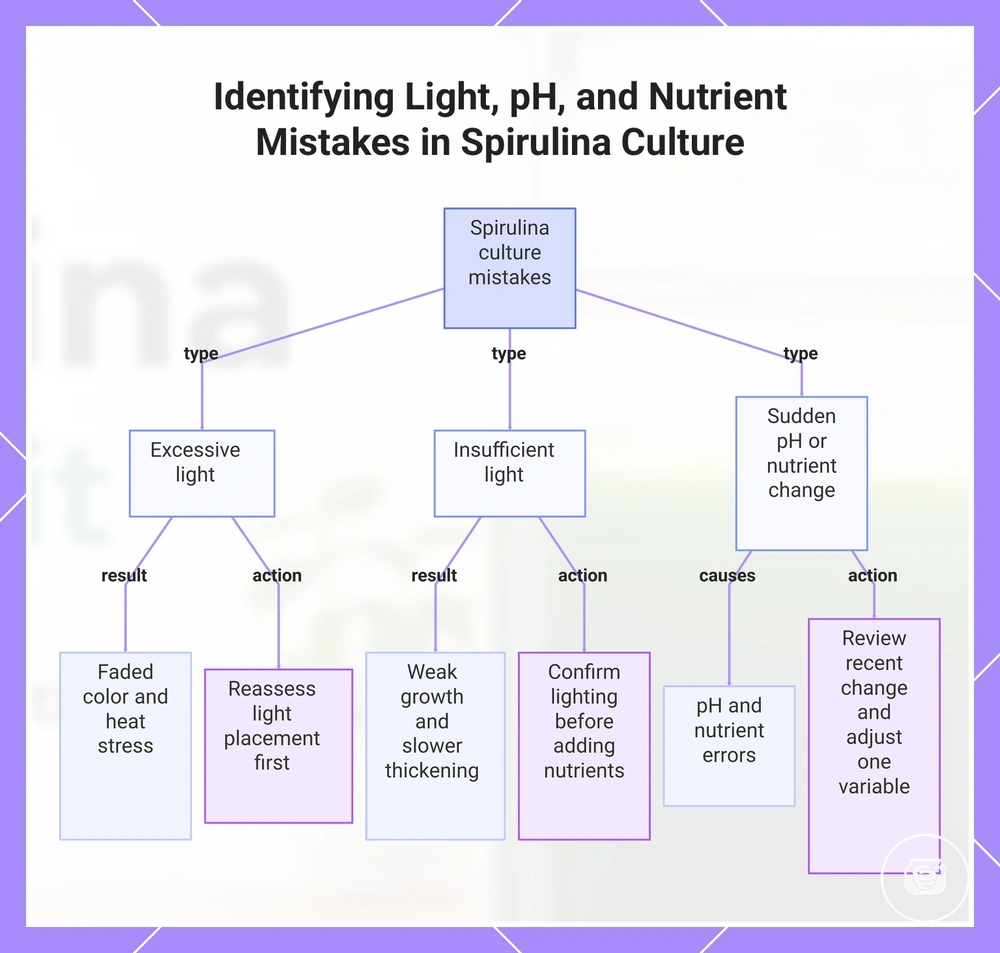
Light, pH, and Nutrient Mistakes are easier to recognise when each variable error is compared with its likely effect instead of assuming one symptom has one cause.
- Too much light: Excessive light may increase culture stress, fade culture colour, or increase heat exposure. Reassess light placement before changing pH or nutrients.
- Too little light: Insufficient light may contribute to weak growth or slower culture thickening. Confirm lighting conditions before increasing nutrient additions.
- Sudden change: Skipped pH checks, sudden pH correction, overfeeding, or nutrient neglect can contribute to instability, cloudiness, or weak growth. Review the most recent change first and adjust only one variable before reassessment.
This chart categorizes the three main types of spirulina culture variable errors, their effects, and the recommended diagnostic action.
Cleanliness and Contamination Risks
Cleanliness and contamination risks affect a growing spirulina culture by increasing the chance that unwanted material enters the culture during repeated daily handling. Clean handling means using clean tools, covered containers, washed hands, and separate measuring items whenever the culture is observed or maintained, reducing avoidable handling risks throughout the growing phase. Within the growing-kit scope, cleanliness functions as a practical growth-risk control rather than a food-safety measure.
Within the growing-kit scope, cleanliness functions as a practical growth-risk control rather than a food-safety measure.
For example, if a culture is opened once each day for seven consecutive days, using the same measuring spoon for nutrients and unrelated household tasks creates seven separate handling events instead of seven controlled handling events with dedicated equipment. If an unusual smell, unexpected colours, or visible foreign material appears after routine care, these observations should be treated as contamination risk signals rather than normal growth changes until the culture is assessed safely within the growing-kit scope. This approach helps distinguish routine culture variation from handling-related concerns without expanding into contamination treatment.
This approach helps distinguish routine culture variation from handling-related concerns without expanding into contamination treatment.
Cleanliness and Contamination Risks are easier to reduce when the following prevention checklist is followed during repeated daily care.
- Clean tools: Use only clean tools whenever the culture container or nutrient solution is handled.
- Covered containers: Keep containers covered immediately after observation or maintenance to reduce exposure to airborne foreign material.
- Washed hands: Wash hands before touching the culture container, lid, or growing-kit accessories.
- Separate measuring items: Reserve spoons, cups, pipettes, or other measuring items exclusively for the spirulina growing kit.
- Risk signals: Treat an unusual smell, unexpected colours, or visible foreign material as contamination signs that require closer assessment instead of routine observation.
- Boundary cue: If multiple contamination signs appear together, pause normal growing actions until the culture is assessed safely within the growing-kit scope before resuming routine care.
When the Culture Is Ready for the Next Stage
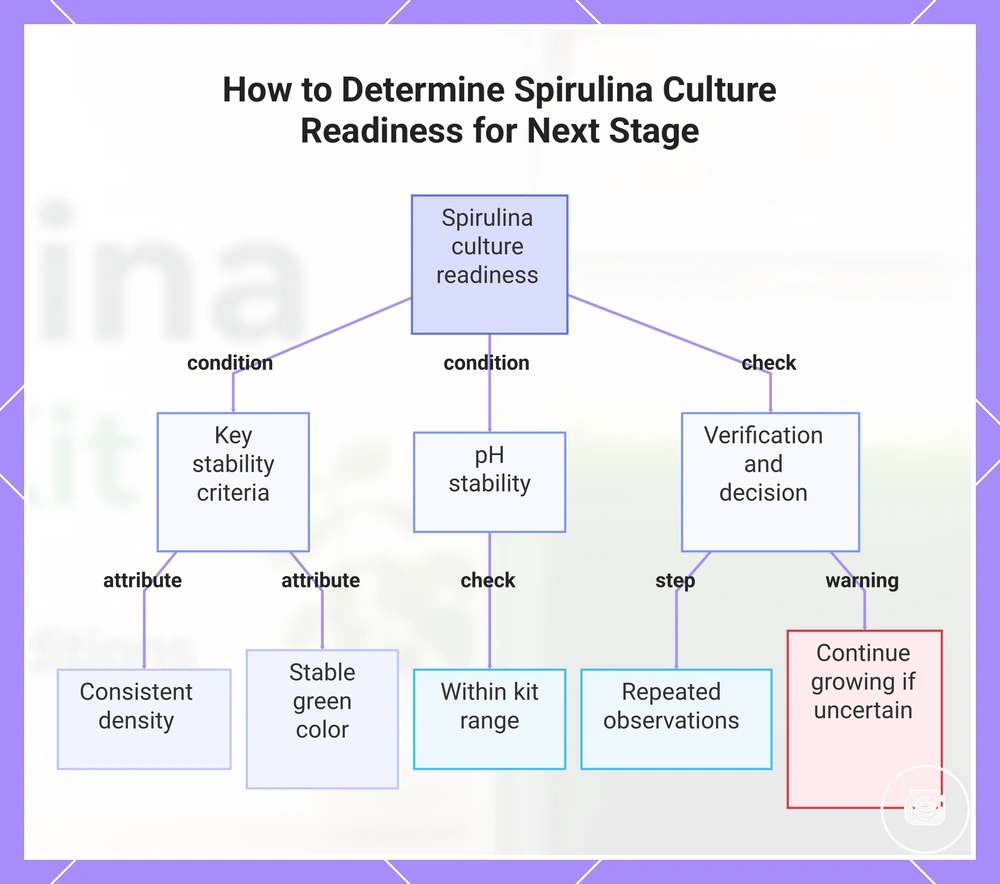
A spirulina culture is ready for the next stage only when culture density, colour, and pH stability remain consistently stable across repeated observations and the culture continues matching the kit instructions. Home spirulina growing kits do not define readiness by an exact day count because growth rate differs with growing conditions and the manufacturer's cultivation method. Readiness is therefore conditional rather than time-based alone.
Readiness is therefore conditional rather than time-based alone.
Judge readiness by considering all key observations together instead of relying on one signal. For example, if three consecutive daily observations show consistent green colour, stable culture density, and pH remaining within the operating range specified by the kit manufacturer, the combined observations provide stronger evidence that the culture is stable enough for the next action than a single favourable reading. If one criterion changes unexpectedly, continue growing and reassess before moving beyond the growing phase.
Judge readiness by considering all key observations together instead of relying on one signal.
When the Culture Is Ready for the Next Stage, the checklist below organises the practical readiness criteria covering density, stability, timing, and the next action. These observations should also be considered alongside growth time expectations, because readiness depends on observed culture stability as well as elapsed growing time.
- Culture density: The culture has become consistently denser across repeated observations rather than during a single inspection.
- Colour: The culture maintains a uniform healthy green colour without persistent unexpected changes.
- pH stability: Repeated measurements remain within the operating range specified by the kit manufacturer.
- Repeated observations: Stable conditions are confirmed over multiple routine checks instead of one favourable result.
- Harvest-readiness boundary: The culture appears stable enough to move toward the next stage, but this readiness check does not determine harvesting or guarantee that harvesting should begin.
- Continue growing: If any readiness criterion remains uncertain, continue growing according to the kit instructions before reassessing.
If the culture is not clearly ready, delay the next action and continue maintenance while growing until repeated observations consistently support readiness. This gradual approach preserves culture stability and helps separate routine cultivation from the next practical stage.
This gradual approach preserves culture stability and helps separate routine cultivation from the next practical stage.
This chart shows the key stability criteria and verification method to judge when a spirulina culture is ready to move to the next stage.