
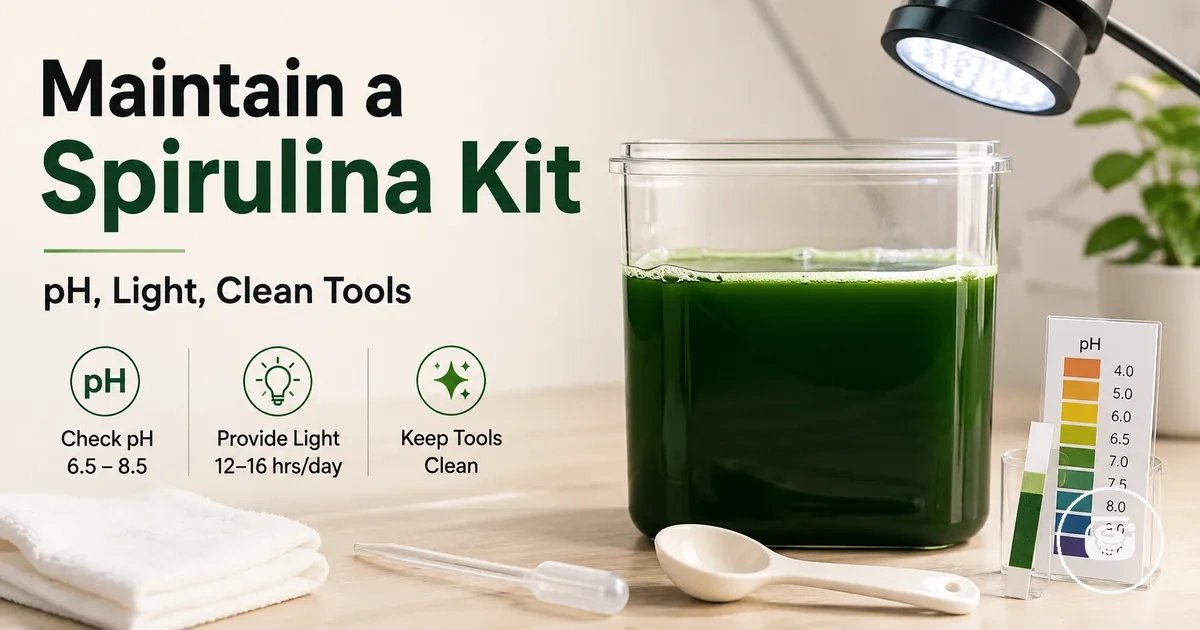
How to Maintain a Spirulina Growing Kit
Maintain a spirulina growing kit through routine monitoring, condition-based balancing, low-disturbance cleaning, and early detection of decline. The live culture should remain within the pH, nutrient, light-exposure, and temperature conditions specified for that kit, while the container and every culture-contact tool should remain visibly free of residue or foreign growth.
Spirulina maintenance connects environmental conditions with observable culture stability rather than relying on one reading.
Spirulina maintenance connects environmental conditions with observable culture stability rather than relying on one reading. The Food and Agriculture Organization’s 2008 review, A Review on Culture, Production and Use of Spirulina as Food for Humans and Feeds for Domestic Animals and Fish, reports laboratory-cultivation reference conditions of pH 8.5–10.5 and 30°C, with light, dissolved solids, water quality, stirring, and macro- and micronutrients also affecting productivity; these are research conditions, not universal home-kit settings.
For example, a culture measured at pH 9.5 and 30°C falls inside the FAO review’s cited laboratory ranges, but those two measurements do not establish stability by themselves.
For example, a culture measured at pH 9.5 and 30°C falls inside the FAO review’s cited laboratory ranges, but those two measurements do not establish stability by themselves. The practical check must also include the culture’s colour and suspension, the medium level, recent nutrient additions, light-related heat, container residue, and the cleanliness of the measuring or stirring tool; any adjustment should follow the kit supplier’s specified medium and dosing instructions because the FAO review does not establish one nutrient dose or light schedule for all home kits.
Normal maintenance involves gradual observation and one controlled change at a time, followed by comparison with the culture’s previous condition.
Normal maintenance involves gradual observation and one controlled change at a time, followed by comparison with the culture’s previous condition. Abrupt colour loss, persistent settling or clumping, unexpected surface material, or continuing decline after the specified conditions are restored exceeds routine maintenance and requires separate contamination or troubleshooting assessment rather than repeated nutrient, pH, light, or temperature corrections.
Table of Contents
Spirulina Kit Maintenance Basics
Spirulina growing kits require routine maintenance to keep the live culture stable after setup. Spirulina kit maintenance is the ongoing process of monitoring the live culture, maintaining the growth medium, checking pH, nutrients, light exposure, temperature, and cleaning practices so the culture remains stable rather than progressing into decline. This routine protects culture stability and is distinct from setup, harvesting, safety procedures, or troubleshooting.
Spirulina growing kits require routine maintenance to keep the live culture stable after setup.
Routine maintenance focuses on keeping the culture within the conditions specified for the kit while monitoring connected variables instead of a single measurement. According to the Food and Agriculture Organization (FAO), spirulina cultivation is commonly performed under alkaline conditions of approximately pH 8.5–10.5 and around 30°C in controlled production systems, but these published cultivation values are not universal maintenance targets for every home kit because nutrient formulations and operating instructions differ by manufacturer. Maintaining live culture stability therefore means observing the complete culture condition rather than reacting to one pH or temperature reading alone.
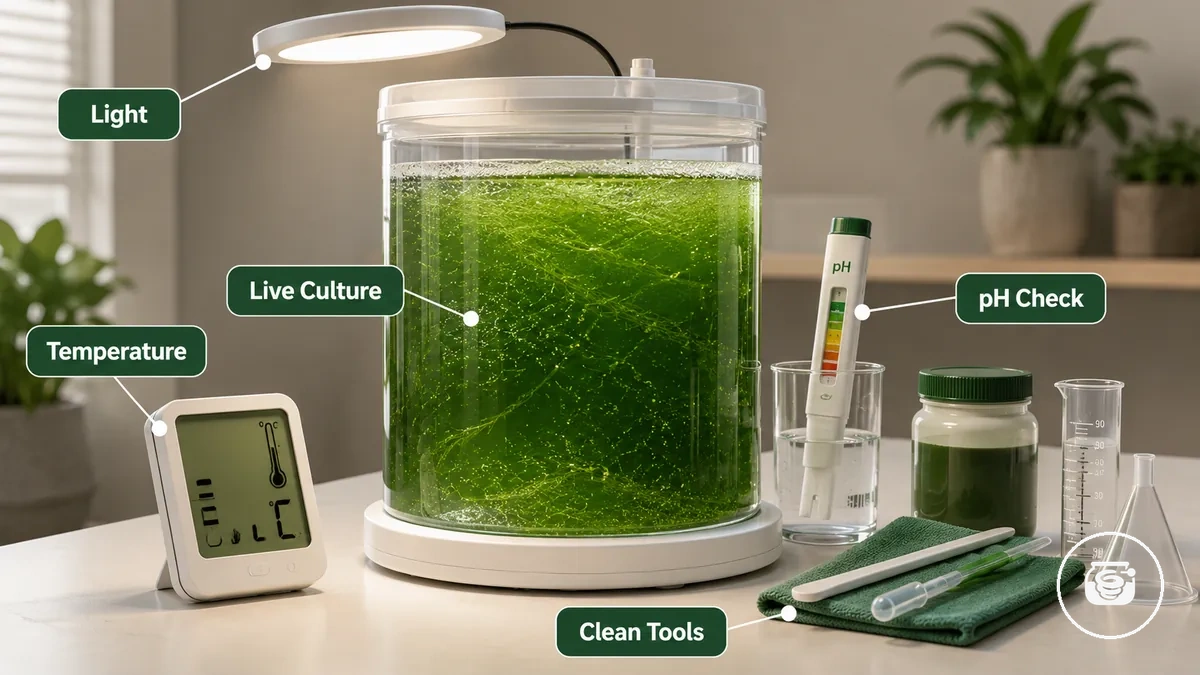
For example, a culture measuring pH 9.5 at 30°C remains within the FAO cultivation reference conditions, but maintenance should also confirm an evenly suspended green culture, clean equipment, and no unexpected surface growth before concluding that the culture is stable. A normal maintenance response is to continue routine monitoring, whereas persistent colour loss, repeated settling, unusual odour, or visible foreign growth indicates that the situation has moved beyond routine maintenance into troubleshooting.
- Check that the live culture remains evenly suspended with its expected green appearance.
- Maintain the growth medium according to the kit's specified pH and nutrient instructions.
- Provide consistent light exposure while avoiding unnecessary heat build-up around the culture.
- Clean the container, stirring tools, and testing equipment before they contact the culture.
- Record gradual changes so routine maintenance can be distinguished from setup, harvesting, safety actions, or troubleshooting.
Daily Checks for a Stable Spirulina Culture
Daily checks for a stable spirulina culture should be observational before corrective. Inspect the culture's colour, density, movement, surface condition, container position, light exposure, and visible stress signals each day without making repeated adjustments unless the same change continues over multiple observations. According to the Food and Agriculture Organization (FAO), stable spirulina cultivation depends on maintaining suitable environmental conditions consistently rather than reacting to a single visual change.
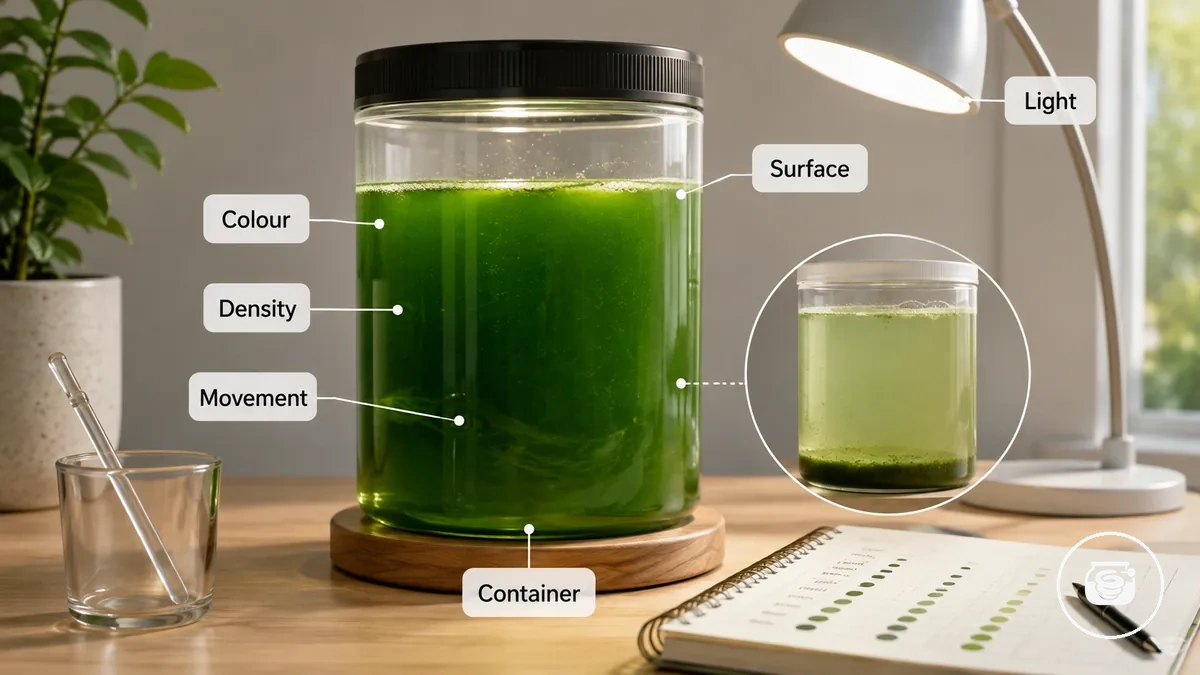
For example, if a spirulina culture remains evenly suspended with a consistent green colour for three consecutive daily observations, continuing routine monitoring is appropriate because no developing pattern suggests instability. In contrast, a culture that becomes progressively lighter in colour, settles more heavily each day, or develops a persistent surface film after the container position or light exposure changes should be observed closely before progressing to separate pH testing, nutrient review, safety checks, or troubleshooting.
- Colour: Normal: Even green appearance. Concerning: Persistent fading, yellowing, or patchy discolouration across successive daily checks.
- Density: Normal: Culture remains evenly suspended after routine mixing. Concerning: Increasing settling or an unusually thin appearance that continues over multiple days.
- Movement: Normal: Gentle circulation after normal stirring. Concerning: Persistent clumps or stagnant areas that become more noticeable over time.
- Surface Condition: Normal: Clean surface without unexpected material. Concerning: A continuing surface film, foam, or foreign growth that was absent during earlier observations.
- Container Position: Keep the container in the same stable location to avoid unnecessary changes in temperature or light exposure.
- Light Exposure and Stress Signals: Maintain a consistent lighting routine and compare today's appearance with previous days because a developing pattern is a more reliable indicator of culture stability than one isolated observation.
Check Culture Colour, Density, and Movement
Visual inspection helps judge whether a spirulina culture still appears active and stable by comparing its colour, visible density, suspended movement, and surface appearance over repeated observations rather than relying on a single check. According to the Food and Agriculture Organization (FAO), stable spirulina cultivation depends on maintaining consistent culture conditions, so visual observations should be interpreted as patterns developing over time instead of isolated signs.
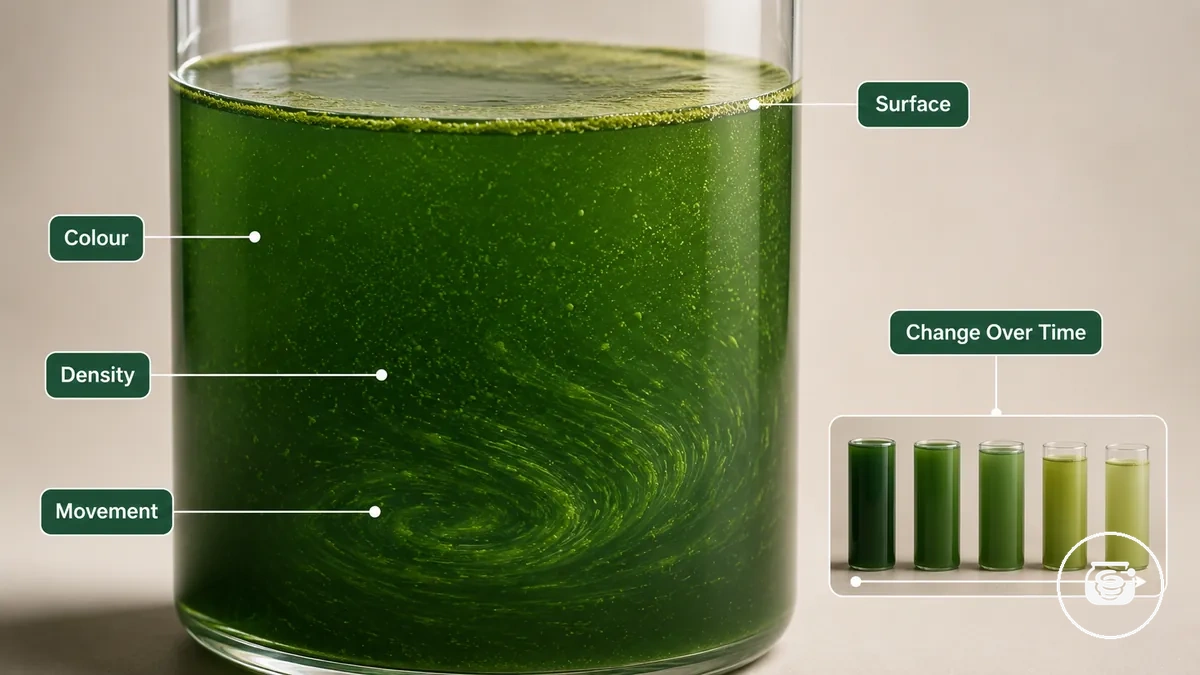
For example, if a culture maintains a consistent green colour, remains evenly suspended after gentle stirring, and shows a clean surface for three consecutive daily observations, the visual pattern indicates stable appearance under unchanged conditions. In contrast, a noticeable colour change within one day, increasing settling after each observation, or the sudden appearance of a persistent surface film represents an abrupt visual change that should be tracked further because rapid changes are more significant than gradual variation alone.
Observe these visual signals during each inspection:
- Colour: A stable culture keeps a consistent green appearance, while persistent fading, yellowing, or patchy discolouration across multiple observations indicates a changing visual pattern.
- Visible Density: The suspended culture should appear evenly distributed after gentle mixing rather than becoming progressively thinner or showing heavier settling over successive days.
- Movement: Gentle circulation after normal stirring indicates the culture remains well suspended, whereas increasing clumping or stagnant areas show that movement has changed over time.
- Surface Appearance: The surface should remain visually clean without persistent film, foam, or unexpected material compared with earlier daily observations.
Keep the Culture Gently Circulating
Gentle circulation keeps a spirulina culture evenly suspended, reducing settling and clumping while supporting more uniform light exposure during routine maintenance. According to the Food and Agriculture Organization (FAO), productive spirulina cultivation depends on maintaining uniform environmental conditions, so gentle container movement should restore an even suspension without creating unnecessary disturbance because stable suspension helps the culture receive more consistent access to light.
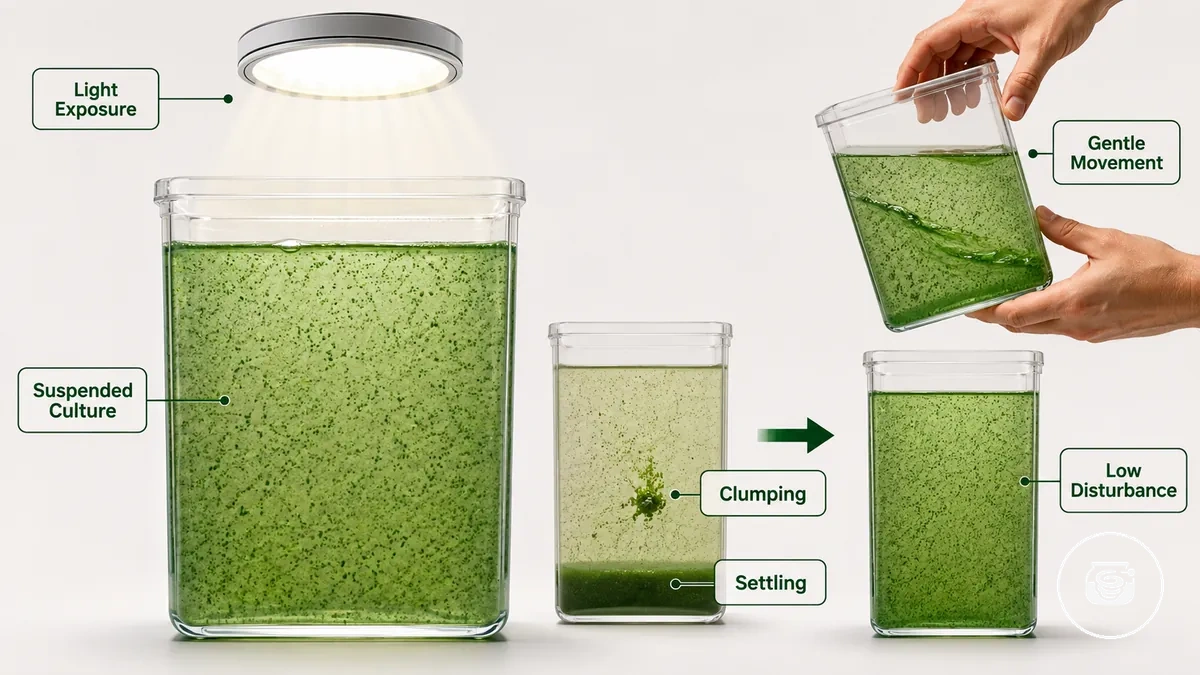
For example, if approximately one-third of the culture has settled at the bottom after standing, gently moving the container until the green culture becomes evenly suspended again restores a uniform appearance without vigorous shaking. This is an illustrative example rather than a measured threshold, and the goal is to achieve an even suspension instead of repeatedly moving the container after every small amount of settling.
This is an illustrative example rather than a measured threshold, and the goal is to achieve an even suspension instead of repeatedly moving the container after every small amount of settling.
Use this simple handling sequence during routine maintenance:
- Move the container gently to resuspend visible settling instead of shaking it forcefully.
- Stop once the spirulina appears evenly suspended and obvious clumps have dispersed.
- Return the container to its normal position so light exposure remains consistent.
- Repeat gentle circulation only when noticeable settling reappears because circulation should support culture stability rather than create unnecessary disturbance.
pH and Nutrient Balance
pH and nutrient balance describe whether a spirulina culture's medium remains within the maintenance conditions specified for that kit. The correct value is therefore the kit-specific pH range and nutrient schedule rather than one universal target or dosing formula, and maintenance should protect culture stability through measured checks and controlled adjustments.
pH and nutrient balance describe whether a spirulina culture's medium remains within the maintenance conditions specified for that kit.
Test or adjust the medium when a confirmed pH result, a recent water or nutrient change, or the culture response no longer matches the kit instructions. Confirm an unexpected result with fresh test strips or a calibrated pH meter, compare it with the specified growth conditions, and make one instruction-based adjustment before observing the next culture response; the reviewed evidence does not establish one nutrient dose or correction amount that applies to every spirulina kit.
| Entity/part | Attribute/criterion | Value/condition | Effect/risk/decision |
|---|---|---|---|
| Growing medium | pH test result | Inside the kit's specified maintenance range | Continue monitoring and avoid an unnecessary pH adjustment. |
| Growing medium | pH test result | Outside the kit's specified range on a confirmed repeat test | Review the kit instructions and make one controlled medium adjustment. |
| Nutrient mix or grow salts | Addition amount | The dose and timing stated by the kit manufacturer | Add only the specified amount; no universal maintenance dose is established for all kits. |
| Spirulina culture | Culture response | Stable colour and suspension after the adjustment | Return to routine observation rather than making another immediate change. |
| Spirulina culture | Culture response | Continuing visible decline after the specified condition is restored | Stop repeated corrections and move to separate troubleshooting or safety assessment. |
When to Test Spirulina pH
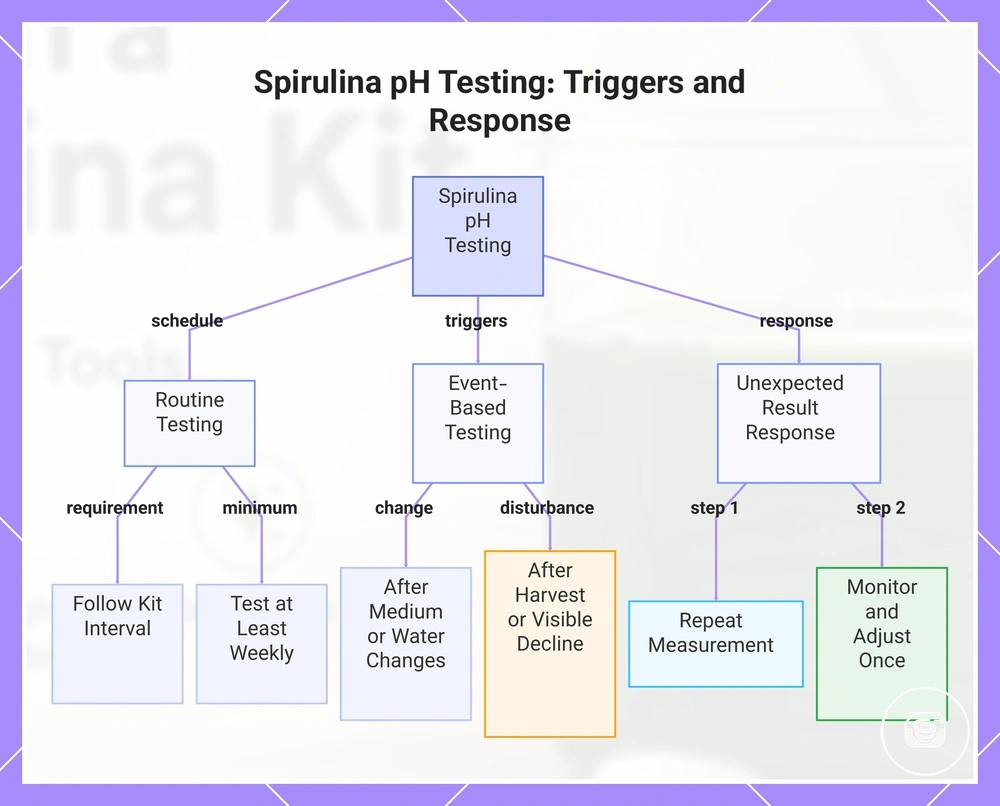
Test spirulina pH on the routine schedule stated in the kit instructions and after preparing new medium, adding water, harvesting, or observing visible decline. Phydrotec's home-cultivation guidance recommends checking pH at least once a week with pH test strips or a digital pH meter, but the kit instructions and recent culture changes should determine whether an earlier check is needed.
Use the same testing method each time so readings remain comparable.
Use the same testing method each time so readings remain comparable. When a result falls outside the kit's specified range, repeat the measurement before adjusting the medium; a confirmed unexpected result should trigger closer monitoring and one instruction-based response rather than repeated immediate corrections, because pH testing alone does not establish culture health or safety.
- Routine schedule: Follow the interval supplied with the kit; where no interval is provided, Phydrotec recommends testing at least once each week.
- New medium: Test after preparing or introducing new medium to compare its pH with the kit's specified condition.
- Water addition: Test after replacement water changes the medium volume or dilution.
- Harvest disturbance: Test after harvesting when culture volume, medium level, or replacement liquid has changed.
- Visible decline: Test when the culture becomes progressively paler, settles unusually, or develops a changed surface appearance, while treating pH as one maintenance signal rather than a diagnosis.
- Unexpected result: Repeat the test with fresh pH test strips or a calibrated pH meter; if the second reading remains outside the kit's specified range, record the result, observe the culture response, and follow the kit's adjustment instructions without making multiple immediate changes.
This chart shows the main testing triggers for spirulina pH and the recommended response when a result falls outside the specified range.
When to Add Nutrients or Grow Salts
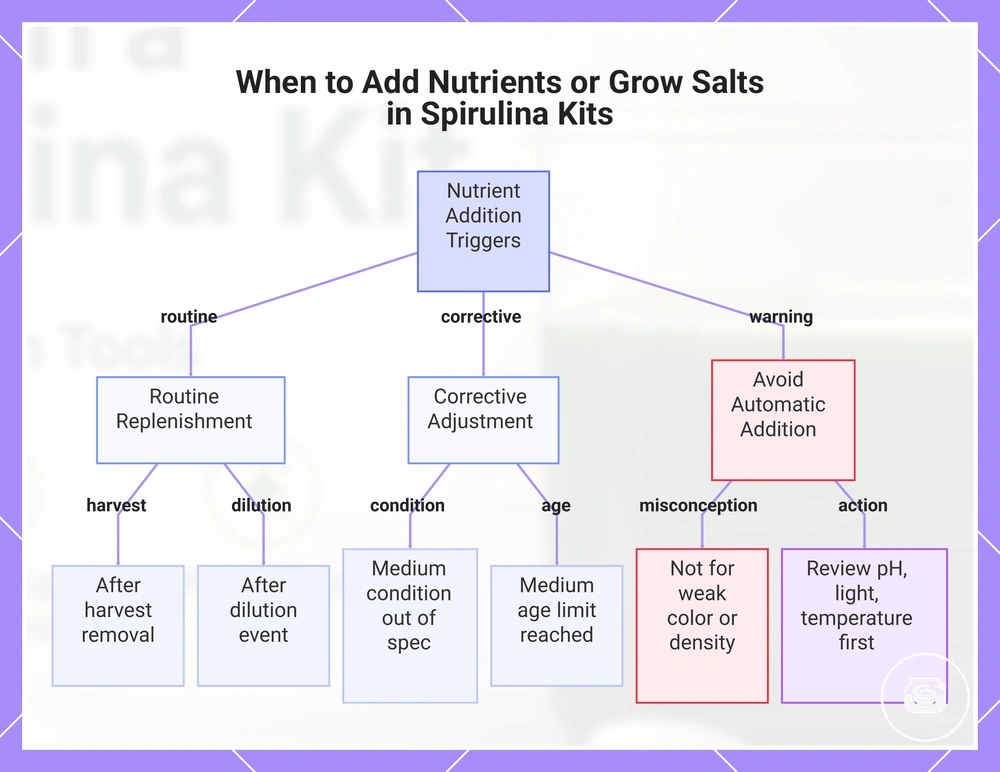
Add nutrients or grow salts only when the kit instructions, the medium condition, or the spirulina culture response provides a defined reason for replenishment. Routine replenishment applies after a kit-specified harvest or dilution event, while corrective adjustment applies only after a measured or observed condition has been confirmed against the kit guidance.
Add nutrients or grow salts only when the kit instructions, the medium condition, or the spirulina culture response provides a defined reason for replenishment.
Use the nutrient mix and quantity specified for the kit instead of treating weak colour, reduced density, or slow growth as automatic evidence of nutrient shortage. The reviewed evidence does not establish one universal nutrient dose, medium-age limit, or culture-density threshold for all spirulina kits, so repeated additions without a defined trigger increase overfeeding risk and make the culture response harder to interpret.
- Kit schedule: Add the specified nutrient mix when the supplier's maintenance instructions call for routine replenishment.
- Harvest removal: Replenish grow salts when the kit instructions require replacement medium after part of the culture and medium has been removed.
- Dilution: If added water dilutes the medium, restore nutrients only in the quantity specified for that replacement-water volume.
- Medium condition: If a measured condition falls outside the kit specification, confirm the result before making one instruction-based corrective adjustment.
- Medium age: Refresh or replace ageing medium only at the interval stated by the kit supplier because no universal replacement interval is established for all kits.
- Culture response: Do not use nutrients as a universal response to weak colour, reduced density, or slow growth; review recent dilution, pH, light, temperature, and maintenance changes before adding more.
This chart shows the defined triggers for adding nutrients or grow salts in spirulina kits and warns against automatic addition based on appearance alone.
Light, Temperature, and Day-Night Rhythm
Light, temperature, and day-night rhythm maintain a spirulina culture by keeping environmental conditions consistent after the kit is already running. Stable maintenance means providing a regular daily light-dark cycle, positioning the grow light to minimise unnecessary heat buildup, maintaining the culture within the kit manufacturer's recommended operating conditions, and keeping the kit in a stable indoor location rather than exposing it to frequent environmental changes.
Confirm that any adjustment remains consistent with the kit's recommended growth conditions .
For an indoor kit, grow light position and room temperature should be managed together because moving the light closer increases both illumination and radiant heat. According to the Food and Agriculture Organization (FAO), spirulina cultivation depends on maintaining stable environmental conditions rather than repeatedly changing individual variables, while research published by the U.S. National Library of Medicine reports that regular light-dark cycles regulate biological circadian rhythms across photosynthetic organisms. For example, if an LED grow light is moved closer and the culture container becomes noticeably warmer than the surrounding room, increasing the lamp distance or improving airflow while keeping the same daily lighting schedule is a better maintenance response than extending light exposure. Confirm that any adjustment remains consistent with the kit's recommended growth conditions.
| Condition | Likely effect | Maintenance check | Adjustment direction |
|---|---|---|---|
| Grow light positioned too close to the culture | Extra radiant heat can warm the culture above normal room conditions | Compare the container temperature with the surrounding room and inspect the culture for unexpected warming | Increase the distance between the grow light and the container or improve airflow while maintaining the same daily lighting routine |
| Cool indoor room | Culture activity may slow compared with previous observations under warmer conditions | Compare recent colour, suspension, and maintenance observations with earlier stable conditions | Return the kit to the manufacturer's recommended operating environment instead of extending the lighting period |
| Irregular day-night rhythm | Less consistent daily maintenance pattern | Review whether lighting starts and stops at similar times each day | Maintain a regular daily light-dark cycle instead of changing exposure times frequently |
| Stable indoor kit placement | More consistent light and temperature exposure | Check that the kit remains away from direct sunlight, heaters, air-conditioning outlets, and cold drafts | Keep the culture in one stable indoor location unless maintenance requires relocation |
Set Consistent Light Exposure
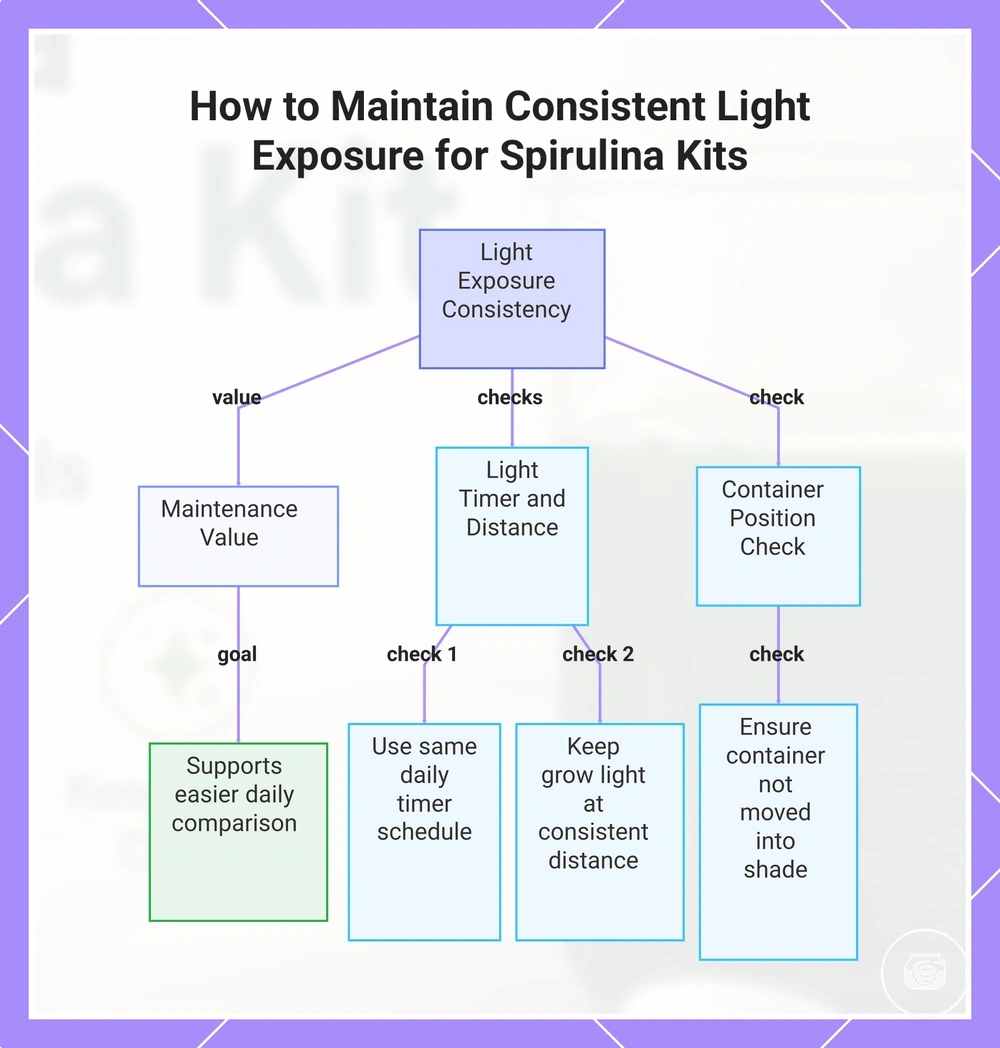
Consistent light exposure supports routine spirulina kit maintenance by keeping daily observations easier to compare rather than by acting as the only growth factor. The practical maintenance value is consistency: use the same daily light schedule, similar light intensity, a stable container position, and the grow light arrangement recommended for the specific kit because no recognised authority or manufacturer specifies one universal light duration, intensity, or lamp distance for all home spirulina growing kits.
Consistent light exposure supports routine spirulina kit maintenance by keeping daily observations easier to compare rather than by acting as the only growth factor.
According to the Food and Agriculture Organization (FAO), stable spirulina cultivation depends on maintaining consistent environmental conditions instead of repeatedly changing individual variables. For example, if a grow light is moved approximately 10 cm closer to the culture and the container becomes noticeably warmer than during previous daily observations, return the light to its earlier position or improve airflow while keeping the same timer schedule. The 10 cm distance is an illustrative example rather than a recommended specification, and the practical goal is to isolate one environmental change so visible culture response is easier to interpret.
According to the Food and Agriculture Organization (FAO), stable spirulina cultivation depends on maintaining consistent environmental conditions instead of repeatedly changing individual variables.
Use these routine maintenance checks to keep light exposure consistent:
- Use the same daily timer schedule instead of switching the grow light on and off at irregular times.
- Keep the grow light at a consistent distance unless overheating or the kit instructions require repositioning.
- Check that the container has not gradually moved into shade, direct sunlight, or another location with different light intensity.
- If the culture appears warmer after changing the light position, restore the previous placement or improve airflow before adjusting other maintenance variables.
- Compare visible culture response across multiple observations before changing light duration because pH, nutrients, temperature, and other maintenance conditions can also influence colour and suspension.
This chart shows why consistent light exposure matters for spirulina kit maintenance and the routine checks to keep daily observations comparable.
Avoid Heat Stress and Low-Temperature Slowdown
Temperature extremes can reduce spirulina culture stability even when pH, nutrients, light, and cleaning are maintained correctly. Routine maintenance should keep the culture within the operating conditions specified by the kit manufacturer, avoid direct heat or cold exposure, and make environmental changes gradually rather than abruptly because the reviewed evidence does not establish one universal operating temperature for all home spirulina kits. Temperature-related symptoms should therefore be interpreted cautiously and not treated as evidence of contamination by themselves.
| Signal | Possible temperature issue | Check | Maintenance response |
|---|---|---|---|
| Culture becomes noticeably warmer after the grow light is repositioned | Heat stress caused by concentrated light heat | Compare the container temperature with the surrounding room and review the recent light position | Move the light farther away or improve airflow, then observe the culture before changing any other maintenance variable |
| Culture activity appears slower after moving the kit beside a cold window or air-conditioning outlet | Low-temperature slowdown caused by cooler room placement | Check whether the new location is cooler than the previous stable position | Return the container gradually to the kit's recommended operating environment rather than applying sudden warming |
| Culture experiences repeated warming during the day and cooling overnight | Temperature fluctuations from unstable container exposure | Review room placement, grow-light heat, and overnight conditions together | Keep the culture in a stable indoor location with a consistent lighting routine and avoid frequent relocation |
| Visible decline continues after environmental conditions are restored | Persistent decline that may involve factors beyond temperature | Review recent pH, nutrient additions, cleaning practices, and other maintenance observations | Stop repeated temperature adjustments and continue with broader troubleshooting instead of assuming contamination |
Cleaning the Culture Container and Tools
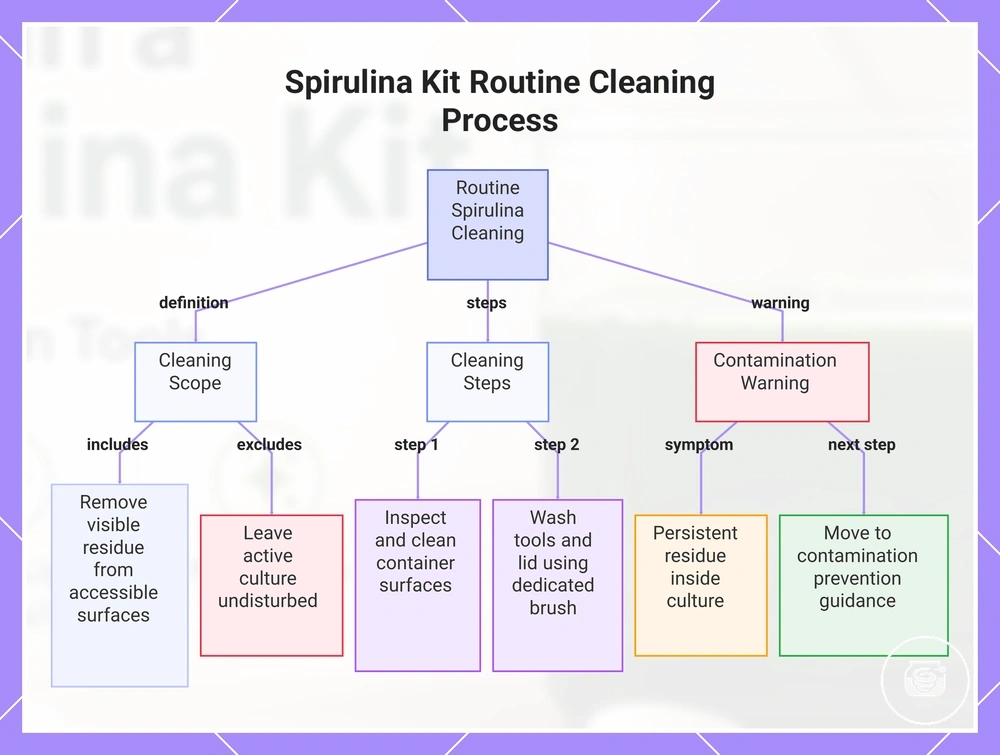
Cleaning the culture container and tools means removing visible residue from accessible surfaces, the lid or cover, brushes, measuring tools, and splash areas while leaving the active spirulina culture undisturbed. Routine cleaning supports culture maintenance rather than resetting the culture, so cleaning should focus on removable equipment and external or exposed surfaces instead of the live growing medium.
According to the University of Minnesota Extension, effective cleaning removes visible debris before washing hard surfaces with detergent and water.
According to the University of Minnesota Extension, effective cleaning removes visible debris before washing hard surfaces with detergent and water. For a home spirulina kit, that principle applies to removable tools and accessible container surfaces only; detergent, disinfectant, or dirty rinse water should not contact the active culture unless the kit manufacturer specifically permits it. If residue persists inside the culture, unexpected growth appears, or an unusual odour develops after routine cleaning, the issue should be treated as a potential contamination concern rather than an ordinary maintenance task.
- Inspect the culture container: Check the rim, outer wall, base, and splash areas for dried residue while leaving the live culture undisturbed.
- Clean the lid or cover: Wash removable covers according to the kit instructions, rinse thoroughly, and allow them to dry before replacing them.
- Clean measuring tools: Wash stirring tools, measuring spoons, test holders, and similar reusable equipment after use so dried medium is not reintroduced into the culture.
- Use a dedicated brush: Reserve one clean brush for the spirulina kit and use it only on surfaces that the manufacturer identifies as suitable for routine cleaning.
- Maintain hygiene boundaries: Keep cleaning chemicals, used cloths, dirty rinse water, and non-dedicated tools away from the live culture during maintenance.
- Confirm a clean result: Return cleaned items only after visible residue has been removed and the equipment has been prepared according to the kit instructions.
If routine cleaning no longer removes recurring residue, foreign material appears, or culture decline continues despite normal maintenance, move from routine hygiene to dedicated contamination prevention guidance instead of repeatedly cleaning the active culture.
This chart shows the routine cleaning process for a spirulina kit, including what to clean, the main steps, and when to escalate to contamination prevention.
This chart shows the routine cleaning process for a spirulina kit, including what to clean, the main steps, and when to escalate to contamination prevention.
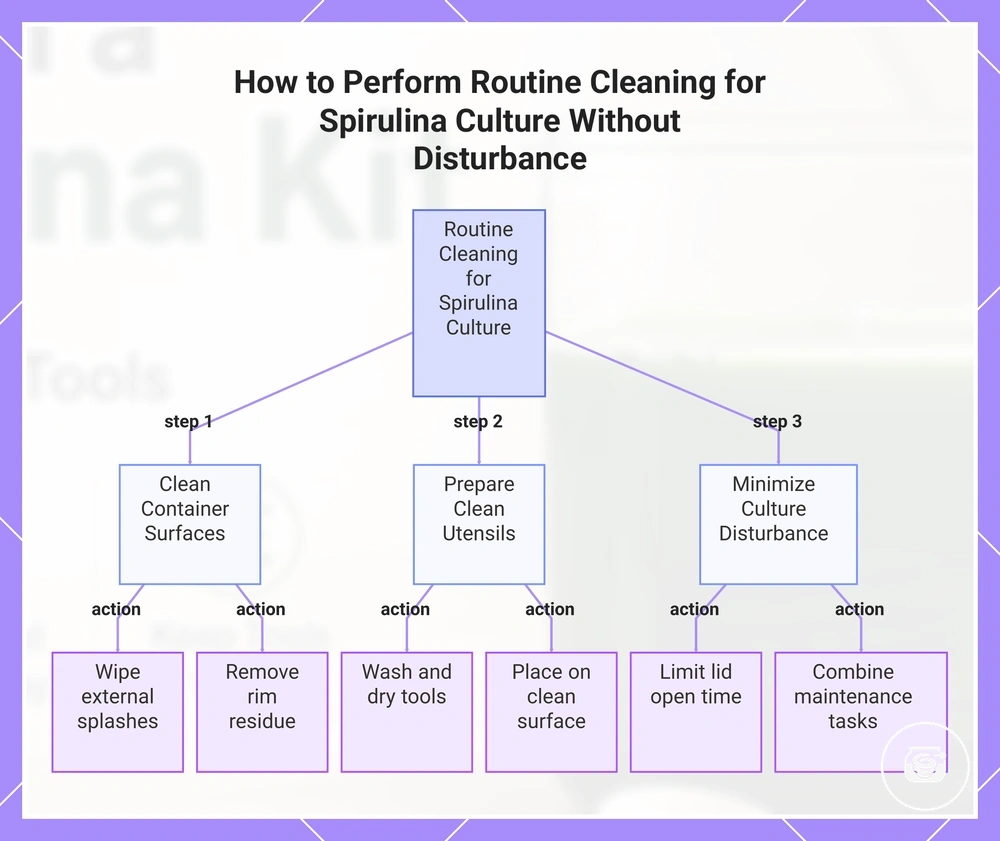
Routine Cleaning Without Disturbing the Culture
Clean around a spirulina culture by removing visible residue from external surfaces, the container rim, and reusable utensils while limiting tool contact with the live medium. Routine cleaning should occur when residue appears or during an existing maintenance session, and it should not involve emptying, resetting, or aggressively scrubbing the culture unless the kit instructions or a separate problem condition requires that action.
- Clean external surfaces: Wipe dried splashes from the outside of the culture container with a clean cloth without allowing cleaning liquid to enter the medium.
- Remove rim residue: Gently wipe visible residue from the rim before it loosens and falls into the culture.
- Prepare clean utensils: Wash and dry measuring tools, stirring utensils, and test equipment before each culture-contact use, then place them on a clean surface.
- Limit culture exposure: Keep the lid or cover open only for the time required to complete the maintenance task, and avoid unnecessary tool contact with the medium.
- Combine maintenance tasks: When practical, clean the rim immediately after scheduled stirring or pH testing so the container is opened once rather than repeatedly.
This chart shows the key steps for routine cleaning of a spirulina culture while minimizing disturbance to the live medium.
Fresh Medium Changes and Container Hygiene
Fresh medium changes and container hygiene become part of spirulina maintenance when the existing culture needs replenishment or routine cleaning without restarting the culture. Medium changes should follow the kit manufacturer's instructions after water additions, harvesting, or a confirmed nutrient imbalance, while container hygiene should remove visible residue from accessible surfaces and reusable tools; no authoritative source establishes one universal replacement schedule for all home spirulina kits because maintenance depends on the specific kit and culture condition.
Fresh medium changes and container hygiene become part of spirulina maintenance when the existing culture needs replenishment or routine cleaning without restarting the culture.
Routine replenishment replaces only the medium or nutrients identified by the kit instructions, whereas corrective cleaning is appropriate only when persistent residue, reduced container clarity, or continuing culture stress remains after normal maintenance. For example, if evaporation is replaced with fresh water and the kit instructions require nutrient replenishment, restore only the specified medium components instead of replacing the entire culture; if residue continues to return after routine cleaning, reassess container hygiene before considering corrective cleaning.
- If fresh water has been added: Check whether the kit instructions require nutrient or grow-salt replenishment to restore the intended medium composition.
- If nutrient balance has changed: Confirm the condition with the recommended test method before making one instruction-based medium adjustment instead of repeated additions.
- If visible residue is present: Clean accessible container surfaces and removable tools while keeping disturbance to the live culture as limited as practical.
- If container clarity has decreased: Determine whether the change results from external residue, normal culture density, or deposits on the container before deciding that corrective cleaning is necessary.
- If culture stress continues after routine maintenance: Treat the condition as a troubleshooting issue rather than repeatedly replacing the medium or performing corrective cleaning without evidence that routine maintenance has failed.
Maintenance Schedule for a Spirulina Growing Kit
A maintenance schedule for spirulina growing kits organises routine culture care by task frequency so daily observations, periodic testing, and maintenance activities are completed consistently without replacing the manufacturer's instructions. No recognised authority specifies one universal maintenance timetable for every home spirulina kit because inspection frequency depends on the kit design, culture condition, recent harvesting, and the supplier's maintenance guidance.
Use the schedule below as a practical planning framework rather than a mandatory calendar.
Use the schedule below as a practical planning framework rather than a mandatory calendar. If the culture is maintained in a small container, uses indoor grow lighting, has been harvested recently, or shows visible changes such as unusual settling, colour changes, residue, or unexpected pH results, perform the relevant maintenance task sooner than the routine interval recommended by the kit manufacturer.
| Frequency | Task | What to check | When to adjust |
|---|---|---|---|
| Daily or as specified by the kit manufacturer | Daily checks | Culture colour, suspension, surface appearance, water level, container position, and obvious residue | Adjust only when visible culture changes or the kit instructions indicate maintenance is required. |
| Weekly or at the interval specified by the kit | pH testing and nutrient review | Measured pH, recent nutrient additions, medium condition, and overall culture response | Confirm the measurement before making one instruction-based pH or nutrient adjustment. |
| During routine maintenance | Cleaning | Container rim, lid, external surfaces, measuring tools, and stirring utensils for visible residue | Clean removable items and accessible surfaces when residue is present while avoiding unnecessary disturbance to the live culture. |
| During routine observation | Light review | Lighting schedule, grow-light position, shading, and signs of excess heat around the container | Reposition the light or improve airflow only if environmental conditions no longer match the kit's recommended operating conditions. |
| Immediately after harvesting | Harvest-related maintenance | Culture volume, replacement medium, water level, and nutrient replenishment requirements | Restore the removed medium only as directed by the kit instructions instead of restarting the culture. |
| After water additions or confirmed medium changes | Medium changes | Dilution, nutrient balance, pH result, and overall medium condition | Make one confirmed, instruction-based medium adjustment rather than repeating corrections without evidence. |
Daily and Weekly Maintenance Tasks
Separate spirulina kit maintenance into daily observation tasks and weekly review tasks so important checks are not missed and the culture is not handled more often than necessary. Daily tasks should remain visual and low-disturbance, while weekly tasks should cover measurements, nutrient review, tool cleaning, and container hygiene according to the kit instructions rather than a universal mandatory schedule.
- Daily — visual inspection: Check the culture colour, visible density, surface condition, settling, and container position without opening or disturbing the culture unless an observable change requires attention.
- Daily — circulation: Confirm that the culture remains reasonably suspended and use only the kit's normal gentle circulation method when visible settling develops.
- Daily — light routine: Check that the grow light follows the usual schedule and that the container has not moved into shade, direct sunlight, or a position with increased lamp heat.
- Weekly — pH testing: Measure pH at the interval specified by the kit, record the result, and repeat an unexpected reading before making an instruction-based adjustment.
- Weekly — nutrient review: Review recent water additions, harvesting, nutrient additions, and visible culture response before deciding whether replenishment is required.
- Weekly — tool cleaning: Clean and dry measuring tools, stirring utensils, and other reusable culture-contact equipment before their next use.
- Weekly — container hygiene: Inspect the rim, lid, external surfaces, and splash areas for residue, then clean only the accessible areas that can be maintained without disturbing the live medium.
- Frequency adjustment: Repeat the relevant daily or weekly check sooner when a recent harvest, water addition, light-position change, unexpected pH result, or continuing visible culture change creates a specific reason for review.
Maintenance After Harvesting or Medium Changes
Maintenance after harvesting or medium changes should concentrate on restoring culture balance because both actions change the culture's growing conditions. Post-action maintenance differs from routine maintenance by confirming culture density, medium level, nutrient balance, pH, light exposure, and tool cleanliness before making any further adjustment, and changes should be monitored gradually rather than corrected repeatedly in the same maintenance session.
Use the same observation method before and after harvesting or replacing medium so changes can be compared consistently.
Use the same observation method before and after harvesting or replacing medium so changes can be compared consistently. If the culture has recently been harvested or fresh medium has been added, reassess the culture after one normal observation period recommended by the kit manufacturer before deciding whether another nutrient or pH adjustment is necessary.
- Check culture density: Confirm that the spirulina culture remains evenly suspended and that any settling matches the culture's normal appearance before taking corrective action.
- Verify the medium level and nutrient balance: Replace only the harvested volume and replenish nutrients according to the kit instructions when harvesting or medium replacement has altered the original culture volume.
- Retest pH after any adjustment: Confirm the previous pH correction with a new measurement before making another nutrient or pH change.
- Review light exposure: Ensure the container has returned to its normal lighting position and that harvesting or maintenance has not unintentionally changed the light conditions.
- Clean reusable tools: Wash and dry harvesting tools, measuring equipment, and stirring utensils before reuse so residue from the previous maintenance session is not returned to the culture.
Early Signs the Culture Is Declining
Early signs of spirulina culture decline should be treated as maintenance indicators rather than proof of one confirmed cause because colour fading, weak density, clumping, unusual odour, residue, low movement, or a pH change can reflect light stress, nutrient imbalance, recent maintenance, or a contamination concern. Interpret each sign by comparing it with the culture's previous condition and recent maintenance history instead of diagnosing the problem from one observation.
Interpret each sign by comparing it with the culture's previous condition and recent maintenance history instead of diagnosing the problem from one observation.
Move beyond routine maintenance when multiple decline signs appear together, one sign persists after a careful review, or the culture continues to worsen after an obvious maintenance condition has been corrected according to the kit instructions. Pause harvesting when persistent odour, unexpected residue, or continuing decline creates a contamination concern, then follow dedicated contamination prevention guidance; when ordinary checks do not identify the cause, use a structured process to fix culture problems rather than repeating nutrient or pH corrections in the same session.
| Sign | Possible maintenance issue | What to check | Next response |
|---|---|---|---|
| Colour fading | Light stress, nutrient imbalance, dilution, or a recent medium change | Compare the current colour with earlier observations and review light position, water additions, and nutrient additions | Observe if the change is recent and isolated; adjust one confirmed maintenance condition if the fading continues |
| Weak culture density | Recent harvesting, added water, settling, or reduced culture activity | Check the medium level, recent harvest volume, and whether the culture becomes evenly suspended after normal circulation | Restore only the medium components specified by the kit and monitor before making another change |
| Clumping or low movement | Insufficient circulation, changing medium conditions, or environmental stress | Check the normal circulation method, light exposure, room conditions, and whether clumps disperse gently | Correct the identified condition and reassess without vigorous mixing or repeated adjustments |
| Unexpected pH change | Water addition, nutrient imbalance, harvesting, or medium alteration | Repeat the pH test with the recommended method and review recent additions | Make one instruction-based adjustment only when the repeated result confirms the change |
| Unusual odour or persistent residue | Tool or container hygiene issue, deteriorating medium, or contamination concern | Inspect reusable tools, the lid, rim, accessible container surfaces, and recent maintenance practices | Stop harvesting while the condition persists and move to contamination assessment rather than routine adjustment |
| Several signs continuing together | A broader culture problem not resolved by routine maintenance | Review pH, nutrients, light, temperature, medium changes, hygiene, and recent harvesting as one maintenance history | Stop repeated corrections and follow the deeper troubleshooting path |
When Maintenance Becomes Troubleshooting
Routine spirulina maintenance becomes troubleshooting when a problem persists, worsens, returns after one basic adjustment, or creates a contamination concern. The boundary is reached when persistent pH instability, visible decline, unusual smell, repeated nutrient imbalance, or poor response can no longer be explained by one temporary maintenance change.
Use recent observations, test results, water additions, nutrient additions, harvesting, and light changes as the comparison record.
Use recent observations, test results, water additions, nutrient additions, harvesting, and light changes as the comparison record. One isolated change may justify observation, but repeated or worsening signs require a structured investigation instead of another unverified correction.
- Persistent pH instability: Move to troubleshooting when repeated measurements remain outside the kit-specified range after one instruction-based adjustment; verify the testing method and recent medium changes before correcting pH again.
- Visible culture decline: Investigate further when colour fading, weak density, clumping, or reduced movement continues after light, circulation, and medium conditions have been reviewed.
- Unusual smell: Stop treating the condition as routine maintenance when an unexpected odour persists, and pause harvesting while its cause remains unclear.
- Suspected contamination: Separate the issue from routine care when foreign material, persistent residue, unusual surface growth, or odour creates a contamination concern.
- Repeated nutrient imbalance: Begin troubleshooting when measured, kit-directed replenishment does not produce a stable response; review dilution, pH, harvest history, and dosing records instead of adding more nutrients automatically.
- Poor response after basic adjustments: Use a structured process to fix culture problems when one-variable adjustments do not produce a stable response or the same symptom returns.
Severe decline, an unclear cause, or any contamination-related concern falls outside routine maintenance and should not be managed through repeated recovery attempts or continued harvesting.