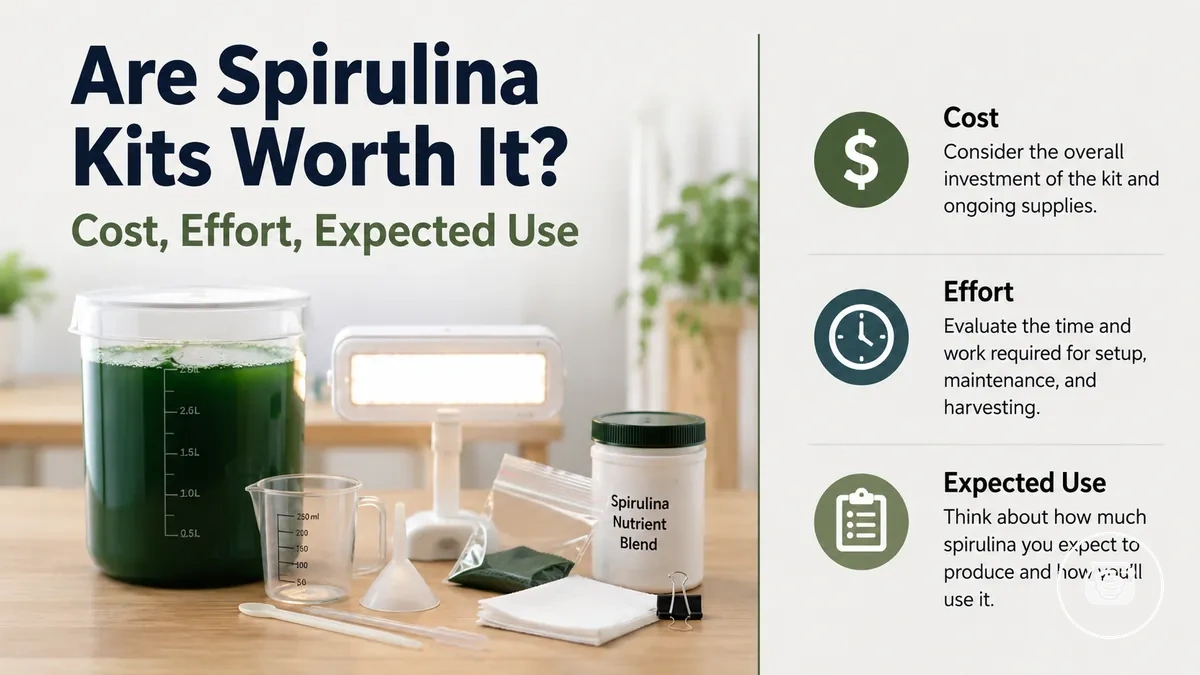
Are Spirulina Growing Kits Worth It?
A spirulina growing kit is worth it if you value harvesting fresh spirulina, are willing to invest time in routine maintenance, and expect to use the kit repeatedly; buying dried spirulina is usually the more practical option if convenience and predictable costs are your priorities. The overall value depends on the upfront kit cost, ongoing supplies, successful culture growth, and realistic home-use expectations rather than on the kit alone. Because no recognised industry standard defines a typical cost, yield, or payback period for home spirulina kits, those values should be evaluated from the specific kit documentation and current local supply prices.
Cost, effort, freshness, and reliability are the primary decision criteria.
Cost, effort, freshness, and reliability are the primary decision criteria. A spirulina growing kit normally requires ongoing supplies such as growth nutrients, replacement culture if contamination occurs, electricity for lighting or aeration where applicable, and regular monitoring to maintain culture stability. Fresh spirulina offers immediate use after harvesting, whereas dried spirulina provides longer storage life and requires no cultivation or routine maintenance.
The answer also depends on user routine, kit completeness, and expectations.
The answer also depends on user routine, kit completeness, and expectations. A starter kit that includes a live culture, growing medium, container, harvesting filter, and essential growing supplies generally reduces additional setup purchases compared with an incomplete kit. For example, in a clearly illustrative scenario, a user who spends approximately 10 to 15 minutes each day monitoring a healthy culture and avoids replacing contaminated supplies is likely to realise more value from the original purchase than someone who must restart the culture after an early failure; this example is hypothetical and illustrates the decision process rather than a measured performance result.
A starter kit that includes a live culture, growing medium, container, harvesting filter, and essential growing supplies generally reduces additional setup purchases compared with an incomplete kit.
For most buyers, the best approach is to compare the total ownership cost—including the initial purchase, ongoing supplies, maintenance time, and the importance of having fresh spirulina—with the simplicity of purchasing dried spirulina. If freshness, learning, and home cultivation are priorities, a spirulina growing kit can provide good value; if convenience, predictable spending, and minimal upkeep matter most, buying dried spirulina is usually the more practical choice.
Table of Contents
What Spirulina Growing Kit Value Depends On
A spirulina growing kit derives its value from both its financial cost and the user's willingness to manage a living culture. Practical value increases when the kit includes the essential supplies for cultivation, matches the user's maintenance routine, and consistently produces fresh spirulina under suitable growing conditions. No recognised industry standard specifies a universal cost, expected output, or return on investment for home spirulina kits, so those values must be assessed from the individual kit specifications and current local supply costs.
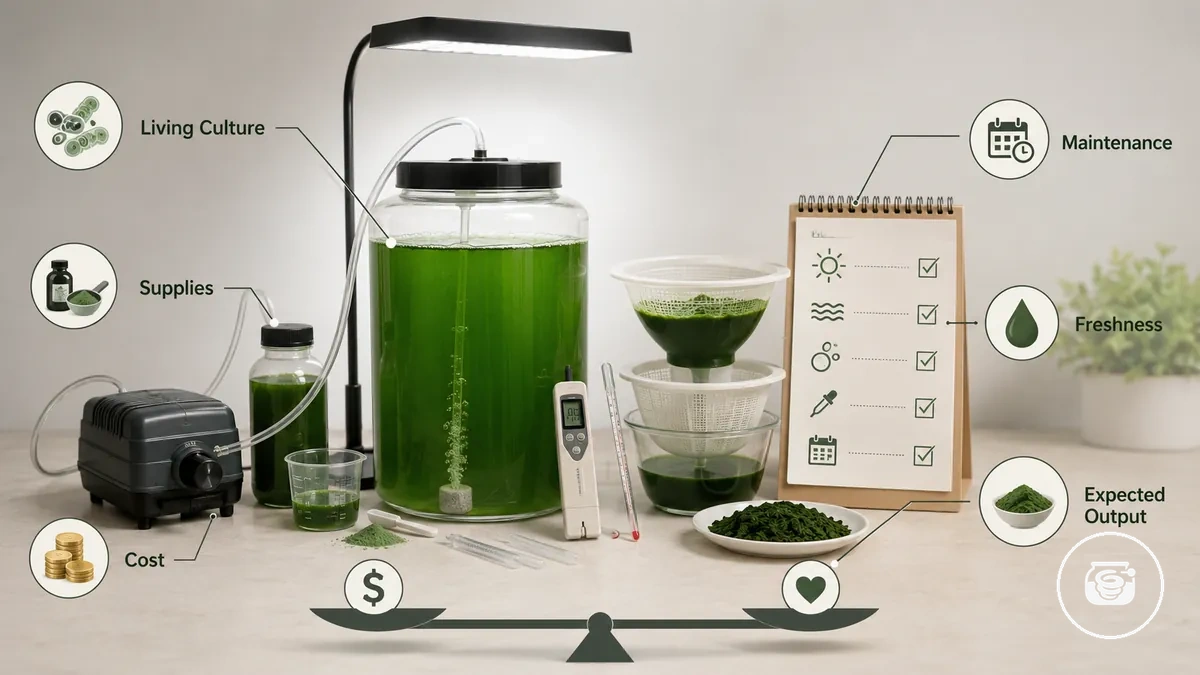
Spirulina growing kits are home cultivation packages designed to maintain a living spirulina culture by providing some or all of the required equipment and consumable supplies. According to the 2022 review Tendencies Affecting the Growth and Cultivation of Genus Spirulina published in Plants, culture productivity depends on environmental conditions such as light intensity, temperature, nutrient availability, pH, salinity, and contamination control rather than on the kit alone. For example, a complete starter kit that already includes a live culture, nutrient medium, harvest filter, and aeration equipment avoids additional purchases, whereas an incomplete kit requires extra spending before cultivation can begin, directly affecting overall value.
Spirulina growing kits are home cultivation packages designed to maintain a living spirulina culture by providing some or all of the required equipment and consumable supplies.
The value of a spirulina growing kit depends on several linked conditions:
- Cost: Evaluate the initial purchase together with nutrient refills, replacement cultures if contamination occurs, electricity where applicable, and any missing equipment.
- Completeness: A kit containing the essential cultivation supplies provides greater setup readiness than a culture-only package.
- Maintenance: Living cultures require regular monitoring, cleaning, and environmental control to remain productive.
- Freshness: Home cultivation provides access to freshly harvested spirulina, while dried spirulina prioritises storage convenience instead of cultivation.
- Expected output: Harvest quantity depends on the cultivation method, environmental conditions, and user consistency because no verified universal yield exists for all home spirulina kits.
- Decision fit: A home growing kit offers better practical value for users who accept routine culture management than for users seeking a maintenance-free supplement.
This section evaluates the value of spirulina growing kits for home use only. It does not assess commercial spirulina farming profitability or make claims about the health effects of spirulina supplements.
Upfront and Ongoing Costs of a Spirulina Growing Kit
The total cost of a spirulina growing kit includes both the upfront cost of the initial purchase and the ongoing cost of maintaining a healthy culture. The overall value cannot be judged from the kit price alone because recurring expenses such as culture medium, nutrients, replacement supplies, and optional equipment continue throughout cultivation. Current evidence does not establish a universal cost range for home spirulina growing kits because included components, culture size, and accessory bundles differ between manufacturers and suppliers.
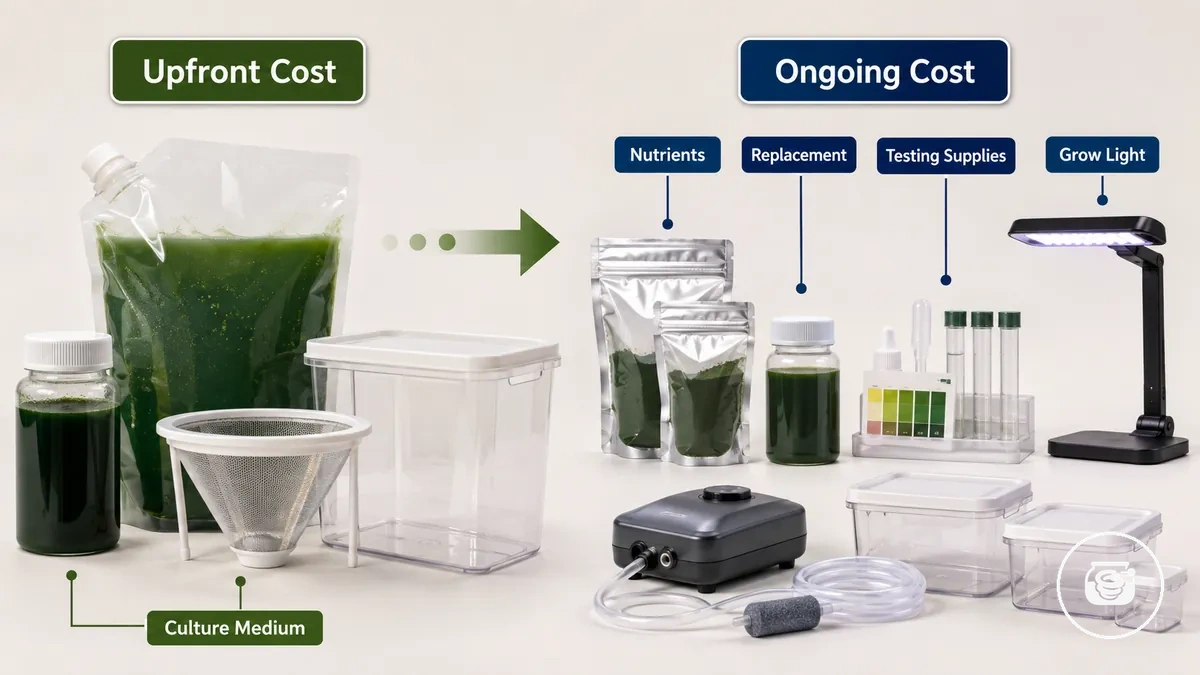
Upfront cost and ongoing cost should be evaluated separately before deciding whether a spirulina growing kit offers good long-term value. The table below organises the major cost categories, the conditions that create each expense, and the resulting value effect for a typical home cultivation setup.
| Cost area | Typical items | When it applies | Value effect |
|---|---|---|---|
| Initial kit purchase | Starter culture, culture medium, harvest filter, basic container | Required for every first-time setup | A complete kit reduces additional purchases and improves setup readiness. |
| Missing setup supplies | Grow light, air pump, larger container, testing supplies | Applies when these items are not included | Raises the upfront cost but provides the equipment needed for stable cultivation. |
| Recurring culture inputs | Culture medium refills, nutrients, replacement water, upkeep supplies | Needed throughout routine maintenance | Determines the ongoing cost required to keep the spirulina culture productive. |
| Optional equipment | Additional grow light, measuring tools, spare containers | Purchased to improve convenience or increase growing capacity | Adds optional cost rather than a mandatory cultivation expense. |
| Replacement or restart costs | Replacement culture, fresh culture medium, replacement nutrients | Required after contamination, failed culture, or prolonged neglect | Creates extra cost and reduces the overall value effect of the original kit. |
For example, an illustrative home setup that already includes a harvest filter, grow light, and testing supplies avoids those additional upfront purchases, whereas a culture-only starter package requires those components to be obtained separately before cultivation can begin. Because manufacturers package different components and replacement supplies vary by region, buyers should compare the complete list of included items and expected refill requirements rather than relying on the initial kit price alone.
Kit Price and Missing Setup Supplies
A lower kit price can result in a higher real setup cost when essential missing supplies must be purchased separately before cultivation begins. The real setup cost depends on whether the package is a complete starter kit, a culture-only kit, or a media kit, and the reviewed evidence does not identify a universal standard for the components included in each category across manufacturers.
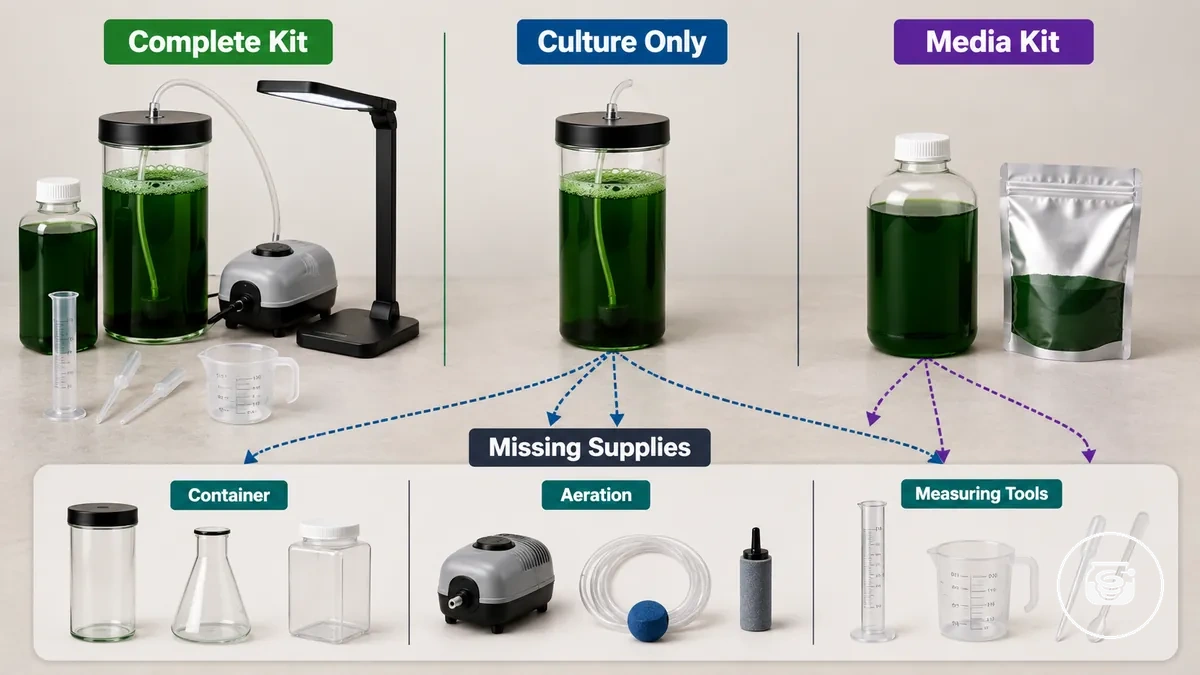
Missing supplies change real setup cost by determining which additional components must be purchased before the spirulina growing kit becomes operational.
- Complete starter kit: Includes the principal starter supplies, typically a live culture, culture medium, container, and core growing accessories, reducing additional setup purchases and improving setup readiness.
- Culture-only kit: Provides only the live spirulina culture, so a container, aeration equipment, light, and measuring tools must usually be obtained separately, increasing the effective setup cost.
- Media kit: Supplies the culture medium but not the complete cultivation system, requiring a live culture and other growing equipment before cultivation can begin, which increases the initial investment.
- Container, aeration, light, and measuring tools: When any of these items are absent, each becomes an additional setup purchase that improves culture management but raises the total amount spent before the first harvest.
For example, an illustrative complete starter kit that already includes four setup components—a container, aeration equipment, light, and measuring tools—eliminates four separate purchases, whereas a culture-only kit requires all four items to be acquired before cultivation can start. This comparison is hypothetical and explains setup cost only; it does not include recurring maintenance expenses.
Refills, Nutrients, Filters, Light, and Culture Upkeep
After a spirulina growing kit is running, recurring refills and maintenance supplies become part of its long-term ownership cost because they must be replaced or used repeatedly throughout culture upkeep. The reviewed evidence does not identify a universal annual or monthly upkeep cost because refill frequency depends on culture stability, growing conditions, kit configuration, and whether the culture must be restarted.
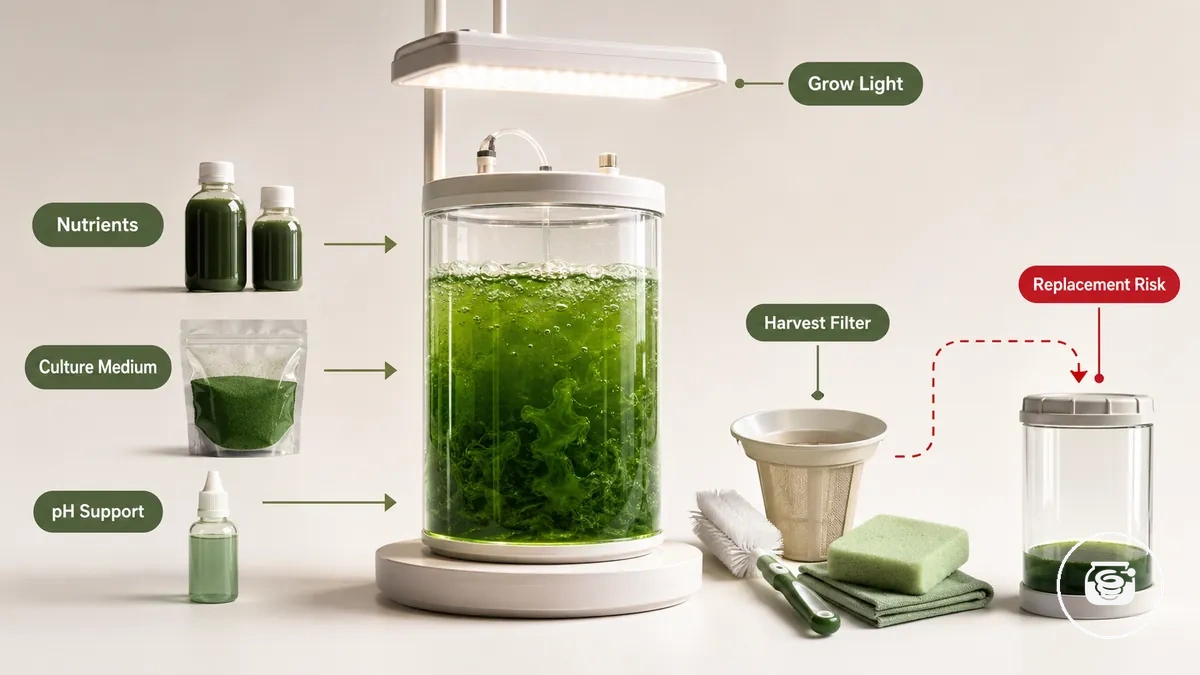
The checklist below shows how recurring supplies influence ongoing cost and culture reliability after the initial setup.
- Nutrients and culture medium: Refill nutrients and culture medium whenever normal cultivation depletes them because regular replenishment supports culture stability while adding recurring upkeep cost.
- pH support: Use pH support only when monitoring indicates correction is needed, helping maintain culture health and reducing unnecessary replacement risk.
- Harvest filter and cleaning supplies: Clean harvest filters after harvesting and replace them only when cleaning no longer restores effective use, extending usable life while limiting replacement expense.
- Grow light: Indoor culture upkeep requires continued grow light operation, making electricity an ongoing operating expense even when no hardware is replaced.
- Replacement risk: If contamination or culture failure occurs, replacement culture together with fresh culture medium and refill supplies increases total upkeep cost beyond routine maintenance.
For example, an illustrative stable culture requires routine nutrient refills, cleaning supplies, and grow-light electricity only, whereas a restarted culture also requires one replacement culture and fresh culture medium before cultivation resumes. This comparison is hypothetical because the reviewed evidence does not specify a universal replacement frequency or standard upkeep cost across home spirulina growing kits.
Practical Benefits That Improve Kit Value
A spirulina growing kit can deliver practical benefits even when measurable cost savings are uncertain, provided home cultivation is successful and aligns with the user's priorities. The retained evidence does not establish a universal financial saving compared with packaged spirulina because kit value depends on successful culture maintenance, regular use, and the importance the user places on non-monetary benefits rather than on purchase price alone.
These benefits remain conditional because they rely on successful home cultivation and consistent use.
Freshness, control over the growing process, learning, and satisfaction are the principal practical benefits that can improve kit value. Freshly harvested spirulina is available immediately after harvesting, home cultivation allows direct control over culture inputs and maintenance decisions, and maintaining a living culture provides educational and hobby value that packaged spirulina cannot provide. For example, in a clearly hypothetical scenario, a user who harvests fresh spirulina 3 times during one month and consumes each harvest shortly afterwards may assign greater personal value to freshness and learning even if the total spending is similar to buying packaged spirulina during the same period. These benefits remain conditional because they rely on successful home cultivation and consistent use.
| Measurable value | Non-monetary value |
|---|---|
| Any financial benefit depends on successful home cultivation, regular harvesting, and avoiding unnecessary culture replacement; the reviewed evidence specifies no universal monetary saving. | Freshness can improve kit value when freshly harvested spirulina is preferred over packaged spirulina. |
| Reduced purchases of packaged spirulina may lower future spending, but the evidence provides no verified cost-saving amount that applies to all users. | Control over culture inputs and the growing process can improve confidence in home cultivation. |
| Financial value should be assessed from actual ownership costs and cultivation success rather than from the kit price alone. | Learning, maintaining a living culture, and personal satisfaction can justify kit value even when measurable cost savings remain uncertain. |
Measurable value reflects observable financial outcomes, whereas non-monetary value reflects personal priorities such as freshness, control, learning, and satisfaction. A spirulina growing kit therefore becomes worthwhile when its practical benefits match the user's expectations, even if the retained evidence does not demonstrate a universal economic advantage over packaged spirulina.
Fresh Spirulina Value Compared with Dried Spirulina
Fresh spirulina adds value primarily through freshness and immediate use after harvesting, whereas dried spirulina generally provides greater convenience and longer practical storage as powder or tablets. Within the decision to buy a spirulina growing kit, fresh spirulina is the better value when freshness justifies the additional cultivation effort, while dried spirulina is the better value when storage convenience and minimal preparation are the priority. The reviewed evidence does not specify one universal storage life for fresh home-grown spirulina because preservation method, packaging, and storage temperature determine usable shelf life.
The comparison below organises the decision around usability, storage, freshness, and effort.
The comparison below organises the decision around usability, storage, freshness, and effort.
| Option | Strength | Limitation | Better fit |
|---|---|---|---|
| Fresh spirulina | Provides maximum freshness immediately after harvesting and allows direct use from a home culture. The 2024 review Manufacturing Processes, Additional Nutritional Value and Versatile Food Applications of Fresh Microalgae Spirulina reports that fresh spirulina offers a refreshing taste and odour after harvesting and suitable processing. | Requires ongoing cultivation, harvesting, preparation effort, and prompt consumption because no single verified storage duration applies across all home storage methods. | People who value freshness, enjoy maintaining a growing kit, and plan to consume fresh harvests regularly. |
| Dried spirulina | Available as powder or tablets, making storage, transport, and routine use more convenient than maintaining a living culture. The same 2024 review explains that drying enables easier storage and wider food applications. | Does not provide the experience of harvesting fresh spirulina and may present different taste and texture characteristics from a fresh harvest. | People who prioritise convenience, longer practical storage, and a simple buying decision without cultivation effort. |
For example, a hypothetical user who harvests fresh spirulina 3 times each week gains recurring freshness but also performs 3 harvesting and cleaning routines, whereas a user relying on dried spirulina powder or tablets performs no cultivation tasks before use. Supplement quality and personal health suitability remain outside this cost-value comparison and should be assessed separately.
Learning, Control, and Home Growing Satisfaction
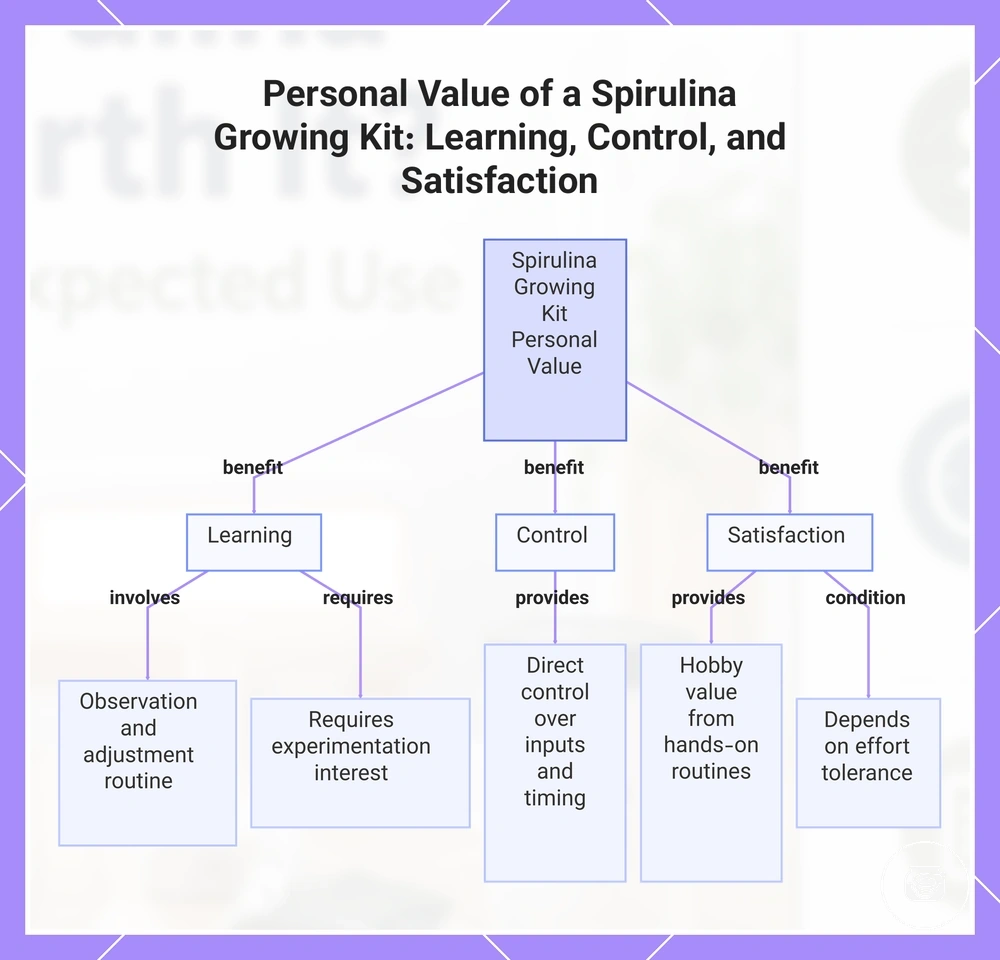
A spirulina growing kit provides personal value when the user enjoys managing a living culture, accepts regular monitoring, and wants hands-on home growing with fresh production. Its non-monetary value is conditional: learning, control, and satisfaction justify the work only when they match the user’s cultivation interest and effort tolerance, rather than creating a guaranteed financial return.
The main personal-value benefits are:
- Learning: Observing culture behaviour, recording changes, and adjusting routine inputs provides practical learning value for a user who enjoys experimentation and repeated monitoring.
- Control: Home growing gives the user direct control over culture inputs, the growing process, harvesting decisions, and the timing of fresh production.
- Satisfaction: Maintaining a living culture can provide hobby value and satisfaction when the user enjoys hands-on routines and accepts the attention required to keep the culture usable.
For example, a clearly hypothetical user who checks the culture once per day and records observations 3 times per week may consider that routine part of the learning experience, while a convenience-focused user may treat the same workload as a disadvantage. Learning, control, and home growing satisfaction therefore improve kit value only when the user’s personal value from the process exceeds the burden created by the required effort.
This chart shows the three main non-monetary benefits of a spirulina growing kit and the conditions under which they provide value.
This chart shows the three main non-monetary benefits of a spirulina growing kit and the conditions under which they provide value.
Time, Attention, and Difficulty Costs
A spirulina growing kit has a real time commitment and attention cost even when the supplies are affordable. Its practical value depends on whether the user can maintain a consistent monitoring routine, because the reviewed evidence does not establish an exact daily or weekly time requirement that applies to every home cultivation system.
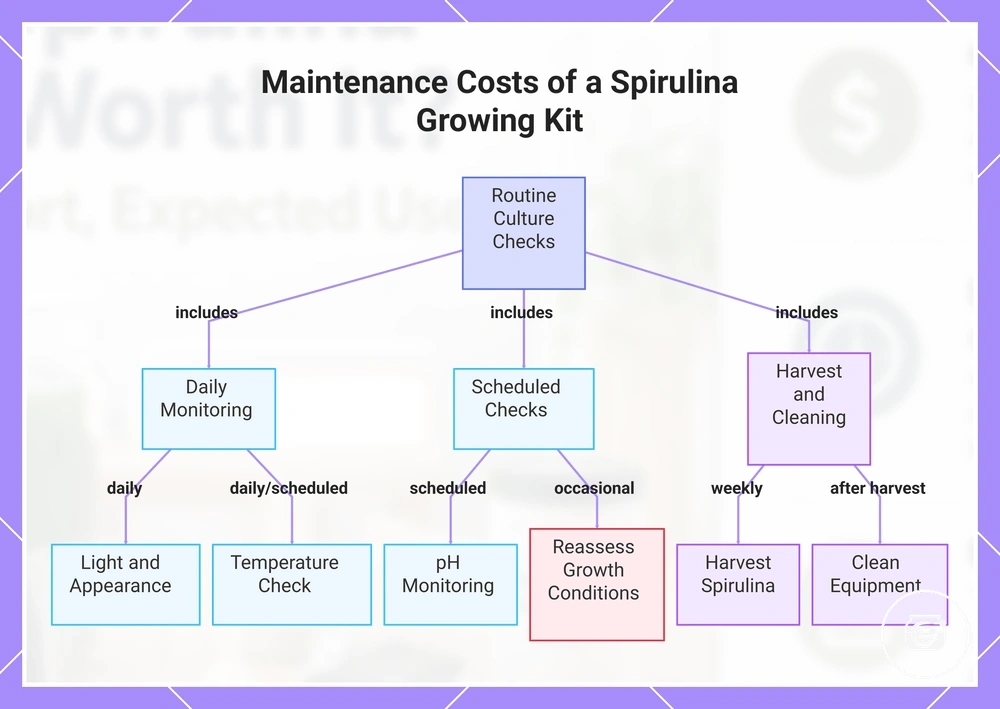
The maintenance burden is determined by routine culture checks rather than by the purchase itself.
The maintenance burden is determined by routine culture checks rather than by the purchase itself. Monitoring frequency and difficulty increase when light, temperature, pH, or culture appearance indicate slow or unstable growth, whereas a stable culture usually requires only repeated routine observation and scheduled harvesting and cleaning.
- Daily — Light and culture appearance: Check that the light source operates correctly and inspect the culture for normal colour and appearance because visible changes may require closer monitoring.
- Daily or scheduled — Temperature: Confirm that the culture remains within the operating conditions specified for the growing system, as unsuitable temperature increases maintenance attention.
- Scheduled — pH monitoring: Measure pH according to the cultivation routine because readings outside the target condition increase the likelihood of additional corrective work.
- Weekly or harvest-based — Harvesting: Harvest spirulina when the culture is ready, adding a recurring handling task that forms part of the overall effort cost.
- After harvesting — Cleaning: Clean harvesting equipment and contacted surfaces after each harvest to reduce contamination risk and maintain culture quality.
- Occasional — Slow or unstable growth: Reassess light, temperature, pH, and culture appearance before changing the growing routine because instability increases attention and maintenance difficulty beyond normal upkeep.
A clearly illustrative example is a user who performs 1 culture inspection each day, 1 harvest during the week, and 1 complete cleaning session after harvesting; this demonstrates recurring attention rather than a recommended schedule because no verified universal maintenance frequency exists for all spirulina growing kits. Users who can maintain that routine are more likely to consider the effort worthwhile than users seeking a maintenance-free product. Reviewing realistic expectations before purchasing helps match the required attention with personal effort tolerance.
Reviewing realistic expectations before purchasing helps match the required attention with personal effort tolerance.
This chart shows the routine checks and tasks that determine the time, attention, and difficulty costs of maintaining a spirulina growing kit.
Spirulina Growing Kits Compared with Buying Spirulina
Spirulina growing kits exchange convenience and reliability for freshness, control, and a home-growing project, while buying spirulina provides ready-made availability without cultivation time or failure risk. Neither decision path has a universal cost advantage because the final value depends on use frequency, recurring purchases, maintenance supplies, culture stability, and the value the user assigns to growing at home.
The table compares both decision paths across cost, convenience, freshness, reliability, control, time, and failure risk.
The table compares both decision paths across cost, convenience, freshness, reliability, control, time, and failure risk. The reviewed evidence does not provide one verified savings figure that applies to every kit, supplier, culture, or purchased spirulina product.
| Decision path | Cost pattern | Convenience | Freshness/control | Main risk | Better fit |
|---|---|---|---|---|---|
| Growing with a kit | Upfront kit cost followed by recurring expenses for nutrients, culture medium, electricity where required, cleaning supplies, and replacement culture after failure. | Requires monitoring, harvesting, cleaning, and continued attention to a living culture. | Provides a fresh harvest and direct control over culture inputs, growing conditions, and harvest timing. | Culture contamination, unstable growth, lost output, or restart costs can reduce reliability and overall value. | Users who value freshness, control, learning, and an ongoing home-growing project. |
| Buying spirulina | Recurring product purchases without cultivation equipment, refill supplies, or restart costs. | Provides ready-made powder, tablets, or other purchased spirulina without a growing routine. | Offers no control over the production process beyond choosing the purchased product and supplier. | Continued dependence on repeat purchases, product availability, storage conditions, and supplier consistency. | Users who prioritise convenience, predictable access, minimal time commitment, and no culture failure risk. |
Buying spirulina offers greater convenience and operational reliability because the user does not need to maintain, harvest, or clean a living culture. For example, in a clearly hypothetical weekly routine, a kit user who completes 1 harvest also completes at least 1 harvesting task and 1 cleaning task, while a user of purchased spirulina completes 0 cultivation tasks before use; this illustrates the time trade-off rather than a universal maintenance schedule.
The kit versus DIY setup comparison addresses that boundary without changing the core choice between growing spirulina and buying spirulina.
This comparison does not include building a complete cultivation system from separately sourced equipment because that introduces another cost and setup decision. The kit versus DIY setup comparison addresses that boundary without changing the core choice between growing spirulina and buying spirulina.
Choose spirulina growing kits when freshness, control, learning, and the home-growing experience justify the required time and failure risk.
Choose spirulina growing kits when freshness, control, learning, and the home-growing experience justify the required time and failure risk. Choose purchased spirulina when convenience, reliability, predictable access, and minimal maintenance have greater value than fresh production.
The products below are useful examples for comparing available options.
The products below are useful examples for comparing available options. Before buying, check that the compatibility criteria, key features, and product details match your needs.
When a Spirulina Growing Kit Makes Sense
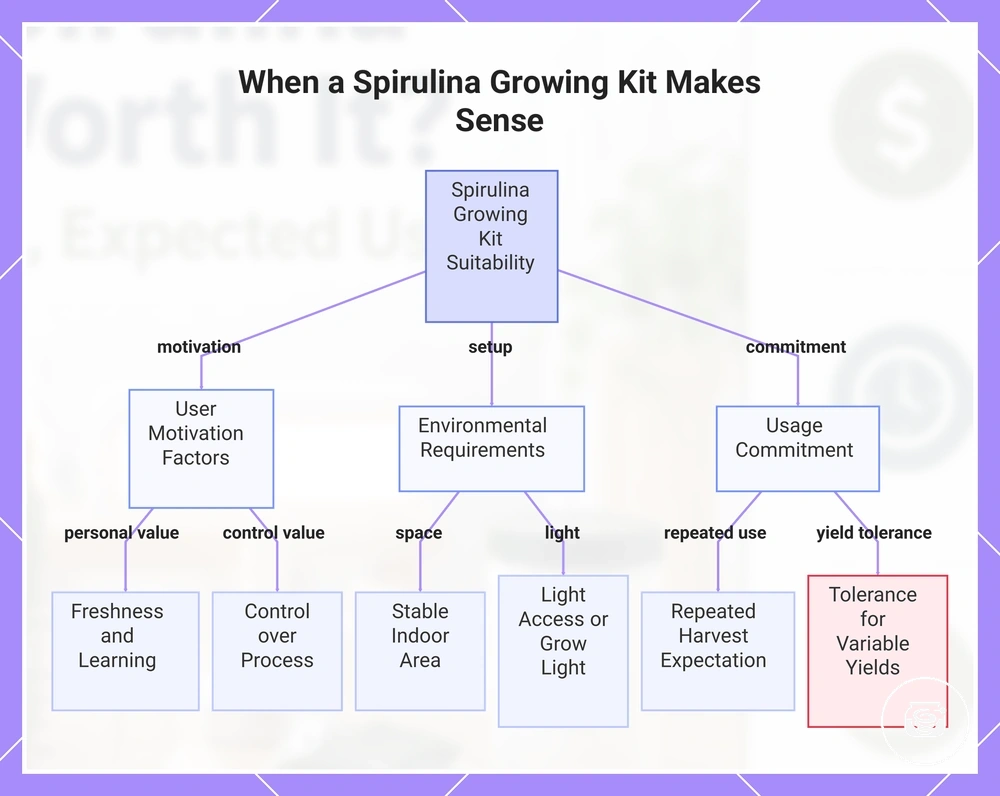
A spirulina growing kit makes sense when the user values freshness, learning, control, and repeated use more than convenience. It is a good fit when the user can maintain culture conditions, provide suitable indoor space and light access, and accept that yields may be imperfect rather than financially predictable.
Purchase readiness depends on user commitment and the indoor growing context.
Purchase readiness depends on user commitment and the indoor growing context. A suitable setup requires a stable area for the culture, either dependable light access or a grow light, and enough willingness to monitor the culture when conditions or output change.
- Freshness: The kit is suitable when a fresh harvest has more personal value than the convenience of ready-made spirulina.
- Learning: The kit provides hobby value when the user wants to observe culture behaviour, build practical knowledge, and learn through repeated monitoring.
- Control: The kit offers practical value when direct control over inputs, culture conditions, and harvest timing is an important decision signal.
- Indoor space: Purchase readiness is stronger when the user has a stable, dedicated area where the culture and supporting equipment can remain undisturbed.
- Light access: The setup is a better home-growing fit when suitable natural light is available or the user is willing to operate and manage a grow light.
- Repeated use: Practical use value increases when the user expects to harvest and use spirulina repeatedly rather than treating the kit as a one-time experiment.
- Tolerance for imperfect yields: The kit makes more sense when the user accepts uneven output and the possibility that an unstable culture may require extra attention or a restart.
Hobby value comes from curiosity, learning, and satisfaction with maintaining a living culture, while practical use value comes from repeated fresh production and control over the growing process. Neither form of value represents a universal financial return, so the buying decision should reflect whether those benefits justify the monitoring effort and imperfect-yield risk.
Reviewing the broader kit selection criteria can confirm whether the available equipment and kit contents match those expectations before purchase.
A buyer is ready for a spirulina growing kit when indoor space, light access, repeated use, culture-management commitment, and tolerance for variable results are all present. Reviewing the broader kit selection criteria can confirm whether the available equipment and kit contents match those expectations before purchase.
This chart shows the key factors that determine whether a spirulina growing kit is a good fit for a user, based on motivation, setup, and commitment.
This chart shows the key factors that determine whether a spirulina growing kit is a good fit for a user, based on motivation, setup, and commitment.
When a Spirulina Growing Kit Is Poor Value
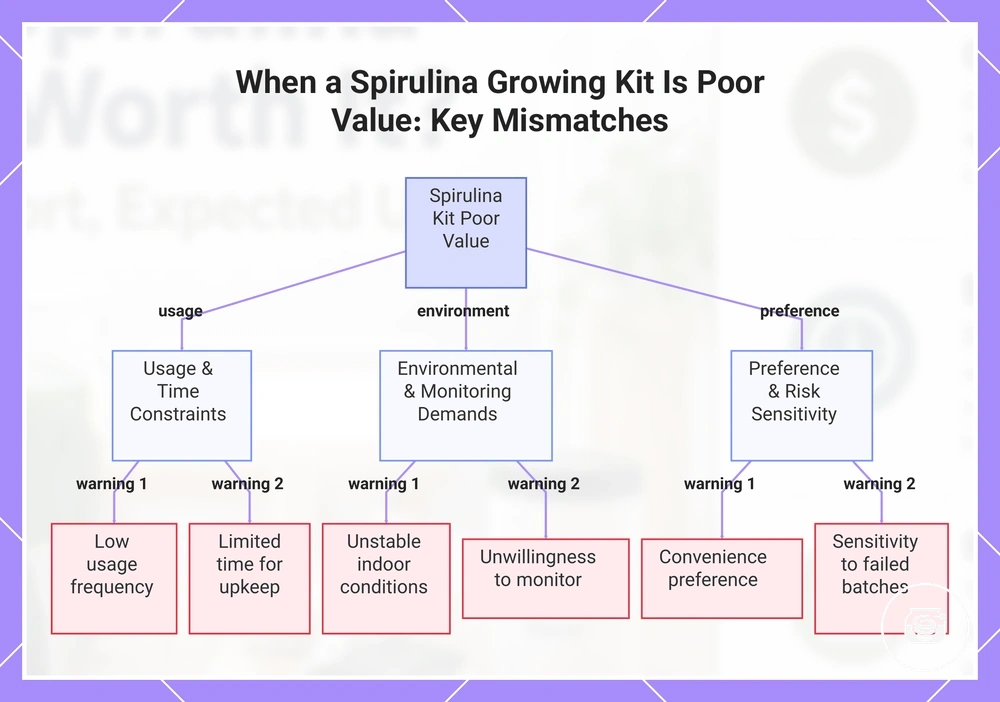
A spirulina growing kit is poor value when the kit’s demands do not match the user’s time, indoor conditions, usage pattern, or preference for convenience. A low purchase price can still produce a weak value decision when the culture is rarely used, receives insufficient attention, or fails before the user gains repeated practical value.
The warning checklist below identifies the main mismatches that turn an affordable kit into a poor fit.
Low usage frequency and limited time reduce value because the user still carries the maintenance burden without receiving regular harvests. The warning checklist below identifies the main mismatches that turn an affordable kit into a poor fit.
- Low usage frequency: The kit provides weak value when the user expects only occasional use, because cultivation, harvesting, and upkeep continue even when spirulina is consumed infrequently.
- Limited time: The kit becomes a poor fit when the user cannot maintain routine monitoring, harvesting, and cleaning without disrupting other commitments.
- Unstable indoor conditions: Inconsistent light or temperature raises the likelihood of unstable growth, extra adjustments, and restart risk, reducing the value of the original purchase.
- Unwillingness to monitor culture health: A user who does not want to observe culture appearance or respond to changing conditions is more exposed to slow growth and failed batches.
- Convenience preference: The kit is a weak value decision when ready-made spirulina better matches the user’s need for immediate use without cultivation work.
- Sensitivity to failed batches: The kit offers poor value when one unsuccessful culture would make the user unwilling to replace supplies, restart the process, or continue learning.
For example, in a clearly hypothetical contrast, a low purchase price still produces poor overall value if a user completes 1 harvest, loses 1 batch, and then stops using the kit, while a higher-priced ready-made option used repeatedly may deliver better practical value through reliability and convenience. The problem is therefore the mismatch between kit demands and user constraints, not the purchase price alone.
The problem is therefore the mismatch between kit demands and user constraints, not the purchase price alone.
This chart shows the main mismatches between kit demands and user constraints that turn an affordable spirulina kit into a poor value decision.
Cost-Value Checks Before Choosing a Spirulina Growing Kit
A spirulina growing kit is worth considering only when its included supplies, ongoing costs, maintenance burden, expected use, and comparison with buying spirulina match the user’s routine and expectations. These cost-value checks support choosing a spirulina growing kit by testing practical ownership conditions rather than relying on the initial purchase price alone.
Use the checklist below to assess kit completeness, recurring effort, safety expectations, and purchase readiness.
Use the checklist below to assess kit completeness, recurring effort, safety expectations, and purchase readiness. Each item follows a check–condition–action sequence so the decision outcome remains tied to the user’s actual setup and intended use.
- Check: Included supplies. Condition: Confirm whether the kit includes a live culture, culture medium, harvest filter, suitable container, and any required measuring tools. Action: Add the cost of every missing essential before comparing kit value.
- Check: Grow light need. Condition: Determine whether the intended indoor location has suitable light access or requires a grow light. Action: Include the equipment, electricity, and management burden of artificial lighting in the ownership decision.
- Check: Ongoing costs. Condition: Identify recurring needs such as culture medium refills, nutrients, cleaning supplies, electricity, and replacement culture after failure. Action: Compare total ownership cost rather than the kit price alone.
- Check: Maintenance burden. Condition: Decide whether monitoring, harvesting, cleaning, and culture care fit the user routine. Action: Reject the kit if regular upkeep would be neglected or treated as an unwanted task.
- Check: Expected use. Condition: Estimate whether fresh spirulina will be harvested and used repeatedly rather than only once or occasionally. Action: Treat infrequent expected use as a negative value signal because the living culture still requires attention between harvests.
- Check: Safety expectations. Condition: Confirm that the user accepts careful culture handling, clean equipment, and realistic limits on home-growing reliability. Action: Learn more about setup and hygiene before comparing products if those expectations are unclear.
- Check: Buying spirulina instead. Condition: Compare freshness and control from home growing with the convenience and reliability of purchased spirulina. Action: Choose the route that better matches the user’s available time, effort tolerance, and intended frequency of use.
Interpret the checklist as a decision filter rather than a product score. For example, in a clearly hypothetical comparison, a kit with 3 missing essentials—a culture medium, harvest filter, and grow light—may create poorer overall value than a more complete option because the buyer must add equipment, supplies, and extra setup work before cultivation begins.
Interpret the checklist as a decision filter rather than a product score.
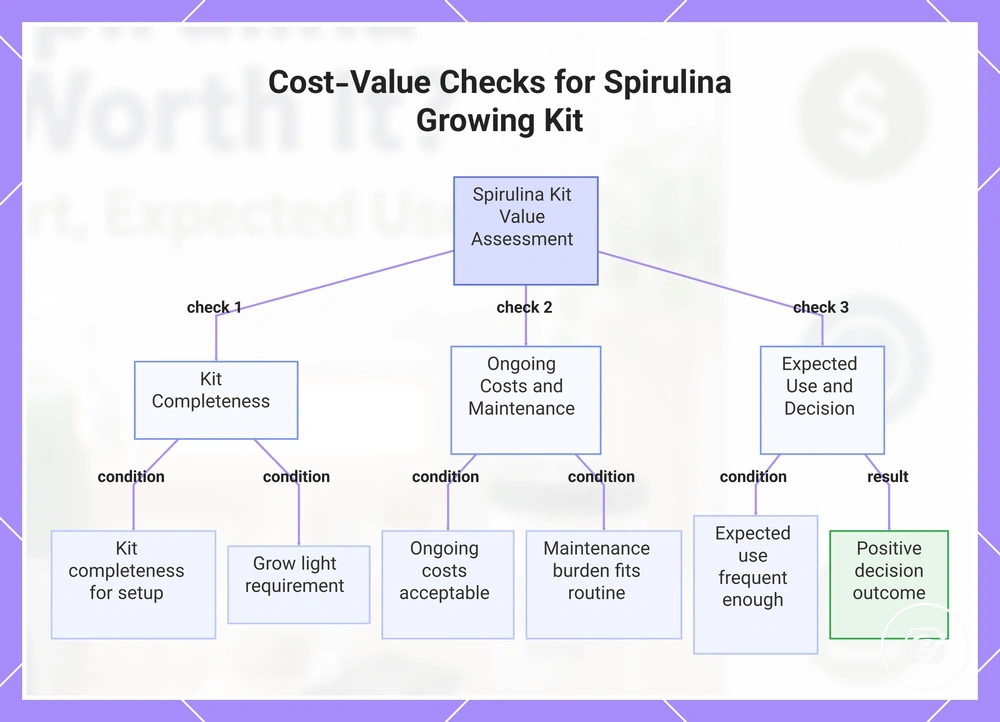
The decision outcome is positive when the kit is complete enough for the planned setup, ongoing costs are acceptable, the maintenance burden fits the user routine, and expected use is frequent enough to justify continued cultivation. If one or more of those conditions remain unresolved, the user is not yet ready to compare individual products.
Users who pass the final checks can move to the detailed buying checklist to compare options consistently.
Users who pass the final checks can move to the detailed buying checklist to compare options consistently. Users who do not pass them should first review setup requirements, culture handling, or realistic growing expectations before moving toward purchase.
Before buying, check that the compatibility criteria, key features, and product details match your needs.
The products below are useful examples for comparing available options. Before buying, check that the compatibility criteria, key features, and product details match your needs.
This chart shows the key cost-value checks to determine if a spirulina growing kit is worth the investment, based on kit completeness, ongoing costs, maintenance, and expected use.